 Add to Chrome
 Add to Firefox
 Add to Edge
MicroVerse: An Instrument for Measuring Self-Authored Identity Drift in Long-Horizon Multi-Agent Language-Model Simulations
Aug 16, 2026
Long-horizon, multi-agent language model (LM) simulations are widely proposed for studying social behavior, yet instruments to measure whether persona-conditioned agents maintain identity fidelity under sustained pressure are lacking. We present MicroVerse, a behavioral-science instrument that measures identity drift in generative agents. Agents carry an immutable "soul file" (core values, moral boundaries, personality, goals) and inhabit a resource-scarce 50 x 50 environment where water is a non-respawning survival constraint. Scarcity is operationalized via a per-tick existence-cost gradient. The eight-verb action space maps directly to moral boundaries (trade, talk, attack, scavenge). Using a three-layer memory architecture, agents periodically revise a mutable current identity against their immutable original soul via importance-triggered reflection. To mitigate survivor bias, MicroVerse decouples measurement from behavior using uniform longitudinal engine snapshots every N ticks alongside a forced-end snapshot of all living and dead agents. Identity drift is scored offline using a paraphrase-aware, value-anchored, multi-register diff rather than raw cosine similarity. We evaluate the instrument via a controlled seed run (n = 25) and a reflection-threshold sweep (thresholds {40, 80, 150}) to determine if drift dynamics are gate artifacts or threshold-robust properties. We report two primary findings: (1) Anti-self-deception emerges unprompted as the single largest semantic category of identity modification (27 of 111 added boundaries, 24%). (2) The system is threshold-robust; lower gates accelerate and increase revision frequency but preserve drift direction. All empirical results are strictly preliminary existence proofs and effect shapes (one model, one seed per arm, n = 25) rather than statistical significance claims.

MatrAIx: Simulating the World with 8.3 Billion Persona Agents
Aug 04, 2026Human evaluation of AI systems and digital products is costly, slow, and difficult to scale. Offline evaluations are more scalable but often abstract away human diversity and interactive behavior. We therefore introduce MatrAIx, a population-scale simulated-user evaluation infrastructure for testing AI systems and digital products with heterogeneous users. MatrAIx has three core components: First, Persona 8B contains 8.3 billion persona records represented by 1,290 categorical dimensions. Records are either sampled from a dependency graph that preserves correlated attributes or derived from human-authored profiles. We release a quality-filtered coreset of approximately 1 million personas, comprising 599,847 human-grounded and 400,000 synthetic records. Second, the MatrAIx Playground provides four environments in which diverse users evaluate and interact with digital products: Survey, AI Chatbot, Web, and App. Third, MatrAIx provides 1,010 application tasks spanning more than 25 domains, including Commerce, Software, Finance, and Healthcare. We conducted 18,189 evaluation trials across eight representative tasks. Persona agents were powered by three LLMs: Claude Opus 4.8, GPT 5.5, and Claude Haiku 4.5. The resulting feedback captures how decisions and preferences vary across persona backgrounds, including hesitation after a price increase, willingness to continue after an AI assistant fails, and latency tolerance. We conducted two main validation studies: First, a 400-trial controlled study evaluated persona adherence across ten behavioral attributes and all four environments. The declared behavior was expressed or correctly suppressed in 366 trials (91.5%). Second, human and LLM judges evaluated the extraction quality of human-grounded personas. Overall, MatrAIx provides an end-to-end infrastructure for evaluating AI systems and digital products with diverse simulated human users.
PALMs: Using Multi Construct-Grounded Rationales for Modeling Population Preferences in LLMs
Aug 02, 2026Large language models are being extensively used to simulate individual user behavior, yet faithfully representing a population requires capturing the systematic variation in values, beliefs, and cultural norms that distinguish one group from another. We introduce Population Aligned Language Models (PALMs), a suite of models each aligned to specific populations, covering five countries: USA, India, Brazil, France and Italy. PALMs are created by synthesizing rationales grounded in psychological and cultural constructs and using these as latent supervision during preference tuning for population-specific alignment. Evaluated across four dimensions: personality, values and beliefs, cultural norms, and morality, PALMs consistently outperform baselines, including culture-specialized models, achieving an average of 8.59% relative improvement over the best baseline across all five populations. Notably, construct-grounded rationales outperform both demographic prompting and survey-based fine-tuning, suggesting that grounding preference learning in psychology and culture provides a richer inductive signal than surface-level response distributions. We further demonstrate strong generalization to downstream applications with- out task-specific supervision: outperforming best baselines by 5.19% in personalized reward modeling, 6.34% in population simulation, and showing strong transfer to social reasoning tasks. Datasets and code are available at: https://github.com/limenlp/PALMs.
Translating the Untranslatable: An Operationalizable Ontology for Untranslatability
Jun 15, 2026Untranslatability, cases where meaning cannot be directly preserved across languages, is well-studied in linguistics but underexplored in NLP. As machine translation (MT) systems improve on standard benchmarks, their limitations increasingly concentrate in such cases, where translation cannot be reduced to one-to-one equivalence. We introduce a structured ontology of untranslatability along with a taxonomy of compensation strategies, which are specific techniques to convey meaning under these untranslatable circumstances. We operationalize this framework into a multilingual dataset of untranslatable sentences paired with strategy-based translations, enabling controlled analysis of translation behavior. Initial human preference studies suggest that translation quality depends on the strategy used, with consistent preferences for outputs that include explanatory context, known as the Annotation compensation strategy. Our framework and dataset provide a foundation for studying and modeling strategy-informed machine translation.
ELI-Why: Evaluating the Pedagogical Utility of Language Model Explanations
Jun 17, 2025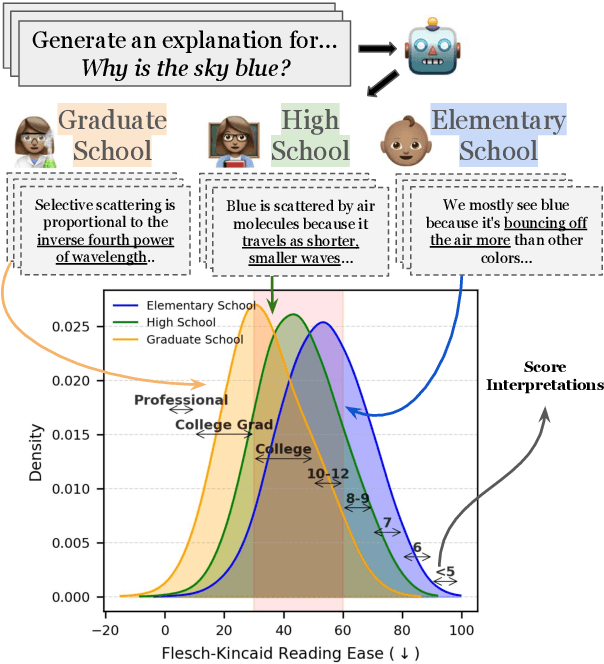
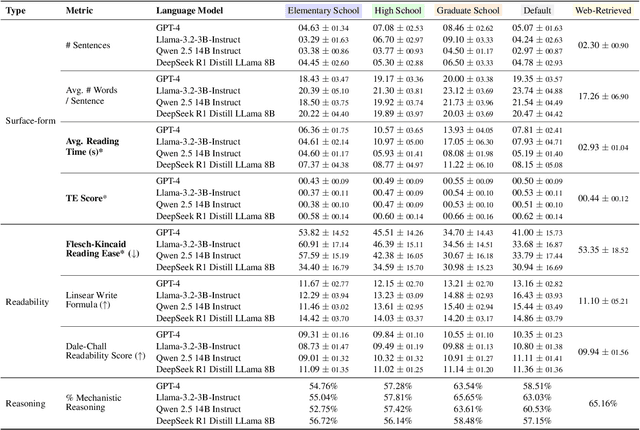
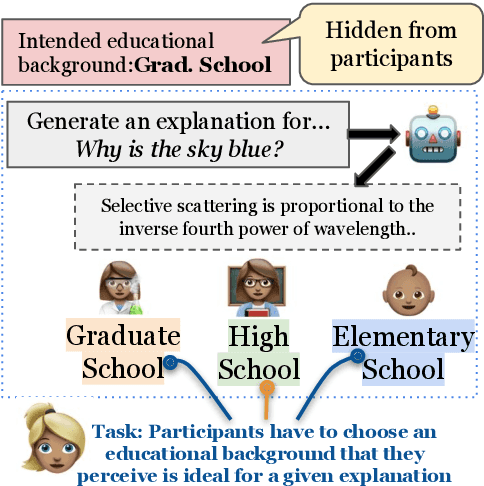
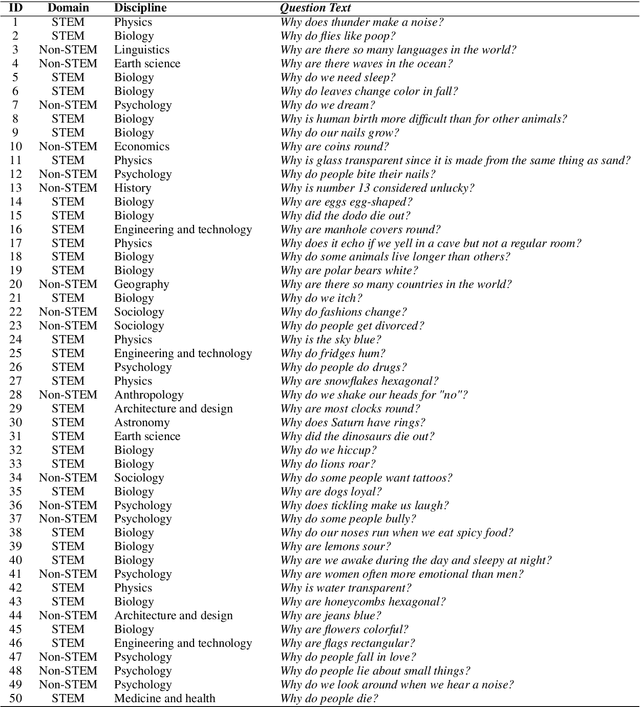
Language models today are widely used in education, yet their ability to tailor responses for learners with varied informational needs and knowledge backgrounds remains under-explored. To this end, we introduce ELI-Why, a benchmark of 13.4K "Why" questions to evaluate the pedagogical capabilities of language models. We then conduct two extensive human studies to assess the utility of language model-generated explanatory answers (explanations) on our benchmark, tailored to three distinct educational grades: elementary, high-school and graduate school. In our first study, human raters assume the role of an "educator" to assess model explanations' fit to different educational grades. We find that GPT-4-generated explanations match their intended educational background only 50% of the time, compared to 79% for lay human-curated explanations. In our second study, human raters assume the role of a learner to assess if an explanation fits their own informational needs. Across all educational backgrounds, users deemed GPT-4-generated explanations 20% less suited on average to their informational needs, when compared to explanations curated by lay people. Additionally, automated evaluation metrics reveal that explanations generated across different language model families for different informational needs remain indistinguishable in their grade-level, limiting their pedagogical effectiveness.
Amulet: Putting Complex Multi-Turn Conversations on the Stand with LLM Juries
May 26, 2025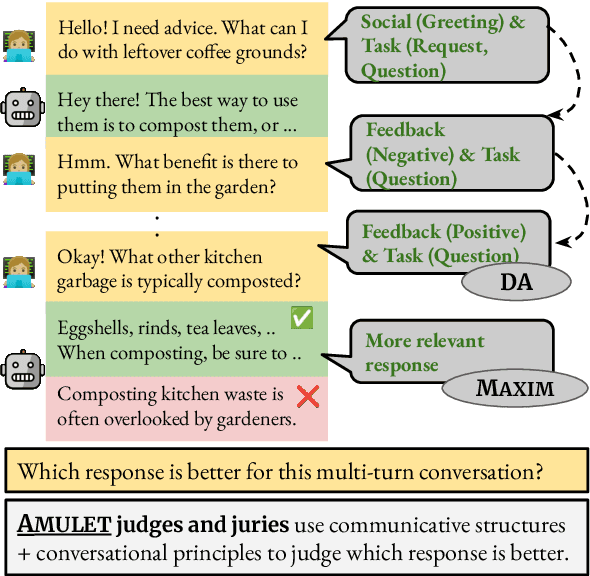
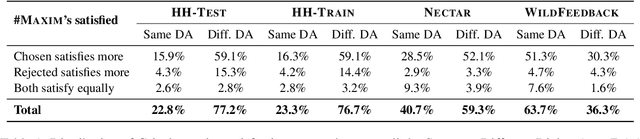
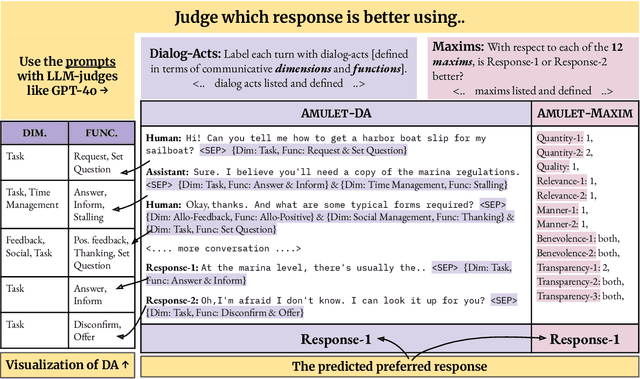
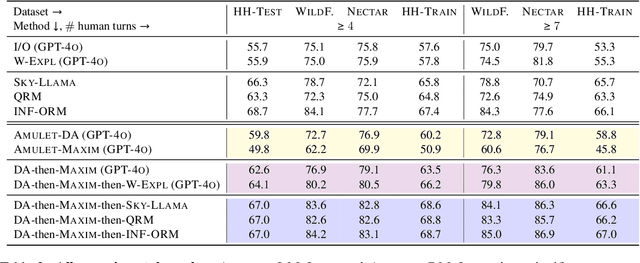
Today, large language models are widely used as judges to evaluate responses from other language models. Hence, it is imperative to benchmark and improve these LLM-judges on real-world language model usage: a typical human-assistant conversation is lengthy, and shows significant diversity in topics, intents, and requirements across turns, e.g. social interactions, task requests, feedback. We present Amulet, a framework that leverages pertinent linguistic concepts of dialog-acts and maxims to improve the accuracy of LLM-judges on preference data with complex, multi-turn conversational context. Amulet presents valuable insights about (a) the communicative structures and intents present in the conversation (dialog acts), and (b) the satisfaction of conversational principles (maxims) by the preference responses, and uses them to make judgments. On four challenging datasets, Amulet shows that (a) humans frequently (60 to 70 percent of the time) change their intents from one turn of the conversation to the next, and (b) in 75 percent of instances, the preference responses can be differentiated via dialog acts and/or maxims, reiterating the latter's significance in judging such data. Amulet can be used either as a judge by applying the framework to a single LLM, or integrated into a jury with different LLM judges; our judges and juries show strong improvements on relevant baselines for all four datasets.
Improving LLM Personas via Rationalization with Psychological Scaffolds
Apr 25, 2025Language models prompted with a user description or persona can predict a user's preferences and opinions, but existing approaches to building personas -- based solely on a user's demographic attributes and/or prior judgments -- fail to capture the underlying reasoning behind said user judgments. We introduce PB&J (Psychology of Behavior and Judgments), a framework that improves LLM personas by incorporating rationales of why a user might make specific judgments. These rationales are LLM-generated, and aim to reason about a user's behavior on the basis of their experiences, personality traits or beliefs. This is done using psychological scaffolds -- structured frameworks grounded in theories such as the Big 5 Personality Traits and Primal World Beliefs -- that help provide structure to the generated rationales. Experiments on public opinion and movie preference prediction tasks demonstrate that LLM personas augmented with PB&J rationales consistently outperform methods using only a user's demographics and/or judgments. Additionally, LLM personas constructed using scaffolds describing user beliefs perform competitively with those using human-written rationales.
CoKe: Customizable Fine-Grained Story Evaluation via Chain-of-Keyword Rationalization
Mar 21, 2025Evaluating creative text such as human-written stories using language models has always been a challenging task -- owing to the subjectivity of multi-annotator ratings. To mimic the thinking process of humans, chain of thought (CoT) generates free-text explanations that help guide a model's predictions and Self-Consistency (SC) marginalizes predictions over multiple generated explanations. In this study, we discover that the widely-used self-consistency reasoning methods cause suboptimal results due to an objective mismatch between generating 'fluent-looking' explanations vs. actually leading to a good rating prediction for an aspect of a story. To overcome this challenge, we propose $\textbf{C}$hain-$\textbf{o}$f-$\textbf{Ke}$ywords (CoKe), that generates a sequence of keywords $\textit{before}$ generating a free-text rationale, that guide the rating prediction of our evaluation language model. Then, we generate a diverse set of such keywords, and aggregate the scores corresponding to these generations. On the StoryER dataset, CoKe based on our small fine-tuned evaluation models not only reach human-level performance and significantly outperform GPT-4 with a 2x boost in correlation with human annotators, but also requires drastically less number of parameters.
OATH-Frames: Characterizing Online Attitudes Towards Homelessness with LLM Assistants
Jun 21, 2024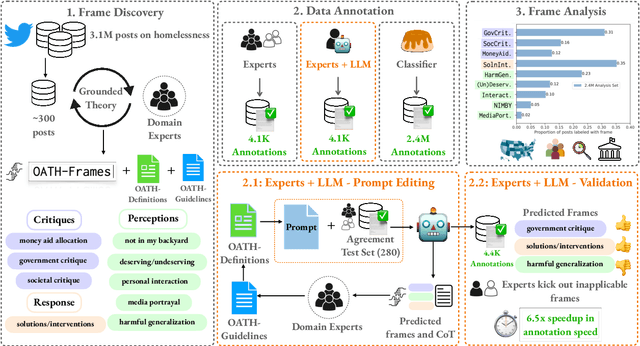


Warning: Contents of this paper may be upsetting. Public attitudes towards key societal issues, expressed on online media, are of immense value in policy and reform efforts, yet challenging to understand at scale. We study one such social issue: homelessness in the U.S., by leveraging the remarkable capabilities of large language models to assist social work experts in analyzing millions of posts from Twitter. We introduce a framing typology: Online Attitudes Towards Homelessness (OATH) Frames: nine hierarchical frames capturing critiques, responses and perceptions. We release annotations with varying degrees of assistance from language models, with immense benefits in scaling: 6.5x speedup in annotation time while only incurring a 3 point F1 reduction in performance with respect to the domain experts. Our experiments demonstrate the value of modeling OATH-Frames over existing sentiment and toxicity classifiers. Our large-scale analysis with predicted OATH-Frames on 2.4M posts on homelessness reveal key trends in attitudes across states, time periods and vulnerable populations, enabling new insights on the issue. Our work provides a general framework to understand nuanced public attitudes at scale, on issues beyond homelessness.
Tailoring Self-Rationalizers with Multi-Reward Distillation
Nov 06, 2023Large language models (LMs) are capable of generating free-text rationales to aid question answering. However, prior work 1) suggests that useful self-rationalization is emergent only at significant scales (e.g., 175B parameter GPT-3); and 2) focuses largely on downstream performance, ignoring the semantics of the rationales themselves, e.g., are they faithful, true, and helpful for humans? In this work, we enable small-scale LMs (approx. 200x smaller than GPT-3) to generate rationales that not only improve downstream task performance, but are also more plausible, consistent, and diverse, assessed both by automatic and human evaluation. Our method, MaRio (Multi-rewArd RatIOnalization), is a multi-reward conditioned self-rationalization algorithm that optimizes multiple distinct properties like plausibility, diversity and consistency. Results on five difficult question-answering datasets StrategyQA, QuaRel, OpenBookQA, NumerSense and QASC show that not only does MaRio improve task accuracy, but it also improves the self-rationalization quality of small LMs across the aforementioned axes better than a supervised fine-tuning (SFT) baseline. Extensive human evaluations confirm that MaRio rationales are preferred vs. SFT rationales, as well as qualitative improvements in plausibility and consistency.