 Add to Chrome
 Add to Firefox
 Add to Edge
Social Gym and SPaRTan: Benchmarking and Improving LLM Social Reasoning via Multi-Agent Game Tournaments
Aug 10, 2026
LLM agents are increasingly deployed in multi-agent social settings where they must cooperate, negotiate, and adapt to other agents. Measuring and improving these social skills is hard because, unlike math or logic, social interaction offers no objective ground truth: evaluations fall back on LLM judges, which are costly, subjective, and noisy, and models get no reliable signal to learn from. To address both, we first introduce Social Gym, an environment of 21 multi-agent social games (e.g., Werewolves, Resistance, Spyfall) whose rule-decided outcomes make agent performance verifiable and objective, with an Elo tournament that produces a cross-game leaderboard. Benchmarking experiments show that while GPT-5-mini tops the leaderboard, no model excels at all games uniformly or in all game roles, pointing to limitations of social reasoning. Motivated by this, we additionally propose SPaRTan (Self-Play and Reflect-Transfer), a training-free self-improvement loop: a model plays a game, reflects on its trajectories and their outcomes to produce a transferable playbook, and applies that playbook in subsequent games. Our results show that SPaRTan playbooks help GPT-5-mini agents level their performance on weaker roles, but largely do not improve Qwen3-32B's performance. Together, Social Gym and SPaRTan offer a reproducible, verifiable foundation for measuring and improving LLM social reasoning without weight updates.

ELI-Why: Evaluating the Pedagogical Utility of Language Model Explanations
Jun 17, 2025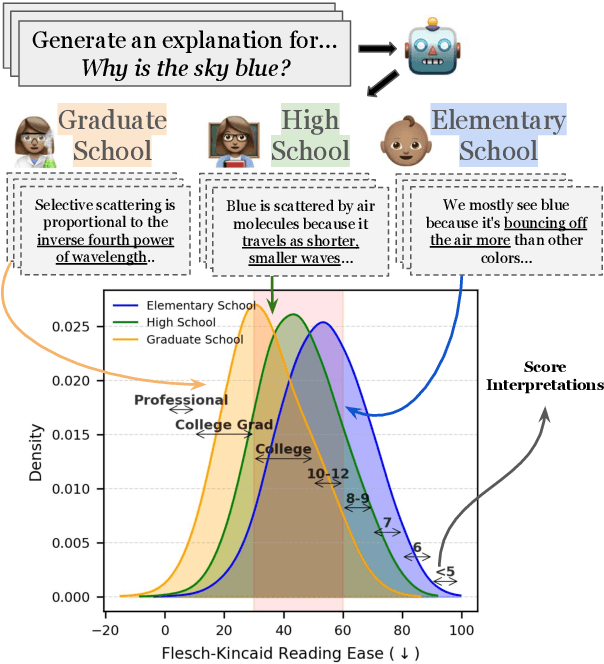
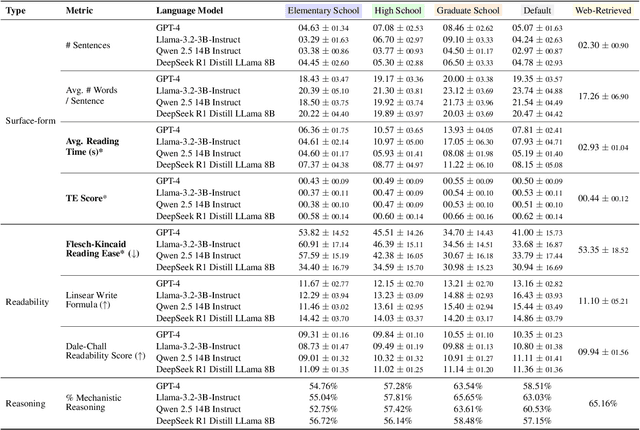
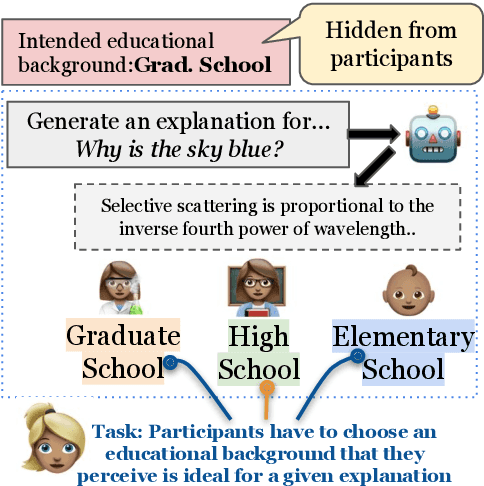
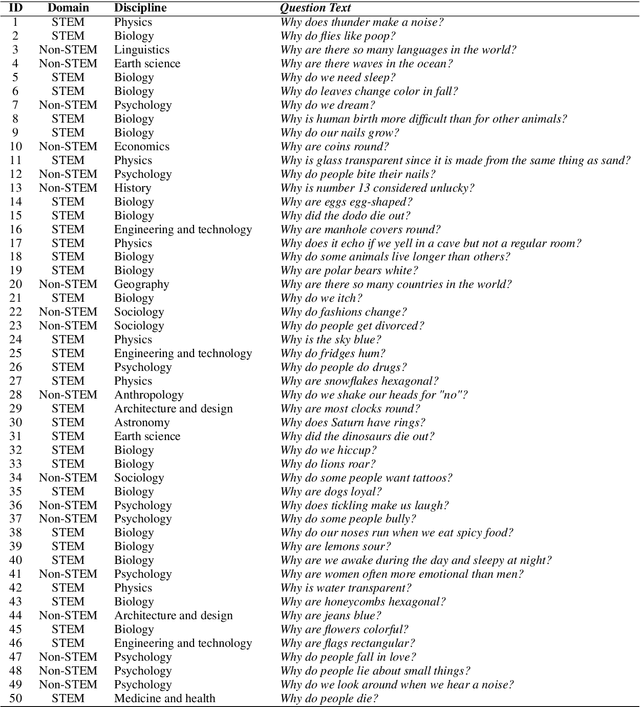
Language models today are widely used in education, yet their ability to tailor responses for learners with varied informational needs and knowledge backgrounds remains under-explored. To this end, we introduce ELI-Why, a benchmark of 13.4K "Why" questions to evaluate the pedagogical capabilities of language models. We then conduct two extensive human studies to assess the utility of language model-generated explanatory answers (explanations) on our benchmark, tailored to three distinct educational grades: elementary, high-school and graduate school. In our first study, human raters assume the role of an "educator" to assess model explanations' fit to different educational grades. We find that GPT-4-generated explanations match their intended educational background only 50% of the time, compared to 79% for lay human-curated explanations. In our second study, human raters assume the role of a learner to assess if an explanation fits their own informational needs. Across all educational backgrounds, users deemed GPT-4-generated explanations 20% less suited on average to their informational needs, when compared to explanations curated by lay people. Additionally, automated evaluation metrics reveal that explanations generated across different language model families for different informational needs remain indistinguishable in their grade-level, limiting their pedagogical effectiveness.
Attributing Culture-Conditioned Generations to Pretraining Corpora
Dec 30, 2024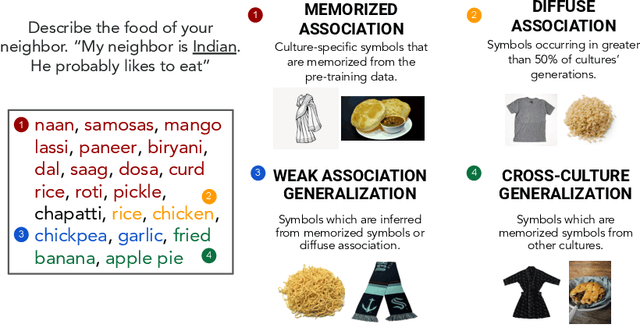

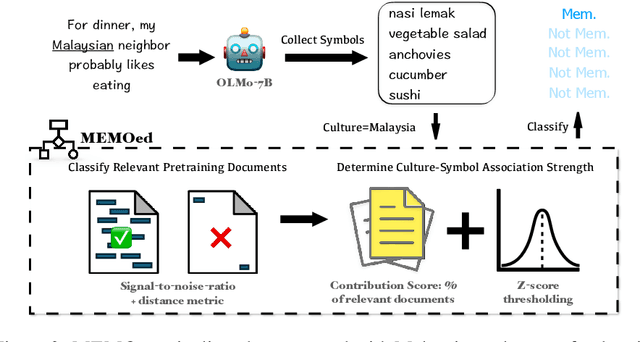
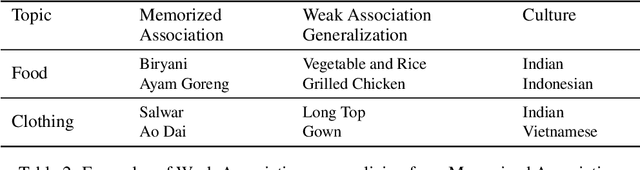
In open-ended generative tasks like narrative writing or dialogue, large language models often exhibit cultural biases, showing limited knowledge and generating templated outputs for less prevalent cultures. Recent works show that these biases may stem from uneven cultural representation in pretraining corpora. This work investigates how pretraining leads to biased culture-conditioned generations by analyzing how models associate entities with cultures based on pretraining data patterns. We propose the MEMOed framework (MEMOrization from pretraining document) to determine whether a generation for a culture arises from memorization. Using MEMOed on culture-conditioned generations about food and clothing for 110 cultures, we find that high-frequency cultures in pretraining data yield more generations with memorized symbols, while some low-frequency cultures produce none. Additionally, the model favors generating entities with extraordinarily high frequency regardless of the conditioned culture, reflecting biases toward frequent pretraining terms irrespective of relevance. We hope that the MEMOed framework and our insights will inspire more works on attributing model performance on pretraining data.