 Add to Chrome
 Add to Firefox
 Add to Edge
MMD-SLAM: Structure-Enhanced Multi-Meta Gaussian Distribution-Guided Visual SLAM
Jun 18, 2026
3D Gaussian Splatting (3DGS) has significantly boosted novel view synthesis and high-fidelity scene reconstruction, expanding the potential of 3DGS-based Visual Simultaneous Localization and Mapping (SLAM) methods. However, most existing systems fail to fully exploit the underlying structural information, which limits rendering quality and often leads to inconsistent maps. To address these limitations, we propose MMD-SLAM, a structure-enhanced Visual SLAM framework that leverages the Atlanta World (AW) assumption to guide a Multi-Meta Gaussian representation for photorealistic mapping. First, we introduce a point-line fusion strategy for pose optimization, where 3D line segments are incorporated to improve tracking robustness and provide additional constraints for mapping. Second, we design a Multi-Meta Gaussian representation with dominant directions, explicitly encoding structural priors from the AW hypothesis. Finally, we propose a Gaussian evolution strategy that adapts to scene geometry and incorporates structural cues into global optimization. Extensive experiments demonstrate that these innovations enable MMD-SLAM to achieve state-of-the-art performance in both tracking accuracy and mapping quality. e.g., our method achieves a 48.56% reduction in ATE RMSE on ScanNet and a 5.71% improvement in PSNR on Replica, compared with MonoGS.

OATH-Frames: Characterizing Online Attitudes Towards Homelessness with LLM Assistants
Jun 21, 2024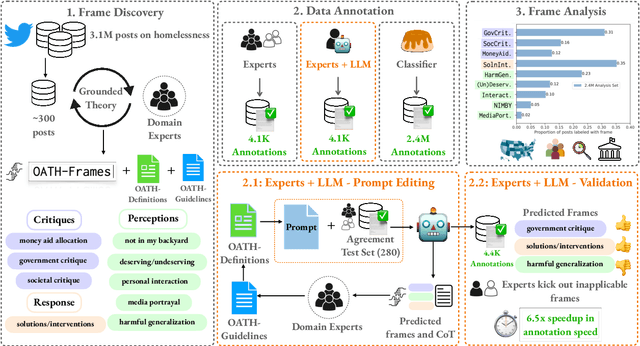


Warning: Contents of this paper may be upsetting. Public attitudes towards key societal issues, expressed on online media, are of immense value in policy and reform efforts, yet challenging to understand at scale. We study one such social issue: homelessness in the U.S., by leveraging the remarkable capabilities of large language models to assist social work experts in analyzing millions of posts from Twitter. We introduce a framing typology: Online Attitudes Towards Homelessness (OATH) Frames: nine hierarchical frames capturing critiques, responses and perceptions. We release annotations with varying degrees of assistance from language models, with immense benefits in scaling: 6.5x speedup in annotation time while only incurring a 3 point F1 reduction in performance with respect to the domain experts. Our experiments demonstrate the value of modeling OATH-Frames over existing sentiment and toxicity classifiers. Our large-scale analysis with predicted OATH-Frames on 2.4M posts on homelessness reveal key trends in attitudes across states, time periods and vulnerable populations, enabling new insights on the issue. Our work provides a general framework to understand nuanced public attitudes at scale, on issues beyond homelessness.