 Add to Chrome
 Add to Firefox
 Add to Edge
MicroVerse: An Instrument for Measuring Self-Authored Identity Drift in Long-Horizon Multi-Agent Language-Model Simulations
Aug 16, 2026
Long-horizon, multi-agent language model (LM) simulations are widely proposed for studying social behavior, yet instruments to measure whether persona-conditioned agents maintain identity fidelity under sustained pressure are lacking. We present MicroVerse, a behavioral-science instrument that measures identity drift in generative agents. Agents carry an immutable "soul file" (core values, moral boundaries, personality, goals) and inhabit a resource-scarce 50 x 50 environment where water is a non-respawning survival constraint. Scarcity is operationalized via a per-tick existence-cost gradient. The eight-verb action space maps directly to moral boundaries (trade, talk, attack, scavenge). Using a three-layer memory architecture, agents periodically revise a mutable current identity against their immutable original soul via importance-triggered reflection. To mitigate survivor bias, MicroVerse decouples measurement from behavior using uniform longitudinal engine snapshots every N ticks alongside a forced-end snapshot of all living and dead agents. Identity drift is scored offline using a paraphrase-aware, value-anchored, multi-register diff rather than raw cosine similarity. We evaluate the instrument via a controlled seed run (n = 25) and a reflection-threshold sweep (thresholds {40, 80, 150}) to determine if drift dynamics are gate artifacts or threshold-robust properties. We report two primary findings: (1) Anti-self-deception emerges unprompted as the single largest semantic category of identity modification (27 of 111 added boundaries, 24%). (2) The system is threshold-robust; lower gates accelerate and increase revision frequency but preserve drift direction. All empirical results are strictly preliminary existence proofs and effect shapes (one model, one seed per arm, n = 25) rather than statistical significance claims.

LLM Reasoning for Subjective Tasks: Failure Modes, Mitigation, and Dynamic Reasoning Routing
Aug 09, 2026Recommendation systems thrive on personalization, where ''correctness'' is rarely a binary truth but a matter of subjective human preference. As Large Language Models (LLMs) are deployed as autonomous verifiers of safety and quality guidelines, they face a distinctive challenge: context-aware preference alignment. Recent gains in Reinforcement Learning with Verifiable Rewards (RLVR) are indexed mostly on objective, mathematical tasks. Through a large-scale study spanning both proprietary and open-source models on four real-world verification tasks from a production recommender platform, we ask whether explicit reasoning generalizes to subjective, human-centric industry rubrics. We expose a fundamental vulnerability: rigid, math-centric reasoning traces actively degrade verification, and applying standard RLVR triggers a phenomenon we term reasoning collapse, in which the policy abandons deliberation in favor of rapid heuristic guessing. We introduce a conditional length-penalized post-training algorithm that intertwines verification accuracy with bounded reasoning length, halting collapse and recovering performance. Finally, we show that a reasoning trace's efficacy is tightly coupled with its socio-linguistic framing: across 1500 synthesized personas, verification accuracy swings by nearly 0.38 macro-F1 depending solely on the adopted reasoning persona---evidence that much subjective-verification error is really reasoning-style mismatch. This observation motivates a mid-training architecture that routes reasoning through contextually aligned personas. This work offers both a scalable algorithmic patch and a long-term architectural blueprint for aligning reasoning models with real-world subjective constraints.
MatrAIx: Simulating the World with 8.3 Billion Persona Agents
Aug 04, 2026Human evaluation of AI systems and digital products is costly, slow, and difficult to scale. Offline evaluations are more scalable but often abstract away human diversity and interactive behavior. We therefore introduce MatrAIx, a population-scale simulated-user evaluation infrastructure for testing AI systems and digital products with heterogeneous users. MatrAIx has three core components: First, Persona 8B contains 8.3 billion persona records represented by 1,290 categorical dimensions. Records are either sampled from a dependency graph that preserves correlated attributes or derived from human-authored profiles. We release a quality-filtered coreset of approximately 1 million personas, comprising 599,847 human-grounded and 400,000 synthetic records. Second, the MatrAIx Playground provides four environments in which diverse users evaluate and interact with digital products: Survey, AI Chatbot, Web, and App. Third, MatrAIx provides 1,010 application tasks spanning more than 25 domains, including Commerce, Software, Finance, and Healthcare. We conducted 18,189 evaluation trials across eight representative tasks. Persona agents were powered by three LLMs: Claude Opus 4.8, GPT 5.5, and Claude Haiku 4.5. The resulting feedback captures how decisions and preferences vary across persona backgrounds, including hesitation after a price increase, willingness to continue after an AI assistant fails, and latency tolerance. We conducted two main validation studies: First, a 400-trial controlled study evaluated persona adherence across ten behavioral attributes and all four environments. The declared behavior was expressed or correctly suppressed in 366 trials (91.5%). Second, human and LLM judges evaluated the extraction quality of human-grounded personas. Overall, MatrAIx provides an end-to-end infrastructure for evaluating AI systems and digital products with diverse simulated human users.
SWE-Marathon: Can Agents Autonomously Complete Ultra-Long-Horizon Software Work?
Jun 05, 2026AI agents are increasingly expected to complete long-horizon workflows that require sustained progress over hours, millions of tokens, and complex environments. Yet current agent benchmarks largely evaluate short-form tasks, such as single pull requests, small tickets, or 5-10 minute exercises, limiting our ability to measure agents' capabilities in planning, long-context understanding, and memory use. We introduce SWE-Marathon, a benchmark of 20 long-horizon tasks spanning software engineering and adjacent technical domains. Each task consists of a unique executable environment, a human-written reference solution, and a multi-layer verification suite. Logged agent attempts average 27.2M total tokens, making SWE-Marathon substantially longer-horizon than existing SWE and command-line agent benchmarks. Current frontier coding agents solve fewer than 30% of tasks. Failures often arise from poor self-verification, self-reported infeasibility, and premature termination. We also observe reward-hacking behavior in 13.8% of rollouts, where agents attempt to exploit the environment or verifier to bypass the intended workflow. SWE-Marathon includes adversarial review of test suites and execution environments, as well as multi-layer checks designed to prevent shortcut solutions. We release SWE-Marathon, evaluation code, and agent trajectories at https://swe-marathon.org/.
Beyond Binary Correctness: Scaling Evaluation of Long-Horizon Agents on Subjective Enterprise Tasks
Mar 24, 2026Large language models excel on objectively verifiable tasks such as math and programming, where evaluation reduces to unit tests or a single correct answer. In contrast, real-world enterprise work is often subjective and context-dependent: success hinges on organizational goals, user intent, and the quality of intermediate artifacts produced across long, multi-tool workflows. We introduce LH-Bench, a three-pillar evaluation design that moves beyond binary correctness to score autonomous, long-horizon execution on subjective enterprise tasks. The pillars are: (i) expert-grounded rubrics that give LLM judges the domain context needed to score subjective work, (ii) curated ground-truth artifacts that enable stepwise reward signals (e.g., chapter-level annotation for content tasks), and (iii) pairwise human preference evaluation for convergent validation. We show that domain-authored rubrics provide substantially more reliable evaluation signals than LLM-authored rubrics (kappa = 0.60 vs. 0.46), and that human preference judgments confirm the same top-tier separation (p < 0.05), evidence that expert-grounded evaluation can scale without sacrificing reliability. We release public datasets and report results on two environments: Figma-to-code (33 real .fig tasks against the Figma API via MCP) and Programmatic content (41 courses comprising 183 individually-evaluated chapters on a course platform serving 30+ daily users).
Scaling Laws and In-Context Learning: A Unified Theoretical Framework
Nov 09, 2025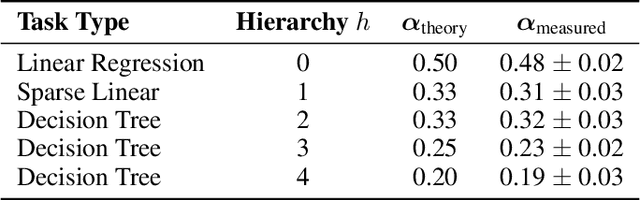
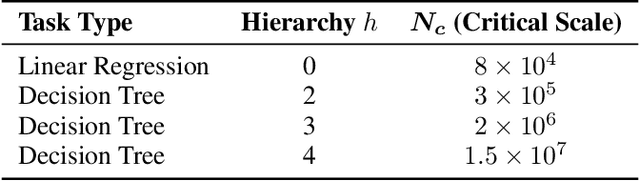


In-context learning (ICL) enables large language models to adapt to new tasks from demonstrations without parameter updates. Despite extensive empirical studies, a principled understanding of ICL emergence at scale remains more elusive. We present a unified theoretical framework connecting scaling laws to ICL emergence in transformers. Our analysis establishes that ICL performance follows power-law relationships with model depth $L$, width $d$, context length $k$, and training data $D$, with exponents determined by task structure. We show that under specific conditions, transformers implement gradient-based metalearning in their forward pass, with an effective learning rate $η_{\text{eff}} = Θ(1/\sqrt{Ld})$. We demonstrate sharp phase transitions at critical scales and derive optimal depth-width allocations favoring $L^* \propto N^{2/3}$, $d^* \propto N^{1/3}$ for the fixed parameter budget $N = Ld$. Systematic experiments on synthetic tasks validate our predictions, with measured scaling exponents closely matching theory. This work provides both necessary and sufficient conditions for the emergence of ICLs and establishes fundamental computational limits on what transformers can learn in-context.