 Add to Chrome
 Add to Firefox
 Add to Edge
VGI-BENCH: Probing Visual Intelligence in Video Generation Models
Aug 20, 2026
Recent studies suggest that video generation models can exhibit certain forms of zero-shot visual reasoning through generated frames. Yet reliable evaluation remains challenging: benchmarks should adopt inputs aligned with the visual priors of current video models, require valid evolving processes rather than only plausible final states, and calibrate task difficulty to remain challenging yet partly feasible. To this end, we introduce VGI-bench, containing 27 tasks and 810 instances, organized by a two-level taxonomy of task domains and skill tags for fine-grained evaluation of visual reasoning capabilities of video generation models. Our evaluations show that current generative systems can solve a subset of visually grounded reasoning tasks, but remain far from reliable, with even the strongest model, Seedance~2.0, achieving only 51.0% under our evaluation criteria. Our analysis further explore the output failure modes, input condition sensitivity, performance transfer boundary from synthetic fine-tuning, and internal denoising perspective revealing limited self-correction, where later steps mainly refine early hypotheses rather than correct reasoning errors. We hope VGI-bench will help stimulate the development of next-generation video generation models. We will release our code and data.

MATCH: Modulating Attention via In-Context Retrieval for Long-Context Transformers
Jun 29, 2026The quadratic computational cost of traditional attention mechanisms poses a major bottleneck to the scalability and practical deployment of large language models (LLMs), particularly in long-context scenarios. To improve efficiency, existing approaches often enforce rigid structural constraints such as local attention windows. However, these strategies typically lead to substantial performance degradation on tasks requiring precise long-range recall. In this work, we propose MATCH, a scalable and efficient framework that augments sparsified attention mechanisms with dynamically integrated in-context information through an efficient retrieval system. Empirical results show that MATCH significantly improves the performance of sparse-attention models on both synthetic and real-world natural-language tasks. These findings highlight the versatility of MATCH as a general approach for enhancing in-context retrieval capabilities while maintaining the efficiency benefits of sparse attention architectures.
Mask Is What DLLM Needs: A Masked Data Training Paradigm for Diffusion LLMs
Mar 16, 2026Discrete diffusion models offer global context awareness and flexible parallel generation. However, uniform random noise schedulers in standard DLLM training overlook the highly non-uniform information density inherent in real-world sequences. This wastes optimization resources on low-density structural glues while leaving high-density logical pivot points severely under-optimized. To address this, we propose an Information Density Driven Smart Noise Scheduler. By extracting information-dense hubs and applying Complementary Priority Masking, our method decouples a single training instance into mutually reinforcing reasoning and syntax samples, forcing the model to master both logical deduction and foundational sequence structure. Experiments demonstrate that our approach improves average accuracy by ~4\% across four Code and Math reasoning benchmarks, significantly outperforming uniform baselines. Mechanistic analyses further reveal that probabilistic priority masking effectively mitigates contextual collapse during block diffusion training. Overall, this density-aware strategy efficiently unlocks the reasoning potential of diffusion language models at minimal annotation cost, emerging as a promising new masked data training paradigm for Diffusion LLMs. Our processed dataset can be found at https://huggingface.co/datasets/malr07/opc-sft-stage2-dense-extracted.
Diffusion In Diffusion: Reclaiming Global Coherence in Semi-Autoregressive Diffusion
Jan 21, 2026One of the most compelling features of global discrete diffusion language models is their global bidirectional contextual capability. However, existing block-based diffusion studies tend to introduce autoregressive priors, which, while offering benefits, can cause models to lose this global coherence at the macro level. To regain global contextual understanding while preserving the advantages of the semi-autoregressive paradigm, we propose Diffusion in Diffusion, a 'draft-then-refine' framework designed to overcome the irreversibility and myopia problems inherent in block diffusion models. Our approach first employs block diffusion to generate rapid drafts using small blocks, then refines these drafts through global bidirectional diffusion with a larger bidirectional receptive field. We utilize snapshot confidence remasking to identify the most critical tokens that require modification, and apply mix-scale training to expand the block diffusion model's global capabilities. Empirical results demonstrate that our approach sets a new benchmark for discrete diffusion models on the OpenWebText dataset. Using only 26% of the fine-tuning budget of baseline models, we reduce generative perplexity from 25.7 to 21.9, significantly narrowing the performance gap with autoregressive models.
Resona: Improving Context Copying in Linear Recurrence Models with Retrieval
Mar 28, 2025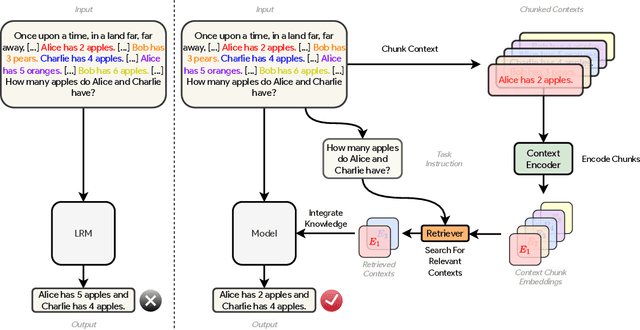
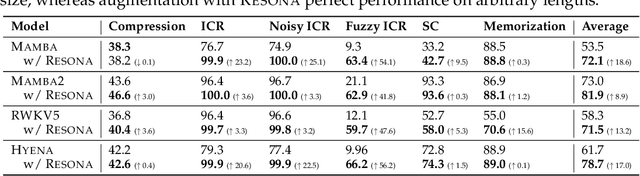
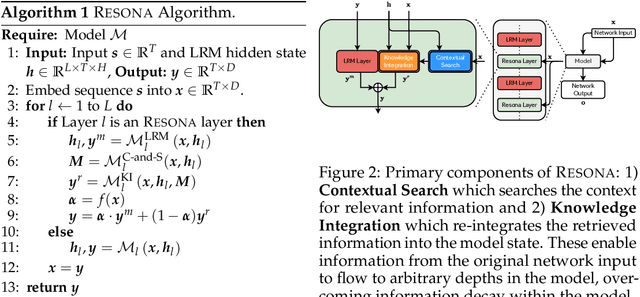
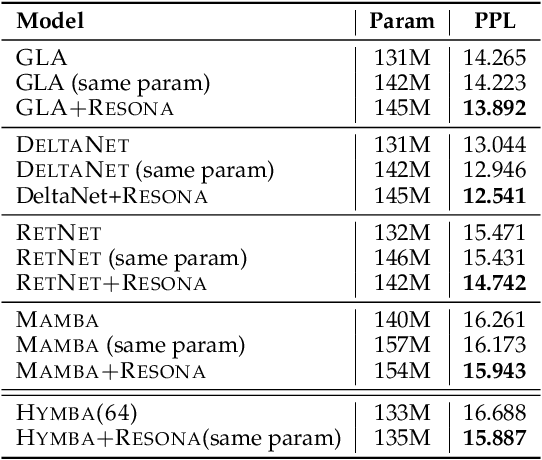
Recent shifts in the space of large language model (LLM) research have shown an increasing focus on novel architectures to compete with prototypical Transformer-based models that have long dominated this space. Linear recurrent models have proven to be a viable competitor due to their computational efficiency. However, such models still demonstrate a sizable gap compared to Transformers in terms of in-context learning among other tasks that require recalling information from a context. In this work, we introduce __Resona__, a simple and scalable framework for augmenting linear recurrent models with retrieval. __Resona__~augments models with the ability to integrate retrieved information from the provided input context, enabling tailored behavior to diverse task requirements. Experiments on a variety of linear recurrent models demonstrate that __Resona__-augmented models observe significant performance gains on a variety of synthetic as well as real-world natural language tasks, highlighting its ability to act as a general purpose method to improve the in-context learning and language modeling abilities of linear recurrent LLMs.
BarlowTwins-CXR : Enhancing Chest X-Ray abnormality localization in heterogeneous data with cross-domain self-supervised learning
Feb 09, 2024Background: Chest X-ray imaging-based abnormality localization, essential in diagnosing various diseases, faces significant clinical challenges due to complex interpretations and the growing workload of radiologists. While recent advances in deep learning offer promising solutions, there is still a critical issue of domain inconsistency in cross-domain transfer learning, which hampers the efficiency and accuracy of diagnostic processes. This study aims to address the domain inconsistency problem and improve autonomic abnormality localization performance of heterogeneous chest X-ray image analysis, by developing a self-supervised learning strategy called "BarlwoTwins-CXR". Methods: We utilized two publicly available datasets: the NIH Chest X-ray Dataset and the VinDr-CXR. The BarlowTwins-CXR approach was conducted in a two-stage training process. Initially, self-supervised pre-training was performed using an adjusted Barlow Twins algorithm on the NIH dataset with a Resnet50 backbone pre-trained on ImageNet. This was followed by supervised fine-tuning on the VinDr-CXR dataset using Faster R-CNN with Feature Pyramid Network (FPN). Results: Our experiments showed a significant improvement in model performance with BarlowTwins-CXR. The approach achieved a 3% increase in mAP50 accuracy compared to traditional ImageNet pre-trained models. In addition, the Ablation CAM method revealed enhanced precision in localizing chest abnormalities. Conclusion: BarlowTwins-CXR significantly enhances the efficiency and accuracy of chest X-ray image-based abnormality localization, outperforming traditional transfer learning methods and effectively overcoming domain inconsistency in cross-domain scenarios. Our experiment results demonstrate the potential of using self-supervised learning to improve the generalizability of models in medical settings with limited amounts of heterogeneous data.