 Add to Chrome
 Add to Firefox
 Add to Edge
Towards Surgical World-Action Modeling: A Preliminary Joint Visual-Trajectory Forecasting for Surgical Motion Planning
Aug 20, 2026
Reliable surgical planning requires models to anticipate not only how instruments will move, but also how the operative visual state will evolve together with such motion. Existing approaches typically treat future scene generation and instrument trajectory prediction as two separate tasks. Scene-only models cannot directly evaluate the accuracy of future instrument motion at the trajectory level, while trajectory-only models fail to capture the visual consequences of instrument movement, leaving the consistency between predicted trajectories and future scene evolution unaddressed. Jointly forecasting both provides a more complete account of surgical action-scene dynamics by enabling explicit trajectory-level evaluation while simultaneously modeling the corresponding visual evolution. To bridge this gap, we present a preliminary joint visual-trajectory world-action model that simultaneously forecasts future visual states and instrument trajectories from historical surgical observations. Specifically, we encode historical video frames and tool trajectories into latent representations, which are processed by a temporal-spatial encoder and subsequently decoded through separate visual-state and trajectory prediction heads. Based on this preliminary architecture, a chunked autoregressive rollout is repeatedly applied to predict fifteen future steps. The chunked strategy consistently outperforms direct one-shot prediction across all evaluated horizons, improving first-segment PSNR from 18.86 to 23.11 dB and reducing ADE from 45.77 to 22.22 pixels. These results demonstrate the initial feasibility of joint visual-motion forecasting. However, we observe progressive visual degradation and accumulated trajectory errors over longer prediction horizons, which remain important challenges for future surgical world-action modeling.

SurgWMBench: A Vision-Based Benchmark for World-Modeling Surgical Instrument Motion Planning
Aug 08, 2026Reliable surgical planning requires models that move beyond recognizing the current surgical step or imitating expert demonstrations, and instead anticipate how instrument motion reshapes subsequent operative states. Most surgical video understanding methods focus on recognizing phases, actions, or workflow states, while providing limited support for explicitly modeling instrument motion. Conversely, existing tool motion prediction methods can forecast instrument trajectories, but they generally do not capture the coupled evolution of future surgical video states. World models offer a natural framework for jointly modeling visual state transitions and instrument motion dynamics. However, existing surgical world model studies remain largely centered on visual generation quality, relying on generation-oriented metrics such as FVD and CD-FVD. These metrics are poorly aligned with instrument motion planning, as they do not directly measure whether predicted trajectories are geometrically accurate, temporally coherent, or actionable for downstream planning. This limitation is partly structural, since the field lacks public datasets and standardized evaluation protocols that provide the benchmarking infrastructure needed to assess motion-centric capabilities in surgical world models. In this paper, we introduce SurgWMBench, a vision-based benchmark for short-horizon surgical motion planning and dynamics prediction. Given intraoperative image sequences and historical instrument trajectory, SurgWMBench evaluates both near-future instrument motion prediction and stability under continuous rollout or input perturbations.
Implicit Virtual Leader: Decentralized Vision-Only Relative Pose Estimation for Multi-Robot Formations
Jul 17, 2026Classical leader-follower formation control suffers from single points of failure and error propagation, and relies on absolute localization sensors that are ill-suited for GPS-denied environments. We address these limitations by introducing a fully decentralized, vision-only relative pose estimation framework based on Graph Neural Networks (GNNs). The key idea is the implicit virtual leader (IVL): a non-physical formation reference frame that is not tied to any individual robot but is implicitly learned within the GNN using only monocular images and inter-robot communication. We attach a heteroscedastic GNLL head for aleatoric uncertainty and MC~Dropout for epistemic uncertainty, and conduct a systematic comparison across simulation and real-world test sets. Our framework achieves competitive pose estimation accuracy and generalizes naturally to heterogeneous robot platforms and varying formation sizes.
FabriVLA: A Lightweight Vision-Language-Action Model for Precise Multi-Task Manipulation
Jul 09, 2026We present FabriVLA, a lightweight Vision-Language-Action model for Precise Multi-Task Manipulation. FabriVLA combines an InternVL3.5 vision-language backbone with a flow-matching action head featuring gated self-attention across action tokens and shallow VLM layer fusion for enriched spatial context. The model is trained via single stage joint optimization from a pretrained VLM and randomly initialized action head. On the Meta-World MT50 benchmark spanning 50 diverse manipulation tasks, FabriVLA achieves a tier-average success rate of 90.0%, demonstrating that a compact VLA built on a 1B scale VLM can achieve strong performance without relying on multi billion parameter VLA backbones.
Fine-Grained Action Segmentation for Renorrhaphy in Robot-Assisted Partial Nephrectomy
Apr 10, 2026Fine-grained action segmentation during renorrhaphy in robot-assisted partial nephrectomy requires frame-level recognition of visually similar suturing gestures with variable duration and substantial class imbalance. The SIA-RAPN benchmark defines this problem on 50 clinical videos acquired with the da Vinci Xi system and annotated with 12 frame-level labels. The benchmark compares four temporal models built on I3D features: MS-TCN++, AsFormer, TUT, and DiffAct. Evaluation uses balanced accuracy, edit score, segmental F1 at overlap thresholds of 10, 25, and 50, frame-wise accuracy, and frame-wise mean average precision. In addition to the primary evaluation across five released split configurations on SIA-RAPN, the benchmark reports cross-domain results on a separate single-port RAPN dataset. Across the strongest reported values over those five runs on the primary dataset, DiffAct achieves the highest F1, frame-wise accuracy, edit score, and frame mAP, while MS-TCN++ attains the highest balanced accuracy.
120 Minutes and a Laptop: Minimalist Image-goal Navigation via Unsupervised Exploration and Offline RL
Mar 27, 2026The prevailing paradigm for image-goal visual navigation often assumes access to large-scale datasets, substantial pretraining, and significant computational resources. In this work, we challenge this assumption. We show that we can collect a dataset, train an in-domain policy, and deploy it to the real world (1) in less than 120 minutes, (2) on a consumer laptop, (3) without any human intervention. Our method, MINav, formulates image-goal navigation as an offline goal-conditioned reinforcement learning problem, combining unsupervised data collection with hindsight goal relabeling and offline policy learning. Experiments in simulation and the real world show that MINav improves exploration efficiency, outperforms zero-shot navigation baselines in target environments, and scales favorably with dataset size. These results suggest that effective real-world robotic learning can be achieved with high computational efficiency, lowering the barrier to rapid policy prototyping and deployment.
SignNav: Leveraging Signage for Semantic Visual Navigation in Large-Scale Indoor Environments
Mar 17, 2026Humans routinely leverage semantic hints provided by signage to navigate to destinations within novel Large-Scale Indoor (LSI) environments, such as hospitals and airport terminals. However, this capability remains underexplored within the field of embodied navigation. This paper introduces a novel embodied navigation task, SignNav, which requires the agent to interpret semantic hint from signage and reason about the subsequent action based on current observation. To facilitate research in this domain, we construct the LSI-Dataset for the training and evaluation of various SignNav agents. Dynamically changing semantic hints and sparse placement of signage in LSI environments present significant challenges to the SignNav task. To address these challenges, we propose the Spatial-Temporal Aware Transformer (START) model for end-to-end decision-making. The spatial-aware module grounds the semantic hint of signage into physical world, while the temporal-aware module captures long-range dependencies between historical states and current observation. Leveraging a two-stage training strategy with Dataset Aggregation (DAgger), our approach achieves state-of-the-art performance, recording an 80% Success Rate (SR) and 0.74 NDTW on val-unseen split. Real-world deployment further demonstrates the practicality of our method in physical environment without pre-built map.
RAP: Runtime-Adaptive Pruning for LLM Inference
May 26, 2025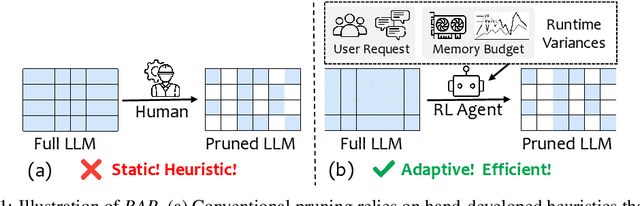
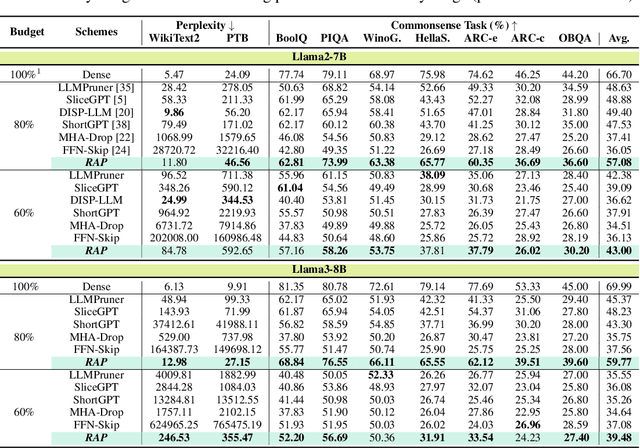
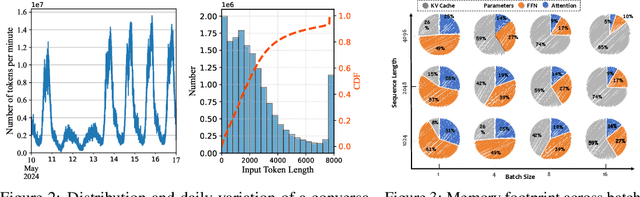
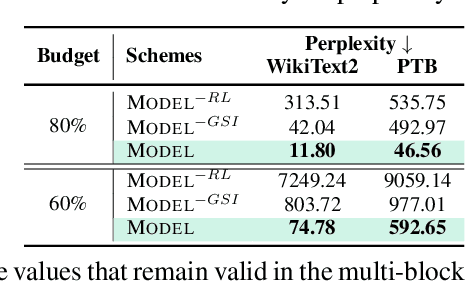
Large language models (LLMs) excel at language understanding and generation, but their enormous computational and memory requirements hinder deployment. Compression offers a potential solution to mitigate these constraints. However, most existing methods rely on fixed heuristics and thus fail to adapt to runtime memory variations or heterogeneous KV-cache demands arising from diverse user requests. To address these limitations, we propose RAP, an elastic pruning framework driven by reinforcement learning (RL) that dynamically adjusts compression strategies in a runtime-aware manner. Specifically, RAP dynamically tracks the evolving ratio between model parameters and KV-cache across practical execution. Recognizing that FFNs house most parameters, whereas parameter -light attention layers dominate KV-cache formation, the RL agent retains only those components that maximize utility within the current memory budget, conditioned on instantaneous workload and device state. Extensive experiments results demonstrate that RAP outperforms state-of-the-art baselines, marking the first time to jointly consider model weights and KV-cache on the fly.
TacGNN:Learning Tactile-based In-hand Manipulation with a Blind Robot
Apr 03, 2023

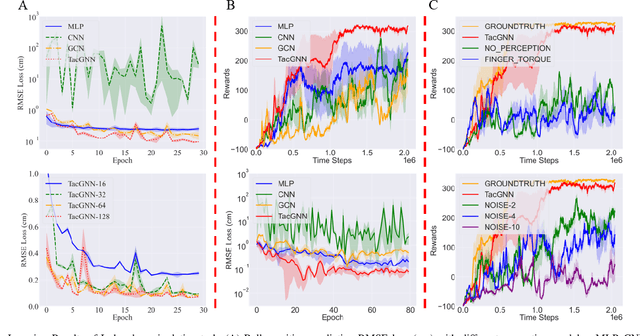
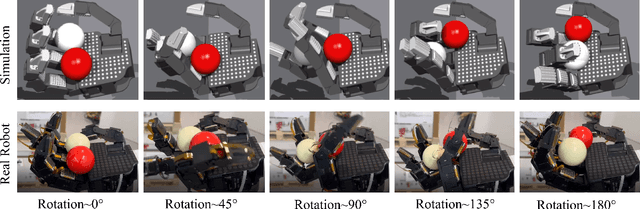
In this paper, we propose a novel framework for tactile-based dexterous manipulation learning with a blind anthropomorphic robotic hand, i.e. without visual sensing. First, object-related states were extracted from the raw tactile signals by a graph-based perception model - TacGNN. The resulting tactile features were then utilized in the policy learning of an in-hand manipulation task in the second stage. This method was examined by a Baoding ball task - simultaneously manipulating two spheres around each other by 180 degrees in hand. We conducted experiments on object states prediction and in-hand manipulation using a reinforcement learning algorithm (PPO). Results show that TacGNN is effective in predicting object-related states during manipulation by decreasing the RMSE of prediction to 0.096cm comparing to other methods, such as MLP, CNN, and GCN. Finally, the robot hand could finish an in-hand manipulation task solely relying on the robotic own perception - tactile sensing and proprioception. In addition, our methods are tested on three tasks with different difficulty levels and transferred to the real robot without further training.
Accelerating Multi-Agent Planning Using Graph Transformers with Bounded Suboptimality
Jan 20, 2023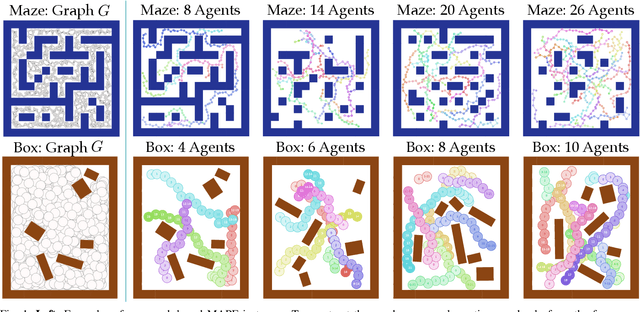
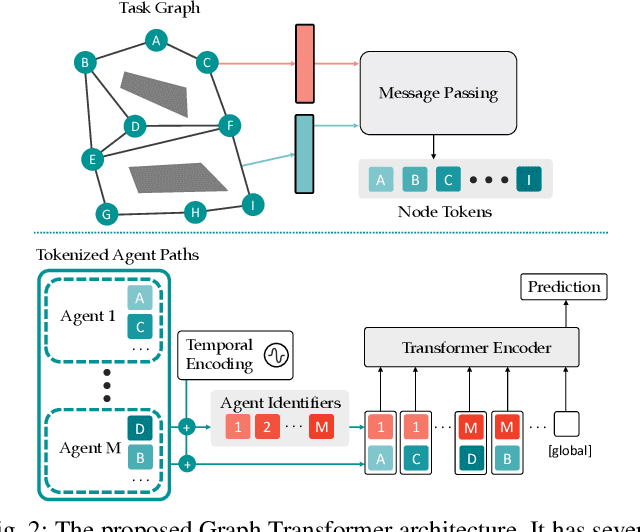
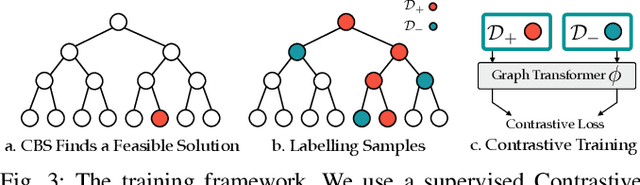
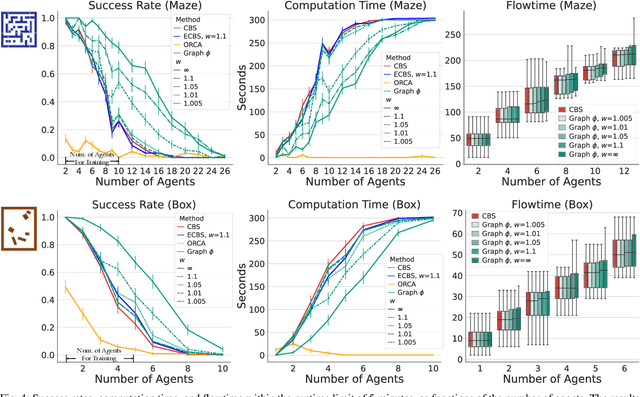
Conflict-Based Search is one of the most popular methods for multi-agent path finding. Though it is complete and optimal, it does not scale well. Recent works have been proposed to accelerate it by introducing various heuristics. However, whether these heuristics can apply to non-grid-based problem settings while maintaining their effectiveness remains an open question. In this work, we find that the answer is prone to be no. To this end, we propose a learning-based component, i.e., the Graph Transformer, as a heuristic function to accelerate the planning. The proposed method is provably complete and bounded-suboptimal with any desired factor. We conduct extensive experiments on two environments with dense graphs. Results show that the proposed Graph Transformer can be trained in problem instances with relatively few agents and generalizes well to a larger number of agents, while achieving better performance than state-of-the-art methods.