 Add to Chrome
 Add to Firefox
 Add to Edge
Depth Anything V4: Dynamic 4D Scene Reconstruction via Riemannian Flow Matching on 4D Gaussian Splatting
Aug 20, 2026
We present Depth Anything V4 (DAV4), a framework for dynamic 4D scene reconstruction from monocular video. Our key contribution is the application of Riemannian Flow Matching (RFM) to 4D Gaussian Splatting parameters, defining probability paths directly on non-Euclidean manifolds (scale, rotation, opacity), ensuring all intermediate states are valid. Through controlled experiments, we isolate RFM's contribution from test-time optimization (TTO) and pre-training. A deterministic MLP baseline with the same data, architecture, and TTO achieves F-score 0.762; RFM achieves 0.806 - the +0.044 gain is RFM's isolated contribution. We provide corrected computational cost analysis: pre-training is 360 GPU-hours, amortizing for large-scale deployment (over 10,000 scenes). Uncertainty is quantified via Negative Gaussian Log-Likelihood and Expected Calibration Error. DAV4 outperforms prior Depth Anything models and per-scene 4D-GS on dynamic reconstruction and novel-view synthesis, while using no human-annotated depth labels as training losses.

SearchOS-V1: Towards Robust Open-Domain Information-Seeking Agent Collaboration
Jul 16, 2026Recent advances in Tool-Integrated Large Language Models have made web search a core capability of information-seeking agents. However, as interaction histories grow, agents increasingly struggle to track task progress. When search attempts fail to yield useful evidence, current single- and multi-agent systems can become trapped in repetitive loops, wasting search budgets and ultimately compromising the quality and completeness of the final output. We introduce SearchOS, a system-level multi-agent framework that turns fragile, implicit search progress into explicit, persistent, and shared state. First, we formulate open-domain information seeking as relational schema completion with grounded citations, where agents discover entities, populate attributes across linked tables, and anchor each value to source evidence. Then we design Search-Oriented Context Management (SOCM), which externalizes the evolving state into Frontier Task, an Evidence Graph, a Coverage Map, and Failure Memory. Built on SOCM, SearchOS applies a pipeline-parallel scheduling mechanism that overlaps the execution of sub-agents and continuously refills freed slots with tasks targeting unresolved coverage gaps to improve utilization and throughput. To schedule and control the execution of search agents, SearchOS introduces a Search Tool Middleware Harness that intercepts model and tool interactions to record grounded evidence and react to stalls or budget exhaustion, and provides a reusable hierarchical skill system comprising strategy and access skills to augment the agents' search process and avoid repeating failed search patterns across runs. On WideSearch and GISA, SearchOS leads all metrics among the evaluated single- and multi-agent baselines, paving the way toward robust information-seeking collaboration.
RedVLA: Physical Red Teaming for Vision-Language-Action Models
Apr 24, 2026The real-world deployment of Vision-Language-Action (VLA) models remains limited by the risk of unpredictable and irreversible physical harm. However, we currently lack effective mechanisms to proactively detect these physical safety risks before deployment. To address this gap, we propose \textbf{RedVLA}, the first red teaming framework for physical safety in VLA models. We systematically uncover unsafe behaviors through a two-stage process: (I) \textbf{Risk Scenario Synthesis} constructs a valid and task-feasible initial risk scene. Specifically, it identifies critical interaction regions from benign trajectories and positions the risk factor within these regions, aiming to entangle it with the VLA's execution flow and elicit a target unsafe behavior. (II) \textbf{Risk Amplification} ensures stable elicitation across heterogeneous models. It iteratively refines the risk factor state through gradient-free optimization guided by trajectory features. Experiments on six representative VLA models show that RedVLA uncovers diverse unsafe behaviors and achieves the ASR up to 95.5\% within 10 optimization iterations. To mitigate these risks, we further propose SimpleVLA-Guard, a lightweight safety guard built from RedVLA-generated data. Our data, assets, and code are available \href{https://redvla.github.io}{here}.
Flatter Tokens are More Valuable for Speculative Draft Model Training
Jan 26, 2026Speculative Decoding (SD) is a key technique for accelerating Large Language Model (LLM) inference, but it typically requires training a draft model on a large dataset. We approach this problem from a data-centric perspective, finding that not all training samples contribute equally to the SD acceptance rate. Specifically, our theoretical analysis and empirical validation reveals that tokens inducing flatter predictive distributions from the target model are more valuable than those yielding sharply peaked distributions. Based on this insight, we propose flatness, a new metric to quantify this property, and develop the Sample-level-flatness-based Dataset Distillation (SFDD) approach, which filters the training data to retain only the most valuable samples. Experiments on the EAGLE framework demonstrate that SFDD can achieve over 2$\times$ training speedup using only 50% of the data, while keeping the final model's inference speedup within 4% of the full-dataset baseline. This work introduces an effective, data-centric approach that substantially improves the training efficiency for Speculative Decoding. Our code is available at https://anonymous.4open.science/r/Flatness.
GraphIC: A Graph-Based In-Context Example Retrieval Model for Multi-Step Reasoning
Oct 03, 2024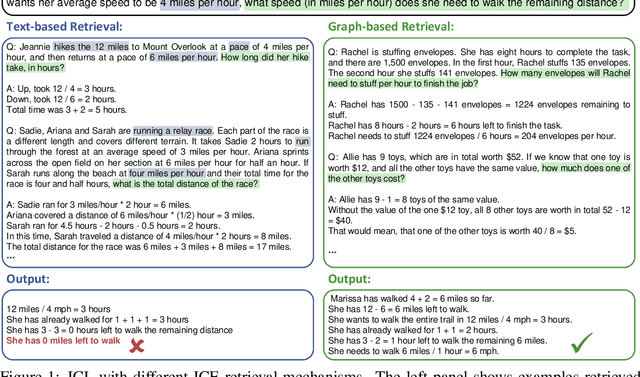
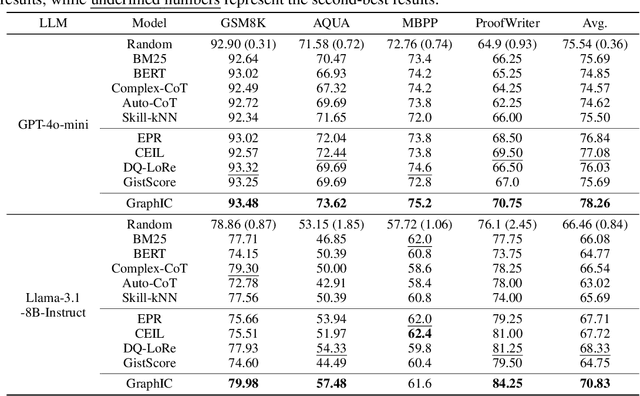


In-context learning (ICL) enables large language models (LLMs) to generalize to new tasks by incorporating a few in-context examples (ICEs) directly in the input, without updating parameters. However, the effectiveness of ICL heavily relies on the selection of ICEs, and conventional text-based embedding methods are often inadequate for tasks that require multi-step reasoning, such as mathematical and logical problem solving. This is due to the bias introduced by shallow semantic similarities that fail to capture the deeper reasoning structures required for these tasks. We present GraphIC, a novel approach that leverages graph-based representations of reasoning processes, coupled with Bayesian Networks (BNs) to select ICEs. Graph structures inherently filter out shallow semantics while preserving the core reasoning structure. Importantly, BNs capture the dependency of a node's attributes on its parent nodes, closely mirroring the hierarchical nature of human cognition-where each thought is shaped by preceding ones. This makes BNs particularly well-suited for multi-step reasoning tasks, aligning the process more closely with human-like reasoning. Extensive experiments across three types of reasoning tasks (mathematical reasoning, code generation, and logical reasoning) demonstrate that GraphIC outperforms both training-free and training-based models in selecting ICEs, excelling in terms of both effectiveness and efficiency. We show that GraphIC enhances ICL's performance and interoperability, significantly advancing ICE selection for multi-step reasoning tasks.