 Add to Chrome
 Add to Firefox
 Add to Edge
Expert-Driven Survival Machines: Improving Stratification and Interpretability in Multiple Clinical Cohorts
Jun 12, 2026
Survival prediction plays a central role for healthcare providers and clinical researchers. Accurate risk stratification enables early intervention and improved patient management. Most existing deep survival models learn one common feature representation for all patients, which may hide important differences between patient subgroups. In contrast, a Mixture-of-Experts (MoE) framework allows different parts of the model to focus on different patient patterns, leading to more individualized representations. Therefore, in this work, we propose a mixture-of-experts enhanced adaptive deep clustering survival framework (AdaCSM) for modeling such heterogeneous survival patterns. We introduce a routing-based expert mechanism that enables conditional specialization within a parametric survival modeling framework. The proposed architecture allocates patients to specialized risk predictors dynamically while preserving the patient survival and subtype clustering objectives. We compare our method with state-of-the-art survival and deep clustering models on multiple real-world longitudinal clinical cohorts spanning diverse disease domains. The proposed method demonstrates improved predictive performance and leads to interpretable results in survival analysis.

Tabular LLMs for Interpretable Few-Shot Alzheimer's Disease Prediction with Multimodal Biomedical Data
Mar 17, 2026Accurate diagnosis of Alzheimer's disease (AD) requires handling tabular biomarker data, yet such data are often small and incomplete, where deep learning models frequently fail to outperform classical methods. Pretrained large language models (LLMs) offer few-shot generalization, structured reasoning, and interpretable outputs, providing a powerful paradigm shift for clinical prediction. We propose TAP-GPT Tabular Alzheimer's Prediction GPT, a domain-adapted tabular LLM framework built on TableGPT2 and fine-tuned for few-shot AD classification using tabular prompts rather than plain texts. We evaluate TAP-GPT across four ADNI-derived datasets, including QT-PAD biomarkers and region-level structural MRI, amyloid PET, and tau PET for binary AD classification. Across multimodal and unimodal settings, TAP-GPT improves upon its backbone models and outperforms traditional machine learning baselines in the few-shot setting while remaining competitive with state-of-the-art general-purpose LLMs. We show that feature selection mitigates degradation in high-dimensional inputs and that TAP-GPT maintains stable performance under simulated and real-world missingness without imputation. Additionally, TAP-GPT produces structured, modality-aware reasoning aligned with established AD biology and shows greater stability under self-reflection, supporting its use in iterative multi-agent systems. To our knowledge, this is the first systematic application of a tabular-specialized LLM to multimodal biomarker-based AD prediction, demonstrating that such pretrained models can effectively address structured clinical prediction tasks and laying the foundation for tabular LLM-driven multi-agent clinical decision-support systems. The source code is publicly available on GitHub: https://github.com/sophie-kearney/TAP-GPT.
Knowledge-Driven Feature Selection and Engineering for Genotype Data with Large Language Models
Oct 02, 2024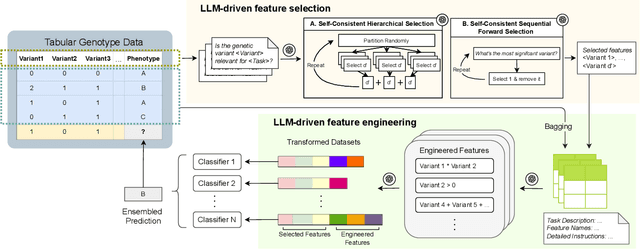

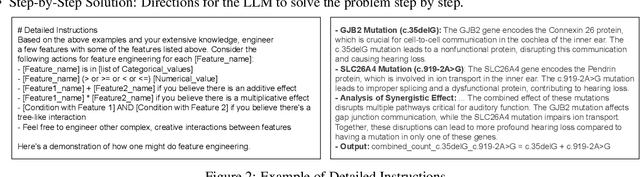
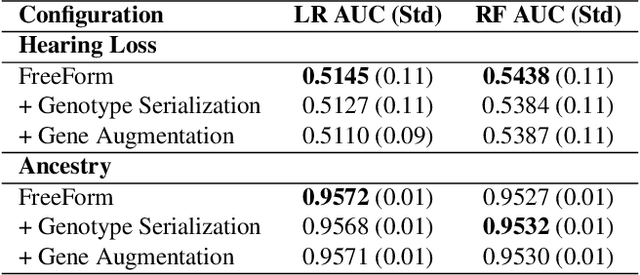
Predicting phenotypes with complex genetic bases based on a small, interpretable set of variant features remains a challenging task. Conventionally, data-driven approaches are utilized for this task, yet the high dimensional nature of genotype data makes the analysis and prediction difficult. Motivated by the extensive knowledge encoded in pre-trained LLMs and their success in processing complex biomedical concepts, we set to examine the ability of LLMs in feature selection and engineering for tabular genotype data, with a novel knowledge-driven framework. We develop FREEFORM, Free-flow Reasoning and Ensembling for Enhanced Feature Output and Robust Modeling, designed with chain-of-thought and ensembling principles, to select and engineer features with the intrinsic knowledge of LLMs. Evaluated on two distinct genotype-phenotype datasets, genetic ancestry and hereditary hearing loss, we find this framework outperforms several data-driven methods, particularly on low-shot regimes. FREEFORM is available as open-source framework at GitHub: https://github.com/PennShenLab/FREEFORM.