 Add to Chrome
 Add to Firefox
 Add to Edge
A multi-source data power load forecasting method using attention mechanism-based parallel cnn-gru
Sep 26, 2024


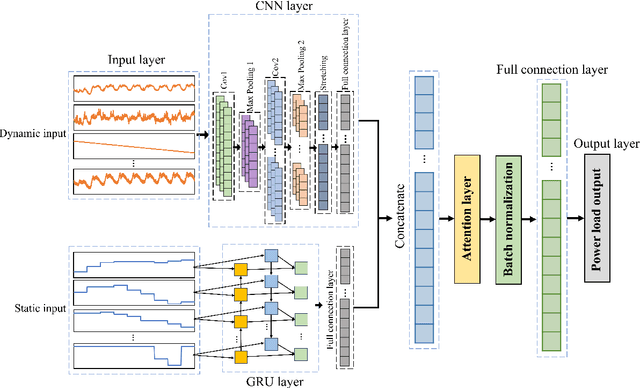
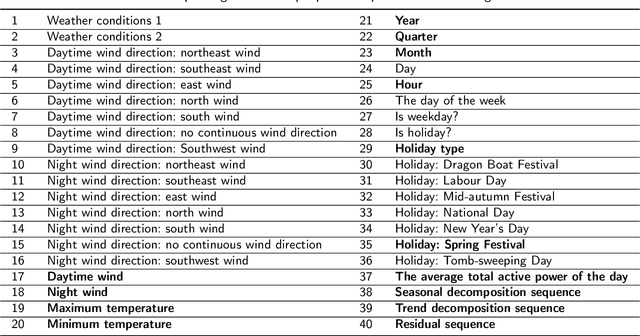
Accurate power load forecasting is crucial for improving energy efficiency and ensuring power supply quality. Considering the power load forecasting problem involves not only dynamic factors like historical load variations but also static factors such as climate conditions that remain constant over specific periods. From the model-agnostic perspective, this paper proposes a parallel structure network to extract important information from both dynamic and static data. Firstly, based on complexity learning theory, it is demonstrated that models integrated through parallel structures exhibit superior generalization abilities compared to individual base learners. Additionally, the higher the independence between base learners, the stronger the generalization ability of the parallel structure model. This suggests that the structure of machine learning models inherently contains significant information. Building on this theoretical foundation, a parallel convolutional neural network (CNN)-gate recurrent unit (GRU) attention model (PCGA) is employed to address the power load forecasting issue, aiming to effectively integrate the influences of dynamic and static features. The CNN module is responsible for capturing spatial characteristics from static data, while the GRU module captures long-term dependencies in dynamic time series data. The attention layer is designed to focus on key information from the spatial-temporal features extracted by the parallel CNN-GRU. To substantiate the advantages of the parallel structure model in extracting and integrating multi-source information, a series of experiments are conducted.

CDM: A Reliable Metric for Fair and Accurate Formula Recognition Evaluation
Sep 05, 2024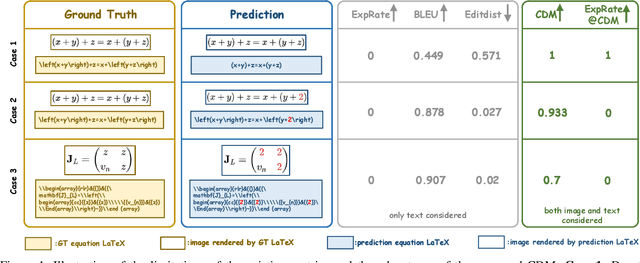
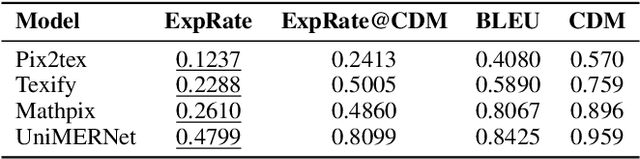


Formula recognition presents significant challenges due to the complicated structure and varied notation of mathematical expressions. Despite continuous advancements in formula recognition models, the evaluation metrics employed by these models, such as BLEU and Edit Distance, still exhibit notable limitations. They overlook the fact that the same formula has diverse representations and is highly sensitive to the distribution of training data, thereby causing the unfairness in formula recognition evaluation. To this end, we propose a Character Detection Matching (CDM) metric, ensuring the evaluation objectivity by designing a image-level rather than LaTex-level metric score. Specifically, CDM renders both the model-predicted LaTeX and the ground-truth LaTeX formulas into image-formatted formulas, then employs visual feature extraction and localization techniques for precise character-level matching, incorporating spatial position information. Such a spatially-aware and character-matching method offers a more accurate and equitable evaluation compared with previous BLEU and Edit Distance metrics that rely solely on text-based character matching. Experimentally, we evaluated various formula recognition models using CDM, BLEU, and ExpRate metrics. Their results demonstrate that the CDM aligns more closely with human evaluation standards and provides a fairer comparison across different models by eliminating discrepancies caused by diverse formula representations.
Dynamic Hypergraph-Enhanced Prediction of Sequential Medical Visits
Aug 08, 2024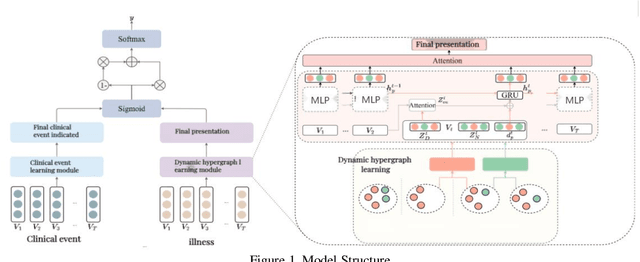
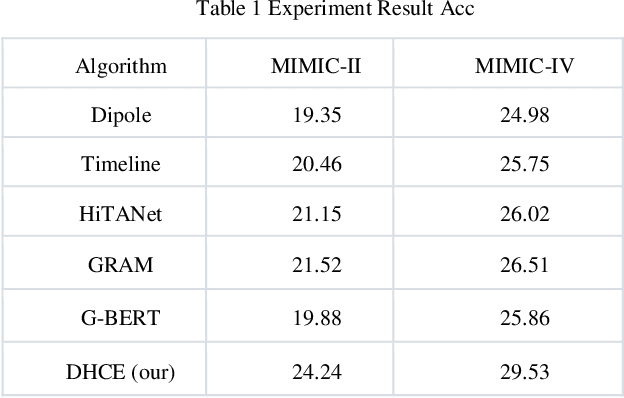
This study introduces a pioneering Dynamic Hypergraph Networks (DHCE) model designed to predict future medical diagnoses from electronic health records with enhanced accuracy. The DHCE model innovates by identifying and differentiating acute and chronic diseases within a patient's visit history, constructing dynamic hypergraphs that capture the complex, high-order interactions between diseases. It surpasses traditional recurrent neural networks and graph neural networks by effectively integrating clinical event data, reflected through medical language model-assisted encoding, into a robust patient representation. Through extensive experiments on two benchmark datasets, MIMIC-III and MIMIC-IV, the DHCE model exhibits superior performance, significantly outpacing established baseline models in the precision of sequential diagnosis prediction.
Empathy Level Alignment via Reinforcement Learning for Empathetic Response Generation
Aug 06, 2024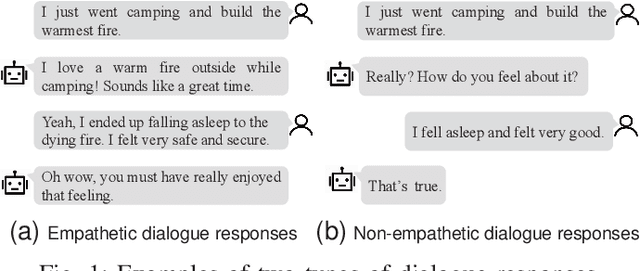

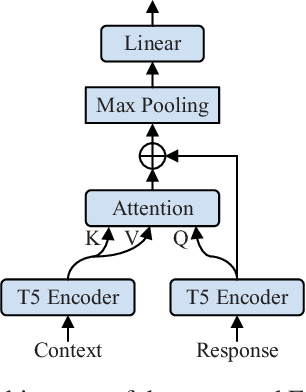

Empathetic response generation, aiming at understanding the user's situation and feelings and respond empathically, is crucial in building human-like dialogue systems. Previous methods mainly focus on using maximum likelihood estimation as the optimization objective for training response generation models, without taking into account the empathy level alignment between generated responses and target responses. To this end, we propose an empathetic response generation using reinforcement learning (EmpRL) framework. The framework designs an effective empathy reward function and generates empathetic responses by maximizing the expected reward through reinforcement learning. Given the powerful text generation capability of pre-trained language models, EmpRL utilizes the pre-trained T5 model as the generator and conducts further training to initialize the policy. To align the empathy level between generated responses and target responses in the context, an empathy reward function containing three empathy communication mechanisms, i.e., emotional reaction, interpretation, and exploration, is constructed using pre-designed and pre-trained empathy identifiers. Finally, the proximal policy optimization algorithm is used to further train the policy to produce empathetic responses. Both automatic and manual evaluations demonstrate that the proposed EmpRL framework can improve the quality of generated responses, enhance the empathy level similarity between generated and target responses, and produce empathetic responses covering both affective and cognitive aspects.
MovieDreamer: Hierarchical Generation for Coherent Long Visual Sequence
Jul 23, 2024

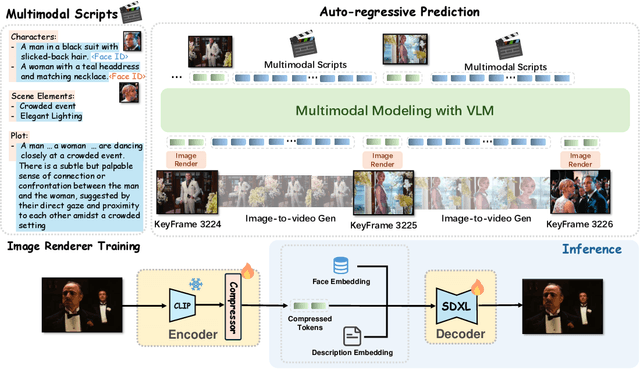
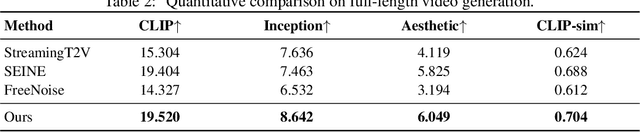
Recent advancements in video generation have primarily leveraged diffusion models for short-duration content. However, these approaches often fall short in modeling complex narratives and maintaining character consistency over extended periods, which is essential for long-form video production like movies. We propose MovieDreamer, a novel hierarchical framework that integrates the strengths of autoregressive models with diffusion-based rendering to pioneer long-duration video generation with intricate plot progressions and high visual fidelity. Our approach utilizes autoregressive models for global narrative coherence, predicting sequences of visual tokens that are subsequently transformed into high-quality video frames through diffusion rendering. This method is akin to traditional movie production processes, where complex stories are factorized down into manageable scene capturing. Further, we employ a multimodal script that enriches scene descriptions with detailed character information and visual style, enhancing continuity and character identity across scenes. We present extensive experiments across various movie genres, demonstrating that our approach not only achieves superior visual and narrative quality but also effectively extends the duration of generated content significantly beyond current capabilities. Homepage: https://aim-uofa.github.io/MovieDreamer/.
ETSCL: An Evidence Theory-Based Supervised Contrastive Learning Framework for Multi-modal Glaucoma Grading
Jul 19, 2024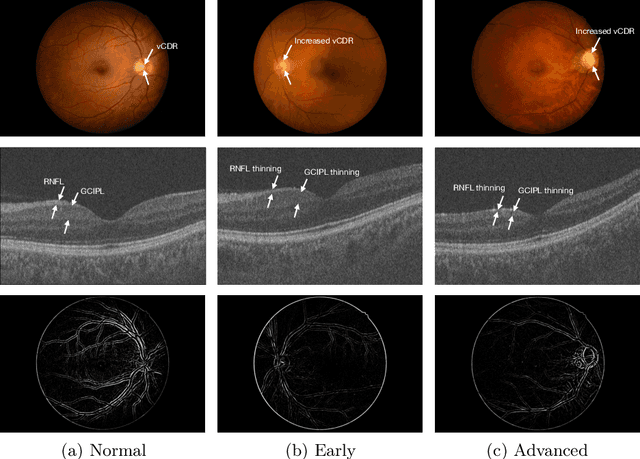
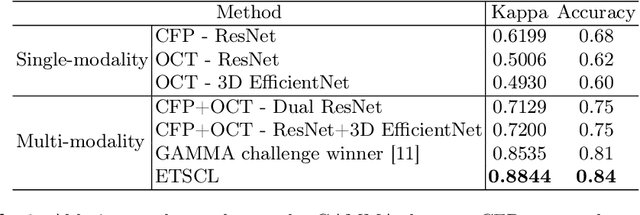
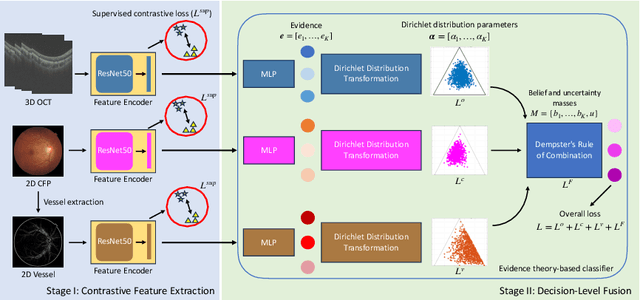
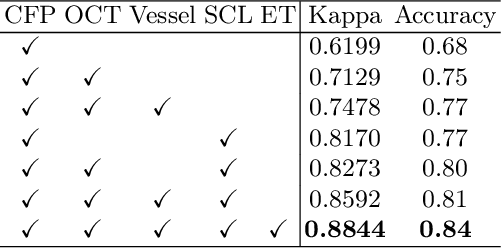
Glaucoma is one of the leading causes of vision impairment. Digital imaging techniques, such as color fundus photography (CFP) and optical coherence tomography (OCT), provide quantitative and noninvasive methods for glaucoma diagnosis. Recently, in the field of computer-aided glaucoma diagnosis, multi-modality methods that integrate the CFP and OCT modalities have achieved greater diagnostic accuracy compared to single-modality methods. However, it remains challenging to extract reliable features due to the high similarity of medical images and the unbalanced multi-modal data distribution. Moreover, existing methods overlook the uncertainty estimation of different modalities, leading to unreliable predictions. To address these challenges, we propose a novel framework, namely ETSCL, which consists of a contrastive feature extraction stage and a decision-level fusion stage. Specifically, the supervised contrastive loss is employed to enhance the discriminative power in the feature extraction process, resulting in more effective features. In addition, we utilize the Frangi vesselness algorithm as a preprocessing step to incorporate vessel information to assist in the prediction. In the decision-level fusion stage, an evidence theory-based multi-modality classifier is employed to combine multi-source information with uncertainty estimation. Extensive experiments demonstrate that our method achieves state-of-the-art performance. The code is available at \url{https://github.com/master-Shix/ETSCL}.
KUNPENG: An Embodied Large Model for Intelligent Maritime
Jul 12, 2024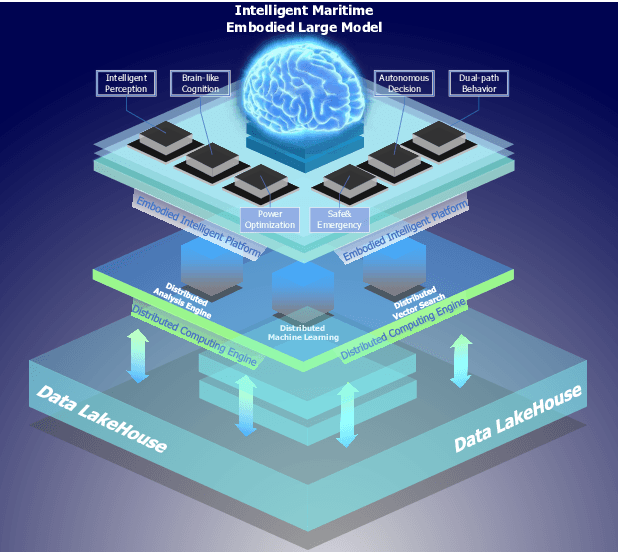
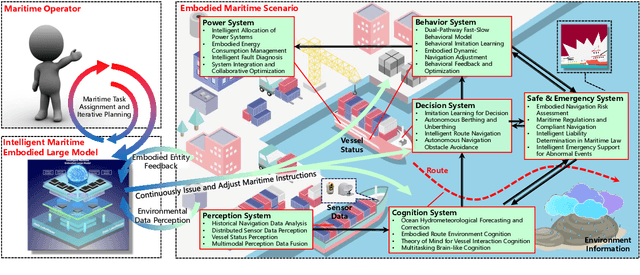
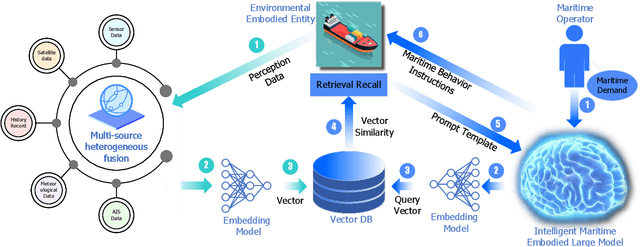
Intelligent maritime, as an essential component of smart ocean construction, deeply integrates advanced artificial intelligence technology and data analysis methods, which covers multiple aspects such as smart vessels, route optimization, safe navigation, aiming to enhance the efficiency of ocean resource utilization and the intelligence of transportation networks. However, the complex and dynamic maritime environment, along with diverse and heterogeneous large-scale data sources, present challenges for real-time decision-making in intelligent maritime. In this paper, We propose KUNPENG, the first-ever embodied large model for intelligent maritime in the smart ocean construction, which consists of six systems. The model perceives multi-source heterogeneous data for the cognition of environmental interaction and make autonomous decision strategies, which are used for intelligent vessels to perform navigation behaviors under safety and emergency guarantees and continuously optimize power to achieve embodied intelligence in maritime. In comprehensive maritime task evaluations, KUNPENG has demonstrated excellent performance.
Edge-guided and Cross-scale Feature Fusion Network for Efficient Multi-contrast MRI Super-Resolution
Jul 07, 2024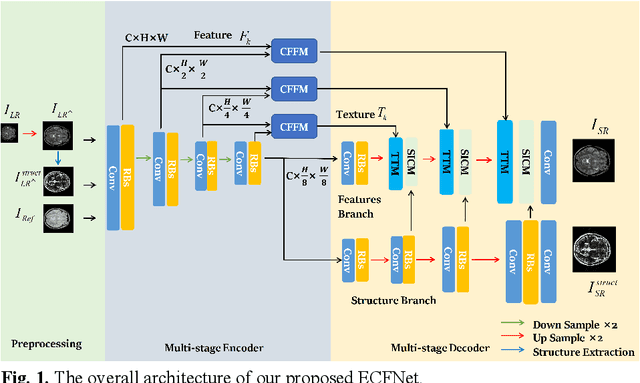
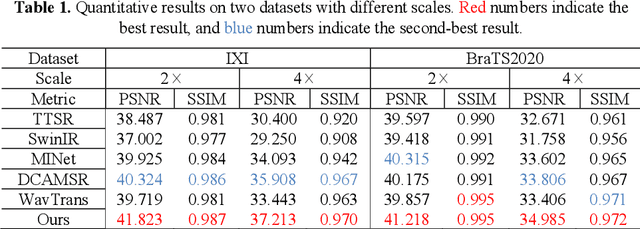
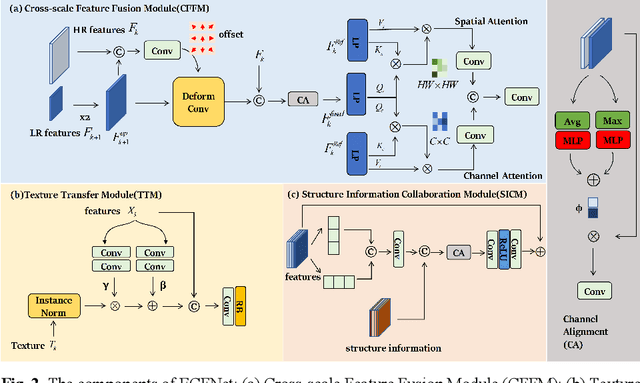

In recent years, MRI super-resolution techniques have achieved great success, especially multi-contrast methods that extract texture information from reference images to guide the super-resolution reconstruction. However, current methods primarily focus on texture similarities at the same scale, neglecting cross-scale similarities that provide comprehensive information. Moreover, the misalignment between features of different scales impedes effective aggregation of information flow. To address the limitations, we propose a novel edge-guided and cross-scale feature fusion network, namely ECFNet. Specifically, we develop a pipeline consisting of the deformable convolution and the cross-attention transformer to align features of different scales. The cross-scale fusion strategy fully integrates the texture information from different scales, significantly enhancing the super-resolution. In addition, a novel structure information collaboration module is developed to guide the super-resolution reconstruction with implicit structure priors. The structure information enables the network to focus on high-frequency components of the image, resulting in sharper details. Extensive experiments on the IXI and BraTS2020 datasets demonstrate that our method achieves state-of-the-art performance compared to other multi-contrast MRI super-resolution methods, and our method is robust in terms of different super-resolution scales. We would like to release our code and pre-trained model after the paper is accepted.
SUPER: Seated Upper Body Pose Estimation using mmWave Radars
Jul 02, 2024In industrial countries, adults spend a considerable amount of time sedentary each day at work, driving and during activities of daily living. Characterizing the seated upper body human poses using mmWave radars is an important, yet under-studied topic with many applications in human-machine interaction, transportation and road safety. In this work, we devise SUPER, a framework for seated upper body human pose estimation that utilizes dual-mmWave radars in close proximity. A novel masking algorithm is proposed to coherently fuse data from the radars to generate intensity and Doppler point clouds with complementary information for high-motion but small radar cross section areas (e.g., upper extremities) and low-motion but large RCS areas (e.g. torso). A lightweight neural network extracts both global and local features of upper body and output pose parameters for the Skinned Multi-Person Linear (SMPL) model. Extensive leave-one-subject-out experiments on various motion sequences from multiple subjects show that SUPER outperforms a state-of-the-art baseline method by 30 -- 184%. We also demonstrate its utility in a simple downstream task for hand-object interaction.
A Comprehensive Taxonomy and Analysis of Talking Head Synthesis: Techniques for Portrait Generation, Driving Mechanisms, and Editing
Jun 18, 2024

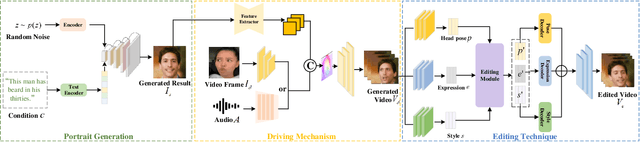

Talking head synthesis, an advanced method for generating portrait videos from a still image driven by specific content, has garnered widespread attention in virtual reality, augmented reality and game production. Recently, significant breakthroughs have been made with the introduction of novel models such as the transformer and the diffusion model. Current methods can not only generate new content but also edit the generated material. This survey systematically reviews the technology, categorizing it into three pivotal domains: portrait generation, driven mechanisms, and editing techniques. We summarize milestone studies and critically analyze their innovations and shortcomings within each domain. Additionally, we organize an extensive collection of datasets and provide a thorough performance analysis of current methodologies based on various evaluation metrics, aiming to furnish a clear framework and robust data support for future research. Finally, we explore application scenarios of talking head synthesis, illustrate them with specific cases, and examine potential future directions.