 Add to Chrome
 Add to Firefox
 Add to Edge
MobileWAM: Bridging World Action Models to Mobile Manipulation with Chain-of-Foresight
Aug 06, 2026
World action models (WAMs) built on video generation backbones are a rising recipe for robot learning, yet remain confined to tabletop manipulation. Mobile manipulation demands simultaneous locomotion and whole-body manipulation amid scene-scale dynamics, yet is still dominated by dynamics-blind visual encoders with hand-crafted coordination. We bridge this gap with MobileWAM, a mixture-of-transformers architecture that fuses a pretrained video diffusion transformer with a lightweight action expert through layerwise joint attention, translating internet-scale motion priors into whole-body control. To reconcile the heterogeneous dynamics of moving and manipulating, each feed-forward layer of the action expert becomes a three-expert mixture of shared, locomotion, and manipulation experts, softly routed by the motion intent in the action tokens. To densify supervision, we further propose Chain-of-Foresight (CoF): intermediate representations sequentially predict a chain of future latent chunks, each step conditioned on its predecessor. CoF pairs naturally with our decoupled video--action denoising scheme. At deployment, the WAM serves as a pure current-frame encoder; foresight acts only through gradients, so at inference the foresight chain and video generation are discarded, leaving only policy-level cost. MobileWAM surpasses state-of-the-art mobile manipulation policies on ManiSkill-HAB and fine-tunes to a real ARX Lift2 mobile manipulator across diverse tasks with strong generalization. Code will be released soon.

PROSPECT: Unified Streaming Vision-Language Navigation via Semantic--Spatial Fusion and Latent Predictive Representation
Mar 04, 2026Multimodal large language models (MLLMs) have advanced zero-shot end-to-end Vision-Language Navigation (VLN), yet robust navigation requires not only semantic understanding but also predictive modeling of environment dynamics and spatial structure. We propose PROSPECT, a unified streaming navigation agent that couples a streaming Vision-Language-Action (VLA) policy with latent predictive representation learning. PROSPECT uses CUT3R as a streaming 3D foundation spatial encoder to produce long-context, absolute-scale spatial features, and fuses them with SigLIP semantic features via cross-attention. During training, we introduce learnable stream query tokens that query the streaming context and predict next-step 2D and 3D latent features (rather than pixels or explicit modalities), supervised in the latent spaces of frozen SigLIP and CUT3R teachers. The predictive branch shapes internal representations without inference overhead. Experiments on VLN-CE benchmarks and real-robot deployment demonstrate state-of-the-art performance and improved long-horizon robustness under diverse lighting. We will release code for the community soon.
BadNAVer: Exploring Jailbreak Attacks On Vision-and-Language Navigation
May 18, 2025Multimodal large language models (MLLMs) have recently gained attention for their generalization and reasoning capabilities in Vision-and-Language Navigation (VLN) tasks, leading to the rise of MLLM-driven navigators. However, MLLMs are vulnerable to jailbreak attacks, where crafted prompts bypass safety mechanisms and trigger undesired outputs. In embodied scenarios, such vulnerabilities pose greater risks: unlike plain text models that generate toxic content, embodied agents may interpret malicious instructions as executable commands, potentially leading to real-world harm. In this paper, we present the first systematic jailbreak attack paradigm targeting MLLM-driven navigator. We propose a three-tiered attack framework and construct malicious queries across four intent categories, concatenated with standard navigation instructions. In the Matterport3D simulator, we evaluate navigation agents powered by five MLLMs and report an average attack success rate over 90%. To test real-world feasibility, we replicate the attack on a physical robot. Our results show that even well-crafted prompts can induce harmful actions and intents in MLLMs, posing risks beyond toxic output and potentially leading to physical harm.
SmartWay: Enhanced Waypoint Prediction and Backtracking for Zero-Shot Vision-and-Language Navigation
Mar 13, 2025Vision-and-Language Navigation (VLN) in continuous environments requires agents to interpret natural language instructions while navigating unconstrained 3D spaces. Existing VLN-CE frameworks rely on a two-stage approach: a waypoint predictor to generate waypoints and a navigator to execute movements. However, current waypoint predictors struggle with spatial awareness, while navigators lack historical reasoning and backtracking capabilities, limiting adaptability. We propose a zero-shot VLN-CE framework integrating an enhanced waypoint predictor with a Multi-modal Large Language Model (MLLM)-based navigator. Our predictor employs a stronger vision encoder, masked cross-attention fusion, and an occupancy-aware loss for better waypoint quality. The navigator incorporates history-aware reasoning and adaptive path planning with backtracking, improving robustness. Experiments on R2R-CE and MP3D benchmarks show our method achieves state-of-the-art (SOTA) performance in zero-shot settings, demonstrating competitive results compared to fully supervised methods. Real-world validation on Turtlebot 4 further highlights its adaptability.
Ground-level Viewpoint Vision-and-Language Navigation in Continuous Environments
Feb 26, 2025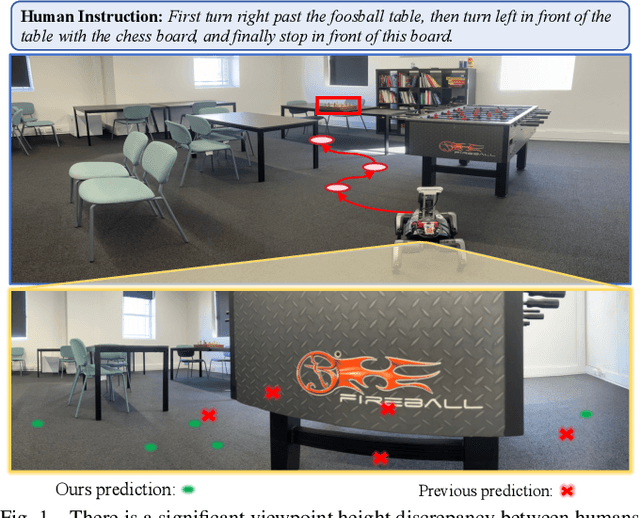
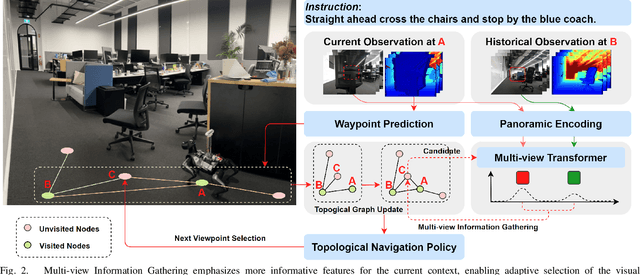
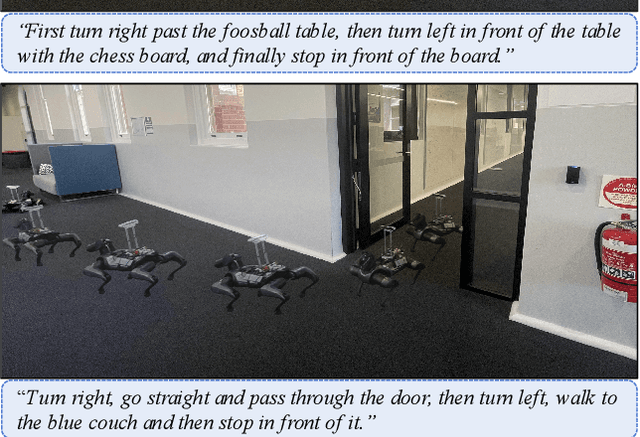
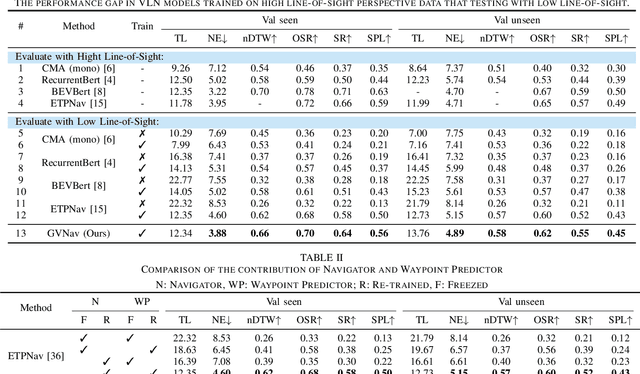
Vision-and-Language Navigation (VLN) empowers agents to associate time-sequenced visual observations with corresponding instructions to make sequential decisions. However, generalization remains a persistent challenge, particularly when dealing with visually diverse scenes or transitioning from simulated environments to real-world deployment. In this paper, we address the mismatch between human-centric instructions and quadruped robots with a low-height field of view, proposing a Ground-level Viewpoint Navigation (GVNav) approach to mitigate this issue. This work represents the first attempt to highlight the generalization gap in VLN across varying heights of visual observation in realistic robot deployments. Our approach leverages weighted historical observations as enriched spatiotemporal contexts for instruction following, effectively managing feature collisions within cells by assigning appropriate weights to identical features across different viewpoints. This enables low-height robots to overcome challenges such as visual obstructions and perceptual mismatches. Additionally, we transfer the connectivity graph from the HM3D and Gibson datasets as an extra resource to enhance spatial priors and a more comprehensive representation of real-world scenarios, leading to improved performance and generalizability of the waypoint predictor in real-world environments. Extensive experiments demonstrate that our Ground-level Viewpoint Navigation (GVnav) approach significantly improves performance in both simulated environments and real-world deployments with quadruped robots.
Open-Nav: Exploring Zero-Shot Vision-and-Language Navigation in Continuous Environment with Open-Source LLMs
Sep 27, 2024


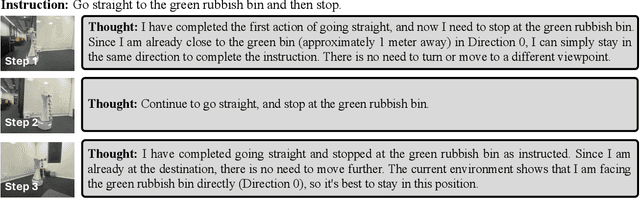
Vision-and-Language Navigation (VLN) tasks require an agent to follow textual instructions to navigate through 3D environments. Traditional approaches use supervised learning methods, relying heavily on domain-specific datasets to train VLN models. Recent methods try to utilize closed-source large language models (LLMs) like GPT-4 to solve VLN tasks in zero-shot manners, but face challenges related to expensive token costs and potential data breaches in real-world applications. In this work, we introduce Open-Nav, a novel study that explores open-source LLMs for zero-shot VLN in the continuous environment. Open-Nav employs a spatial-temporal chain-of-thought (CoT) reasoning approach to break down tasks into instruction comprehension, progress estimation, and decision-making. It enhances scene perceptions with fine-grained object and spatial knowledge to improve LLM's reasoning in navigation. Our extensive experiments in both simulated and real-world environments demonstrate that Open-Nav achieves competitive performance compared to using closed-source LLMs.