 Add to Chrome
 Add to Firefox
 Add to Edge
Adv-Inpainting: Generating Natural and Transferable Adversarial Patch via Attention-guided Feature Fusion
Aug 10, 2023
The rudimentary adversarial attacks utilize additive noise to attack facial recognition (FR) models. However, because manipulating the total face is impractical in the physical setting, most real-world FR attacks are based on adversarial patches, which limit perturbations to a small area. Previous adversarial patch attacks often resulted in unnatural patterns and clear boundaries that were easily noticeable. In this paper, we argue that generating adversarial patches with plausible content can result in stronger transferability than using additive noise or directly sampling from the latent space. To generate natural-looking and highly transferable adversarial patches, we propose an innovative two-stage coarse-to-fine attack framework called Adv-Inpainting. In the first stage, we propose an attention-guided StyleGAN (Att-StyleGAN) that adaptively combines texture and identity features based on the attention map to generate high-transferable and natural adversarial patches. In the second stage, we design a refinement network with a new boundary variance loss to further improve the coherence between the patch and its surrounding area. Experiment results demonstrate that Adv-Inpainting is stealthy and can produce adversarial patches with stronger transferability and improved visual quality than previous adversarial patch attacks.

AdvDiff: Generating Unrestricted Adversarial Examples using Diffusion Models
Jul 24, 2023Unrestricted adversarial attacks present a serious threat to deep learning models and adversarial defense techniques. They pose severe security problems for deep learning applications because they can effectively bypass defense mechanisms. However, previous attack methods often utilize Generative Adversarial Networks (GANs), which are not theoretically provable and thus generate unrealistic examples by incorporating adversarial objectives, especially for large-scale datasets like ImageNet. In this paper, we propose a new method, called AdvDiff, to generate unrestricted adversarial examples with diffusion models. We design two novel adversarial guidance techniques to conduct adversarial sampling in the reverse generation process of diffusion models. These two techniques are effective and stable to generate high-quality, realistic adversarial examples by integrating gradients of the target classifier interpretably. Experimental results on MNIST and ImageNet datasets demonstrate that AdvDiff is effective to generate unrestricted adversarial examples, which outperforms GAN-based methods in terms of attack performance and generation quality.
Fast Continual Multi-View Clustering with Incomplete Views
Jun 04, 2023


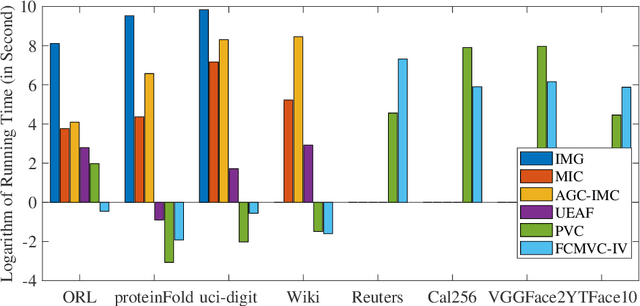
Multi-view clustering (MVC) has gained broad attention owing to its capacity to exploit consistent and complementary information across views. This paper focuses on a challenging issue in MVC called the incomplete continual data problem (ICDP). In specific, most existing algorithms assume that views are available in advance and overlook the scenarios where data observations of views are accumulated over time. Due to privacy considerations or memory limitations, previous views cannot be stored in these situations. Some works are proposed to handle it, but all fail to address incomplete views. Such an incomplete continual data problem (ICDP) in MVC is tough to solve since incomplete information with continual data increases the difficulty of extracting consistent and complementary knowledge among views. We propose Fast Continual Multi-View Clustering with Incomplete Views (FCMVC-IV) to address it. Specifically, it maintains a consensus coefficient matrix and updates knowledge with the incoming incomplete view rather than storing and recomputing all the data matrices. Considering that the views are incomplete, the newly collected view might contain samples that have yet to appear; two indicator matrices and a rotation matrix are developed to match matrices with different dimensions. Besides, we design a three-step iterative algorithm to solve the resultant problem in linear complexity with proven convergence. Comprehensive experiments on various datasets show the superiority of FCMVC-IV.
Table Detection for Visually Rich Document Images
May 30, 2023
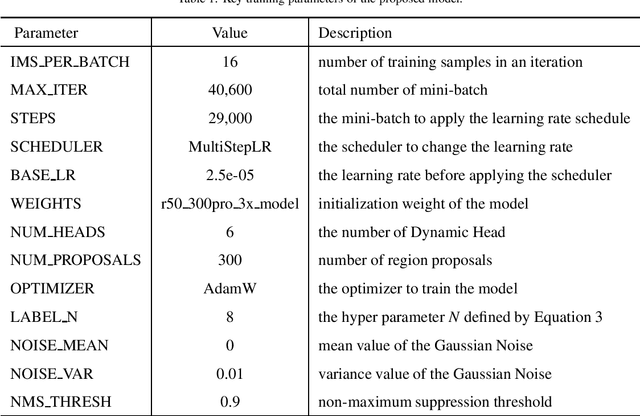

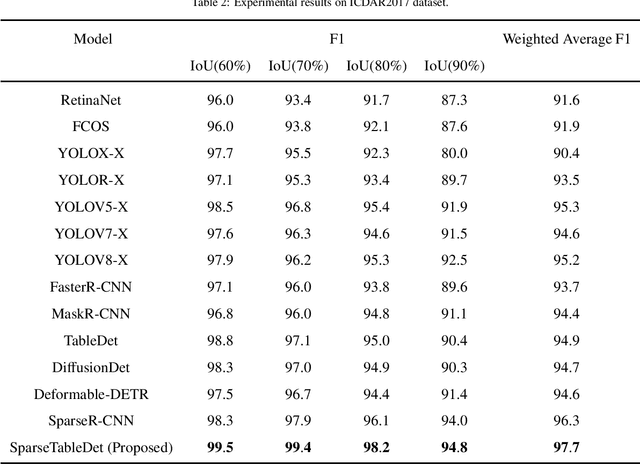
Table Detection (TD) is a fundamental task towards visually rich document understanding. Current studies usually formulate the TD problem as an object detection problem, then leverage Intersection over Union (IoU) based metrics to evaluate the model performance and IoU-based loss functions to optimize the model. TD applications usually require the prediction results to cover all the table contents and avoid information loss. However, IoU and IoU-based loss functions cannot directly reflect the degree of information loss for the prediction results. Therefore, we propose to decouple IoU into a ground truth coverage term and a prediction coverage term, in which the former can be used to measure the information loss of the prediction results. Besides, tables in the documents are usually large, sparsely distributed, and have no overlaps because they are designed to summarize essential information to make it easy to read and interpret for human readers. Therefore, in this study, we use SparseR-CNN as the base model, and further improve the model by using Gaussian Noise Augmented Image Size region proposals and many-to-one label assignments. To demonstrate the effectiveness of proposed method and compare with state-of-the-art methods fairly, we conduct experiments and use IoU-based evaluation metrics to evaluate the model performance. The experimental results show that the proposed method can consistently outperform state-of-the-art methods under different IoU-based metric on a variety of datasets. We conduct further experiments to show the superiority of the proposed decoupled IoU for the TD applications by replacing the IoU-based loss functions and evaluation metrics with proposed decoupled IoU counterparts. The experimental results show that our proposed decoupled IoU loss can encourage the model to alleviate information loss.
i-Code V2: An Autoregressive Generation Framework over Vision, Language, and Speech Data
May 21, 2023
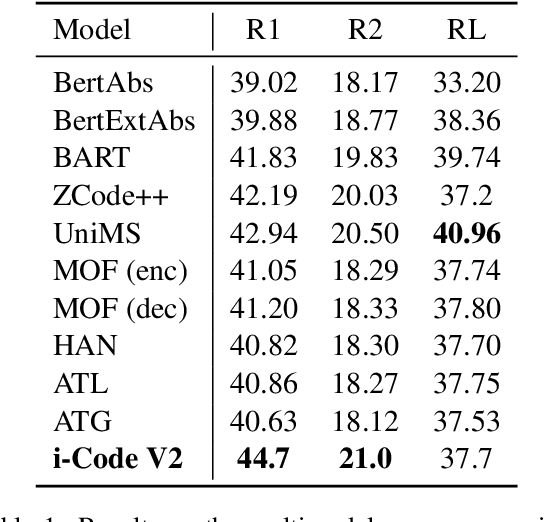
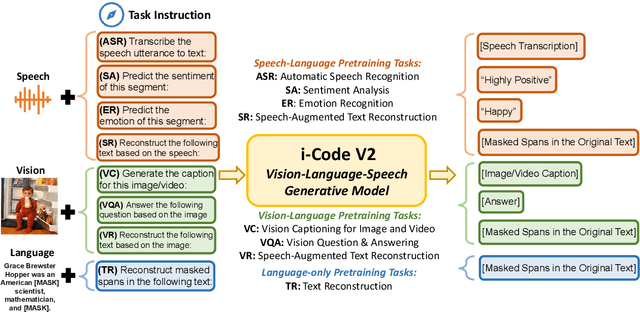
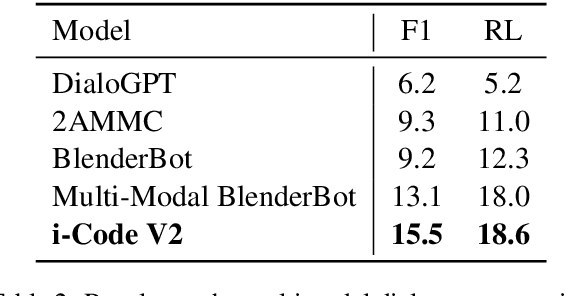
The convergence of text, visual, and audio data is a key step towards human-like artificial intelligence, however the current Vision-Language-Speech landscape is dominated by encoder-only models which lack generative abilities. We propose closing this gap with i-Code V2, the first model capable of generating natural language from any combination of Vision, Language, and Speech data. i-Code V2 is an integrative system that leverages state-of-the-art single-modality encoders, combining their outputs with a new modality-fusing encoder in order to flexibly project combinations of modalities into a shared representational space. Next, language tokens are generated from these representations via an autoregressive decoder. The whole framework is pretrained end-to-end on a large collection of dual- and single-modality datasets using a novel text completion objective that can be generalized across arbitrary combinations of modalities. i-Code V2 matches or outperforms state-of-the-art single- and dual-modality baselines on 7 multimodal tasks, demonstrating the power of generative multimodal pretraining across a diversity of tasks and signals.
Revisiting Table Detection Datasets for Visually Rich Documents
May 04, 2023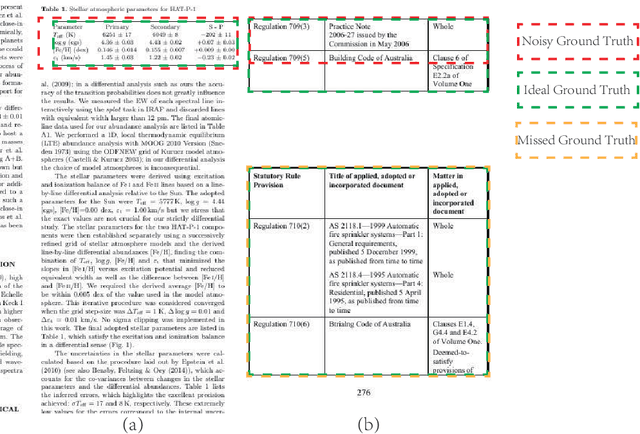
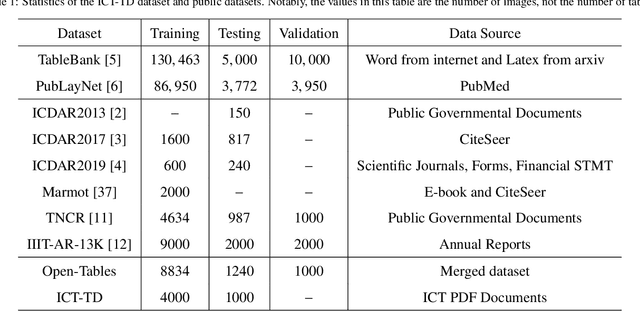
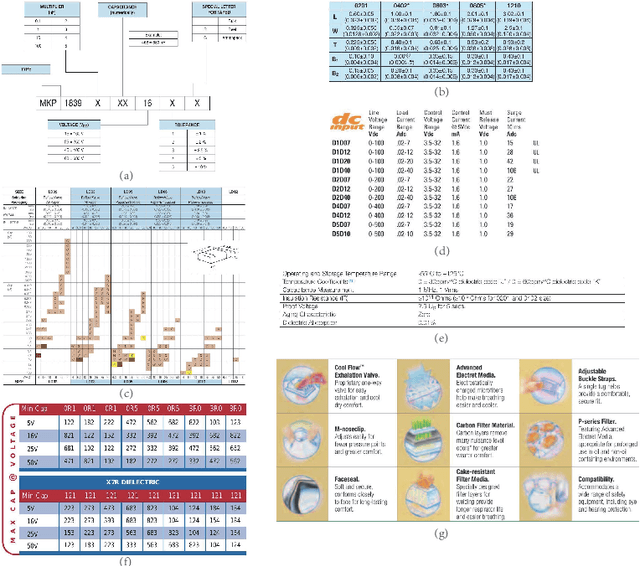
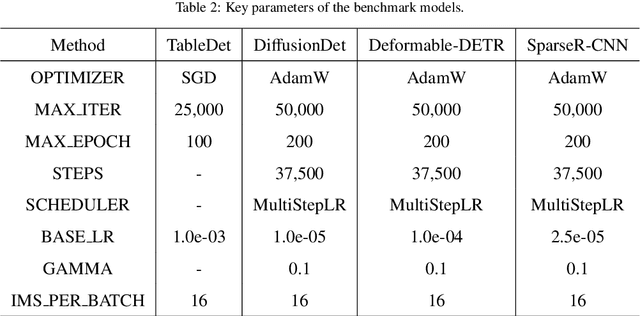
Table Detection has become a fundamental task for visually rich document understanding with the surging number of electronic documents. There have been some open datasets widely used in many studies. However, popular available datasets have some inherent limitations, including the noisy and inconsistent samples, and the limit number of training samples, and the limit number of data-sources. These limitations make these datasets unreliable to evaluate the model performance and cannot reflect the actual capacity of models. Therefore, in this paper, we revisit some open datasets with high quality of annotations, identify and clean the noise, and align the annotation definitions of these datasets to merge a larger dataset, termed with Open-Tables. Moreover, to enrich the data sources, we propose a new dataset, termed with ICT-TD, using the PDF files of Information and communication technologies (ICT) commodities which is a different domain containing unique samples that hardly appear in open datasets. To ensure the label quality of the dataset, we annotated the dataset manually following the guidance of a domain expert. The proposed dataset has a larger intra-variance and smaller inter-variance, making it more challenging and can be a sample of actual cases in the business context. We built strong baselines using various state-of-the-art object detection models and also built the baselines in the cross-domain setting. Our experimental results show that the domain difference among existing open datasets are small, even they have different data-sources. Our proposed Open-tables and ICT-TD are more suitable for the cross domain setting, and can provide more reliable evaluation for model because of their high quality and consistent annotations.
StyLess: Boosting the Transferability of Adversarial Examples
Apr 23, 2023Adversarial attacks can mislead deep neural networks (DNNs) by adding imperceptible perturbations to benign examples. The attack transferability enables adversarial examples to attack black-box DNNs with unknown architectures or parameters, which poses threats to many real-world applications. We find that existing transferable attacks do not distinguish between style and content features during optimization, limiting their attack transferability. To improve attack transferability, we propose a novel attack method called style-less perturbation (StyLess). Specifically, instead of using a vanilla network as the surrogate model, we advocate using stylized networks, which encode different style features by perturbing an adaptive instance normalization. Our method can prevent adversarial examples from using non-robust style features and help generate transferable perturbations. Comprehensive experiments show that our method can significantly improve the transferability of adversarial examples. Furthermore, our approach is generic and can outperform state-of-the-art transferable attacks when combined with other attack techniques.
SARF: Aliasing Relation Assisted Self-Supervised Learning for Few-shot Relation Reasoning
Apr 20, 2023Few-shot relation reasoning on knowledge graphs (FS-KGR) aims to infer long-tail data-poor relations, which has drawn increasing attention these years due to its practicalities. The pre-training of previous methods needs to manually construct the meta-relation set, leading to numerous labor costs. Self-supervised learning (SSL) is treated as a solution to tackle the issue, but still at an early stage for FS-KGR task. Moreover, most of the existing methods ignore leveraging the beneficial information from aliasing relations (AR), i.e., data-rich relations with similar contextual semantics to the target data-poor relation. Therefore, we proposed a novel Self-Supervised Learning model by leveraging Aliasing Relations to assist FS-KGR, termed SARF. Concretely, four main components are designed in our model, i.e., SSL reasoning module, AR-assisted mechanism, fusion module, and scoring function. We first generate the representation of the co-occurrence patterns in a generative manner. Meanwhile, the representations of aliasing relations are learned to enhance reasoning in the AR-assist mechanism. Besides, multiple strategies, i.e., simple summation and learnable fusion, are offered for representation fusion. Finally, the generated representation is used for scoring. Extensive experiments on three few-shot benchmarks demonstrate that SARF achieves state-of-the-art performance compared with other methods in most cases.
DAA: A Delta Age AdaIN operation for age estimation via binary code transformer
Mar 14, 2023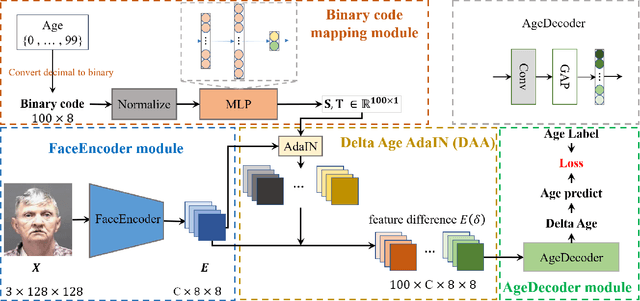
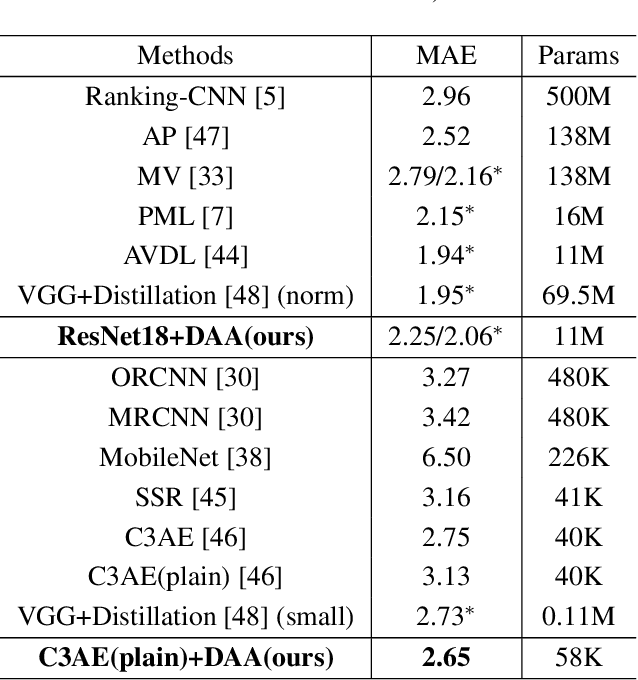
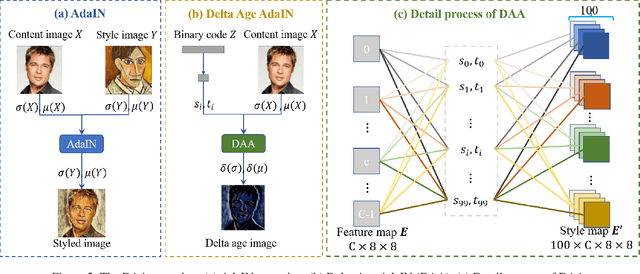
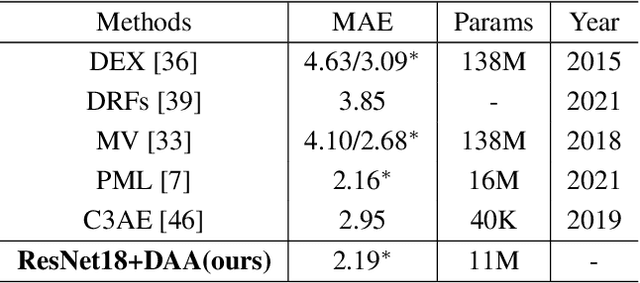
Naked eye recognition of age is usually based on comparison with the age of others. However, this idea is ignored by computer tasks because it is difficult to obtain representative contrast images of each age. Inspired by the transfer learning, we designed the Delta Age AdaIN (DAA) operation to obtain the feature difference with each age, which obtains the style map of each age through the learned values representing the mean and standard deviation. We let the input of transfer learning as the binary code of age natural number to obtain continuous age feature information. The learned two groups of values in Binary code mapping are corresponding to the mean and standard deviation of the comparison ages. In summary, our method consists of four parts: FaceEncoder, DAA operation, Binary code mapping, and AgeDecoder modules. After getting the delta age via AgeDecoder, we take the average value of all comparison ages and delta ages as the predicted age. Compared with state-of-the-art methods, our method achieves better performance with fewer parameters on multiple facial age datasets.
Revisiting Initializing Then Refining: An Incomplete and Missing Graph Imputation Network
Feb 15, 2023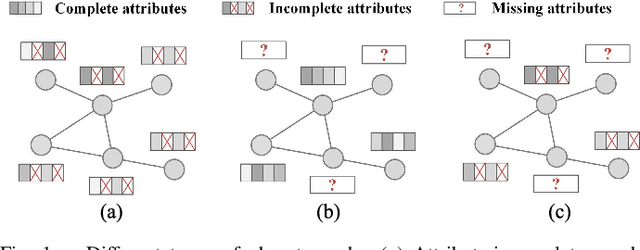
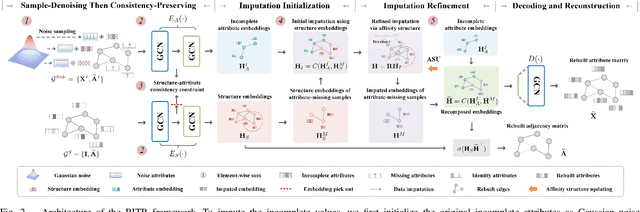
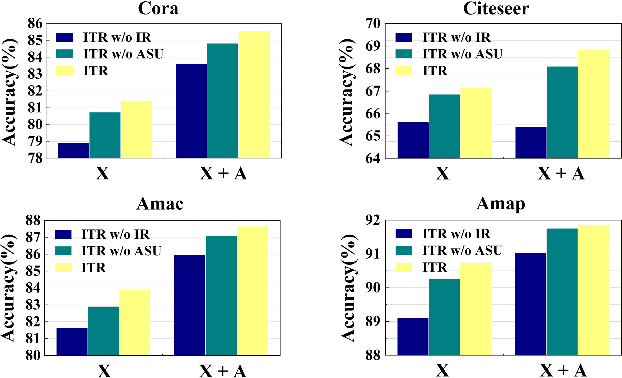
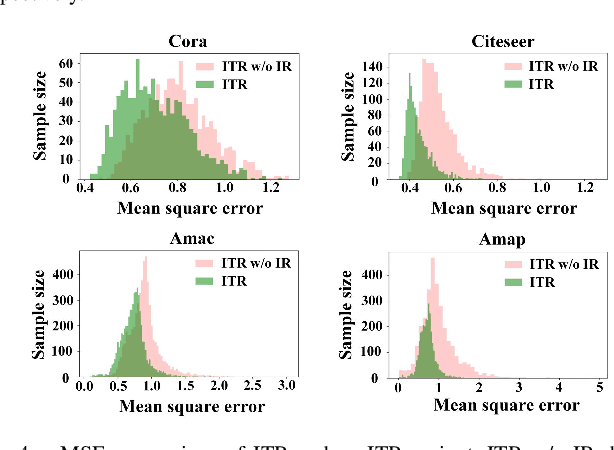
With the development of various applications, such as social networks and knowledge graphs, graph data has been ubiquitous in the real world. Unfortunately, graphs usually suffer from being absent due to privacy-protecting policies or copyright restrictions during data collection. The absence of graph data can be roughly categorized into attribute-incomplete and attribute-missing circumstances. Specifically, attribute-incomplete indicates that a part of the attribute vectors of all nodes are incomplete, while attribute-missing indicates that the whole attribute vectors of partial nodes are missing. Although many efforts have been devoted, none of them is custom-designed for a common situation where both types of graph data absence exist simultaneously. To fill this gap, we develop a novel network termed Revisiting Initializing Then Refining (RITR), where we complete both attribute-incomplete and attribute-missing samples under the guidance of a novel initializing-then-refining imputation criterion. Specifically, to complete attribute-incomplete samples, we first initialize the incomplete attributes using Gaussian noise before network learning, and then introduce a structure-attribute consistency constraint to refine incomplete values by approximating a structure-attribute correlation matrix to a high-order structural matrix. To complete attribute-missing samples, we first adopt structure embeddings of attribute-missing samples as the embedding initialization, and then refine these initial values by adaptively aggregating the reliable information of attribute-incomplete samples according to a dynamic affinity structure. To the best of our knowledge, this newly designed method is the first unsupervised framework dedicated to handling hybrid-absent graphs. Extensive experiments on four datasets have verified that our methods consistently outperform existing state-of-the-art competitors.