 Add to Chrome
 Add to Firefox
 Add to Edge
Structure-Internalized Rule Language Model for Faithful Knowledge Graph Reasoning
Aug 18, 2026
Knowledge Graph Reasoning (KGR) aims to discover latent facts by leveraging the structural evidence available in KGs, posing a challenge to the structural semantic understanding capability of KGR models. Recent studies have demonstrated that Large Language Models (LLMs) can achieve remarkable progress on KGR tasks via flexible in-context learning. However, the inherent representation inconsistency between KG structural context and LLM parametric knowledge remains inadequately addressed. This limitation prevents LLMs from effectively perceiving reasoning evidence that aligns with KG constraints, which undermines both the effectiveness and faithfulness of reasoning. We refer to this problem as reasoning evidence perception drift of LLMs over KGs. To address this problem, we propose a Structure-Internalized Rule Language Model (SIRLM), which centers on structural rule generation to couple the parametric learning of structural knowledge with the faithfulness evaluation of reasoning logic, enabling LLMs to anchor tightly to KG-grounded evidence. Specifically, we first design a Structure-Internalized Rule Generator (SIRG), which incorporates an in-context learning block augmented with a structural relation memory to coordinate structural and parametric knowledge. Furthermore, we equip SIRG with a KG tokenizer based on structural invariance learning and a neuro-symbolic reasoner based on rule-constrained message propagation. These components provide SIRG with learnable structural representations and faithful rule-execution feedback, respectively. Our SIRLM can be seamlessly integrated into standard LLM training paradigms, such as SFT and GRPO. Extensive experiments against 17 state-of-the-art KGR methods on 36 datasets demonstrate the significant superiority of SIRLM.

Trajectory-Guided Forget-Recover Network for Continual LLM Unlearning
Aug 04, 2026Machine unlearning aims to eliminate the influence of sensitive data on a model. In the real world, unlearning requests arrive continually, which gives rise to two challenges. First, an unlearning intervention may redistribute target-related computation across remaining pathways, allowing previously forgotten knowledge to re-emerge. Second, repeated unlearning interventions may progressively reduce the model capacity needed to preserve retained utility. To address these challenges, we propose the Trajectory-guided Forget-Recover Network (TFR-Net). TFR-Net tracks channel-level risk across requests. It separates persistent target-related channels from transient hotspots and suppresses only the persistent ones. TFR-Net also recovers model capacity by reactivating dormant channels. These channels make strong contributions to retained utility and show low current and historical forget risk. The recovery is accepted only when retained-utility degradation remains within a predefined tolerance. Experiments on four datasets show that TFR-Net consistently achieves a more favorable trade-off between unlearning effectiveness and retained utility than representative baselines.
ProPRL: Property-Aware Prerequisite Relation Learning in Educational Knowledge Graphs
Aug 04, 2026Prerequisite relation learning is central to adaptive instruction, yet existing methods often formulate it as conventional link prediction, limiting their ability to adaptively integrate complementary educational evidence for individual candidate pairs and to discourage contradictory reverse predictions. We propose ProPRL, a Property-aware Prerequisite Relation Learning framework. ProPRL first learns complementary concept representations from a concept-resource hypergraph and a directed learning-behavior graph, where direction-preserving personalized propagation aggregates multi-hop behavioral evidence. It then employs a Pair-conditioned Gate to adaptively weight and fuse the two views for each candidate ordered concept pair. Finally, an \textit{Irreversibility Constraint} introduces an anti-symmetry regularizer that penalizes simultaneously high confidence in both directions of the same concept pair. Experiments on multiple real-world educational datasets show that ProPRL achieves state-of-the-art performance on prerequisite relation learning.
CAGE: Cognitive Attribution Graphs for Faithful Inline Citation Generation in Long-Form Question Answering
Jul 27, 2026Long-form question answering increasingly relies on retrieved evidence to make LLM outputs verifiable, with inline citations tracing claims to source documents. However, existing systems often attach citations that are topically related but insufficient to support their claims. We identify attribution ambiguity as a structural challenge: end-to-end generation must implicitly resolve combinatorial claim--document assignments, obscuring evidential boundaries and increasing the risk of evidence-boundary overrun, where claims exceed cited support. To address this challenge, we propose CAGE (Cognitive Attribution Graphs for Citation Generation), a two-stage framework that introduces an explicit cognitive attribution map before answer generation. CAGE first trains a plug-and-play Cognitive Map Induction Model to construct answer-centered support subgraphs, aligning each semantic answer unit with supporting documents through explicit relations. A Structured Citation Reasoning Model then realizes these units as sentence-level claims with map-aligned citations. Experiments on ASQA, ELI5, and ExpertQA show that CAGE achieves state-of-the-art performance, demonstrating the effectiveness of attribution-space contraction and map-guided citation generation.
AnchorRefine: Synergy-Manipulation Based on Trajectory Anchor and Residual Refinement for Vision-Language-Action Models
Apr 20, 2026Precision-critical manipulation requires both global trajectory organization and local execution correction, yet most vision-language-action (VLA) policies generate actions within a single unified space. This monolithic formulation forces macro-level transport and micro-level refinement to be optimized under the same objective, causing large motions to dominate learning while suppressing small but failure-critical corrective signals. In contrast, human manipulation is structured by global movement planning together with continuous local adjustment during execution. Motivated by this principle, we propose AnchorRefine, a hierarchical framework that factorizes VLA action modeling into trajectory anchor and residual refinement. The anchor planner predicts a coarse motion scaffold, while the refinement module corrects execution-level deviations to improve geometric and contact precision. We further introduce a decision-aware gripper refinement mechanism to better capture the discrete and boundary-sensitive nature of gripper control. Experiments on LIBERO, CALVIN, and real-robot tasks demonstrate that AnchorRefine consistently improves both regression-based and diffusion-based VLA backbones, yielding gains of up to 7.8% in simulation success rate and 18% in real-world success rate.
LogicScore: Fine-grained Logic Evaluation of Conciseness, Completeness, and Determinateness in Attributed Question Answering
Jan 22, 2026Current evaluation methods for Attributed Question Answering (AQA) suffer from \textit{attribution myopia}: they emphasize verification of isolated statements and their attributions but overlook the global logical integrity of long-form answers. Consequently, Large Language Models (LLMs) often produce factually grounded yet logically incoherent responses with elusive deductive gaps. To mitigate this limitation, we present \textsc{LogicScore}, a unified evaluation framework that shifts the paradigm from local assessment to global reasoning scrutiny. Grounded in Horn Rules, our approach integrates a backward verification mechanism to systematically evaluate three key reasoning dimensions: \textit{Completeness} (logically sound deduction), \textit{Conciseness} (non-redundancy), and \textit{Determinateness} (consistent answer entailment). Extensive experiments across three multi-hop QA datasets (HotpotQA, MusiQue, and 2WikiMultiHopQA) and over 20 LLMs (including GPT-5, Gemini-3-Pro, LLaMA3, and task-specific tuned models) reveal a critical capability gap: leading models often achieve high attribution scores (e.g., 92.85\% precision for Gemini-3 Pro) but struggle with global reasoning quality (e.g., 35.11\% Conciseness for Gemini-3 Pro). Our work establishes a robust standard for logical evaluation, highlighting the need to prioritize reasoning coherence alongside factual grounding in LLM development. Codes are available at: https://github.com/zhichaoyan11/LogicScore.
Knowledge Restoration-driven Prompt Optimization: Unlocking LLM Potential for Open-Domain Relational Triplet Extraction
Jan 21, 2026Open-domain Relational Triplet Extraction (ORTE) is the foundation for mining structured knowledge without predefined schemas. Despite the impressive in-context learning capabilities of Large Language Models (LLMs), existing methods are hindered by their reliance on static, heuristic-driven prompting strategies. Due to the lack of reflection mechanisms required to internalize erroneous signals, these methods exhibit vulnerability in semantic ambiguity, often making erroneous extraction patterns permanent. To address this bottleneck, we propose a Knowledge Reconstruction-driven Prompt Optimization (KRPO) framework to assist LLMs in continuously improving their extraction capabilities for complex ORTE task flows. Specifically, we design a self-evaluation mechanism based on knowledge restoration, which provides intrinsic feedback signals by projecting structured triplets into semantic consistency scores. Subsequently, we propose a prompt optimizer based on a textual gradient that can internalize historical experiences to iteratively optimize prompts, which can better guide LLMs to handle subsequent extraction tasks. Furthermore, to alleviate relation redundancy, we design a relation canonicalization memory that collects representative relations and provides semantically distinct schemas for the triplets. Extensive experiments across three datasets show that KRPO significantly outperforms strong baselines in the extraction F1 score.
\textsc{LogicScore}: Fine-grained Logic Evaluation of Conciseness, Completeness, and Determinateness in Attributed Question Answering
Jan 21, 2026Current evaluation methods for Attributed Question Answering (AQA) suffer from \textit{attribution myopia}: they emphasize verification of isolated statements and their attributions but overlook the global logical integrity of long-form answers. Consequently, Large Language Models (LLMs) often produce factually grounded yet logically incoherent responses with elusive deductive gaps. To mitigate this limitation, we present \textsc{LogicScore}, a unified evaluation framework that shifts the paradigm from local assessment to global reasoning scrutiny. Grounded in Horn Rules, our approach integrates a backward verification mechanism to systematically evaluate three key reasoning dimensions: \textit{Completeness} (logically sound deduction), \textit{Conciseness} (non-redundancy), and \textit{Determinateness} (consistent answer entailment). Extensive experiments across three multi-hop QA datasets (HotpotQA, MusiQue, and 2WikiMultiHopQA) and over 20 LLMs (including GPT-5, Gemini-3-Pro, LLaMA3, and task-specific tuned models) reveal a critical capability gap: leading models often achieve high attribution scores (e.g., 92.85\% precision for Gemini-3 Pro) but struggle with global reasoning quality (e.g., 35.11\% Conciseness for Gemini-3 Pro). Our work establishes a robust standard for logical evaluation, highlighting the need to prioritize reasoning coherence alongside factual grounding in LLM development. Codes are available at: https://github.com/zhichaoyan11/LogicScore.
Cumulative Path-Level Semantic Reasoning for Inductive Knowledge Graph Completion
Jan 09, 2026Conventional Knowledge Graph Completion (KGC) methods aim to infer missing information in incomplete Knowledge Graphs (KGs) by leveraging existing information, which struggle to perform effectively in scenarios involving emerging entities. Inductive KGC methods can handle the emerging entities and relations in KGs, offering greater dynamic adaptability. While existing inductive KGC methods have achieved some success, they also face challenges, such as susceptibility to noisy structural information during reasoning and difficulty in capturing long-range dependencies in reasoning paths. To address these challenges, this paper proposes the Cumulative Path-Level Semantic Reasoning for inductive knowledge graph completion (CPSR) framework, which simultaneously captures both the structural and semantic information of KGs to enhance the inductive KGC task. Specifically, the proposed CPSR employs a query-dependent masking module to adaptively mask noisy structural information while retaining important information closely related to the targets. Additionally, CPSR introduces a global semantic scoring module that evaluates both the individual contributions and the collective impact of nodes along the reasoning path within KGs. The experimental results demonstrate that CPSR achieves state-of-the-art performance.
Contrastive Learning Meets Pseudo-label-assisted Mixup Augmentation: A Comprehensive Graph Representation Framework from Local to Global
Jan 30, 2025

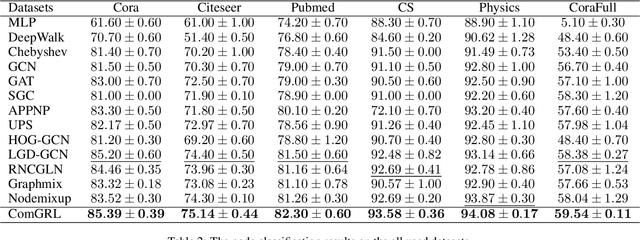

Graph Neural Networks (GNNs) have demonstrated remarkable effectiveness in various graph representation learning tasks. However, most existing GNNs focus primarily on capturing local information through explicit graph convolution, often neglecting global message-passing. This limitation hinders the establishment of a collaborative interaction between global and local information, which is crucial for comprehensively understanding graph data. To address these challenges, we propose a novel framework called Comprehensive Graph Representation Learning (ComGRL). ComGRL integrates local information into global information to derive powerful representations. It achieves this by implicitly smoothing local information through flexible graph contrastive learning, ensuring reliable representations for subsequent global exploration. Then ComGRL transfers the locally derived representations to a multi-head self-attention module, enhancing their discriminative ability by uncovering diverse and rich global correlations. To further optimize local information dynamically under the self-supervision of pseudo-labels, ComGRL employs a triple sampling strategy to construct mixed node pairs and applies reliable Mixup augmentation across attributes and structure for local contrastive learning. This approach broadens the receptive field and facilitates coordination between local and global representation learning, enabling them to reinforce each other. Experimental results across six widely used graph datasets demonstrate that ComGRL achieves excellent performance in node classification tasks. The code could be available at https://github.com/JinluWang1002/ComGRL.