 Add to Chrome
 Add to Firefox
 Add to Edge
FastTPS: An Optimized Method for LLM Token Phase for AI accelerators
Jul 13, 2026
The popularity of large language models (LLMs) escalates an ongoing demand for effective inference. However, due to the sequential processing of tokens during the token phase in decoder-only LLMs inference, the inherent low parallelism leads to reduced throughput and suboptimal utilization of the computing units on artificial intelligence (AI) accelerators, particularly when handling long-sequence inputs that impose significant memory overhead. Recently, many reported methods have been developed as potential solutions, since they emerge with numeric deviation. This paper presents FastTPS, a high performance and low-precision loss method for accelerating the token-phase in LLM inference on general AI accelerators which includes three key components: (1) AI accelerator-enabled reloading-free KV Cache concatenation which decreases memory access overhead as well as enables full fusion of Attention, (2) high-efficiency and high-accuracy 'RoPE' attention based on the tiling optimized FLAT, and (3) highly-fused MLP with fine-grain pipeline scheduling. Our results confirm that FastTPS significantly alleviates memory bottlenecks in the token phase, delivering a 6x speed improvement (compared to none-fusion) on an AMD Ryzen AI 300 series NPU with BF16 precision while sustaining 93% peak memory bandwidth utilization during Phi3-mini-4k-instruct inference.

MINCE: Shrinking LLM Evaluation Datasets via Few-Model Monte Carlo Calibration
Jun 22, 2026Evaluating LLMs across many model variants -- quantized, fine-tuned, or deployment-specific -- requires running large benchmarks repeatedly, a process that can take tens of hours per model on edge hardware such as NPUs. Existing subset selection methods reduce this cost but depend on large calibration pools or learned prediction layers. We introduce MINCE (Monte Carlo Informed N-sizing for Compact Evaluation), which uses Monte Carlo simulation over per-item logs from a small set of calibration models to find the minimum subset size that bounds accuracy drift and then fixes a randomly sampled subset at that size, with no prediction layer needed. MINCE reduces IFEVAL by 54\%, MMLU by 89\%, and GSM8K by 70\% with maximum drift $\leq$2.62\,pp on BF16 models and mean drift of 0.77--3.59\,pp on held-out NPU models, while delivering median GPU evaluation speedups of 2.7--8.1$\times$ and NPU evaluation speedups of 1.7--2.0$\times$. The method is robust to calibration pool size and achieves lower drift than tinyBenchmarks (12$\times$ lower on MMLU, 3.3$\times$ on GSM8K) while using 57$\times$ fewer calibration models.
UltraQuant: 4-bit KV Caching for Context-Heavy Agents
Jun 18, 2026Context-heavy agents place unusual pressure on the key-value (KV) cache: long prefixes are reused across many short turns, while concurrency determines whether the serving system can keep GPUs utilized. We study 4-bit KV-cache compression for this setting, using TurboQuant-style rotation and codebook quantization as a quality anchor and vLLM FP8 KV caching as the deployment anchor. We report three contributions. First, we frame 4-bit KV caching around multi-round agent workloads where task quality, cache residency, and serving throughput must be measured jointly. Second, we describe the practical design choices needed to make the 4-bit path robust, including asymmetric K/V treatment, Walsh-Hadamard rotation, QJL removal, and block-scale variants. Third, we present serving optimizations on AMD GPUs, including optimized decode-attention kernels and UltraQuant, an FP4 approximation path that uses FP8 queries, FP4 KV tensors, UE8M0 group scales, and native scaled-MFMA support on CDNA4. On a long-context, multi-turn agentic workload, UltraQuant cuts P50 time-to-first-token by 3.47x in the cache-pressured late rounds (2.3x across all rounds) and raises output throughput by 1.63x over the FP8 KV baseline.
Recover-LoRA for Aggressive Quantization: Reclaiming Accuracy in 2-Bit Language Models via Low-Rank Adaptation with Knowledge Distillation on Synthetic Data
Jun 02, 2026Aggressive weight quantization to 2-bit precision offers substantial throughput and memory gains for large language model (LLM) inference, but typically incurs severe accuracy degradation. These gains are particularly relevant for edge and on-device deployment, where memory capacity and bandwidth are primary constraints. In this work, we extend Recover-LoRA -- a lightweight, data-free accuracy recovery method originally developed for general model weight corruption -- to the setting of ultra-low-bit quantization. We propose a selective mixed-precision strategy in which only gate and up projection layers of the MLP are quantized to 2-bit (W2), while all other linear layers remain at higher precision, yielding a mixed-precision GateUp configuration. We demonstrate via roofline analysis across three model families (4B--20B) and two hardware platforms that a W4/W2-GateUp deployment (4-bit base with 2-bit gate/up) delivers 7.5--23.3\% TPS improvement over uniform W4 depending on model and context length, while confining quantization error to a predictable subset of layers. We then apply Recover-LoRA -- training low-rank adapters on the quantized layers via logit distillation with synthetic data -- to recover accuracy lost from 2-bit quantization of the gate and up layers. In a case study on Qwen3-4B, Recover-LoRA achieves 80--95\% accuracy recovery on 9 of 12 benchmarks, using only 10k synthetic training samples and no labeled data. We further demonstrate that synthetic data performs comparably to curated labeled data for distillation-based recovery, and that recovery generalizes to out-of-distribution evaluation tasks. Our results present Recover-LoRA as a practical post-quantization accuracy recovery tool for aggressive weight compression in deployment settings.
Privatar: Scalable Privacy-preserving Multi-user VR via Secure Offloading
Apr 19, 2026Multi-user virtual reality enables immersive interaction. However, rendering avatars for numerous participants on each headset incurs prohibitive computational overhead, limiting scalability. We introduce a framework, Privatar, to offload avatar reconstruction from headset to untrusted devices within the same local network while safeguarding attacks against adversaries capable of intercepting offloaded data. Privatar's key insight is that domain-specific knowledge of avatar reconstruction enables provably private offloading at minimal cost. (1) System level. We observe avatar reconstruction is frequency-domain decomposable via BDCT with negligible quality drop, and propose Horizontal Partitioning (HP) to keep high-energy frequency components on-device and offloads only low-energy components. HP offloads local computation while reducing information leakage to low-energy subsets only. (2) Privacy level. For individually offloaded, multi-dimensional signals without aggregation, worst-case local Differential Privacy requires prohibitive noise, ruining utility. We observe users' expression statistical distribution are slowly changing over time and trackable online, and hence propose Distribution-Aware Minimal Perturbation. DAMP minimizes noise based on each user's expression distribution to significantly reduce its effects on utility, retaining formal privacy guarantee. Combined, HP provides empirical privacy against expression identification attacks. DAMP further augments it to offer a formal guarantee against arbitrary adversaries. On a Meta Quest Pro, Privatar supports 2.37x more concurrent users at 6.5% higher reconstruction loss and 9% energy overhead, providing a better throughout-loss Pareto frontier over quantization, sparsity and local construction baselines. Privatar provides both provable privacy guarantee and stays robust against both empirical and NN-based attacks.
SDFP: Speculative Decoding with FIT-Pruned Models for Training-Free and Plug-and-Play LLM Acceleration
Feb 05, 2026Large language models (LLMs) underpin interactive multimedia applications such as captioning, retrieval, recommendation, and creative content generation, yet their autoregressive decoding incurs substantial latency. Speculative decoding reduces latency using a lightweight draft model, but deployment is often limited by the cost and complexity of acquiring, tuning, and maintaining an effective draft model. Recent approaches usually require auxiliary training or specialization, and even training-free methods incur costly search or optimization. We propose SDFP, a fully training-free and plug-and-play framework that builds the draft model via Fisher Information Trace (FIT)-based layer pruning of a given LLM. Using layer sensitivity as a proxy for output perturbation, SDFP removes low-impact layers to obtain a compact draft while preserving compatibility with the original model for standard speculative verification. SDFP needs no additional training, hyperparameter tuning, or separately maintained drafts, enabling rapid, deployment-friendly draft construction. Across benchmarks, SDFP delivers 1.32x-1.5x decoding speedup without altering the target model's output distribution, supporting low-latency multimedia applications.
DiP-GO: A Diffusion Pruner via Few-step Gradient Optimization
Oct 22, 2024
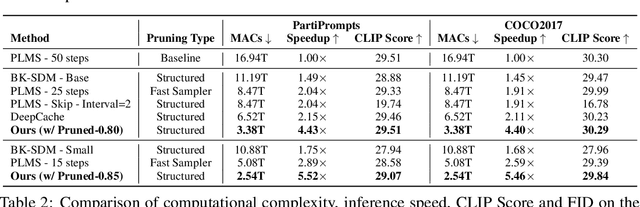

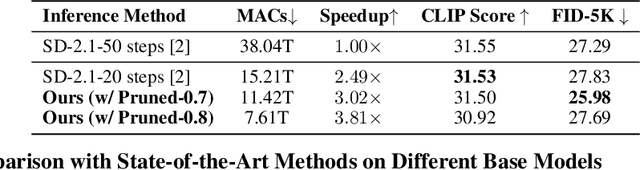
Diffusion models have achieved remarkable progress in the field of image generation due to their outstanding capabilities. However, these models require substantial computing resources because of the multi-step denoising process during inference. While traditional pruning methods have been employed to optimize these models, the retraining process necessitates large-scale training datasets and extensive computational costs to maintain generalization ability, making it neither convenient nor efficient. Recent studies attempt to utilize the similarity of features across adjacent denoising stages to reduce computational costs through simple and static strategies. However, these strategies cannot fully harness the potential of the similar feature patterns across adjacent timesteps. In this work, we propose a novel pruning method that derives an efficient diffusion model via a more intelligent and differentiable pruner. At the core of our approach is casting the model pruning process into a SubNet search process. Specifically, we first introduce a SuperNet based on standard diffusion via adding some backup connections built upon the similar features. We then construct a plugin pruner network and design optimization losses to identify redundant computation. Finally, our method can identify an optimal SubNet through few-step gradient optimization and a simple post-processing procedure. We conduct extensive experiments on various diffusion models including Stable Diffusion series and DiTs. Our DiP-GO approach achieves 4.4 x speedup for SD-1.5 without any loss of accuracy, significantly outperforming the previous state-of-the-art methods.
Enhancing One-shot Pruned Pre-trained Language Models through Sparse-Dense-Sparse Mechanism
Aug 20, 2024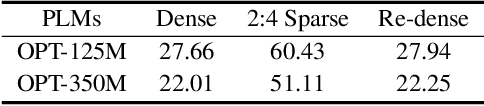
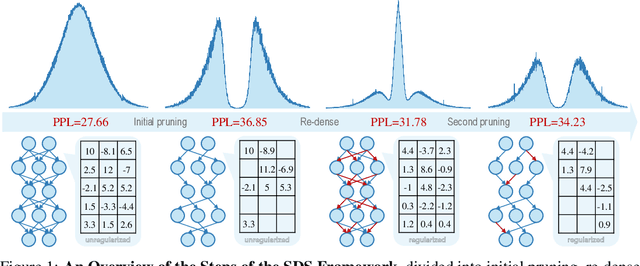
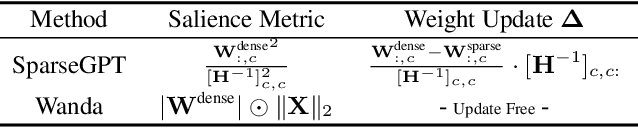
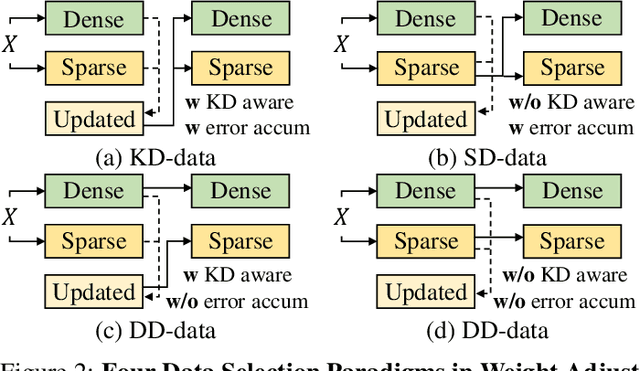
Pre-trained language models (PLMs) are engineered to be robust in contextual understanding and exhibit outstanding performance in various natural language processing tasks. However, their considerable size incurs significant computational and storage costs. Modern pruning strategies employ one-shot techniques to compress PLMs without the need for retraining on task-specific or otherwise general data; however, these approaches often lead to an indispensable reduction in performance. In this paper, we propose SDS, a Sparse-Dense-Sparse pruning framework to enhance the performance of the pruned PLMs from a weight distribution optimization perspective. We outline the pruning process in three steps. Initially, we prune less critical connections in the model using conventional one-shot pruning methods. Next, we reconstruct a dense model featuring a pruning-friendly weight distribution by reactivating pruned connections with sparse regularization. Finally, we perform a second pruning round, yielding a superior pruned model compared to the initial pruning. Experimental results demonstrate that SDS outperforms the state-of-the-art pruning techniques SparseGPT and Wanda under an identical sparsity configuration. For instance, SDS reduces perplexity by 9.13 on Raw-Wikitext2 and improves accuracy by an average of 2.05% across multiple zero-shot benchmarks for OPT-125M with 2:4 sparsity.
Towards Scale-Aware Full Surround Monodepth with Transformers
Jul 15, 2024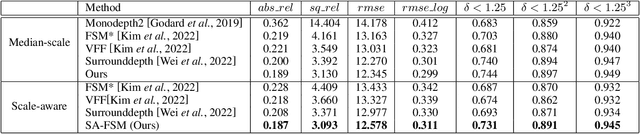
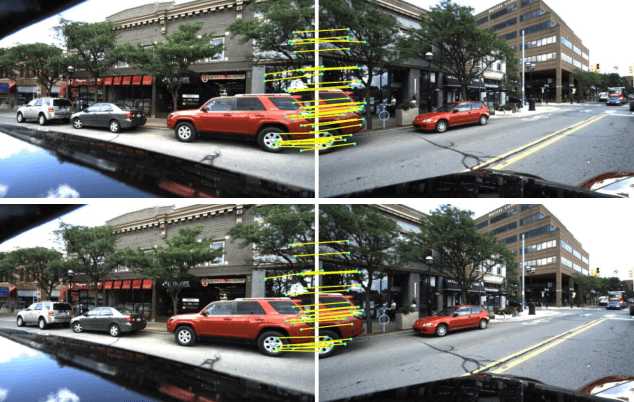


Full surround monodepth (FSM) methods can learn from multiple camera views simultaneously in a self-supervised manner to predict the scale-aware depth, which is more practical for real-world applications in contrast to scale-ambiguous depth from a standalone monocular camera. In this work, we focus on enhancing the scale-awareness of FSM methods for depth estimation. To this end, we propose to improve FSM from two perspectives: depth network structure optimization and training pipeline optimization. First, we construct a transformer-based depth network with neighbor-enhanced cross-view attention (NCA). The cross-attention modules can better aggregate the cross-view context in both global and neighboring views. Second, we formulate a transformer-based feature matching scheme with progressive training to improve the structure-from-motion (SfM) pipeline. That allows us to learn scale-awareness with sufficient matches and further facilitate network convergence by removing mismatches based on SfM loss. Experiments demonstrate that the resulting Scale-aware full surround monodepth (SA-FSM) method largely improves the scale-aware depth predictions without median-scaling at the test time, and performs favorably against the state-of-the-art FSM methods, e.g., surpassing SurroundDepth by 3.8% in terms of accuracy at delta<1.25 on the DDAD benchmark.
Sparse Laneformer
Apr 11, 2024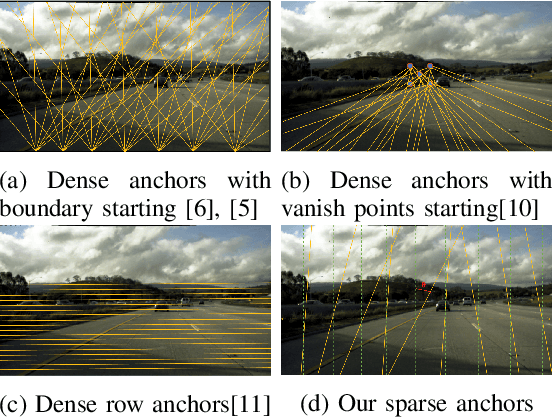
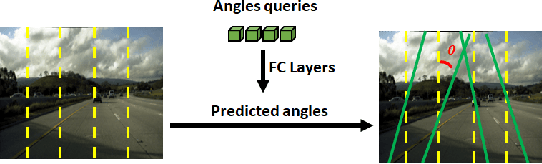
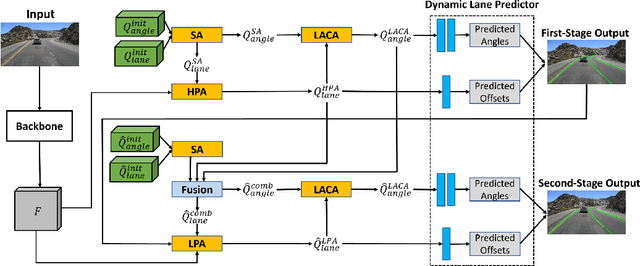

Lane detection is a fundamental task in autonomous driving, and has achieved great progress as deep learning emerges. Previous anchor-based methods often design dense anchors, which highly depend on the training dataset and remain fixed during inference. We analyze that dense anchors are not necessary for lane detection, and propose a transformer-based lane detection framework based on a sparse anchor mechanism. To this end, we generate sparse anchors with position-aware lane queries and angle queries instead of traditional explicit anchors. We adopt Horizontal Perceptual Attention (HPA) to aggregate the lane features along the horizontal direction, and adopt Lane-Angle Cross Attention (LACA) to perform interactions between lane queries and angle queries. We also propose Lane Perceptual Attention (LPA) based on deformable cross attention to further refine the lane predictions. Our method, named Sparse Laneformer, is easy-to-implement and end-to-end trainable. Extensive experiments demonstrate that Sparse Laneformer performs favorably against the state-of-the-art methods, e.g., surpassing Laneformer by 3.0% F1 score and O2SFormer by 0.7% F1 score with fewer MACs on CULane with the same ResNet-34 backbone.