 Add to Chrome
 Add to Firefox
 Add to Edge
Structured Thoughts For Improved Reasoning And Context Pruning
Jul 11, 2026
Large language models (LLMs) excel at generating long chains of thought, but long reasoning traces are often verbose and memory-inefficient. In this work, we introduce Structured Thoughts, a framework that organizes reasoning into alternating <try> and <outcome> blocks: <try> captures exploratory scratch work, while <outcome> contains the distilled conclusion of that step. We construct a dataset of structured thoughts by segmenting reasoning traces into <try> blocks and prompting an LLM to summarize each step into its corresponding <outcome>. Fine-tuning pretrained foundation models on this reformatted data produces models that adopt the structured reasoning style, leading to performance gains of up to 8.08\% on reasoning benchmarks compared to standard SFT. The explicit structure also enables context pruning: after each <try>/<outcome> pair, the <try> can be pruned, allowing the model to retain conclusions without keeping the full scratch work in the context. A proof-of-concept pruning implementation achieves an average of 85\% memory / context savings with an 8.67\% performance drop across mathematical tasks.

Project Auto-World: Towards Automated Benchmarking of Neural Relational Reasoners
Jun 23, 2026Reasoning about relational structures remains a significant challenge for neural models, particularly when they must systematically apply learned knowledge to problem instances that are harder than those seen in training. Progress is hampered by the difficulty of evaluating such generalization, since a priori, it is rarely clear what makes an instance hard. We study how this issue can be addressed by using large language models (LLMs) to automate benchmark generation, learning to produce increasingly challenging instances in an end-to-end manner. Concretely, given a world parametrized by Datalog rules, and an Edge Transformer as the reasoning evaluator, we use LLM-driven evolutionary search (based on FunSearch) and autonomous agentic search to discover sampling functions that yield hard problem instances. We also show that the Edge Transformer can be improved using this data such that it generalizes well to further data perturbations. Finally, we show that the same machinery can be applied to novel worlds proposed by LLMs, opening the door to autonomous research on neural relational reasoning.
T1-Bench: Benchmarking Multi-Scenario Agents in Real-World Domains
Jun 09, 2026Recent advances in reasoning and tool-calling capabilities of large language models (LLMs) have enabled increasingly capable agentic systems. However, existing benchmarks remain limited in task complexity, realism, and domain diversity, and often fail to capture interactions that span multiple domains, limiting their ability to evaluate agents in realistic multi-step settings that require sustained reasoning and coordination. To address these limitations, we introduce T1-Bench, a high-fidelity, comprehensive benchmark for evaluating agentic systems in realistic customer-facing, multi-domain environments, featuring interleaved scenarios that require structured reasoning across multi-turn user-assistant interactions and substantially increasing both compositional complexity and evaluative rigor across 25 domains of varying difficulty. We evaluate T1-Bench using 12 proprietary and open-weight models, providing a reproducible and standardized framework for assessing agent behavior, tool utilization, and conversational quality in complex, multi-step environments. We further complement automatic evaluation with human judgments to strengthen the assessment of qualitative performance. Overall, T1-Bench substantially advances prior benchmarks by increasing task complexity, interaction depth, and domain coverage in simulated multi-domain environments. To facilitate future research on agentic systems, we will publicly release data and evaluation code as open source.
AVSD: Adaptive-View Self-Distillation by Balancing Consensus and Teacher-Specific Privileged Signals
May 20, 2026Self-distillation enables language models to learn on-policy from their own trajectories by using the same model as both student and teacher, with the teacher being conditioned on privileged information unavailable to the student. Such information can come in different types or views, such as solutions, demonstrations, feedback, or final answers. This setup provides dense token-level feedback without relying on a separate external model, but creates a fundamental asymmetry: the teacher may rely on view-specific information that the student cannot access at inference time. Moreover, the best type of privileged information is often task-dependent, making it difficult to choose a single teacher view. In this work, we address both these challenges jointly by introducing AVSD (Adaptive-View Self-Distillation), a novel method of self-distillation with multiple privileged-information views, which reconstructs token-level supervision by separating stable cross-view consensus from view-specific residual signals. AVSD identifies the consensus signal shared across views, which provides a reliable update direction, and then selectively adds the view-specific residual signal to adjust the update magnitude when it both aligns with the consensus direction and remains proportionate to the consensus signal. Experiments on math competition benchmarks (AIME24, AIME25, and HMMT25) show that AVSD consistently outperforms both single-view self-distillation baselines and GRPO, achieving average Avg@8 gains of 3.1% and 2.2% over the strongest baselines on Qwen3-8B and Qwen3-4B, respectively. Moreover, on code-generation benchmarks (Codeforces, LiveCodeBench v6) using Qwen3-8B, AVSD outperforms the single-view self-distillation baseline by 2.4% on average.
Your Model Diversity, Not Method, Determines Reasoning Strategy
Apr 12, 2026Compute scaling for LLM reasoning requires allocating budget between exploring solution approaches ($breadth$) and refining promising solutions ($depth$). Most methods implicitly trade off one for the other, yet why a given trade-off works remains unclear, and validation on a single model obscures the role of the model itself. We argue that $\textbf{the optimal strategy depends on the model's diversity profile, the spread of probability mass across solution approaches, and that this must be characterized before any exploration strategy is adopted.}$ We formalize this through a theoretical framework decomposing reasoning uncertainty and derive conditions under which tree-style depth refinement outperforms parallel sampling. We validate it on Qwen-3 4B and Olmo-3 7B families, showing that lightweight signals suffice for depth-based refinement on low-diversity aligned models while yielding limited utility for high-diversity base models, which we hypothesize require stronger compensation for lower exploration coverage.
Can Large Language Models Understand, Reason About, and Generate Code-Switched Text?
Jan 12, 2026Code-switching is a pervasive phenomenon in multilingual communication, yet the robustness of large language models (LLMs) in mixed-language settings remains insufficiently understood. In this work, we present a comprehensive evaluation of LLM capabilities in understanding, reasoning over, and generating code-switched text. We introduce CodeMixQA a novel benchmark with high-quality human annotations, comprising 16 diverse parallel code-switched language-pair variants that span multiple geographic regions and code-switching patterns, and include both original scripts and their transliterated forms. Using this benchmark, we analyze the reasoning behavior of LLMs on code-switched question-answering tasks, shedding light on how models process and reason over mixed-language inputs. We further conduct a systematic evaluation of LLM-generated synthetic code-switched text, focusing on both naturalness and semantic fidelity, and uncover key limitations in current generation capabilities. Our findings reveal persistent challenges in both reasoning and generation under code-switching conditions and provide actionable insights for building more robust multilingual LLMs. We release the dataset and code as open source.
T1: A Tool-Oriented Conversational Dataset for Multi-Turn Agentic Planning
May 22, 2025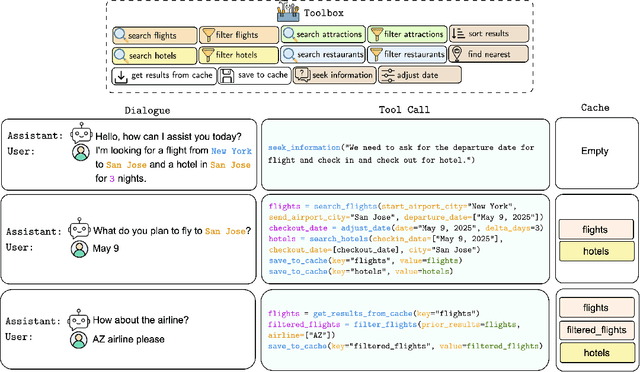
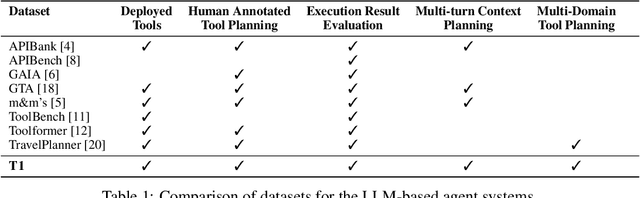
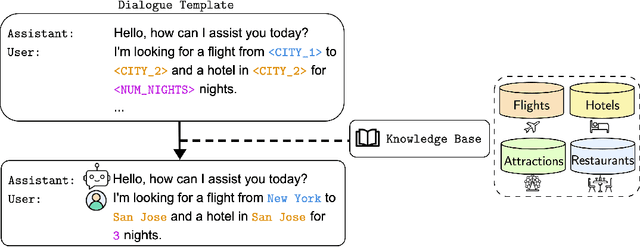

Large Language Models (LLMs) have demonstrated impressive capabilities as intelligent agents capable of solving complex problems. However, effective planning in scenarios involving dependencies between API or tool calls-particularly in multi-turn conversations-remains a significant challenge. To address this, we introduce T1, a tool-augmented, multi-domain, multi-turn conversational dataset specifically designed to capture and manage inter-tool dependencies across diverse domains. T1 enables rigorous evaluation of agents' ability to coordinate tool use across nine distinct domains (4 single domain and 5 multi-domain) with the help of an integrated caching mechanism for both short- and long-term memory, while supporting dynamic replanning-such as deciding whether to recompute or reuse cached results. Beyond facilitating research on tool use and planning, T1 also serves as a benchmark for evaluating the performance of open-source language models. We present results powered by T1-Agent, highlighting their ability to plan and reason in complex, tool-dependent scenarios.
Continual Pre-training of MoEs: How robust is your router?
Mar 06, 2025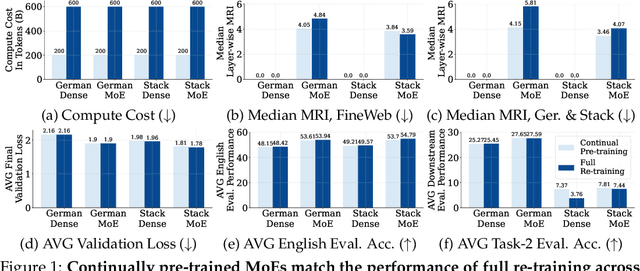
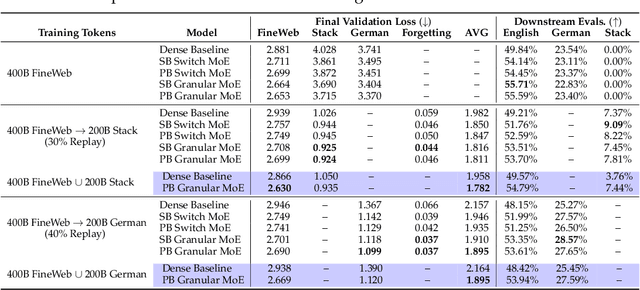
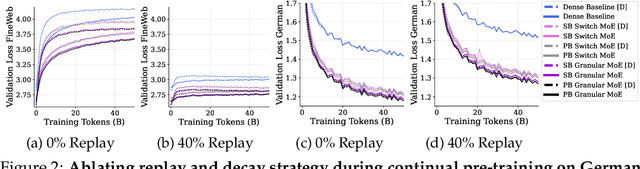
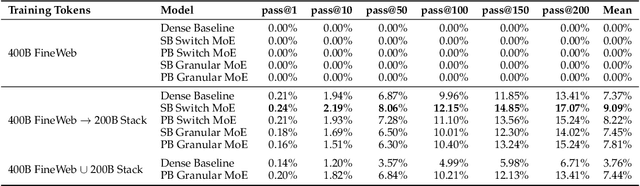
Sparsely-activated Mixture of Experts (MoE) transformers are promising architectures for foundation models. Compared to dense transformers that require the same amount of floating point operations (FLOPs) per forward pass, MoEs benefit from improved sample efficiency at training time and achieve much stronger performance. Many closed-source and open-source frontier language models have thus adopted an MoE architecture. Naturally, practitioners will want to extend the capabilities of these models with large amounts of newly collected data without completely re-training them. Prior work has shown that a simple combination of replay and learning rate re-warming and re-decaying can enable the continual pre-training (CPT) of dense decoder-only transformers with minimal performance degradation compared to full re-training. In the case of decoder-only MoE transformers, however, it is unclear how the routing algorithm will impact continual pre-training performance: 1) do the MoE transformer's routers exacerbate forgetting relative to a dense model?; 2) do the routers maintain a balanced load on previous distributions after CPT?; 3) are the same strategies applied to dense models sufficient to continually pre-train MoE LLMs? In what follows, we conduct a large-scale (>2B parameter switch and DeepSeek MoE LLMs trained for 600B tokens) empirical study across four MoE transformers to answer these questions. Our results establish a surprising robustness to distribution shifts for both Sinkhorn-Balanced and Z-and-Aux-loss-balanced routing algorithms, even in MoEs continually pre-trained without replay. Moreover, we show that MoE LLMs maintain their sample efficiency (relative to a FLOP-matched dense model) during CPT and that they can match the performance of a fully re-trained MoE at a fraction of the cost.
WorldCuisines: A Massive-Scale Benchmark for Multilingual and Multicultural Visual Question Answering on Global Cuisines
Oct 16, 2024

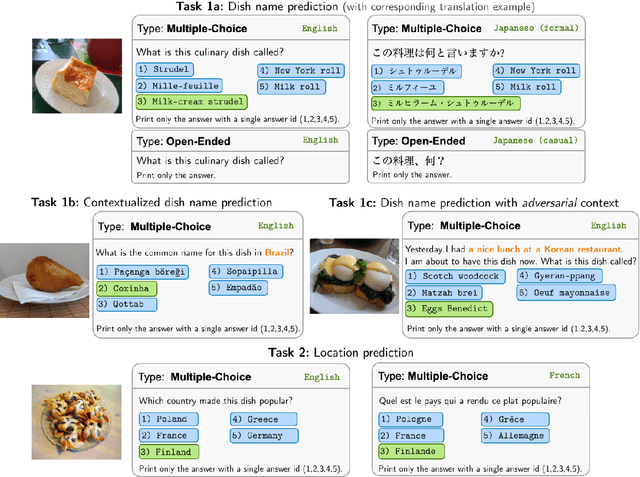

Vision Language Models (VLMs) often struggle with culture-specific knowledge, particularly in languages other than English and in underrepresented cultural contexts. To evaluate their understanding of such knowledge, we introduce WorldCuisines, a massive-scale benchmark for multilingual and multicultural, visually grounded language understanding. This benchmark includes a visual question answering (VQA) dataset with text-image pairs across 30 languages and dialects, spanning 9 language families and featuring over 1 million data points, making it the largest multicultural VQA benchmark to date. It includes tasks for identifying dish names and their origins. We provide evaluation datasets in two sizes (12k and 60k instances) alongside a training dataset (1 million instances). Our findings show that while VLMs perform better with correct location context, they struggle with adversarial contexts and predicting specific regional cuisines and languages. To support future research, we release a knowledge base with annotated food entries and images along with the VQA data.
RainbowPO: A Unified Framework for Combining Improvements in Preference Optimization
Oct 05, 2024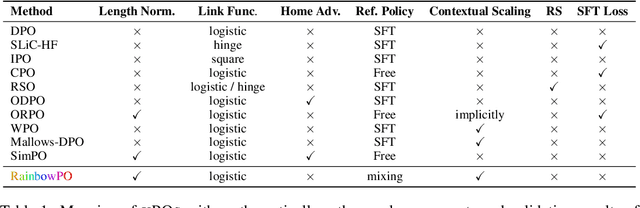


Recently, numerous preference optimization algorithms have been introduced as extensions to the Direct Preference Optimization (DPO) family. While these methods have successfully aligned models with human preferences, there is a lack of understanding regarding the contributions of their additional components. Moreover, fair and consistent comparisons are scarce, making it difficult to discern which components genuinely enhance downstream performance. In this work, we propose RainbowPO, a unified framework that demystifies the effectiveness of existing DPO methods by categorizing their key components into seven broad directions. We integrate these components into a single cohesive objective, enhancing the performance of each individual element. Through extensive experiments, we demonstrate that RainbowPO outperforms existing DPO variants. Additionally, we provide insights to guide researchers in developing new DPO methods and assist practitioners in their implementations.