 Add to Chrome
 Add to Firefox
 Add to Edge
Towards Scalable Customization and Deployment of Multi-Agent Systems for Enterprise Applications
Jun 16, 2026
Large language model (LLM)-based multi-agent systems demonstrate strong performance on complex reasoning and task execution, enabling broad enterprise applications. However, production deployment remains challenging due to domain-specific customization requirements and high latency and inference costs in agentic workflows. We propose a unified framework for customization and efficient deployment of multi-agent systems in real-world settings. The first stage, Agentic Model Customization, combines continual pretraining, supervised fine-tuning, and preference optimization to adapt a compact model to specialized domains while retaining strong agentic capabilities. The second stage, Inference Optimization, integrates speculative decoding and FP8 quantization with targeted calibration to enable cost-efficient serving with minimal quality loss. Across enterprise workloads, our framework enables rapid domain adaptation and achieves a 4.48x speedup in throughput while maintaining performance and improving robustness on long-tail scenarios.

T1-Bench: Benchmarking Multi-Scenario Agents in Real-World Domains
Jun 09, 2026Recent advances in reasoning and tool-calling capabilities of large language models (LLMs) have enabled increasingly capable agentic systems. However, existing benchmarks remain limited in task complexity, realism, and domain diversity, and often fail to capture interactions that span multiple domains, limiting their ability to evaluate agents in realistic multi-step settings that require sustained reasoning and coordination. To address these limitations, we introduce T1-Bench, a high-fidelity, comprehensive benchmark for evaluating agentic systems in realistic customer-facing, multi-domain environments, featuring interleaved scenarios that require structured reasoning across multi-turn user-assistant interactions and substantially increasing both compositional complexity and evaluative rigor across 25 domains of varying difficulty. We evaluate T1-Bench using 12 proprietary and open-weight models, providing a reproducible and standardized framework for assessing agent behavior, tool utilization, and conversational quality in complex, multi-step environments. We further complement automatic evaluation with human judgments to strengthen the assessment of qualitative performance. Overall, T1-Bench substantially advances prior benchmarks by increasing task complexity, interaction depth, and domain coverage in simulated multi-domain environments. To facilitate future research on agentic systems, we will publicly release data and evaluation code as open source.
Can Large Language Models Understand, Reason About, and Generate Code-Switched Text?
Jan 12, 2026Code-switching is a pervasive phenomenon in multilingual communication, yet the robustness of large language models (LLMs) in mixed-language settings remains insufficiently understood. In this work, we present a comprehensive evaluation of LLM capabilities in understanding, reasoning over, and generating code-switched text. We introduce CodeMixQA a novel benchmark with high-quality human annotations, comprising 16 diverse parallel code-switched language-pair variants that span multiple geographic regions and code-switching patterns, and include both original scripts and their transliterated forms. Using this benchmark, we analyze the reasoning behavior of LLMs on code-switched question-answering tasks, shedding light on how models process and reason over mixed-language inputs. We further conduct a systematic evaluation of LLM-generated synthetic code-switched text, focusing on both naturalness and semantic fidelity, and uncover key limitations in current generation capabilities. Our findings reveal persistent challenges in both reasoning and generation under code-switching conditions and provide actionable insights for building more robust multilingual LLMs. We release the dataset and code as open source.
T1: A Tool-Oriented Conversational Dataset for Multi-Turn Agentic Planning
May 22, 2025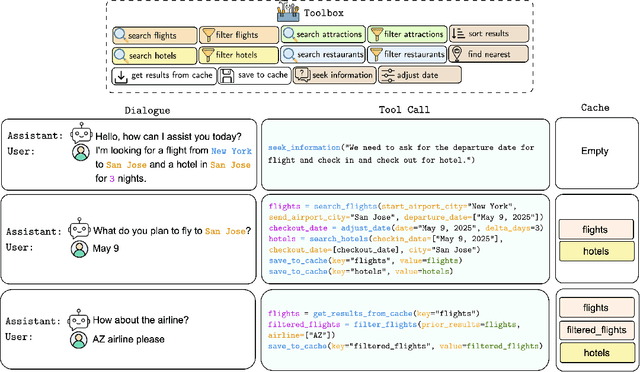
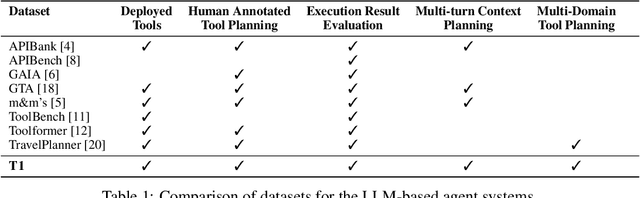
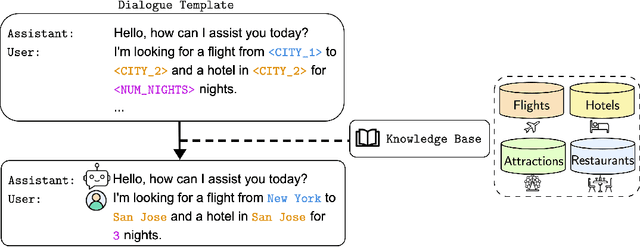

Large Language Models (LLMs) have demonstrated impressive capabilities as intelligent agents capable of solving complex problems. However, effective planning in scenarios involving dependencies between API or tool calls-particularly in multi-turn conversations-remains a significant challenge. To address this, we introduce T1, a tool-augmented, multi-domain, multi-turn conversational dataset specifically designed to capture and manage inter-tool dependencies across diverse domains. T1 enables rigorous evaluation of agents' ability to coordinate tool use across nine distinct domains (4 single domain and 5 multi-domain) with the help of an integrated caching mechanism for both short- and long-term memory, while supporting dynamic replanning-such as deciding whether to recompute or reuse cached results. Beyond facilitating research on tool use and planning, T1 also serves as a benchmark for evaluating the performance of open-source language models. We present results powered by T1-Agent, highlighting their ability to plan and reason in complex, tool-dependent scenarios.