 Add to Chrome
 Add to Firefox
 Add to Edge
Momento: Evaluating Persistent Memory and Reasoning with Multi-Session Agentic Conversations
May 30, 2026
Recent advances in agentic AI have enabled agents to complete complex tasks through tool use, reasoning, and multi-step planning. Yet existing benchmarks evaluate agents within a single session, ignoring past actions, stated preferences, and prior decisions that agents must integrate to fulfill personalized user goals. We introduce Momento, a benchmark for persistent agentic task completion in multi-session service environments, requiring agents to take consequential, tool-mediated actions while resolving temporal dependencies and evolving user goals across sessions. Experimental results reveal that current agents fail primarily through misestimation of user state, treating prior session history as a reliable proxy for current context rather than stale information requiring re-validation, highlighting a substantial gap between current agent capabilities and realistic long-horizon human-agent interaction.

Anthropogenic Regional Adaptation in Multimodal Vision-Language Model
Apr 13, 2026While the field of vision-language (VL) has achieved remarkable success in integrating visual and textual information across multiple languages and domains, there is still no dedicated framework for assessing human-centric alignment in vision-language systems. We offer two contributions to address this gap. First, we introduce Anthropogenic Regional Adaptation: a novel paradigm that aims to optimize model relevance to specific regional contexts while ensuring the retention of global generalization capabilities. Second, we present a simple, but effective adaptation method named Geographical-generalization-made-easy (GG-EZ), which utilizes regional data filtering and model merging. Through comprehensive experiments on 3 VL architectures: large vision-language models, text-to-image diffusion models, and vision-language embedding models, and a case study in Southeast Asia (SEA) regional adaptation, we demonstrate the importance of Anthropogenic Regional Adaptation and the effectiveness of GG-EZ, showing 5-15% gains in cultural relevance metrics across SEA while maintaining over 98% of global performance and even occasionally surpassing it. Our findings establish Anthropogenic Regional Alignment as a foundational paradigm towards applicability of multimodal vision-language models in diverse regions and demonstrate a simple-yet-effective baseline method that optimizes regional value alignment while preserving global generalization.
SparkMe: Adaptive Semi-Structured Interviewing for Qualitative Insight Discovery
Feb 24, 2026Qualitative insights from user experiences are critical for informing product and policy decisions, but collecting such data at scale is constrained by the time and availability of experts to conduct semi-structured interviews. Recent work has explored using large language models (LLMs) to automate interviewing, yet existing systems lack a principled mechanism for balancing systematic coverage of predefined topics with adaptive exploration, or the ability to pursue follow-ups, deep dives, and emergent themes that arise organically during conversation. In this work, we formulate adaptive semi-structured interviewing as an optimization problem over the interviewer's behavior. We define interview utility as a trade-off between coverage of a predefined interview topic guide, discovery of relevant emergent themes, and interview cost measured by length. Based on this formulation, we introduce SparkMe, a multi-agent LLM interviewer that performs deliberative planning via simulated conversation rollouts to select questions with high expected utility. We evaluate SparkMe through controlled experiments with LLM-based interviewees, showing that it achieves higher interview utility, improving topic guide coverage (+4.7% over the best baseline) and eliciting richer emergent insights while using fewer conversational turns than prior LLM interviewing approaches. We further validate SparkMe in a user study with 70 participants across 7 professions on the impact of AI on their workflows. Domain experts rate SparkMe as producing high-quality adaptive interviews that surface helpful profession-specific insights not captured by prior approaches. The code, datasets, and evaluation protocols for SparkMe are available as open-source at https://github.com/SALT-NLP/SparkMe.
CommonLID: Re-evaluating State-of-the-Art Language Identification Performance on Web Data
Jan 25, 2026Language identification (LID) is a fundamental step in curating multilingual corpora. However, LID models still perform poorly for many languages, especially on the noisy and heterogeneous web data often used to train multilingual language models. In this paper, we introduce CommonLID, a community-driven, human-annotated LID benchmark for the web domain, covering 109 languages. Many of the included languages have been previously under-served, making CommonLID a key resource for developing more representative high-quality text corpora. We show CommonLID's value by using it, alongside five other common evaluation sets, to test eight popular LID models. We analyse our results to situate our contribution and to provide an overview of the state of the art. In particular, we highlight that existing evaluations overestimate LID accuracy for many languages in the web domain. We make CommonLID and the code used to create it available under an open, permissive license.
Can Large Language Models Understand, Reason About, and Generate Code-Switched Text?
Jan 12, 2026Code-switching is a pervasive phenomenon in multilingual communication, yet the robustness of large language models (LLMs) in mixed-language settings remains insufficiently understood. In this work, we present a comprehensive evaluation of LLM capabilities in understanding, reasoning over, and generating code-switched text. We introduce CodeMixQA a novel benchmark with high-quality human annotations, comprising 16 diverse parallel code-switched language-pair variants that span multiple geographic regions and code-switching patterns, and include both original scripts and their transliterated forms. Using this benchmark, we analyze the reasoning behavior of LLMs on code-switched question-answering tasks, shedding light on how models process and reason over mixed-language inputs. We further conduct a systematic evaluation of LLM-generated synthetic code-switched text, focusing on both naturalness and semantic fidelity, and uncover key limitations in current generation capabilities. Our findings reveal persistent challenges in both reasoning and generation under code-switching conditions and provide actionable insights for building more robust multilingual LLMs. We release the dataset and code as open source.
Rethinking what Matters: Effective and Robust Multilingual Realignment for Low-Resource Languages
Nov 09, 2025Realignment is a promising strategy to improve cross-lingual transfer in multilingual language models. However, empirical results are mixed and often unreliable, particularly for typologically distant or low-resource languages (LRLs) compared to English. Moreover, word realignment tools often rely on high-quality parallel data, which can be scarce or noisy for many LRLs. In this work, we conduct an extensive empirical study to investigate whether realignment truly benefits from using all available languages, or if strategically selected subsets can offer comparable or even improved cross-lingual transfer, and study the impact on LRLs. Our controlled experiments show that realignment can be particularly effective for LRLs and that using carefully selected, linguistically diverse subsets can match full multilingual alignment, and even outperform it for unseen LRLs. This indicates that effective realignment does not require exhaustive language coverage and can reduce data collection overhead, while remaining both efficient and robust when guided by informed language selection.
IndoPref: A Multi-Domain Pairwise Preference Dataset for Indonesian
Jul 29, 2025Over 200 million people speak Indonesian, yet the language remains significantly underrepresented in preference-based research for large language models (LLMs). Most existing multilingual datasets are derived from English translations, often resulting in content that lacks cultural and linguistic authenticity. To address this gap, we introduce IndoPref, the first fully human-authored and multi-domain Indonesian preference dataset specifically designed to evaluate the naturalness and quality of LLM-generated text. All annotations are natively written in Indonesian and evaluated using Krippendorff's alpha, demonstrating strong inter-annotator agreement. Additionally, we benchmark the dataset across multiple LLMs and assess the output quality of each model.
R3: Robust Rubric-Agnostic Reward Models
May 19, 2025Reward models are essential for aligning language model outputs with human preferences, yet existing approaches often lack both controllability and interpretability. These models are typically optimized for narrow objectives, limiting their generalizability to broader downstream tasks. Moreover, their scalar outputs are difficult to interpret without contextual reasoning. To address these limitations, we introduce R3, a novel reward modeling framework that is rubric-agnostic, generalizable across evaluation dimensions, and provides interpretable, reasoned score assignments. R3 enables more transparent and flexible evaluation of language models, supporting robust alignment with diverse human values and use cases. Our models, data, and code are available as open source at https://github.com/rubricreward/r3
Crowdsource, Crawl, or Generate? Creating SEA-VL, a Multicultural Vision-Language Dataset for Southeast Asia
Mar 10, 2025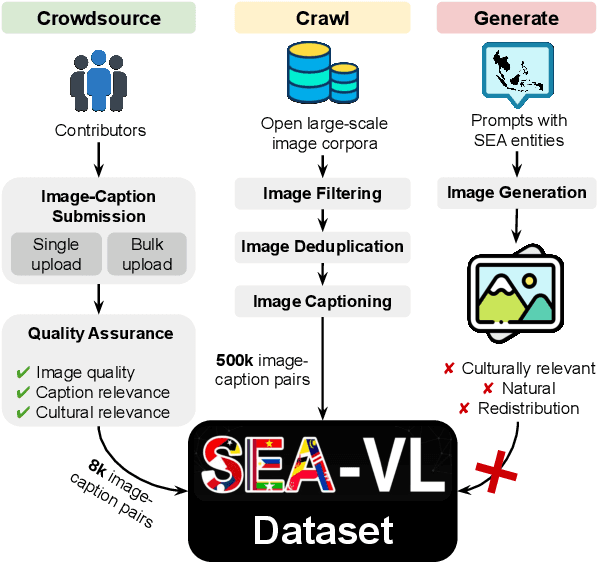
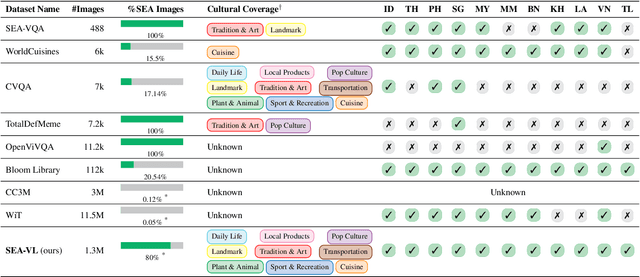
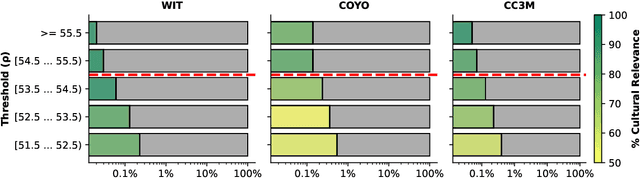
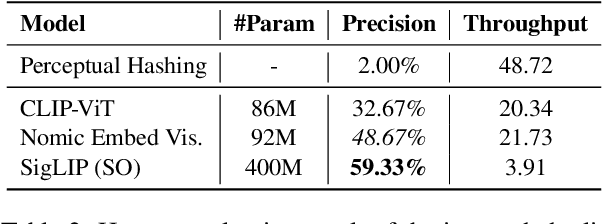
Southeast Asia (SEA) is a region of extraordinary linguistic and cultural diversity, yet it remains significantly underrepresented in vision-language (VL) research. This often results in artificial intelligence (AI) models that fail to capture SEA cultural nuances. To fill this gap, we present SEA-VL, an open-source initiative dedicated to developing high-quality, culturally relevant data for SEA languages. By involving contributors from SEA countries, SEA-VL aims to ensure better cultural relevance and diversity, fostering greater inclusivity of underrepresented languages in VL research. Beyond crowdsourcing, our initiative goes one step further in the exploration of the automatic collection of culturally relevant images through crawling and image generation. First, we find that image crawling achieves approximately ~85% cultural relevance while being more cost- and time-efficient than crowdsourcing. Second, despite the substantial progress in generative vision models, synthetic images remain unreliable in accurately reflecting SEA cultures. The generated images often fail to reflect the nuanced traditions and cultural contexts of the region. Collectively, we gather 1.28M SEA culturally-relevant images, more than 50 times larger than other existing datasets. Through SEA-VL, we aim to bridge the representation gap in SEA, fostering the development of more inclusive AI systems that authentically represent diverse cultures across SEA.
MetaMetrics-MT: Tuning Meta-Metrics for Machine Translation via Human Preference Calibration
Nov 01, 2024We present MetaMetrics-MT, an innovative metric designed to evaluate machine translation (MT) tasks by aligning closely with human preferences through Bayesian optimization with Gaussian Processes. MetaMetrics-MT enhances existing MT metrics by optimizing their correlation with human judgments. Our experiments on the WMT24 metric shared task dataset demonstrate that MetaMetrics-MT outperforms all existing baselines, setting a new benchmark for state-of-the-art performance in the reference-based setting. Furthermore, it achieves comparable results to leading metrics in the reference-free setting, offering greater efficiency.