 Add to Chrome
 Add to Firefox
 Add to Edge
Language as a Sensor: Calibrated Spatial Belief Estimation in 3D Scenes from Natural Language
Jun 07, 2026
Robots deployed in human-centric environments routinely receive natural-language descriptions of spatial information ("I left my backpack on the table") that reference parts of the world beyond their perceptual field of view. Traditional metric-semantic mapping ignores this signal, while off-the-shelf multimodal models remain limited in 3D spatial reasoning and are not directly amenable to fusion with other sensor modalities. To convert language observations into a calibrated spatial distribution, we train a Language Sensor Model (LSM) that maps each utterance and its scene-graph context to a multimodal distribution, with mixture weights encoding referential ambiguity (e.g., "which table") and component covariances encoding spatial uncertainty (e.g., where "on the table" the target lies). We then introduce VL-Map (Vision-Language Metric-Semantic Mapping), a probabilistic framework that treats these language predictions as stochastic observations and fuses them with onboard perception within a unified belief map. On the VLA-3D benchmark as well as on a real-world mobile robot, LSM is the only language predictor whose covariance estimates remain within the calibrated regime; fused into VL-Map, it leads to more accurate predictions of the target object location (~70% more probability mass on the true target compared to the strongest foundation-model baseline).

Robots That Know What to Ask: Recovering Misaligned Rewards through Targeted Explanations
May 21, 2026Learning reward functions from demonstrations assumes that demonstrations provide adequate supervision over all features -- or task-relevant aspects of behavior. In practice, demonstrations are often imperfect: humans may under-emphasize certain features due to cognitive load or physical difficulty, or the training regime may fail to sufficiently cover all relevant situations. In either case, important features may be underspecified, leading to ambiguity in the learned reward function and misaligned behavior at deployment. We propose a framework that detects such underspecified features and actively solicits targeted corrective demonstrations. Our key insight is that demonstrations implicitly reveal which features are well specified: features that are consistently optimized show little variation across demonstrations, while features that are underspecified vary widely. We leverage this statistical signal to infer which features may have been insufficiently demonstrated. The robot then explains which features it is uncertain about in natural language and queries for demonstrations that explicitly address the identified gaps. We evaluate our approach in a simulated tabletop manipulation domain and in a user study with a real Franka robot. Targeted, explanation-guided queries significantly improve reward recovery compared to random querying and passive data collection, reducing ambiguity that would otherwise persist in learning from imperfect demonstrations.
Human-Guided Harm Recovery for Computer Use Agents
Apr 20, 2026As LM agents gain the ability to execute actions on real computer systems, we need ways to not only prevent harmful actions at scale but also effectively remediate harm when prevention fails. We formalize a solution to this neglected challenge in post-execution safeguards as harm recovery: the problem of optimally steering an agent from a harmful state back to a safe one in alignment with human preferences. We ground preference-aligned recovery through a formative user study that identifies valued recovery dimensions and produces a natural language rubric. Our dataset of 1,150 pairwise judgments reveals context-dependent shifts in attribute importance, such as preferences for pragmatic, targeted strategies over comprehensive long-term approaches. We operationalize these learned insights in a reward model, re-ranking multiple candidate recovery plans generated by an agent scaffold at test time. To evaluate recovery capabilities systematically, we introduce BackBench, a benchmark of 50 computer-use tasks that test an agent's ability to recover from harmful states. Human evaluation shows our reward model scaffold yields higher-quality recovery trajectories than base agents and rubric-based scaffolds. Together, these contributions lay the foundation for a new class of agent safety methods -- ones that confront harm not only by preventing it, but by navigating its aftermath with alignment and intent.
GIFT: Generalizing Intent for Flexible Test-Time Rewards
Mar 23, 2026Robots learn reward functions from user demonstrations, but these rewards often fail to generalize to new environments. This failure occurs because learned rewards latch onto spurious correlations in training data rather than the underlying human intent that demonstrations represent. Existing methods leverage visual or semantic similarity to improve robustness, yet these surface-level cues often diverge from what humans actually care about. We present Generalizing Intent for Flexible Test-Time Rewards (GIFT), a framework that grounds reward generalization in human intent rather than surface cues. GIFT leverages language models to infer high-level intent from user demonstrations by contrasting preferred with non-preferred behaviors. At deployment, GIFT maps novel test states to behaviorally equivalent training states via intent-conditioned similarity, enabling learned rewards to generalize across distribution shifts without retraining. We evaluate GIFT on tabletop manipulation tasks with new objects and layouts. Across four simulated tasks with over 50 unseen objects, GIFT consistently outperforms visual and semantic similarity baselines in test-time pairwise win rate and state-alignment F1 score. Real-world experiments on a 7-DoF Franka Panda robot demonstrate that GIFT reliably transfers to physical settings. Further discussion can be found at https://mit-clear-lab.github.io/GIFT/
Improving through Interaction: Searching Behavioral Representation Spaces with CMA-ES-IG
Mar 09, 2026Robots that interact with humans must adapt to individual users' preferences to operate effectively in human-centered environments. An intuitive and effective technique to learn non-expert users' preferences is through rankings of robot behaviors, e.g., trajectories, gestures, or voices. Existing techniques primarily focus on generating queries that optimize preference learning outcomes, such as sample efficiency or final preference estimation accuracy. However, the focus on outcome overlooks key user expectations in the process of providing these rankings, which can negatively impact users' adoption of robotic systems. This work proposes the Covariance Matrix Adaptation Evolution Strategies with Information Gain (CMA-ES-IG) algorithm. CMA-ES-IG explicitly incorporates user experience considerations into the preference learning process by suggesting perceptually distinct and informative trajectories for users to rank. We demonstrate these benefits through both simulated studies and real-robot experiments. CMA-ES-IG, compared to state-of-the-art alternatives, (1) scales more effectively to higher-dimensional preference spaces, (2) maintains computational tractability for high-dimensional problems, (3) is robust to noisy or inconsistent user feedback, and (4) is preferred by non-expert users in identifying their preferred robot behaviors. This project's code is available at github.com/interaction-lab/CMA-ES-IG
Robometer: Scaling General-Purpose Robotic Reward Models via Trajectory Comparisons
Mar 02, 2026General-purpose robot reward models are typically trained to predict absolute task progress from expert demonstrations, providing only local, frame-level supervision. While effective for expert demonstrations, this paradigm scales poorly to large-scale robotics datasets where failed and suboptimal trajectories are abundant and assigning dense progress labels is ambiguous. We introduce Robometer, a scalable reward modeling framework that combines intra-trajectory progress supervision with inter-trajectory preference supervision. Robometer is trained with a dual objective: a frame-level progress loss that anchors reward magnitude on expert data, and a trajectory-comparison preference loss that imposes global ordering constraints across trajectories of the same task, enabling effective learning from both real and augmented failed trajectories. To support this formulation at scale, we curate RBM-1M, a reward-learning dataset comprising over one million trajectories spanning diverse robot embodiments and tasks, including substantial suboptimal and failure data. Across benchmarks and real-world evaluations, Robometer learns more generalizable reward functions than prior methods and improves robot learning performance across a diverse set of downstream applications. Code, model weights, and videos at https://robometer.github.io/.
Value of Information: A Framework for Human-Agent Communication
Jan 10, 2026Large Language Model (LLM) agents deployed for real-world tasks face a fundamental dilemma: user requests are underspecified, yet agents must decide whether to act on incomplete information or interrupt users for clarification. Existing approaches either rely on brittle confidence thresholds that require task-specific tuning, or fail to account for the varying stakes of different decisions. We introduce a decision-theoretic framework that resolves this trade-off through the Value of Information (VoI), enabling agents to dynamically weigh the expected utility gain from asking questions against the cognitive cost imposed on users. Our inference-time method requires no hyperparameter tuning and adapts seamlessly across contexts-from casual games to medical diagnosis. Experiments across four diverse domains (20 Questions, medical diagnosis, flight booking, and e-commerce) show that VoI consistently matches or exceeds the best manually-tuned baselines, achieving up to 1.36 utility points higher in high-cost settings. This work provides a parameter-free framework for adaptive agent communication that explicitly balances task risk, query ambiguity, and user effort.
Masked IRL: LLM-Guided Reward Disambiguation from Demonstrations and Language
Nov 18, 2025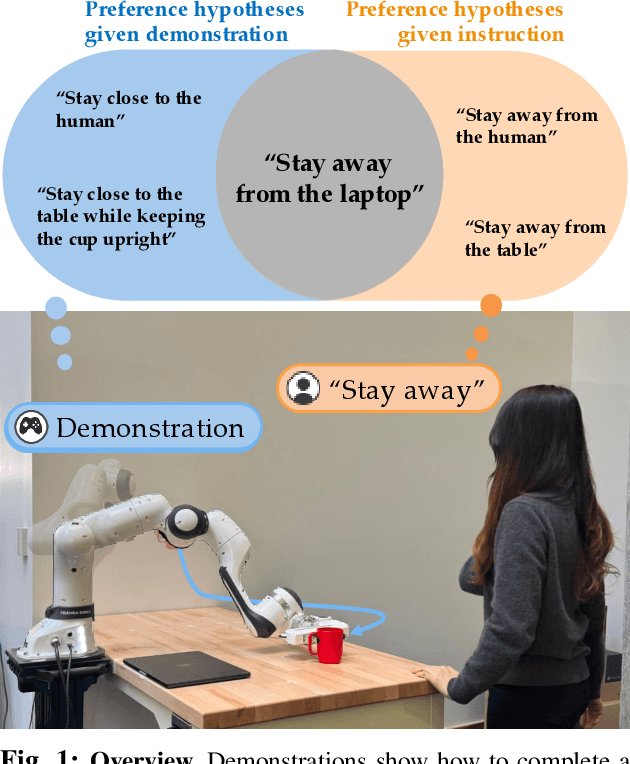
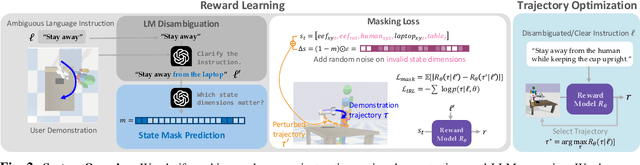
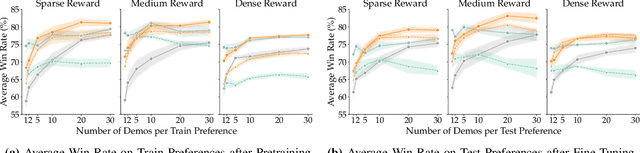
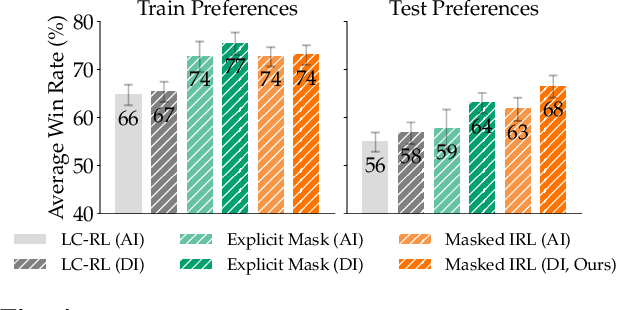
Robots can adapt to user preferences by learning reward functions from demonstrations, but with limited data, reward models often overfit to spurious correlations and fail to generalize. This happens because demonstrations show robots how to do a task but not what matters for that task, causing the model to focus on irrelevant state details. Natural language can more directly specify what the robot should focus on, and, in principle, disambiguate between many reward functions consistent with the demonstrations. However, existing language-conditioned reward learning methods typically treat instructions as simple conditioning signals, without fully exploiting their potential to resolve ambiguity. Moreover, real instructions are often ambiguous themselves, so naive conditioning is unreliable. Our key insight is that these two input types carry complementary information: demonstrations show how to act, while language specifies what is important. We propose Masked Inverse Reinforcement Learning (Masked IRL), a framework that uses large language models (LLMs) to combine the strengths of both input types. Masked IRL infers state-relevance masks from language instructions and enforces invariance to irrelevant state components. When instructions are ambiguous, it uses LLM reasoning to clarify them in the context of the demonstrations. In simulation and on a real robot, Masked IRL outperforms prior language-conditioned IRL methods by up to 15% while using up to 4.7 times less data, demonstrating improved sample-efficiency, generalization, and robustness to ambiguous language. Project page: https://MIT-CLEAR-Lab.github.io/Masked-IRL and Code: https://github.com/MIT-CLEAR-Lab/Masked-IRL
Open-Universe Assistance Games
Aug 20, 2025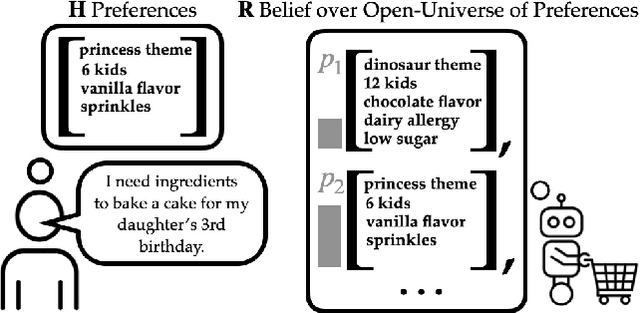
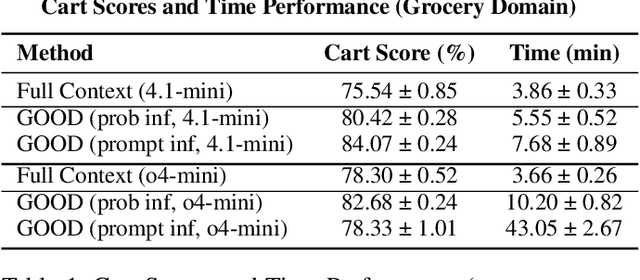

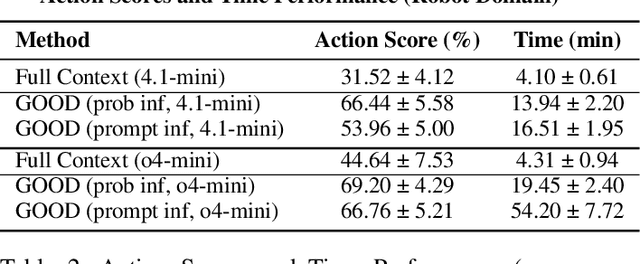
Embodied AI agents must infer and act in an interpretable way on diverse human goals and preferences that are not predefined. To formalize this setting, we introduce Open-Universe Assistance Games (OU-AGs), a framework where the agent must reason over an unbounded and evolving space of possible goals. In this context, we introduce GOOD (GOals from Open-ended Dialogue), a data-efficient, online method that extracts goals in the form of natural language during an interaction with a human, and infers a distribution over natural language goals. GOOD prompts an LLM to simulate users with different complex intents, using its responses to perform probabilistic inference over candidate goals. This approach enables rich goal representations and uncertainty estimation without requiring large offline datasets. We evaluate GOOD in a text-based grocery shopping domain and in a text-operated simulated household robotics environment (AI2Thor), using synthetic user profiles. Our method outperforms a baseline without explicit goal tracking, as confirmed by both LLM-based and human evaluations.
Context Matters: Learning Generalizable Rewards via Calibrated Features
Jun 17, 2025A key challenge in reward learning from human input is that desired agent behavior often changes based on context. Traditional methods typically treat each new context as a separate task with its own reward function. For example, if a previously ignored stove becomes too hot to be around, the robot must learn a new reward from scratch, even though the underlying preference for prioritizing safety over efficiency remains unchanged. We observe that context influences not the underlying preference itself, but rather the $\textit{saliency}$--or importance--of reward features. For instance, stove heat affects the importance of the robot's proximity, yet the human's safety preference stays the same. Existing multi-task and meta IRL methods learn context-dependent representations $\textit{implicitly}$--without distinguishing between preferences and feature importance--resulting in substantial data requirements. Instead, we propose $\textit{explicitly}$ modeling context-invariant preferences separately from context-dependent feature saliency, creating modular reward representations that adapt to new contexts. To achieve this, we introduce $\textit{calibrated features}$--representations that capture contextual effects on feature saliency--and present specialized paired comparison queries that isolate saliency from preference for efficient learning. Experiments with simulated users show our method significantly improves sample efficiency, requiring 10x fewer preference queries than baselines to achieve equivalent reward accuracy, with up to 15% better performance in low-data regimes (5-10 queries). An in-person user study (N=12) demonstrates that participants can effectively teach their unique personal contextual preferences using our method, enabling more adaptable and personalized reward learning.