 Add to Chrome
 Add to Firefox
 Add to Edge
Selective Visual Representations Improve Convergence and Generalization for Embodied AI
Nov 07, 2023
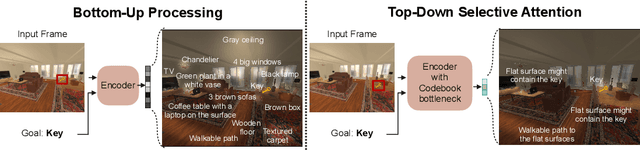
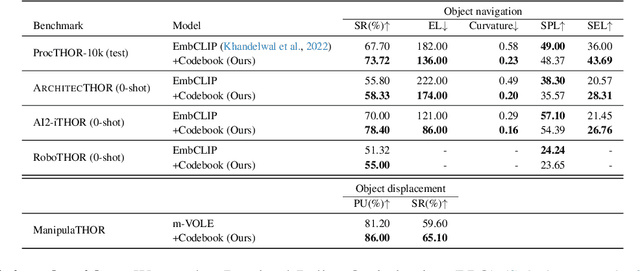
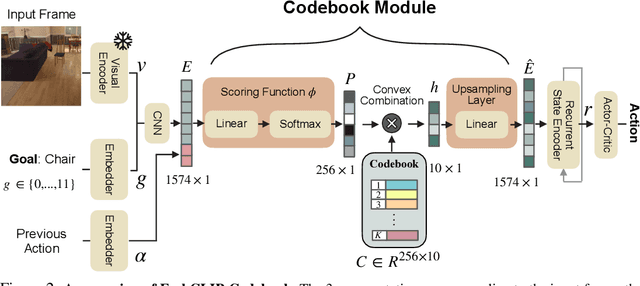

Embodied AI models often employ off the shelf vision backbones like CLIP to encode their visual observations. Although such general purpose representations encode rich syntactic and semantic information about the scene, much of this information is often irrelevant to the specific task at hand. This introduces noise within the learning process and distracts the agent's focus from task-relevant visual cues. Inspired by selective attention in humans-the process through which people filter their perception based on their experiences, knowledge, and the task at hand-we introduce a parameter-efficient approach to filter visual stimuli for embodied AI. Our approach induces a task-conditioned bottleneck using a small learnable codebook module. This codebook is trained jointly to optimize task reward and acts as a task-conditioned selective filter over the visual observation. Our experiments showcase state-of-the-art performance for object goal navigation and object displacement across 5 benchmarks, ProcTHOR, ArchitecTHOR, RoboTHOR, AI2-iTHOR, and ManipulaTHOR. The filtered representations produced by the codebook are also able generalize better and converge faster when adapted to other simulation environments such as Habitat. Our qualitative analyses show that agents explore their environments more effectively and their representations retain task-relevant information like target object recognition while ignoring superfluous information about other objects. Code and pretrained models are available at our project website: https://embodied-codebook.github.io.

CLIP meets Model Zoo Experts: Pseudo-Supervision for Visual Enhancement
Oct 21, 2023Contrastive language image pretraining (CLIP) is a standard method for training vision-language models. While CLIP is scalable, promptable, and robust to distribution shifts on image classification tasks, it lacks object localization capabilities. This paper studies the following question: Can we augment CLIP training with task-specific vision models from model zoos to improve its visual representations? Towards this end, we leverage open-source task-specific vision models to generate pseudo-labels for an uncurated and noisy image-text dataset. Subsequently, we train CLIP models on these pseudo-labels in addition to the contrastive training on image and text pairs. This simple setup shows substantial improvements of up to 16.3% across different vision tasks, including segmentation, detection, depth estimation, and surface normal estimation. Importantly, these enhancements are achieved without compromising CLIP's existing capabilities, including its proficiency in promptable zero-shot classification.
SHARCS: Efficient Transformers through Routing with Dynamic Width Sub-networks
Oct 18, 2023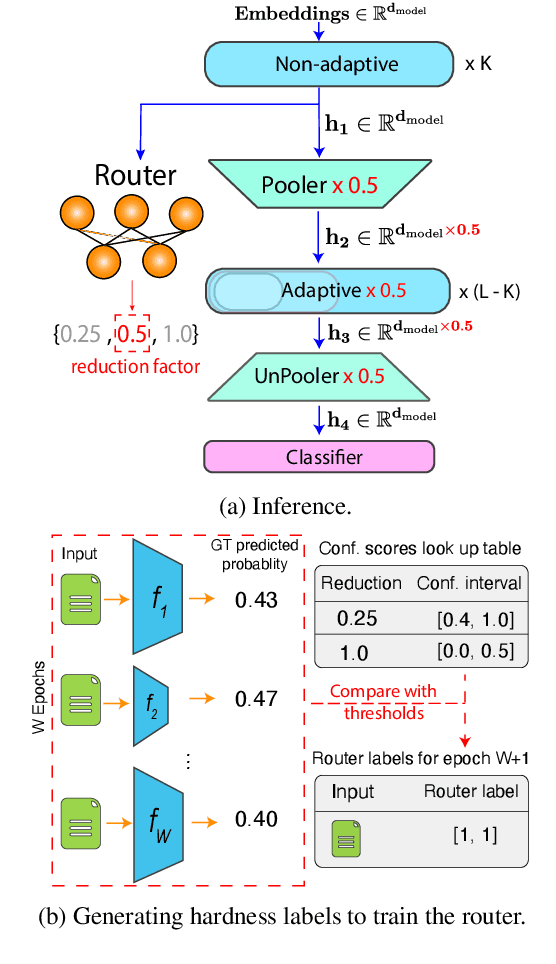

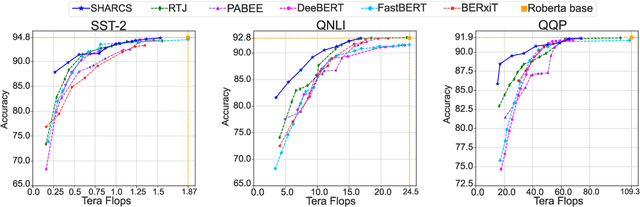
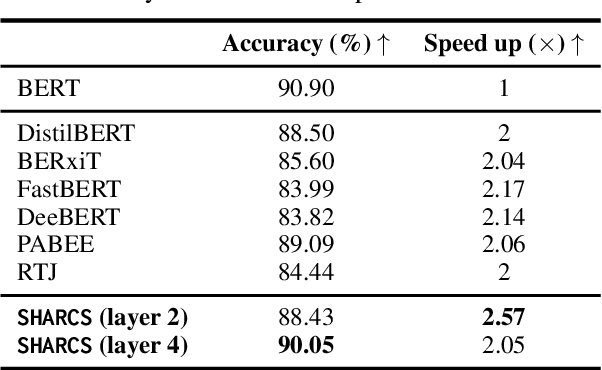
We introduce SHARCS for adaptive inference that takes into account the hardness of input samples. SHARCS can train a router on any transformer network, enabling the model to direct different samples to sub-networks with varying widths. Our experiments demonstrate that: (1) SHARCS outperforms or complements existing per-sample adaptive inference methods across various classification tasks in terms of accuracy vs. FLOPs; (2) SHARCS generalizes across different architectures and can be even applied to compressed and efficient transformer encoders to further improve their efficiency; (3) SHARCS can provide a 2 times inference speed up at an insignificant drop in accuracy.
MatFormer: Nested Transformer for Elastic Inference
Oct 11, 2023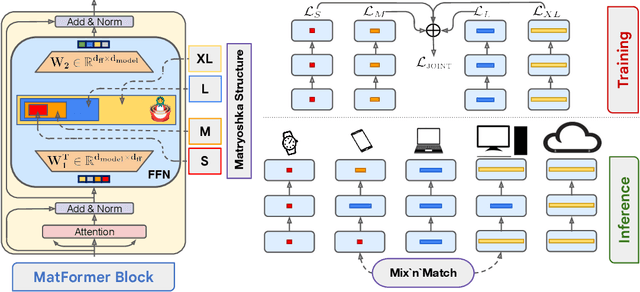
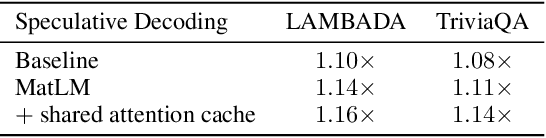
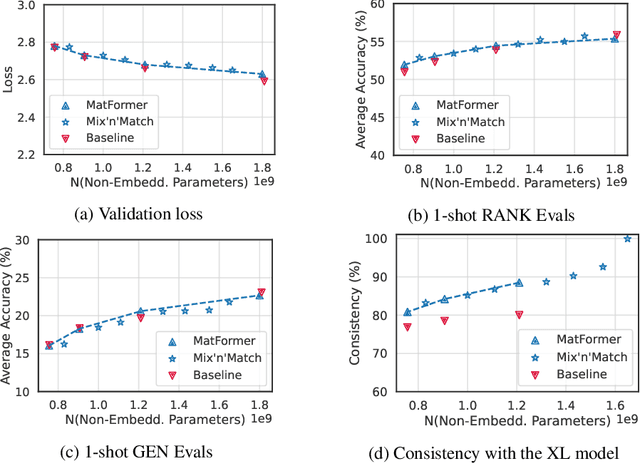
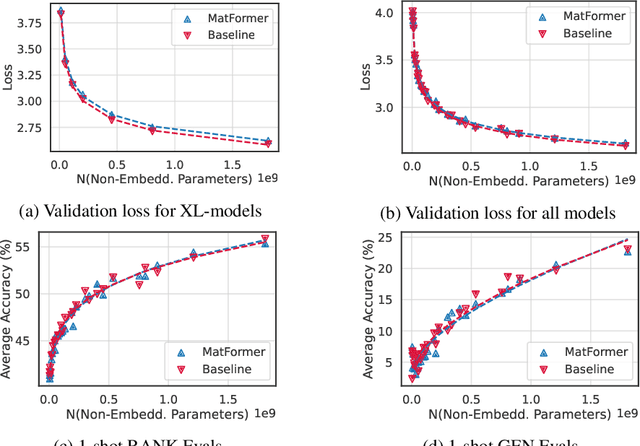
Transformer models are deployed in a wide range of settings, from multi-accelerator clusters to standalone mobile phones. The diverse inference constraints in these scenarios necessitate practitioners to train foundation models such as PaLM 2, Llama, & ViTs as a series of models of varying sizes. Due to significant training costs, only a select few model sizes are trained and supported, limiting more fine-grained control over relevant tradeoffs, including latency, cost, and accuracy. This work introduces MatFormer, a nested Transformer architecture designed to offer elasticity in a variety of deployment constraints. Each Feed Forward Network (FFN) block of a MatFormer model is jointly optimized with a few nested smaller FFN blocks. This training procedure allows for the Mix'n'Match of model granularities across layers -- i.e., a trained universal MatFormer model enables extraction of hundreds of accurate smaller models, which were never explicitly optimized. We empirically demonstrate MatFormer's effectiveness across different model classes (decoders & encoders), modalities (language & vision), and scales (up to 2.6B parameters). We find that a 2.6B decoder-only MatFormer language model (MatLM) allows us to extract smaller models spanning from 1.5B to 2.6B, each exhibiting comparable validation loss and one-shot downstream evaluations to their independently trained counterparts. Furthermore, we observe that smaller encoders extracted from a universal MatFormer-based ViT (MatViT) encoder preserve the metric-space structure for adaptive large-scale retrieval. Finally, we showcase that speculative decoding with the accurate and consistent submodels extracted from MatFormer can further reduce inference latency.
On the Connection between Pre-training Data Diversity and Fine-tuning Robustness
Jul 24, 2023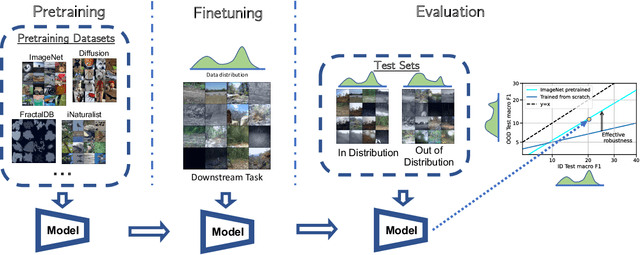

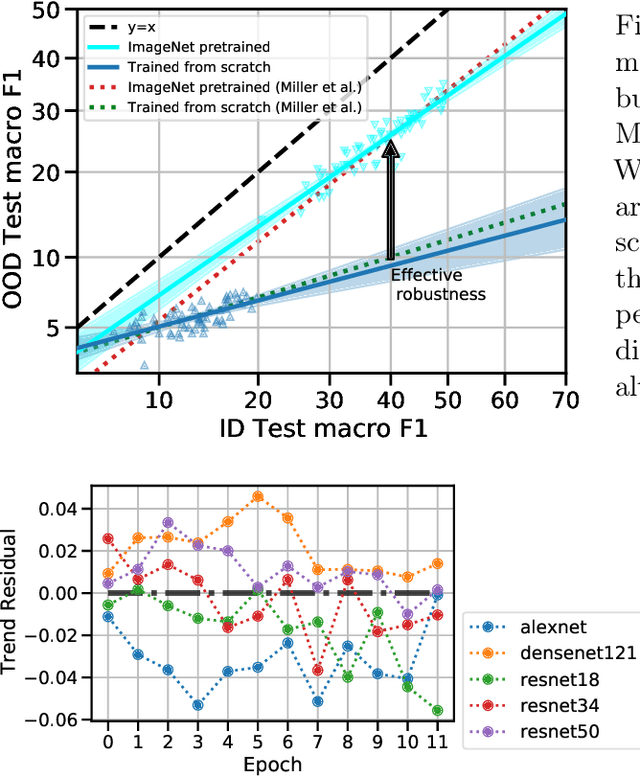
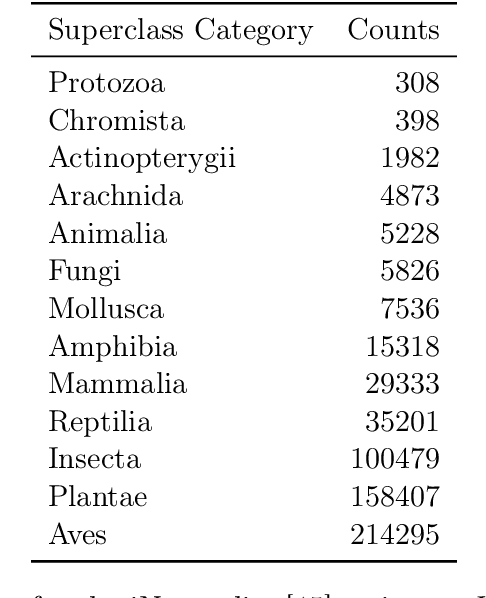
Pre-training has been widely adopted in deep learning to improve model performance, especially when the training data for a target task is limited. In our work, we seek to understand the implications of this training strategy on the generalization properties of downstream models. More specifically, we ask the following question: how do properties of the pre-training distribution affect the robustness of a fine-tuned model? The properties we explore include the label space, label semantics, image diversity, data domains, and data quantity of the pre-training distribution. We find that the primary factor influencing downstream effective robustness (Taori et al., 2020) is data quantity, while other factors have limited significance. For example, reducing the number of ImageNet pre-training classes by 4x while increasing the number of images per class by 4x (that is, keeping total data quantity fixed) does not impact the robustness of fine-tuned models. We demonstrate our findings on pre-training distributions drawn from various natural and synthetic data sources, primarily using the iWildCam-WILDS distribution shift as a test for downstream robustness.
Objaverse-XL: A Universe of 10M+ 3D Objects
Jul 11, 2023Natural language processing and 2D vision models have attained remarkable proficiency on many tasks primarily by escalating the scale of training data. However, 3D vision tasks have not seen the same progress, in part due to the challenges of acquiring high-quality 3D data. In this work, we present Objaverse-XL, a dataset of over 10 million 3D objects. Our dataset comprises deduplicated 3D objects from a diverse set of sources, including manually designed objects, photogrammetry scans of landmarks and everyday items, and professional scans of historic and antique artifacts. Representing the largest scale and diversity in the realm of 3D datasets, Objaverse-XL enables significant new possibilities for 3D vision. Our experiments demonstrate the improvements enabled with the scale provided by Objaverse-XL. We show that by training Zero123 on novel view synthesis, utilizing over 100 million multi-view rendered images, we achieve strong zero-shot generalization abilities. We hope that releasing Objaverse-XL will enable further innovations in the field of 3D vision at scale.
Neural Priming for Sample-Efficient Adaptation
Jun 24, 2023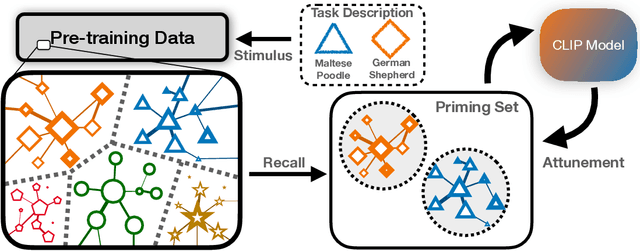
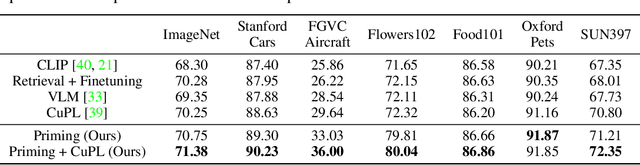
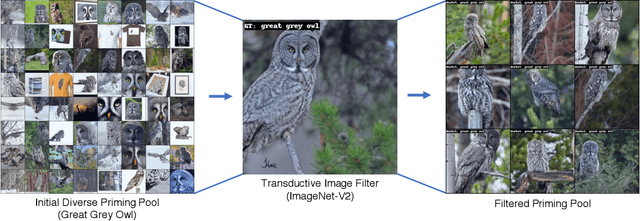
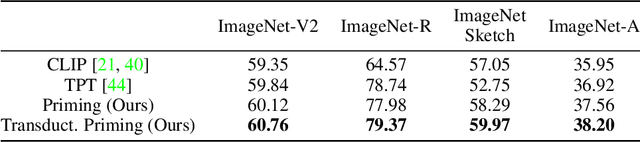
We propose Neural Priming, a technique for adapting large pretrained models to distribution shifts and downstream tasks given few or no labeled examples. Presented with class names or unlabeled test samples, Neural Priming enables the model to recall and conditions its parameters on relevant data seen throughout pretraining, thereby priming it for the test distribution. Neural Priming can be performed at test time, even for pretraining datasets as large as LAION-2B. Performing lightweight updates on the recalled data significantly improves accuracy across a variety of distribution shift and transfer learning benchmarks. Concretely, in the zero-shot setting, we see a 2.45% improvement in accuracy on ImageNet and 3.81% accuracy improvement on average across standard transfer learning benchmarks. Further, using Neural Priming at inference to adapt to distribution shift, we see a 1.41% accuracy improvement on ImageNetV2. These results demonstrate the effectiveness of Neural Priming in addressing the challenge of limited labeled data and changing distributions. Code is available at github.com/RAIVNLab/neural-priming.
Bytes Are All You Need: Transformers Operating Directly On File Bytes
May 31, 2023Modern deep learning approaches usually transform inputs into a modality-specific form. For example, the most common deep learning approach to image classification involves decoding image file bytes into an RGB tensor which is passed into a neural network. Instead, we investigate performing classification directly on file bytes, without the need for decoding files at inference time. Using file bytes as model inputs enables the development of models which can operate on multiple input modalities. Our model, \emph{ByteFormer}, achieves an ImageNet Top-1 classification accuracy of $77.33\%$ when training and testing directly on TIFF file bytes using a transformer backbone with configuration similar to DeiT-Ti ($72.2\%$ accuracy when operating on RGB images). Without modifications or hyperparameter tuning, ByteFormer achieves $95.42\%$ classification accuracy when operating on WAV files from the Speech Commands v2 dataset (compared to state-of-the-art accuracy of $98.7\%$). Additionally, we demonstrate that ByteFormer has applications in privacy-preserving inference. ByteFormer is capable of performing inference on particular obfuscated input representations with no loss of accuracy. We also demonstrate ByteFormer's ability to perform inference with a hypothetical privacy-preserving camera which avoids forming full images by consistently masking $90\%$ of pixel channels, while still achieving $71.35\%$ accuracy on ImageNet. Our code will be made available at https://github.com/apple/ml-cvnets/tree/main/examples/byteformer.
AdANNS: A Framework for Adaptive Semantic Search
May 30, 2023

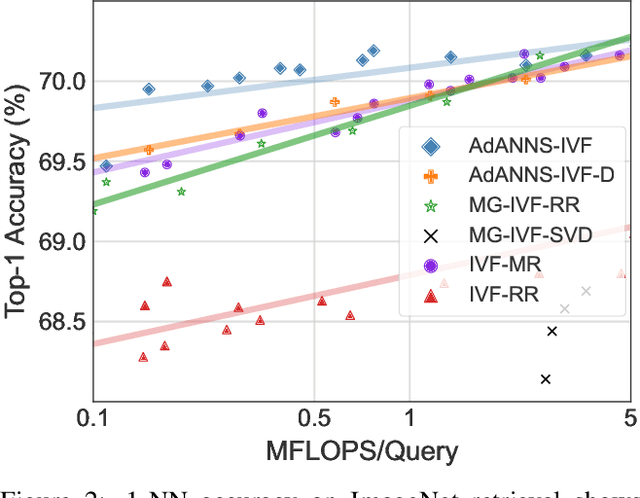

Web-scale search systems learn an encoder to embed a given query which is then hooked into an approximate nearest neighbor search (ANNS) pipeline to retrieve similar data points. To accurately capture tail queries and data points, learned representations typically are rigid, high-dimensional vectors that are generally used as-is in the entire ANNS pipeline and can lead to computationally expensive retrieval. In this paper, we argue that instead of rigid representations, different stages of ANNS can leverage adaptive representations of varying capacities to achieve significantly better accuracy-compute trade-offs, i.e., stages of ANNS that can get away with more approximate computation should use a lower-capacity representation of the same data point. To this end, we introduce AdANNS, a novel ANNS design framework that explicitly leverages the flexibility of Matryoshka Representations. We demonstrate state-of-the-art accuracy-compute trade-offs using novel AdANNS-based key ANNS building blocks like search data structures (AdANNS-IVF) and quantization (AdANNS-OPQ). For example on ImageNet retrieval, AdANNS-IVF is up to 1.5% more accurate than the rigid representations-based IVF at the same compute budget; and matches accuracy while being up to 90x faster in wall-clock time. For Natural Questions, 32-byte AdANNS-OPQ matches the accuracy of the 64-byte OPQ baseline constructed using rigid representations -- same accuracy at half the cost! We further show that the gains from AdANNS translate to modern-day composite ANNS indices that combine search structures and quantization. Finally, we demonstrate that AdANNS can enable inference-time adaptivity for compute-aware search on ANNS indices built non-adaptively on matryoshka representations. Code is open-sourced at https://github.com/RAIVNLab/AdANNS.
DataComp: In search of the next generation of multimodal datasets
May 03, 2023Large multimodal datasets have been instrumental in recent breakthroughs such as CLIP, Stable Diffusion, and GPT-4. At the same time, datasets rarely receive the same research attention as model architectures or training algorithms. To address this shortcoming in the machine learning ecosystem, we introduce DataComp, a benchmark where the training code is fixed and researchers innovate by proposing new training sets. We provide a testbed for dataset experiments centered around a new candidate pool of 12.8B image-text pairs from Common Crawl. Participants in our benchmark design new filtering techniques or curate new data sources and then evaluate their new dataset by running our standardized CLIP training code and testing on 38 downstream test sets. Our benchmark consists of multiple scales, with four candidate pool sizes and associated compute budgets ranging from 12.8M to 12.8B samples seen during training. This multi-scale design facilitates the study of scaling trends and makes the benchmark accessible to researchers with varying resources. Our baseline experiments show that the DataComp workflow is a promising way of improving multimodal datasets. We introduce DataComp-1B, a dataset created by applying a simple filtering algorithm to the 12.8B candidate pool. The resulting 1.4B subset enables training a CLIP ViT-L/14 from scratch to 79.2% zero-shot accuracy on ImageNet. Our new ViT-L/14 model outperforms a larger ViT-g/14 trained on LAION-2B by 0.7 percentage points while requiring 9x less training compute. We also outperform OpenAI's CLIP ViT-L/14 by 3.7 percentage points, which is trained with the same compute budget as our model. These gains highlight the potential for improving model performance by carefully curating training sets. We view DataComp-1B as only the first step and hope that DataComp paves the way toward the next generation of multimodal datasets.