 Add to Chrome
 Add to Firefox
 Add to Edge
IHBench: Evaluating Post-Interruption Recovery in Voice Agents with Structured Workflows
Jun 17, 2026
Voice agents deployed in structured workflows (customer service, healthcare scheduling, account management) must handle frequent user interruptions while maintaining progress through multi-step procedures. Existing benchmarks for speech-capable models focus on the timing of interruptions: barge-in detection, endpointing, and turn-taking dynamics. They leave unmeasured what happens after the interruption: does the agent resume the workflow at the correct step? Does it address the user's interjection? Does it avoid re-delivering content the user already heard? We introduce IHBench (Interruption Handling Benchmark), a benchmark that evaluates post-interruption recovery in voice agents executing state-machine-driven workflows across 10 enterprise domains. Six interruption types are injected at controlled points mid-utterance, with per-interruption evaluation rubrics generated alongside the data. Each interruption is scored on two axes: task fulfillment and recovery quality. We evaluate 27 audio-language model configurations from OpenAI, Google, and the open-weight community. Models vary widely, and recovery quality depends strongly on the interruption type. Across our experiments, closed-weight models are consistently more robust to interruptions than open-weight ones: they win far more often on task fulfillment, degrade roughly 3.3x more slowly as conversations grow longer, and show no audio-versus-text modality gap, whereas the open-weight models lose ground on all three. A human study validates the LLM judge against human annotators, and a cross-benchmark analysis against AudioMultiChallenge indicates that recovery quality is a largely distinct capability axis.

ProactBench: Beyond What The User Asked For
May 09, 2026Most LLM benchmarks score how well a model responds to explicit requests. They leave unmeasured a different conversational ability: noticing and acting on needs the user has implied but not said. We call this \emph{conversational proactivity}. ProactBench decomposes it into three phase-tied types: \textsc{Emergent}, inference from a single disclosed anchor; \textsc{Critical}, synthesis across multiple anchors; and \textsc{Recovery}, grounded forward-looking value after task completion. We operationalise the benchmark with three agents: a Planner, a User Agent, and an Assistant Model. Their information asymmetries defend against style-confounded scoring, rubric leakage, external-context contamination, and information dumps. The released corpus contains 198 curated dialogues with 624 trigger points across 24 communication styles drawn from a psychometric inventory and audited by an independent LLM judge. Across 16 frontier and open-weight models, \textsc{Recovery} is both difficult and weakly predicted by six standard benchmarks, making it a useful new evaluation signal.
The Pokémon Theorem and other Fairness Impossibility Results
May 09, 2026Fairness impossibility results often look like distinct scalar incompatibility statements. We show that several share one RKHS geometry: fairness criteria are linear constraints on conditional mean embeddings, and unequal base rates make the law of total expectation overdetermine those constraints. This view yields four results. The Kleinberg--Mullainathan--Raghavan dichotomy needs only group-conditional unbiasedness, not full calibration. The \emph{Pokémon theorem} shows that a distinct group pair satisfying any finite collection of linear mean-fairness criteria leaves a residual violation witnessed by the MMD, decaying at the Kolmogorov $m$-width rate under spectral regularity. The same tools prove an impossibility for fair feature learning: parity and class-conditional separation in representation space force class collapse under unequal base rates. The approximate relaxations yield signal and error frontiers, allowing a trade-off between real-world estimators and fairness goals. Experiments on standard fairness benchmarks are consistent with our bounds.
Back to Basics: Revisiting ASR in the Age of Voice Agents
Mar 26, 2026Automatic speech recognition (ASR) systems have achieved near-human accuracy on curated benchmarks, yet still fail in real-world voice agents under conditions that current evaluations do not systematically cover. Without diagnostic tools that isolate specific failure factors, practitioners cannot anticipate which conditions, in which languages, will cause what degree of degradation. We introduce WildASR, a multilingual (four-language) diagnostic benchmark sourced entirely from real human speech that factorizes ASR robustness along three axes: environmental degradation, demographic shift, and linguistic diversity. Evaluating seven widely used ASR systems, we find severe and uneven performance degradation, and model robustness does not transfer across languages or conditions. Critically, models often hallucinate plausible but unspoken content under partial or degraded inputs, creating concrete safety risks for downstream agent behavior. Our results demonstrate that targeted, factor-isolated evaluation is essential for understanding and improving ASR reliability in production systems. Besides the benchmark itself, we also present three analytical tools that practitioners can use to guide deployment decisions.
EmergentTTS-Eval: Evaluating TTS Models on Complex Prosodic, Expressiveness, and Linguistic Challenges Using Model-as-a-Judge
May 29, 2025Text-to-Speech (TTS) benchmarks often fail to capture how well models handle nuanced and semantically complex text. Building on $\textit{EmergentTTS}$, we introduce $\textit{EmergentTTS-Eval}$, a comprehensive benchmark covering six challenging TTS scenarios: emotions, paralinguistics, foreign words, syntactic complexity, complex pronunciation (e.g. URLs, formulas), and questions. Crucially, our framework automates both test-case generation and evaluation, making the benchmark easily extensible. Starting from a small set of human-written seed prompts, we iteratively extend them using LLMs to target specific structural, phonetic and prosodic challenges, resulting in 1,645 diverse test cases. Moreover, we employ a model-as-a-judge approach, using a Large Audio Language Model (LALM) to assess the speech across multiple dimensions such as expressed emotion, prosodic, intonational, and pronunciation accuracy. We evaluate state-of-the-art open-source and proprietary TTS systems, such as 11Labs, Deepgram, and OpenAI's 4o-mini-TTS, on EmergentTTS-Eval, demonstrating its ability to reveal fine-grained performance differences. Results show that the model-as-a-judge approach offers robust TTS assessment and a high correlation with human preferences. We open source the evaluation $\href{https://github.com/boson-ai/EmergentTTS-Eval-public}{code}$ and the $\href{https://huggingface.co/datasets/bosonai/EmergentTTS-Eval}{dataset}$.
L3Ms -- Lagrange Large Language Models
Oct 28, 2024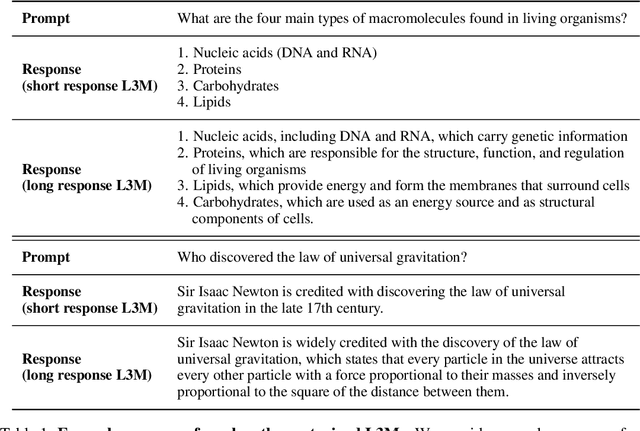
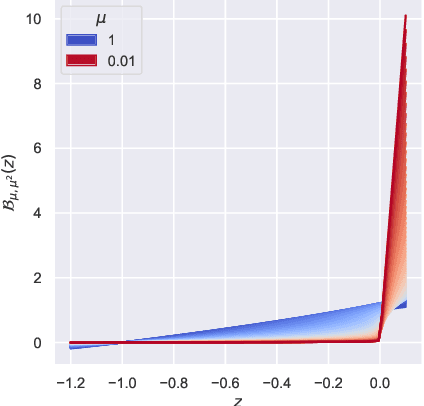
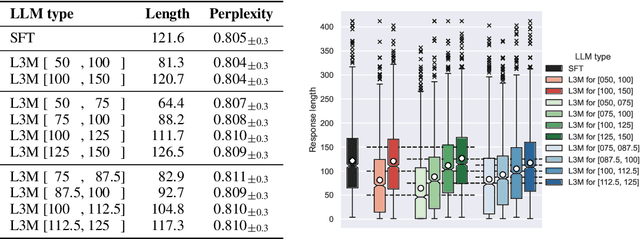
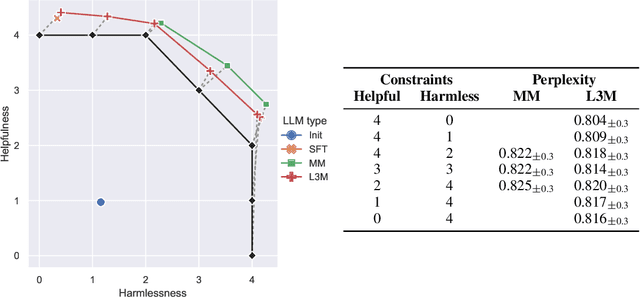
Supervised fine-tuning (SFT) and alignment of large language models (LLMs) are key steps in providing a good user experience. However, the concept of an appropriate alignment is inherently application-dependent, and current methods often rely on heuristic choices to drive the optimization. In this work, we formulate SFT and alignment as a constrained optimization problem, where the LLM is trained on a task while being required to meet application-specific requirements, without resorting to heuristics. To solve this, we propose Lagrange Large Language Models (L3Ms), which employ logarithmic barriers to enforce the constraints. This approach allows for the customization of L3Ms across diverse applications while avoiding heuristic-driven processes. We demonstrate experimentally the versatility and efficacy of L3Ms in achieving tailored alignments for various applications.
A Cheaper and Better Diffusion Language Model with Soft-Masked Noise
Apr 10, 2023Diffusion models that are based on iterative denoising have been recently proposed and leveraged in various generation tasks like image generation. Whereas, as a way inherently built for continuous data, existing diffusion models still have some limitations in modeling discrete data, e.g., languages. For example, the generally used Gaussian noise can not handle the discrete corruption well, and the objectives in continuous spaces fail to be stable for textual data in the diffusion process especially when the dimension is high. To alleviate these issues, we introduce a novel diffusion model for language modeling, Masked-Diffuse LM, with lower training cost and better performances, inspired by linguistic features in languages. Specifically, we design a linguistic-informed forward process which adds corruptions to the text through strategically soft-masking to better noise the textual data. Also, we directly predict the categorical distribution with cross-entropy loss function in every diffusion step to connect the continuous space and discrete space in a more efficient and straightforward way. Through experiments on 5 controlled generation tasks, we demonstrate that our Masked-Diffuse LM can achieve better generation quality than the state-of-the-art diffusion models with better efficiency.
Prompt Pre-Training with Twenty-Thousand Classes for Open-Vocabulary Visual Recognition
Apr 10, 2023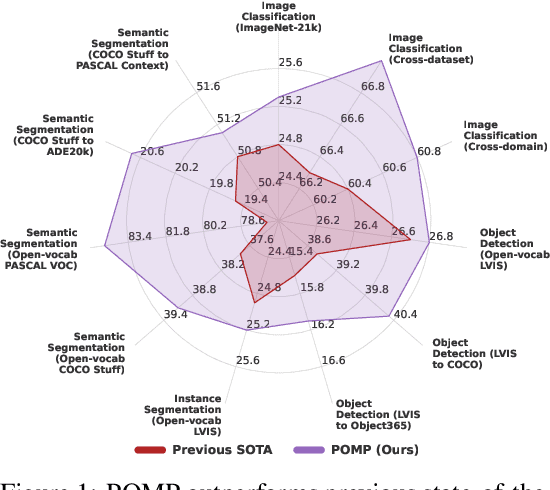
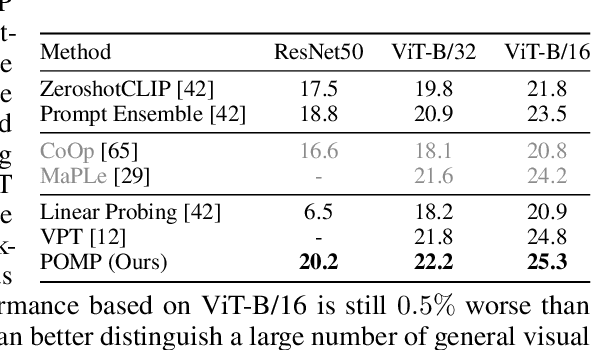
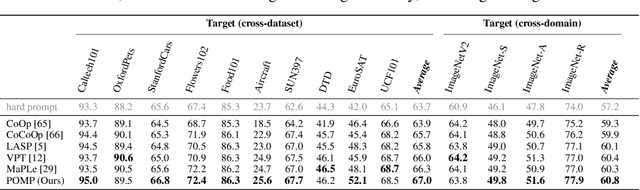
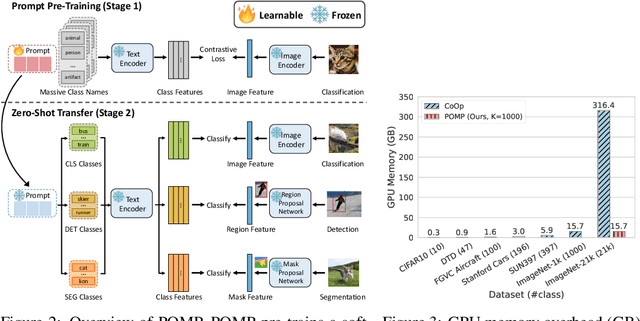
This work proposes POMP, a prompt pre-training method for vision-language models. Being memory and computation efficient, POMP enables the learned prompt to condense semantic information for a rich set of visual concepts with over twenty-thousand classes. Once pre-trained, the prompt with a strong transferable ability can be directly plugged into a variety of visual recognition tasks including image classification, semantic segmentation, and object detection, to boost recognition performances in a zero-shot manner. Empirical evaluation shows that POMP achieves state-of-the-art performances on 21 downstream datasets, e.g., 67.0% average accuracy on 10 classification dataset (+3.1% compared to CoOp) and 84.4 hIoU on open-vocabulary Pascal VOC segmentation (+6.9 compared to ZSSeg).
Multimodal Chain-of-Thought Reasoning in Language Models
Feb 17, 2023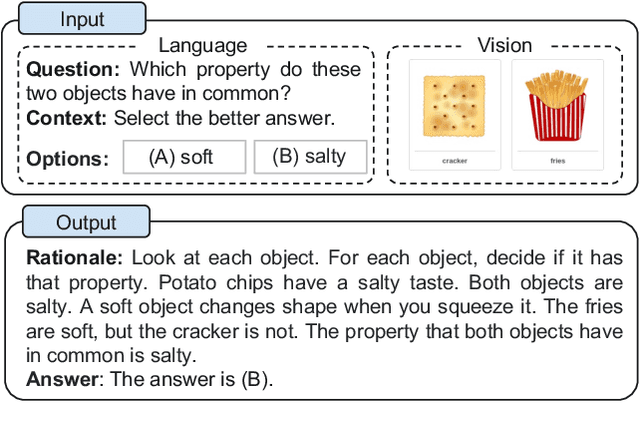
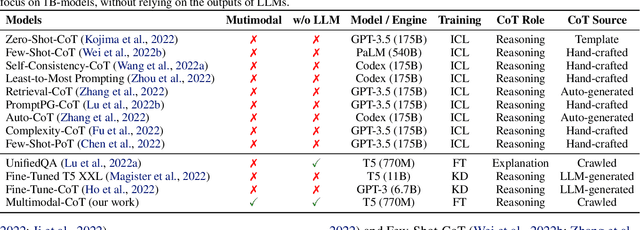
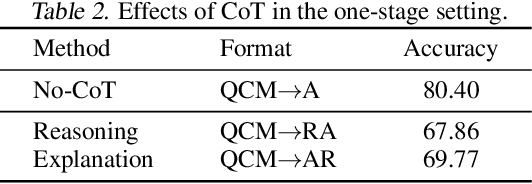
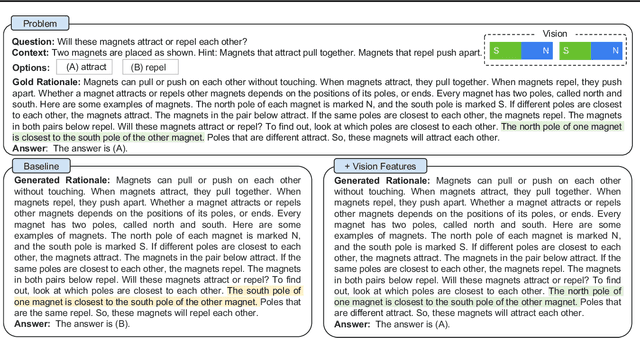
Large language models (LLMs) have shown impressive performance on complex reasoning by leveraging chain-of-thought (CoT) prompting to generate intermediate reasoning chains as the rationale to infer the answer. However, existing CoT studies have focused on the language modality. We propose Multimodal-CoT that incorporates language (text) and vision (images) modalities into a two-stage framework that separates rationale generation and answer inference. In this way, answer inference can leverage better generated rationales that are based on multimodal information. With Multimodal-CoT, our model under 1 billion parameters outperforms the previous state-of-the-art LLM (GPT-3.5) by 16 percentage points (75.17%->91.68% accuracy) on the ScienceQA benchmark and even surpasses human performance. Code is publicly available available at https://github.com/amazon-science/mm-cot.
RLSbench: Domain Adaptation Under Relaxed Label Shift
Feb 06, 2023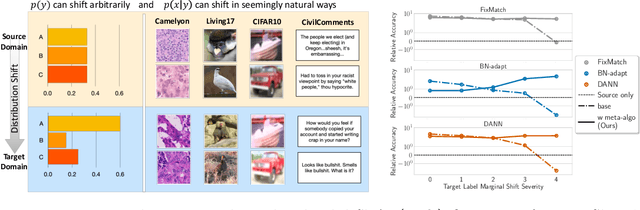
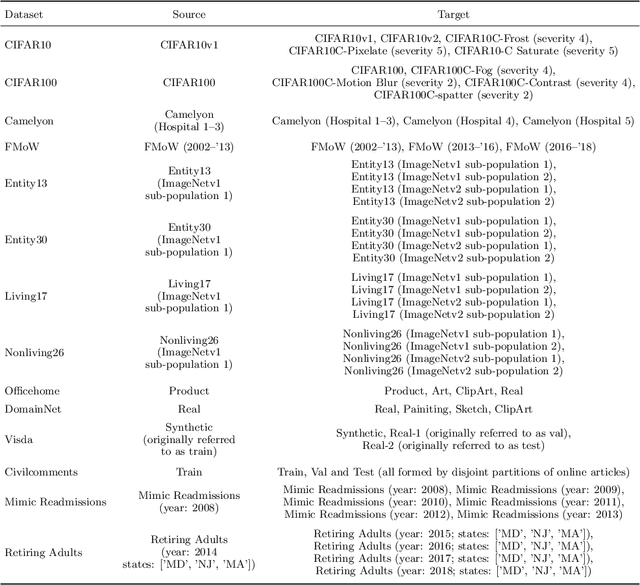
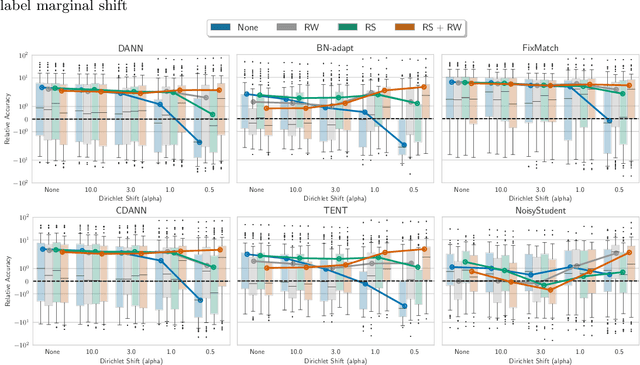

Despite the emergence of principled methods for domain adaptation under label shift, the sensitivity of these methods for minor shifts in the class conditional distributions remains precariously under explored. Meanwhile, popular deep domain adaptation heuristics tend to falter when faced with shifts in label proportions. While several papers attempt to adapt these heuristics to accommodate shifts in label proportions, inconsistencies in evaluation criteria, datasets, and baselines, make it hard to assess the state of the art. In this paper, we introduce RLSbench, a large-scale relaxed label shift benchmark, consisting of >500 distribution shift pairs that draw on 14 datasets across vision, tabular, and language modalities and compose them with varying label proportions. First, we evaluate 13 popular domain adaptation methods, demonstrating more widespread failures under label proportion shifts than were previously known. Next, we develop an effective two-step meta-algorithm that is compatible with most deep domain adaptation heuristics: (i) pseudo-balance the data at each epoch; and (ii) adjust the final classifier with (an estimate of) target label distribution. The meta-algorithm improves existing domain adaptation heuristics often by 2--10\% accuracy points under extreme label proportion shifts and has little (i.e., <0.5\%) effect when label proportions do not shift. We hope that these findings and the availability of RLSbench will encourage researchers to rigorously evaluate proposed methods in relaxed label shift settings. Code is publicly available at https://github.com/acmi-lab/RLSbench.