 Add to Chrome
 Add to Firefox
 Add to Edge
Repetition Improves Language Model Embeddings
Feb 23, 2024

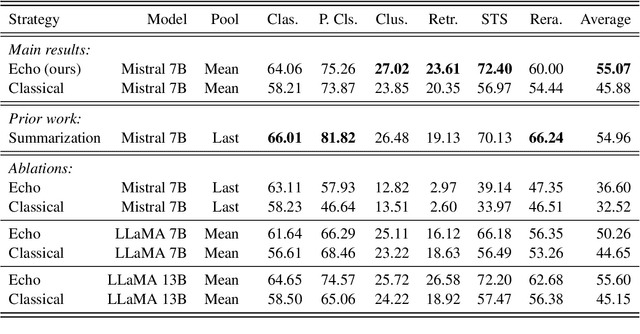


Recent approaches to improving the extraction of text embeddings from autoregressive large language models (LLMs) have largely focused on improvements to data, backbone pretrained language models, or improving task-differentiation via instructions. In this work, we address an architectural limitation of autoregressive models: token embeddings cannot contain information from tokens that appear later in the input. To address this limitation, we propose a simple approach, "echo embeddings," in which we repeat the input twice in context and extract embeddings from the second occurrence. We show that echo embeddings of early tokens can encode information about later tokens, allowing us to maximally leverage high-quality LLMs for embeddings. On the MTEB leaderboard, echo embeddings improve over classical embeddings by over 9% zero-shot and by around 0.7% when fine-tuned. Echo embeddings with a Mistral-7B model achieve state-of-the-art compared to prior open source models that do not leverage synthetic fine-tuning data.

AutoFT: Robust Fine-Tuning by Optimizing Hyperparameters on OOD Data
Jan 18, 2024Foundation models encode rich representations that can be adapted to a desired task by fine-tuning on task-specific data. However, fine-tuning a model on one particular data distribution often compromises the model's original performance on other distributions. Current methods for robust fine-tuning utilize hand-crafted regularization techniques to constrain the fine-tuning process towards the base foundation model. Yet, it is hard to precisely specify what characteristics of the foundation model to retain during fine-tuning, as this depends on how the pre-training, fine-tuning, and evaluation data distributions relate to each other. We propose AutoFT, a data-driven approach for guiding foundation model fine-tuning. AutoFT optimizes fine-tuning hyperparameters to maximize performance on a small out-of-distribution (OOD) validation set. To guide fine-tuning in a granular way, AutoFT searches a highly expressive hyperparameter space that includes weight coefficients for many different losses, in addition to learning rate and weight decay values. We evaluate AutoFT on nine natural distribution shifts which include domain shifts and subpopulation shifts. Our experiments show that AutoFT significantly improves generalization to new OOD data, outperforming existing robust fine-tuning methods. Notably, AutoFT achieves new state-of-the-art performance on the WILDS-iWildCam and WILDS-FMoW benchmarks, outperforming the previous best methods by $6.0\%$ and $1.5\%$, respectively.
Complementary Benefits of Contrastive Learning and Self-Training Under Distribution Shift
Dec 06, 2023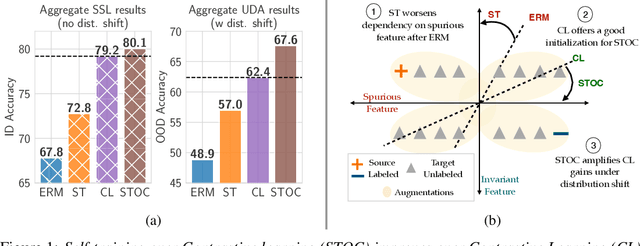
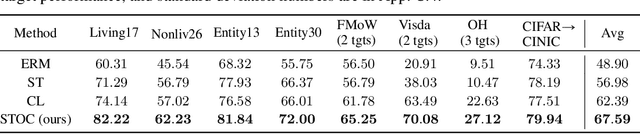

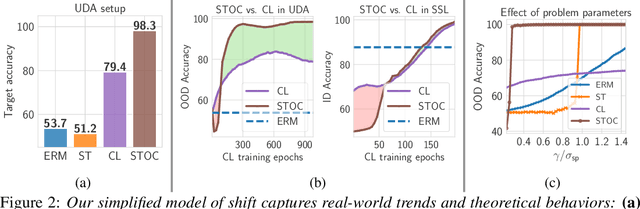
Self-training and contrastive learning have emerged as leading techniques for incorporating unlabeled data, both under distribution shift (unsupervised domain adaptation) and when it is absent (semi-supervised learning). However, despite the popularity and compatibility of these techniques, their efficacy in combination remains unexplored. In this paper, we undertake a systematic empirical investigation of this combination, finding that (i) in domain adaptation settings, self-training and contrastive learning offer significant complementary gains; and (ii) in semi-supervised learning settings, surprisingly, the benefits are not synergistic. Across eight distribution shift datasets (e.g., BREEDs, WILDS), we demonstrate that the combined method obtains 3--8% higher accuracy than either approach independently. We then theoretically analyze these techniques in a simplified model of distribution shift, demonstrating scenarios under which the features produced by contrastive learning can yield a good initialization for self-training to further amplify gains and achieve optimal performance, even when either method alone would fail.
Multitask Learning Can Improve Worst-Group Outcomes
Dec 05, 2023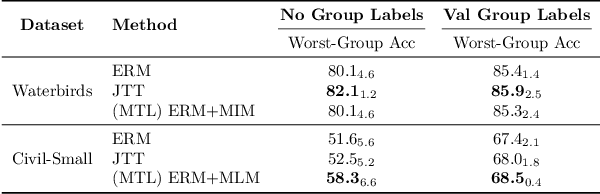
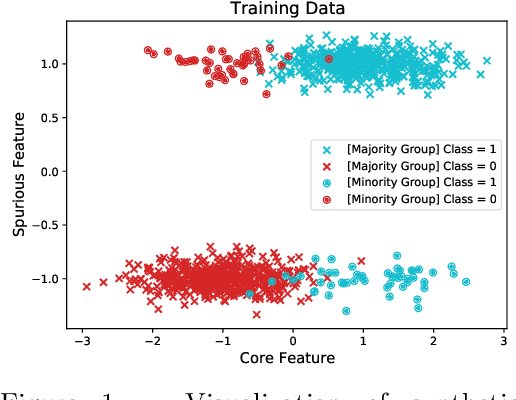
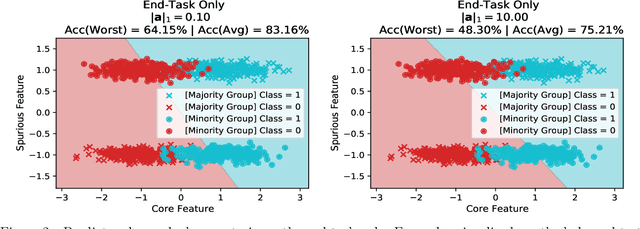
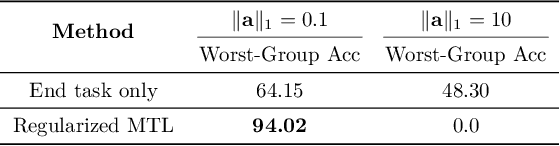
In order to create machine learning systems that serve a variety of users well, it is vital to not only achieve high average performance but also ensure equitable outcomes across diverse groups. However, most machine learning methods are designed to improve a model's average performance on a chosen end task without consideration for their impact on worst group error. Multitask learning (MTL) is one such widely used technique. In this paper, we seek not only to understand the impact of MTL on worst-group accuracy but also to explore its potential as a tool to address the challenge of group-wise fairness. We primarily consider the common setting of fine-tuning a pre-trained model, where, following recent work (Gururangan et al., 2020; Dery et al., 2023), we multitask the end task with the pre-training objective constructed from the end task data itself. In settings with few or no group annotations, we find that multitasking often, but not always, achieves better worst-group accuracy than Just-Train-Twice (JTT; Liu et al. (2021)) -- a representative distributionally robust optimization (DRO) method. Leveraging insights from synthetic data experiments, we propose to modify standard MTL by regularizing the joint multitask representation space. We run a large number of fine-tuning experiments across computer vision and natural language and find that our regularized MTL approach consistently outperforms JTT on both worst and average group outcomes. Our official code can be found here: https://github.com/atharvajk98/MTL-group-robustness.
Reliable Test-Time Adaptation via Agreement-on-the-Line
Oct 07, 2023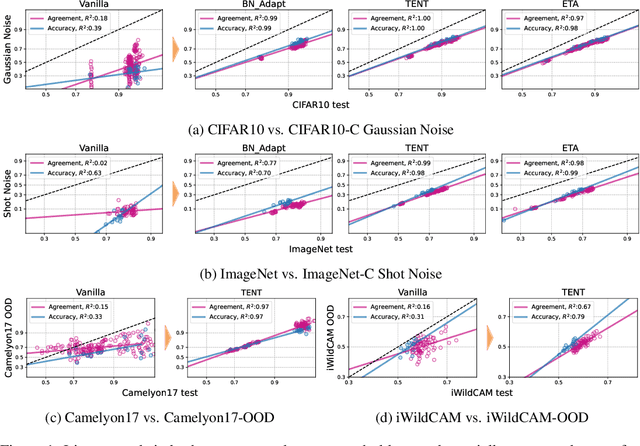
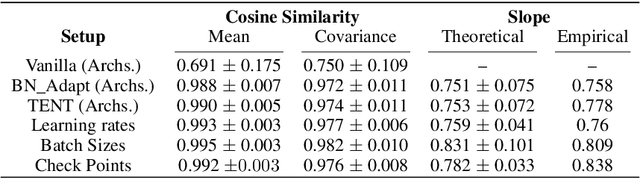
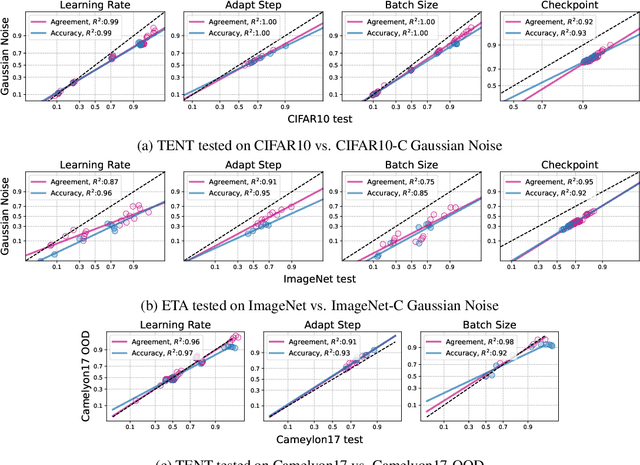
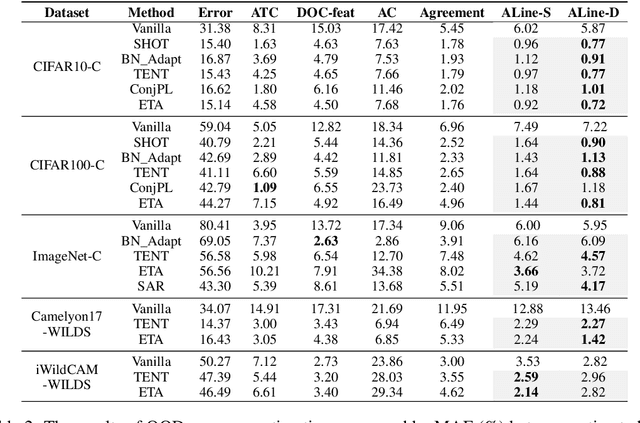
Test-time adaptation (TTA) methods aim to improve robustness to distribution shifts by adapting models using unlabeled data from the shifted test distribution. However, there remain unresolved challenges that undermine the reliability of TTA, which include difficulties in evaluating TTA performance, miscalibration after TTA, and unreliable hyperparameter tuning for adaptation. In this work, we make a notable and surprising observation that TTAed models strongly show the agreement-on-the-line phenomenon (Baek et al., 2022) across a wide range of distribution shifts. We find such linear trends occur consistently in a wide range of models adapted with various hyperparameters, and persist in distributions where the phenomenon fails to hold in vanilla models (i.e., before adaptation). We leverage these observations to make TTA methods more reliable in three perspectives: (i) estimating OOD accuracy (without labeled data) to determine when TTA helps and when it hurts, (ii) calibrating TTAed models without label information, and (iii) reliably determining hyperparameters for TTA without any labeled validation data. Through extensive experiments, we demonstrate that various TTA methods can be precisely evaluated, both in terms of their improvements and degradations. Moreover, our proposed methods on unsupervised calibration and hyperparameters tuning for TTA achieve results close to the ones assuming access to ground-truth labels, in terms of both OOD accuracy and calibration error.
Understanding Catastrophic Forgetting in Language Models via Implicit Inference
Sep 18, 2023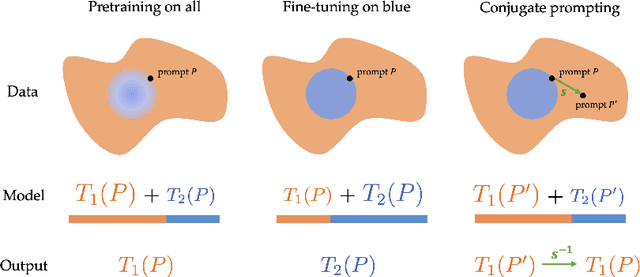
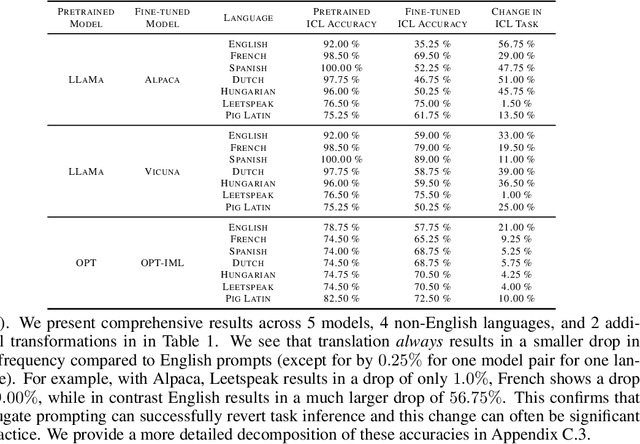

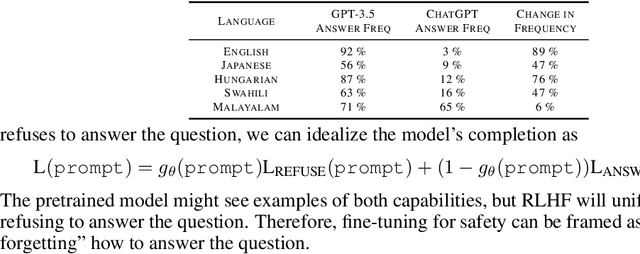
Fine-tuning (via methods such as instruction-tuning or reinforcement learning from human feedback) is a crucial step in training language models to robustly carry out tasks of interest. However, we lack a systematic understanding of the effects of fine-tuning, particularly on tasks outside the narrow fine-tuning distribution. In a simplified scenario, we demonstrate that improving performance on tasks within the fine-tuning data distribution comes at the expense of suppressing model capabilities on other tasks. This degradation is especially pronounced for tasks "closest" to the fine-tuning distribution. We hypothesize that language models implicitly infer the task of the prompt corresponds, and the fine-tuning process predominantly skews this task inference towards tasks in the fine-tuning distribution. To test this hypothesis, we propose Conjugate Prompting to see if we can recover pretrained capabilities. Conjugate prompting artificially makes the task look farther from the fine-tuning distribution while requiring the same capability. We find that conjugate prompting systematically recovers some of the pretraining capabilities on our synthetic setup. We then apply conjugate prompting to real-world LLMs using the observation that fine-tuning distributions are typically heavily skewed towards English. We find that simply translating the prompts to different languages can cause the fine-tuned models to respond like their pretrained counterparts instead. This allows us to recover the in-context learning abilities lost via instruction tuning, and more concerningly, to recover harmful content generation suppressed by safety fine-tuning in chatbots like ChatGPT.
Contextual Reliability: When Different Features Matter in Different Contexts
Jul 19, 2023
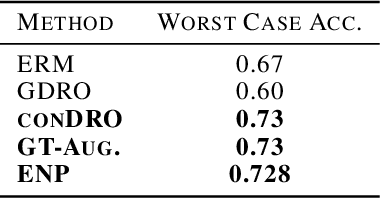
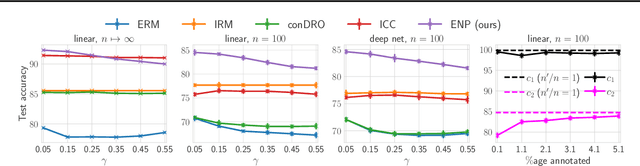
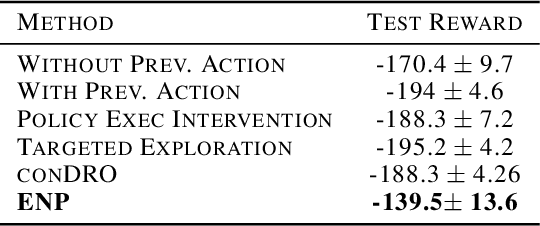
Deep neural networks often fail catastrophically by relying on spurious correlations. Most prior work assumes a clear dichotomy into spurious and reliable features; however, this is often unrealistic. For example, most of the time we do not want an autonomous car to simply copy the speed of surrounding cars -- we don't want our car to run a red light if a neighboring car does so. However, we cannot simply enforce invariance to next-lane speed, since it could provide valuable information about an unobservable pedestrian at a crosswalk. Thus, universally ignoring features that are sometimes (but not always) reliable can lead to non-robust performance. We formalize a new setting called contextual reliability which accounts for the fact that the "right" features to use may vary depending on the context. We propose and analyze a two-stage framework called Explicit Non-spurious feature Prediction (ENP) which first identifies the relevant features to use for a given context, then trains a model to rely exclusively on these features. Our work theoretically and empirically demonstrates the advantages of ENP over existing methods and provides new benchmarks for contextual reliability.
T-MARS: Improving Visual Representations by Circumventing Text Feature Learning
Jul 06, 2023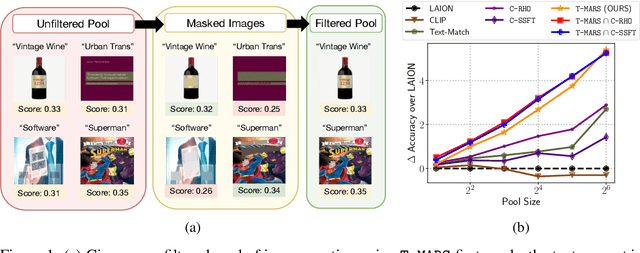
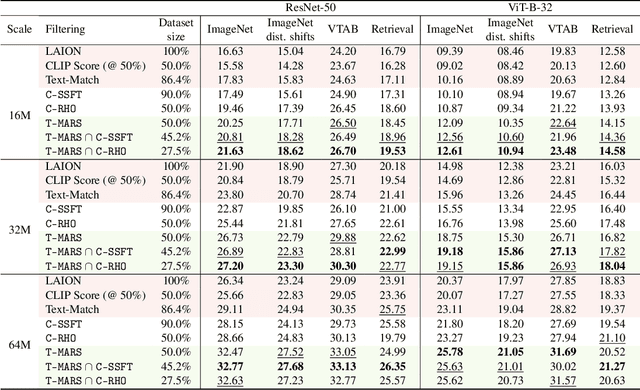
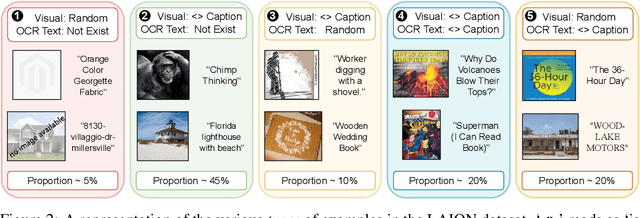
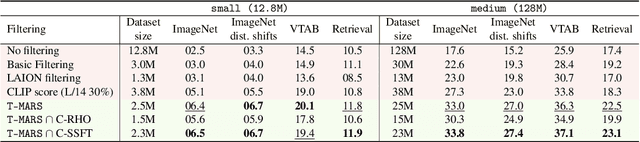
Large web-sourced multimodal datasets have powered a slew of new methods for learning general-purpose visual representations, advancing the state of the art in computer vision and revolutionizing zero- and few-shot recognition. One crucial decision facing practitioners is how, if at all, to curate these ever-larger datasets. For example, the creators of the LAION-5B dataset chose to retain only image-caption pairs whose CLIP similarity score exceeded a designated threshold. In this paper, we propose a new state-of-the-art data filtering approach motivated by our observation that nearly 40% of LAION's images contain text that overlaps significantly with the caption. Intuitively, such data could be wasteful as it incentivizes models to perform optical character recognition rather than learning visual features. However, naively removing all such data could also be wasteful, as it throws away images that contain visual features (in addition to overlapping text). Our simple and scalable approach, T-MARS (Text Masking and Re-Scoring), filters out only those pairs where the text dominates the remaining visual features -- by first masking out the text and then filtering out those with a low CLIP similarity score of the masked image. Experimentally, T-MARS outperforms the top-ranked method on the "medium scale" of DataComp (a data filtering benchmark) by a margin of 6.5% on ImageNet and 4.7% on VTAB. Additionally, our systematic evaluation on various data pool sizes from 2M to 64M shows that the accuracy gains enjoyed by T-MARS linearly increase as data and compute are scaled exponentially. Code is available at https://github.com/locuslab/T-MARS.
ALP: Action-Aware Embodied Learning for Perception
Jun 16, 2023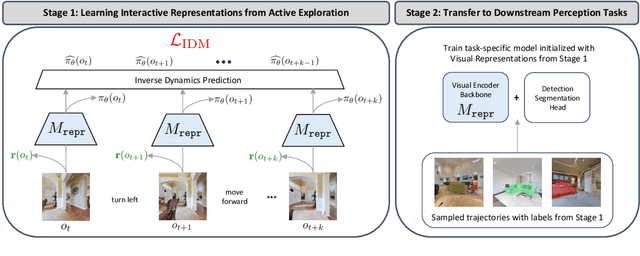

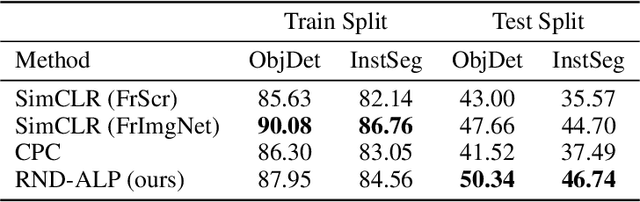
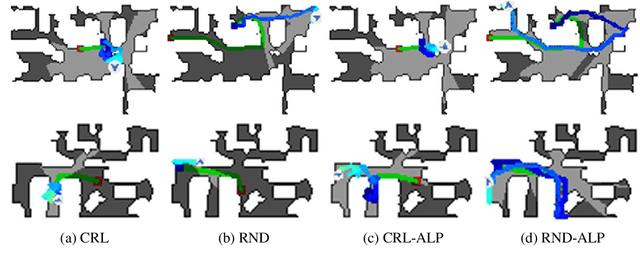
Current methods in training and benchmarking vision models exhibit an over-reliance on passive, curated datasets. Although models trained on these datasets have shown strong performance in a wide variety of tasks such as classification, detection, and segmentation, they fundamentally are unable to generalize to an ever-evolving world due to constant out-of-distribution shifts of input data. Therefore, instead of training on fixed datasets, can we approach learning in a more human-centric and adaptive manner? In this paper, we introduce \textbf{A}ction-aware Embodied \textbf{L}earning for \textbf{P}erception (ALP), an embodied learning framework that incorporates action information into representation learning through a combination of optimizing policy gradients through reinforcement learning and inverse dynamics prediction objectives. Our method actively explores complex 3D environments to both learn generalizable task-agnostic representations as well as collect downstream training data. We show that ALP outperforms existing baselines in object detection and semantic segmentation. In addition, we show that by training on actively collected data more relevant to the environment and task, our method generalizes more robustly to downstream tasks compared to models pre-trained on fixed datasets such as ImageNet.
Automatically Auditing Large Language Models via Discrete Optimization
Mar 08, 2023Auditing large language models for unexpected behaviors is critical to preempt catastrophic deployments, yet remains challenging. In this work, we cast auditing as an optimization problem, where we automatically search for input-output pairs that match a desired target behavior. For example, we might aim to find a non-toxic input that starts with "Barack Obama" that a model maps to a toxic output. This optimization problem is difficult to solve as the set of feasible points is sparse, the space is discrete, and the language models we audit are non-linear and high-dimensional. To combat these challenges, we introduce a discrete optimization algorithm, ARCA, that jointly and efficiently optimizes over inputs and outputs. Our approach automatically uncovers derogatory completions about celebrities (e.g. "Barack Obama is a legalized unborn" -> "child murderer"), produces French inputs that complete to English outputs, and finds inputs that generate a specific name. Our work offers a promising new tool to uncover models' failure-modes before deployment.