 Add to Chrome
 Add to Firefox
 Add to Edge
Developing and evaluating a chatbot to support maternal health care
Mar 13, 2026
The ability to provide trustworthy maternal health information using phone-based chatbots can have a significant impact, particularly in low-resource settings where users have low health literacy and limited access to care. However, deploying such systems is technically challenging: user queries are short, underspecified, and code-mixed across languages, answers require regional context-specific grounding, and partial or missing symptom context makes safe routing decisions difficult. We present a chatbot for maternal health in India developed through a partnership between academic researchers, a health tech company, a public health nonprofit, and a hospital. The system combines (1) stage-aware triage, routing high-risk queries to expert templates, (2) hybrid retrieval over curated maternal/newborn guidelines, and (3) evidence-conditioned generation from an LLM. Our core contribution is an evaluation workflow for high-stakes deployment under limited expert supervision. Targeting both component-level and end-to-end testing, we introduce: (i) a labeled triage benchmark (N=150) achieving 86.7% emergency recall, explicitly reporting the missed-emergency vs. over-escalation trade-off; (ii) a synthetic multi-evidence retrieval benchmark (N=100) with chunk-level evidence labels; (iii) LLM-as-judge comparison on real queries (N=781) using clinician-codesigned criteria; and (iv) expert validation. Our findings show that trustworthy medical assistants in multilingual, noisy settings require defense-in-depth design paired with multi-method evaluation, rather than any single model and evaluation method choice.

Pairwise Spatiotemporal Partial Trajectory Matching for Co-movement Analysis
Dec 03, 2024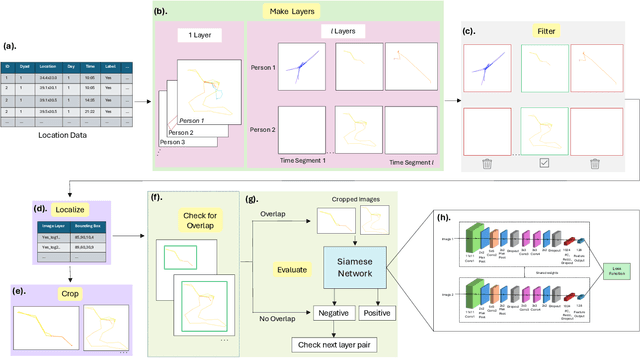
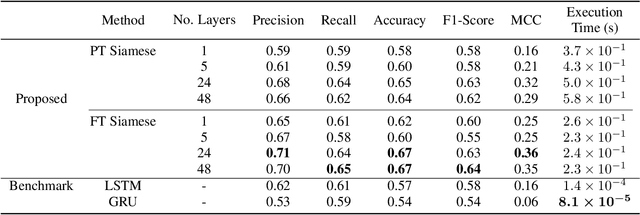
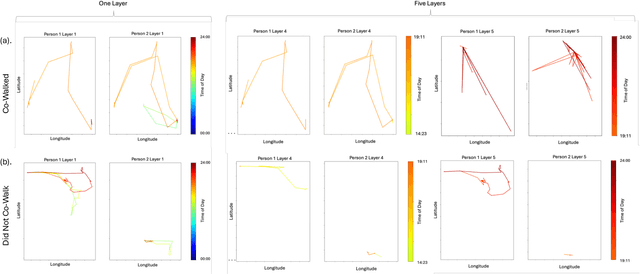
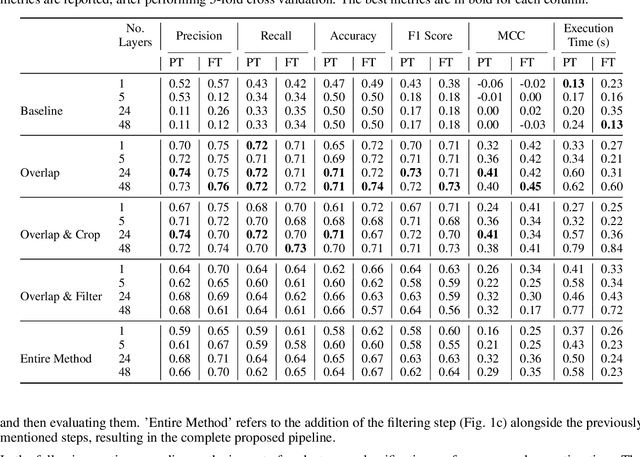
Spatiotemporal pairwise movement analysis involves identifying shared geographic-based behaviors between individuals within specific time frames. Traditionally, this task relies on sequence modeling and behavior analysis techniques applied to tabular or video-based data, but these methods often lack interpretability and struggle to capture partial matching. In this paper, we propose a novel method for pairwise spatiotemporal partial trajectory matching that transforms tabular spatiotemporal data into interpretable trajectory images based on specified time windows, allowing for partial trajectory analysis. This approach includes localization of trajectories, checking for spatial overlap, and pairwise matching using a Siamese Neural Network. We evaluate our method on a co-walking classification task, demonstrating its effectiveness in a novel co-behavior identification application. Our model surpasses established methods, achieving an F1-score up to 0.73. Additionally, we explore the method's utility for pair routine pattern analysis in real-world scenarios, providing insights into the frequency, timing, and duration of shared behaviors. This approach offers a powerful, interpretable framework for spatiotemporal behavior analysis, with potential applications in social behavior research, urban planning, and healthcare.