 Add to Chrome
 Add to Firefox
 Add to Edge
Multi Agent Path Finding
Papers and Code
Windowed MAPF with Completeness Guarantees
Oct 02, 2024
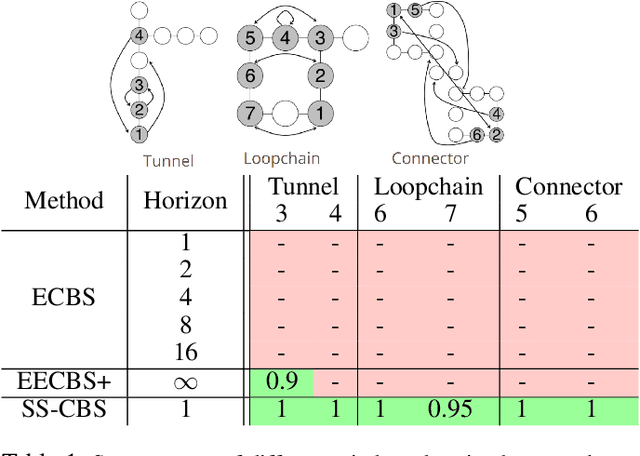
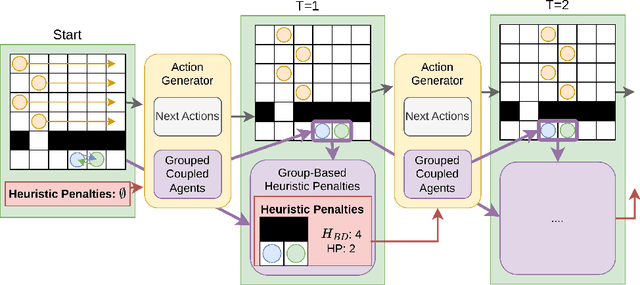
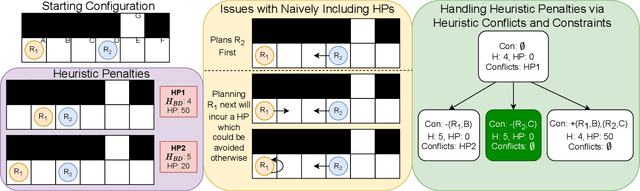
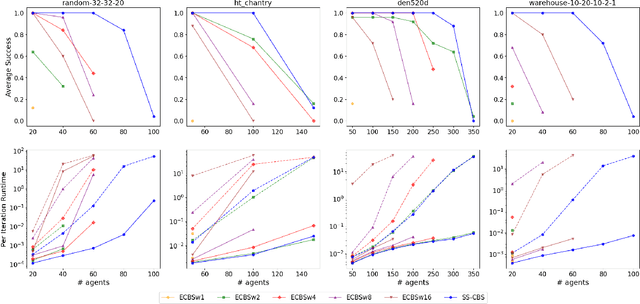
Traditional multi-agent path finding (MAPF) methods try to compute entire start-goal paths which are collision free. However, computing an entire path can take too long for MAPF systems where agents need to replan fast. Methods that address this typically employ a "windowed" approach and only try to find collision free paths for a small windowed timestep horizon. This adaptation comes at the cost of incompleteness; all current windowed approaches can become stuck in deadlock or livelock. Our main contribution is to introduce our framework, WinC-MAPF, for Windowed MAPF that enables completeness. Our framework uses heuristic update insights from single-agent real-time heuristic search algorithms as well as agent independence ideas from MAPF algorithms. We also develop Single-Step CBS (SS-CBS), an instantiation of this framework using a novel modification to CBS. We show how SS-CBS, which only plans a single step and updates heuristics, can effectively solve tough scenarios where existing windowed approaches fail.

Anytime Multi-Agent Path Finding with an Adaptive Delay-Based Heuristic
Aug 06, 2024Anytime multi-agent path finding (MAPF) is a promising approach to scalable path optimization in multi-agent systems. MAPF-LNS, based on Large Neighborhood Search (LNS), is the current state-of-the-art approach where a fast initial solution is iteratively optimized by destroying and repairing selected paths of the solution. Current MAPF-LNS variants commonly use an adaptive selection mechanism to choose among multiple destroy heuristics. However, to determine promising destroy heuristics, MAPF-LNS requires a considerable amount of exploration time. As common destroy heuristics are non-adaptive, any performance bottleneck caused by these heuristics cannot be overcome via adaptive heuristic selection alone, thus limiting the overall effectiveness of MAPF-LNS in terms of solution cost. In this paper, we propose Adaptive Delay-based Destroy-and-Repair Enhanced with Success-based Self-Learning (ADDRESS) as a single-destroy-heuristic variant of MAPF-LNS. ADDRESS applies restricted Thompson Sampling to the top-K set of the most delayed agents to select a seed agent for adaptive LNS neighborhood generation. We evaluate ADDRESS in multiple maps from the MAPF benchmark set and demonstrate cost improvements by at least 50% in large-scale scenarios with up to a thousand agents, compared with the original MAPF-LNS and other state-of-the-art methods.
Benchmarking Large Neighborhood Search for Multi-Agent Path Finding
Jul 12, 2024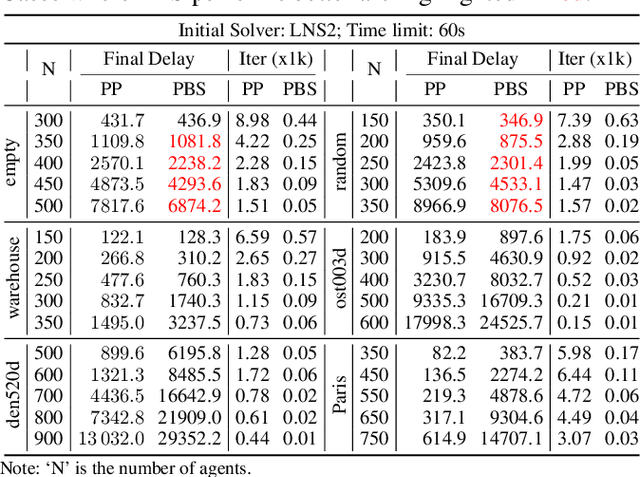
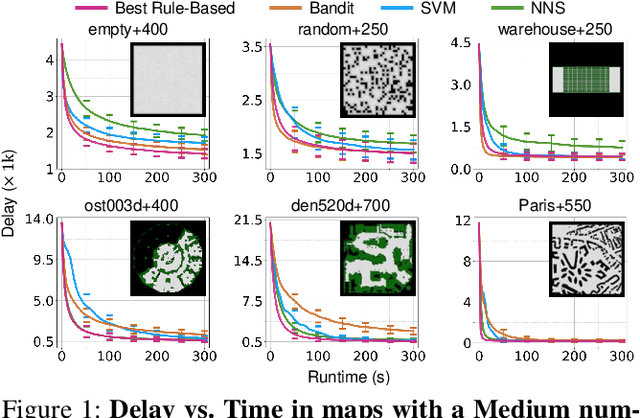
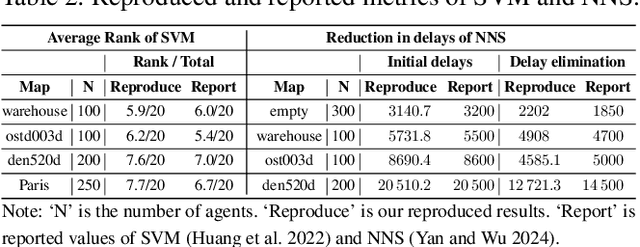
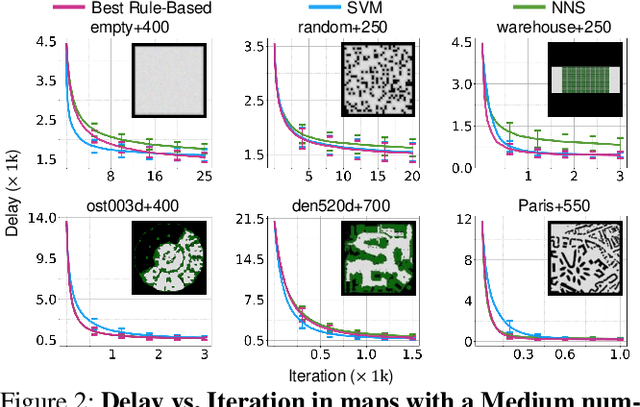
Multi-Agent Path Finding (MAPF) aims to arrange collision-free goal-reaching paths for a group of agents. Anytime MAPF solvers based on large neighborhood search (LNS) have gained prominence recently due to their flexibility and scalability. Neighborhood selection strategy is crucial to the success of MAPF-LNS and a flurry of methods have been proposed. However, several pitfalls exist and hinder a comprehensive evaluation of these new methods, which mainly include: 1) Lower than actual or incorrect baseline performance; 2) Lack of a unified evaluation setting and criterion; 3) Lack of a codebase or executable model for supervised learning methods. To overcome these challenges, we conduct a fair comparison across prominent methods on the same benchmark and hyperparameter search settings. Additionally, we propose a simple neighborhood selection strategy which marks a clear advancement in terms of runtime efficiency in large maps with large number of agents. Our benchmarking evaluation promotes new challenges for existing learning based methods and presents opportunities for future research when machine learning is integrated with MAPF-LNS. Code and data are available at https://github.com/ChristinaTan0704/mapf-lns-benchmark.
Multi-Agent Target Assignment and Path Finding for Intelligent Warehouse: A Cooperative Multi-Agent Deep Reinforcement Learning Perspective
Aug 25, 2024


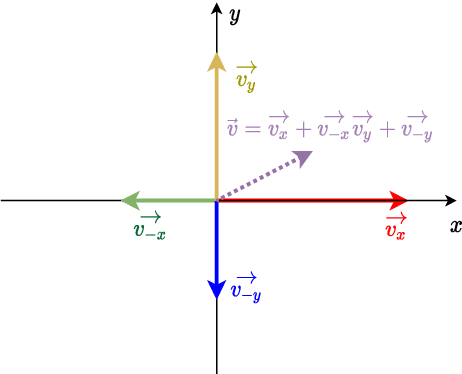
Multi-agent target assignment and path planning (TAPF) are two key problems in intelligent warehouse. However, most literature only addresses one of these two problems separately. In this study, we propose a method to simultaneously solve target assignment and path planning from a perspective of cooperative multi-agent deep reinforcement learning (RL). To the best of our knowledge, this is the first work to model the TAPF problem for intelligent warehouse to cooperative multi-agent deep RL, and the first to simultaneously address TAPF based on multi-agent deep RL. Furthermore, previous literature rarely considers the physical dynamics of agents. In this study, the physical dynamics of the agents is considered. Experimental results show that our method performs well in various task settings, which means that the target assignment is solved reasonably well and the planned path is almost shortest. Moreover, our method is more time-efficient than baselines.
Work Smarter Not Harder: Simple Imitation Learning with CS-PIBT Outperforms Large Scale Imitation Learning for MAPF
Sep 22, 2024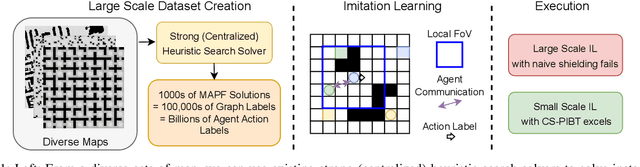
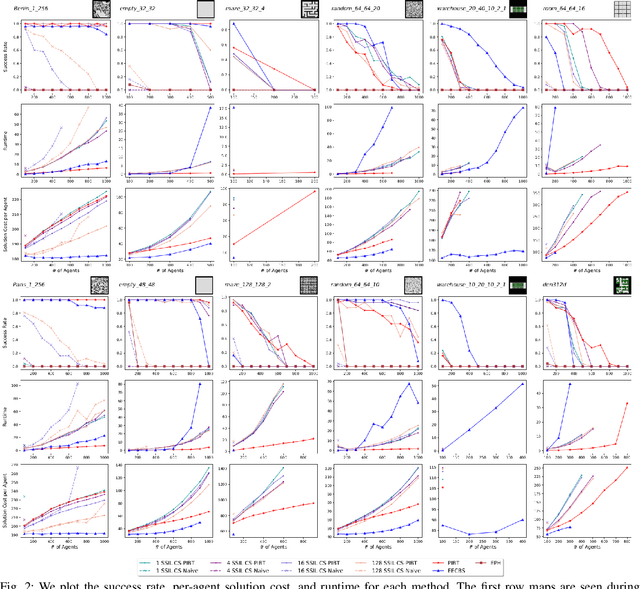
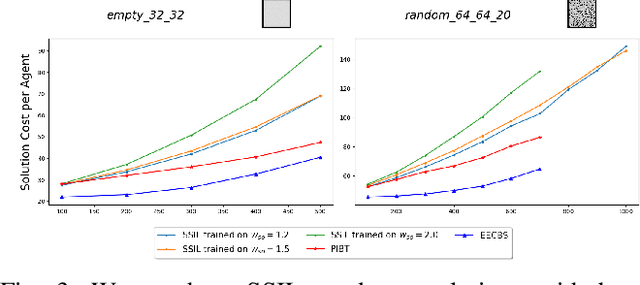

Multi-Agent Path Finding (MAPF) is the problem of effectively finding efficient collision-free paths for a group of agents in a shared workspace. The MAPF community has largely focused on developing high-performance heuristic search methods. Recently, several works have applied various machine learning (ML) techniques to solve MAPF, usually involving sophisticated architectures, reinforcement learning techniques, and set-ups, but none using large amounts of high-quality supervised data. Our initial objective in this work was to show how simple large scale imitation learning of high-quality heuristic search methods can lead to state-of-the-art ML MAPF performance. However, we find that, at least with our model architecture, simple large scale (700k examples with hundreds of agents per example) imitation learning does \textit{not} produce impressive results. Instead, we find that by using prior work that post-processes MAPF model predictions to resolve 1-step collisions (CS-PIBT), we can train a simple ML MAPF model in minutes that dramatically outperforms existing ML MAPF policies. This has serious implications for all future ML MAPF policies (with local communication) which currently struggle to scale. In particular, this finding implies that future learnt policies should (1) always use smart 1-step collision shields (e.g. CS-PIBT), (2) always include the collision shield with greedy actions as a baseline (e.g. PIBT) and (3) motivates future models to focus on longer horizon / more complex planning as 1-step collisions can be efficiently resolved.
Agent-Centric Projection of Prompting Techniques and Implications for Synthetic Training Data for Large Language Models
Jan 14, 2025Recent advances in prompting techniques and multi-agent systems for Large Language Models (LLMs) have produced increasingly complex approaches. However, we lack a framework for characterizing and comparing prompting techniques or understanding their relationship to multi-agent LLM systems. This position paper introduces and explains the concepts of linear contexts (a single, continuous sequence of interactions) and non-linear contexts (branching or multi-path) in LLM systems. These concepts enable the development of an agent-centric projection of prompting techniques, a framework that can reveal deep connections between prompting strategies and multi-agent systems. We propose three conjectures based on this framework: (1) results from non-linear prompting techniques can predict outcomes in equivalent multi-agent systems, (2) multi-agent system architectures can be replicated through single-LLM prompting techniques that simulate equivalent interaction patterns, and (3) these equivalences suggest novel approaches for generating synthetic training data. We argue that this perspective enables systematic cross-pollination of research findings between prompting and multi-agent domains, while providing new directions for improving both the design and training of future LLM systems.
Hijacking Vision-and-Language Navigation Agents with Adversarial Environmental Attacks
Dec 03, 2024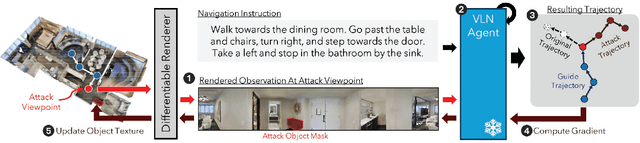
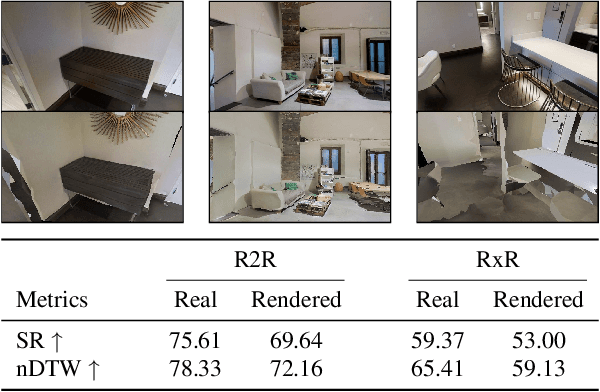

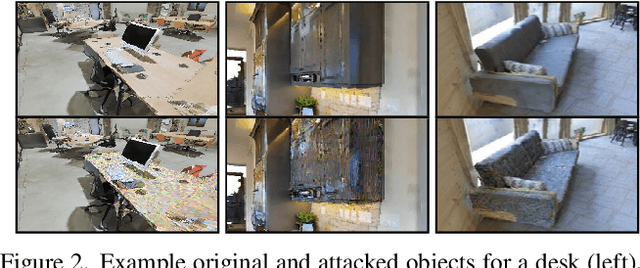
Assistive embodied agents that can be instructed in natural language to perform tasks in open-world environments have the potential to significantly impact labor tasks like manufacturing or in-home care -- benefiting the lives of those who come to depend on them. In this work, we consider how this benefit might be hijacked by local modifications in the appearance of the agent's operating environment. Specifically, we take the popular Vision-and-Language Navigation (VLN) task as a representative setting and develop a whitebox adversarial attack that optimizes a 3D attack object's appearance to induce desired behaviors in pretrained VLN agents that observe it in the environment. We demonstrate that the proposed attack can cause VLN agents to ignore their instructions and execute alternative actions after encountering the attack object -- even for instructions and agent paths not considered when optimizing the attack. For these novel settings, we find our attacks can induce early-termination behaviors or divert an agent along an attacker-defined multi-step trajectory. Under both conditions, environmental attacks significantly reduce agent capabilities to successfully follow user instructions.
Algorithm Selection for Optimal Multi-Agent Path Finding via Graph Embedding
Jun 16, 2024
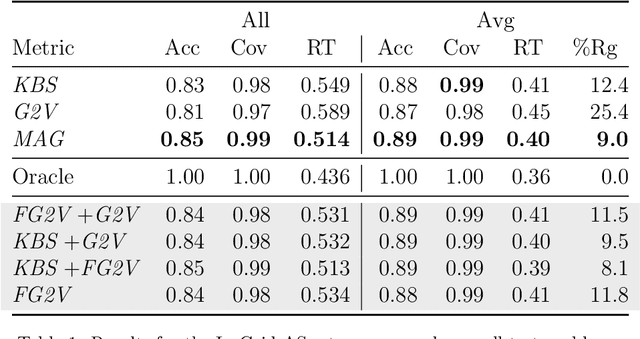

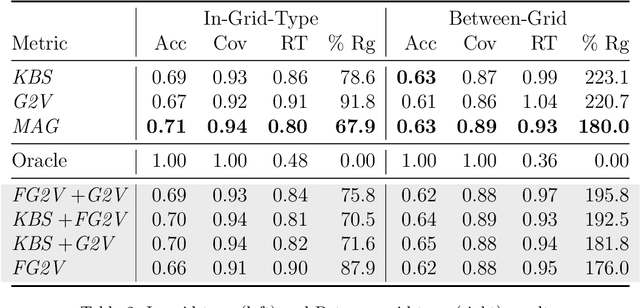
Multi-agent path finding (MAPF) is the problem of finding paths for multiple agents such that they do not collide. This problem manifests in numerous real-world applications such as controlling transportation robots in automated warehouses, moving characters in video games, and coordinating self-driving cars in intersections. Finding optimal solutions to MAPF is NP-Hard, yet modern optimal solvers can scale to hundreds of agents and even thousands in some cases. Different solvers employ different approaches, and there is no single state-of-the-art approach for all problems. Furthermore, there are no clear, provable, guidelines for choosing when each optimal MAPF solver to use. Prior work employed Algorithm Selection (AS) techniques to learn such guidelines from past data. A major challenge when employing AS for choosing an optimal MAPF algorithm is how to encode the given MAPF problem. Prior work either used hand-crafted features or an image representation of the problem. We explore graph-based encodings of the MAPF problem and show how they can be used on-the-fly with a modern graph embedding algorithm called FEATHER. Then, we show how this encoding can be effectively joined with existing encodings, resulting in a novel AS method we call MAPF Algorithm selection via Graph embedding (MAG). An extensive experimental evaluation of MAG on several MAPF algorithm selection tasks reveals that it is either on-par or significantly better than existing methods.
Expected $1.x$-Makespan-Optimal MAPF on Grids in Low-Poly Time
Aug 09, 2024Multi-Agent Path Finding (MAPF) is NP-hard to solve optimally, even on graphs, suggesting no polynomial-time algorithms can compute exact optimal solutions for them. This raises a natural question: How optimal can polynomial-time algorithms reach? Whereas algorithms for computing constant-factor optimal solutions have been developed, the constant factor is generally very large, limiting their application potential. In this work, among other breakthroughs, we propose the first low-polynomial-time MAPF algorithms delivering $1$-$1.5$ (resp., $1$-$1.67$) asymptotic makespan optimality guarantees for 2D (resp., 3D) grids for random instances at a very high $1/3$ agent density, with high probability. Moreover, when regularly distributed obstacles are introduced, our methods experience no performance degradation. These methods generalize to support $100\%$ agent density. Regardless of the dimensionality and density, our high-quality methods are enabled by a unique hierarchical integration of two key building blocks. At the higher level, we apply the labeled Grid Rearrangement Algorithm (RTA), capable of performing efficient reconfiguration on grids through row/column shuffles. At the lower level, we devise novel methods that efficiently simulate row/column shuffles returned by RTA. Our implementations of RTA-based algorithms are highly effective in extensive numerical evaluations, demonstrating excellent scalability compared to other SOTA methods. For example, in 3D settings, \rta-based algorithms readily scale to grids with over $370,000$ vertices and over $120,000$ agents and consistently achieve conservative makespan optimality approaching $1.5$, as predicted by our theoretical analysis.
Social Behavior as a Key to Learning-based Multi-Agent Pathfinding Dilemmas
Aug 06, 2024The Multi-agent Path Finding (MAPF) problem involves finding collision-free paths for a team of agents in a known, static environment, with important applications in warehouse automation, logistics, or last-mile delivery. To meet the needs of these large-scale applications, current learning-based methods often deploy the same fully trained, decentralized network to all agents to improve scalability. However, such parameter sharing typically results in homogeneous behaviors among agents, which may prevent agents from breaking ties around symmetric conflict (e.g., bottlenecks) and might lead to live-/deadlocks. In this paper, we propose SYLPH, a novel learning-based MAPF framework aimed to mitigate the adverse effects of homogeneity by allowing agents to learn and dynamically select different social behaviors (akin to individual, dynamic roles), without affecting the scalability offered by parameter sharing. Specifically, SYLPH agents learn to select their Social Value Orientation (SVO) given the situation at hand, quantifying their own level of selfishness/altruism, as well as an SVO-conditioned MAPF policy dictating their movement actions. To these ends, each agent first determines the most influential other agent in the system by predicting future conflicts/interactions with other agents. Each agent selects its own SVO towards that agent, and trains its decentralized MAPF policy to enact this SVO until another agent becomes more influential. To further allow agents to consider each others' social preferences, each agent gets access to the SVO value of their neighbors. As a result of this hierarchical decision-making and exchange of social preferences, SYLPH endows agents with the ability to reason about the MAPF task through more latent spaces and nuanced contexts, leading to varied responses that can help break ties around symmetric conflicts. [...]