 Add to Chrome
 Add to Firefox
 Add to Edge
Photoplethysmography
Photoplethysmography (PPG) is a non-invasive optical technique used to measure blood volume changes in the microvascular bed of tissue.
Papers and Code
Gaze into the Heart: A Multi-View Video Dataset for rPPG and Health Biomarkers Estimation
Aug 25, 2025
Progress in remote PhotoPlethysmoGraphy (rPPG) is limited by the critical issues of existing publicly available datasets: small size, privacy concerns with facial videos, and lack of diversity in conditions. The paper introduces a novel comprehensive large-scale multi-view video dataset for rPPG and health biomarkers estimation. Our dataset comprises 3600 synchronized video recordings from 600 subjects, captured under varied conditions (resting and post-exercise) using multiple consumer-grade cameras at different angles. To enable multimodal analysis of physiological states, each recording is paired with a 100 Hz PPG signal and extended health metrics, such as electrocardiogram, arterial blood pressure, biomarkers, temperature, oxygen saturation, respiratory rate, and stress level. Using this data, we train an efficient rPPG model and compare its quality with existing approaches in cross-dataset scenarios. The public release of our dataset and model should significantly speed up the progress in the development of AI medical assistants.

Robust and Generalizable Heart Rate Estimation via Deep Learning for Remote Photoplethysmography in Complex Scenarios
Jul 10, 2025Non-contact remote photoplethysmography (rPPG) technology enables heart rate measurement from facial videos. However, existing network models still face challenges in accu racy, robustness, and generalization capability under complex scenarios. This paper proposes an end-to-end rPPG extraction network that employs 3D convolutional neural networks to reconstruct accurate rPPG signals from raw facial videos. We introduce a differential frame fusion module that integrates differential frames with original frames, enabling frame-level representations to capture blood volume pulse (BVP) variations. Additionally, we incorporate Temporal Shift Module (TSM) with self-attention mechanisms, which effectively enhance rPPG features with minimal computational overhead. Furthermore, we propose a novel dynamic hybrid loss function that provides stronger supervision for the network, effectively mitigating over fitting. Comprehensive experiments were conducted on not only the PURE and UBFC-rPPG datasets but also the challenging MMPD dataset under complex scenarios, involving both intra dataset and cross-dataset evaluations, which demonstrate the superior robustness and generalization capability of our network. Specifically, after training on PURE, our model achieved a mean absolute error (MAE) of 7.58 on the MMPD test set, outperforming the state-of-the-art models.
Not Only Consistency: Enhance Test-Time Adaptation with Spatio-temporal Inconsistency for Remote Physiological Measurement
Jul 10, 2025Remote photoplethysmography (rPPG) has emerged as a promising non-invasive method for monitoring physiological signals using the camera. Although various domain adaptation and generalization methods were proposed to promote the adaptability of deep-based rPPG models in unseen deployment environments, considerations in aspects like privacy concerns and real-time adaptation restrict their application in real-world deployment. Thus, we aim to propose a novel fully Test-Time Adaptation (TTA) strategy tailored for rPPG tasks in this work. Specifically, based on prior knowledge in physiology and our observations, we noticed not only there is spatio-temporal consistency in the frequency domain of rPPG signals, but also that inconsistency in the time domain was significant. Given this, by leveraging both consistency and inconsistency priors, we introduce an innovative expert knowledge-based self-supervised \textbf{C}onsistency-\textbf{i}n\textbf{C}onsistency-\textbf{i}ntegration (\textbf{CiCi}) framework to enhances model adaptation during inference. Besides, our approach further incorporates a gradient dynamic control mechanism to mitigate potential conflicts between priors, ensuring stable adaptation across instances. Through extensive experiments on five diverse datasets under the TTA protocol, our method consistently outperforms existing techniques, presenting state-of-the-art performance in real-time self-supervised adaptation without accessing source data. The code will be released later.
CAST-Phys: Contactless Affective States Through Physiological signals Database
Jul 08, 2025In recent years, affective computing and its applications have become a fast-growing research topic. Despite significant advancements, the lack of affective multi-modal datasets remains a major bottleneck in developing accurate emotion recognition systems. Furthermore, the use of contact-based devices during emotion elicitation often unintentionally influences the emotional experience, reducing or altering the genuine spontaneous emotional response. This limitation highlights the need for methods capable of extracting affective cues from multiple modalities without physical contact, such as remote physiological emotion recognition. To address this, we present the Contactless Affective States Through Physiological Signals Database (CAST-Phys), a novel high-quality dataset explicitly designed for multi-modal remote physiological emotion recognition using facial and physiological cues. The dataset includes diverse physiological signals, such as photoplethysmography (PPG), electrodermal activity (EDA), and respiration rate (RR), alongside high-resolution uncompressed facial video recordings, enabling the potential for remote signal recovery. Our analysis highlights the crucial role of physiological signals in realistic scenarios where facial expressions alone may not provide sufficient emotional information. Furthermore, we demonstrate the potential of remote multi-modal emotion recognition by evaluating the impact of individual and fused modalities, showcasing its effectiveness in advancing contactless emotion recognition technologies.
Non-Contact Health Monitoring During Daily Personal Care Routines
Jun 11, 2025Remote photoplethysmography (rPPG) enables non-contact, continuous monitoring of physiological signals and offers a practical alternative to traditional health sensing methods. Although rPPG is promising for daily health monitoring, its application in long-term personal care scenarios, such as mirror-facing routines in high-altitude environments, remains challenging due to ambient lighting variations, frequent occlusions from hand movements, and dynamic facial postures. To address these challenges, we present LADH (Long-term Altitude Daily Health), the first long-term rPPG dataset containing 240 synchronized RGB and infrared (IR) facial videos from 21 participants across five common personal care scenarios, along with ground-truth PPG, respiration, and blood oxygen signals. Our experiments demonstrate that combining RGB and IR video inputs improves the accuracy and robustness of non-contact physiological monitoring, achieving a mean absolute error (MAE) of 4.99 BPM in heart rate estimation. Furthermore, we find that multi-task learning enhances performance across multiple physiological indicators simultaneously. Dataset and code are open at https://github.com/McJackTang/FusionVitals.
Versatile Cardiovascular Signal Generation with a Unified Diffusion Transformer
May 28, 2025Cardiovascular signals such as photoplethysmography (PPG), electrocardiography (ECG), and blood pressure (BP) are inherently correlated and complementary, together reflecting the health of cardiovascular system. However, their joint utilization in real-time monitoring is severely limited by diverse acquisition challenges from noisy wearable recordings to burdened invasive procedures. Here we propose UniCardio, a multi-modal diffusion transformer that reconstructs low-quality signals and synthesizes unrecorded signals in a unified generative framework. Its key innovations include a specialized model architecture to manage the signal modalities involved in generation tasks and a continual learning paradigm to incorporate varying modality combinations. By exploiting the complementary nature of cardiovascular signals, UniCardio clearly outperforms recent task-specific baselines in signal denoising, imputation, and translation. The generated signals match the performance of ground-truth signals in detecting abnormal health conditions and estimating vital signs, even in unseen domains, while ensuring interpretability for human experts. These advantages position UniCardio as a promising avenue for advancing AI-assisted healthcare.
Non-Invasive Arterial Pulse Detection with Millimeter-wave Radar and Comparison With Photoplethysmography
May 19, 2025Cardiovascular diseases remain a leading cause of mortality and disability. The convenient measurement of cardiovascular health using smart systems is therefore a key enabler to foster accurate and early detection and diagnosis of cardiovascular diseases and it require accessing a correct pulse morphology similar to arterial pressure wave. This paper investigates the comparison between different sensor modalities, such as mmWave and photoplethysmography from the same physiological site and reference continuous non-invasive blood pressure devide. We have developed a hardware prototype and established an experiment consist of 23 test participants. Both mmWave and PPG are capable of detecting inter-beat intervals. mmWave is providing more accurate arterial pulse waveform than green photoplethysmography.
Uncertainty quantification with approximate variational learning for wearable photoplethysmography prediction tasks
May 16, 2025Photoplethysmography (PPG) signals encode information about relative changes in blood volume that can be used to assess various aspects of cardiac health non-invasively, e.g.\ to detect atrial fibrillation (AF) or predict blood pressure (BP). Deep networks are well-equipped to handle the large quantities of data acquired from wearable measurement devices. However, they lack interpretability and are prone to overfitting, leaving considerable risk for poor performance on unseen data and misdiagnosis. Here, we describe the use of two scalable uncertainty quantification techniques: Monte Carlo Dropout and the recently proposed Improved Variational Online Newton. These techniques are used to assess the trustworthiness of models trained to perform AF classification and BP regression from raw PPG time series. We find that the choice of hyperparameters has a considerable effect on the predictive performance of the models and on the quality and composition of predicted uncertainties. E.g. the stochasticity of the model parameter sampling determines the proportion of the total uncertainty that is aleatoric, and has varying effects on predictive performance and calibration quality dependent on the chosen uncertainty quantification technique and the chosen expression of uncertainty. We find significant discrepancy in the quality of uncertainties over the predicted classes, emphasising the need for a thorough evaluation protocol that assesses local and adaptive calibration. This work suggests that the choice of hyperparameters must be carefully tuned to balance predictive performance and calibration quality, and that the optimal parameterisation may vary depending on the chosen expression of uncertainty.
Efficient and Robust Multidimensional Attention in Remote Physiological Sensing through Target Signal Constrained Factorization
May 11, 2025Remote physiological sensing using camera-based technologies offers transformative potential for non-invasive vital sign monitoring across healthcare and human-computer interaction domains. Although deep learning approaches have advanced the extraction of physiological signals from video data, existing methods have not been sufficiently assessed for their robustness to domain shifts. These shifts in remote physiological sensing include variations in ambient conditions, camera specifications, head movements, facial poses, and physiological states which often impact real-world performance significantly. Cross-dataset evaluation provides an objective measure to assess generalization capabilities across these domain shifts. We introduce Target Signal Constrained Factorization module (TSFM), a novel multidimensional attention mechanism that explicitly incorporates physiological signal characteristics as factorization constraints, allowing more precise feature extraction. Building on this innovation, we present MMRPhys, an efficient dual-branch 3D-CNN architecture designed for simultaneous multitask estimation of photoplethysmography (rPPG) and respiratory (rRSP) signals from multimodal RGB and thermal video inputs. Through comprehensive cross-dataset evaluation on five benchmark datasets, we demonstrate that MMRPhys with TSFM significantly outperforms state-of-the-art methods in generalization across domain shifts for rPPG and rRSP estimation, while maintaining a minimal inference latency suitable for real-time applications. Our approach establishes new benchmarks for robust multitask and multimodal physiological sensing and offers a computationally efficient framework for practical deployment in unconstrained environments. The web browser-based application featuring on-device real-time inference of MMRPhys model is available at https://physiologicailab.github.io/mmrphys-live
A Dataset and Toolkit for Multiparameter Cardiovascular Physiology Sensing on Rings
May 08, 2025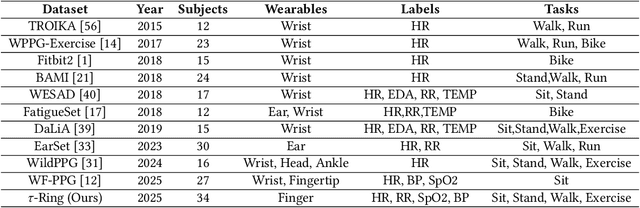
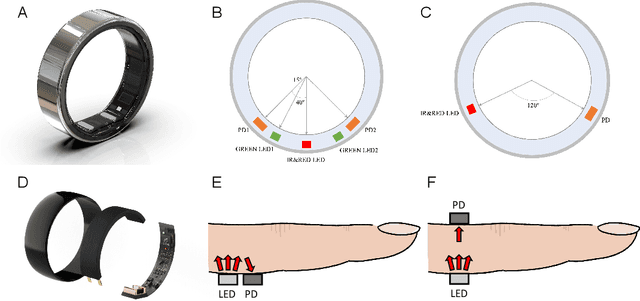
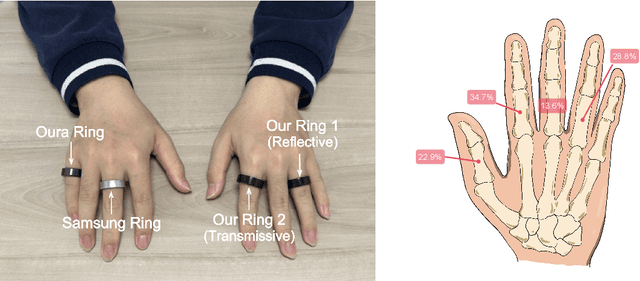
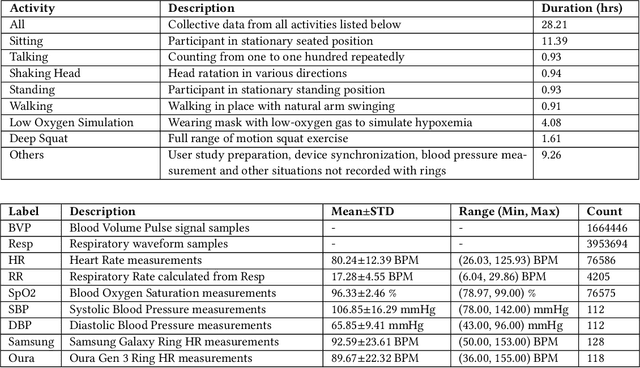
Smart rings offer a convenient way to continuously and unobtrusively monitor cardiovascular physiological signals. However, a gap remains between the ring hardware and reliable methods for estimating cardiovascular parameters, partly due to the lack of publicly available datasets and standardized analysis tools. In this work, we present $\tau$-Ring, the first open-source ring-based dataset designed for cardiovascular physiological sensing. The dataset comprises photoplethysmography signals (infrared and red channels) and 3-axis accelerometer data collected from two rings (reflective and transmissive optical paths), with 28.21 hours of raw data from 34 subjects across seven activities. $\tau$-Ring encompasses both stationary and motion scenarios, as well as stimulus-evoked abnormal physiological states, annotated with four ground-truth labels: heart rate, respiratory rate, oxygen saturation, and blood pressure. Using our proposed RingTool toolkit, we evaluated three widely-used physics-based methods and four cutting-edge deep learning approaches. Our results show superior performance compared to commercial rings, achieving best MAE values of 5.18 BPM for heart rate, 2.98 BPM for respiratory rate, 3.22\% for oxygen saturation, and 13.33/7.56 mmHg for systolic/diastolic blood pressure estimation. The open-sourced dataset and toolkit aim to foster further research and community-driven advances in ring-based cardiovascular health sensing.