 Add to Chrome
 Add to Firefox
 Add to Edge
Volumetric Medical Image Segmentation
Papers and Code
Segment Any Tumour: An Uncertainty-Aware Vision Foundation Model for Whole-Body Analysis
Nov 11, 2025
Prompt-driven vision foundation models, such as the Segment Anything Model, have recently demonstrated remarkable adaptability in computer vision. However, their direct application to medical imaging remains challenging due to heterogeneous tissue structures, imaging artefacts, and low-contrast boundaries, particularly in tumours and cancer primaries leading to suboptimal segmentation in ambiguous or overlapping lesion regions. Here, we present Segment Any Tumour 3D (SAT3D), a lightweight volumetric foundation model designed to enable robust and generalisable tumour segmentation across diverse medical imaging modalities. SAT3D integrates a shifted-window vision transformer for hierarchical volumetric representation with an uncertainty-aware training pipeline that explicitly incorporates uncertainty estimates as prompts to guide reliable boundary prediction in low-contrast regions. Adversarial learning further enhances model performance for the ambiguous pathological regions. We benchmark SAT3D against three recent vision foundation models and nnUNet across 11 publicly available datasets, encompassing 3,884 tumour and cancer cases for training and 694 cases for in-distribution evaluation. Trained on 17,075 3D volume-mask pairs across multiple modalities and cancer primaries, SAT3D demonstrates strong generalisation and robustness. To facilitate practical use and clinical translation, we developed a 3D Slicer plugin that enables interactive, prompt-driven segmentation and visualisation using the trained SAT3D model. Extensive experiments highlight its effectiveness in improving segmentation accuracy under challenging and out-of-distribution scenarios, underscoring its potential as a scalable foundation model for medical image analysis.

A methodology for clinically driven interactive segmentation evaluation
Oct 10, 2025Interactive segmentation is a promising strategy for building robust, generalisable algorithms for volumetric medical image segmentation. However, inconsistent and clinically unrealistic evaluation hinders fair comparison and misrepresents real-world performance. We propose a clinically grounded methodology for defining evaluation tasks and metrics, and built a software framework for constructing standardised evaluation pipelines. We evaluate state-of-the-art algorithms across heterogeneous and complex tasks and observe that (i) minimising information loss when processing user interactions is critical for model robustness, (ii) adaptive-zooming mechanisms boost robustness and speed convergence, (iii) performance drops if validation prompting behaviour/budgets differ from training, (iv) 2D methods perform well with slab-like images and coarse targets, but 3D context helps with large or irregularly shaped targets, (v) performance of non-medical-domain models (e.g. SAM2) degrades with poor contrast and complex shapes.
PETAR: Localized Findings Generation with Mask-Aware Vision-Language Modeling for PET Automated Reporting
Oct 31, 2025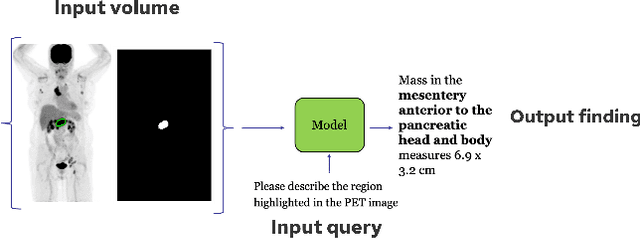
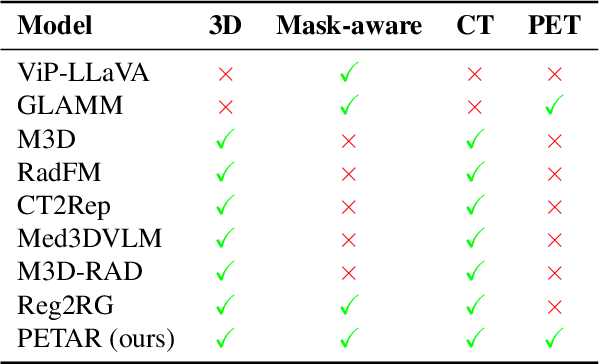

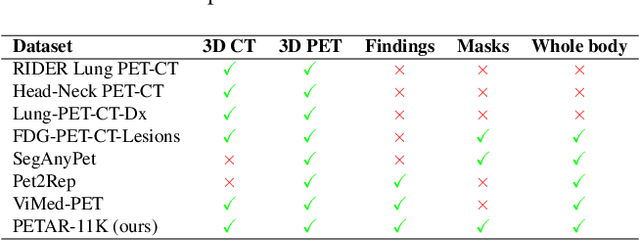
Recent advances in vision-language models (VLMs) have enabled impressive multimodal reasoning, yet most medical applications remain limited to 2D imaging. In this work, we extend VLMs to 3D positron emission tomography and computed tomography (PET/CT), a domain characterized by large volumetric data, small and dispersed lesions, and lengthy radiology reports. We introduce a large-scale dataset comprising over 11,000 lesion-level descriptions paired with 3D segmentations from more than 5,000 PET/CT exams, extracted via a hybrid rule-based and large language model (LLM) pipeline. Building upon this dataset, we propose PETAR-4B, a 3D mask-aware vision-language model that integrates PET, CT, and lesion contours for spatially grounded report generation. PETAR bridges global contextual reasoning with fine-grained lesion awareness, producing clinically coherent and localized findings. Comprehensive automated and human evaluations demonstrate that PETAR substantially improves PET/CT report generation quality, advancing 3D medical vision-language understanding.
VGDM: Vision-Guided Diffusion Model for Brain Tumor Detection and Segmentation
Oct 02, 2025Accurate detection and segmentation of brain tumors from magnetic resonance imaging (MRI) are essential for diagnosis, treatment planning, and clinical monitoring. While convolutional architectures such as U-Net have long been the backbone of medical image segmentation, their limited capacity to capture long-range dependencies constrains performance on complex tumor structures. Recent advances in diffusion models have demonstrated strong potential for generating high-fidelity medical images and refining segmentation boundaries. In this work, we propose VGDM: Vision-Guided Diffusion Model for Brain Tumor Detection and Segmentation framework, a transformer-driven diffusion framework for brain tumor detection and segmentation. By embedding a vision transformer at the core of the diffusion process, the model leverages global contextual reasoning together with iterative denoising to enhance both volumetric accuracy and boundary precision. The transformer backbone enables more effective modeling of spatial relationships across entire MRI volumes, while diffusion refinement mitigates voxel-level errors and recovers fine-grained tumor details. This hybrid design provides a pathway toward improved robustness and scalability in neuro-oncology, moving beyond conventional U-Net baselines. Experimental validation on MRI brain tumor datasets demonstrates consistent gains in Dice similarity and Hausdorff distance, underscoring the potential of transformer-guided diffusion models to advance the state of the art in tumor segmentation.
The Missing Piece: A Case for Pre-Training in 3D Medical Object Detection
Sep 19, 2025Large-scale pre-training holds the promise to advance 3D medical object detection, a crucial component of accurate computer-aided diagnosis. Yet, it remains underexplored compared to segmentation, where pre-training has already demonstrated significant benefits. Existing pre-training approaches for 3D object detection rely on 2D medical data or natural image pre-training, failing to fully leverage 3D volumetric information. In this work, we present the first systematic study of how existing pre-training methods can be integrated into state-of-the-art detection architectures, covering both CNNs and Transformers. Our results show that pre-training consistently improves detection performance across various tasks and datasets. Notably, reconstruction-based self-supervised pre-training outperforms supervised pre-training, while contrastive pre-training provides no clear benefit for 3D medical object detection. Our code is publicly available at: https://github.com/MIC-DKFZ/nnDetection-finetuning.
* MICCAI 2025
Medverse: A Universal Model for Full-Resolution 3D Medical Image Segmentation, Transformation and Enhancement
Sep 11, 2025In-context learning (ICL) offers a promising paradigm for universal medical image analysis, enabling models to perform diverse image processing tasks without retraining. However, current ICL models for medical imaging remain limited in two critical aspects: they cannot simultaneously achieve high-fidelity predictions and global anatomical understanding, and there is no unified model trained across diverse medical imaging tasks (e.g., segmentation and enhancement) and anatomical regions. As a result, the full potential of ICL in medical imaging remains underexplored. Thus, we present \textbf{Medverse}, a universal ICL model for 3D medical imaging, trained on 22 datasets covering diverse tasks in universal image segmentation, transformation, and enhancement across multiple organs, imaging modalities, and clinical centers. Medverse employs a next-scale autoregressive in-context learning framework that progressively refines predictions from coarse to fine, generating consistent, full-resolution volumetric outputs and enabling multi-scale anatomical awareness. We further propose a blockwise cross-attention module that facilitates long-range interactions between context and target inputs while preserving computational efficiency through spatial sparsity. Medverse is extensively evaluated on a broad collection of held-out datasets covering previously unseen clinical centers, organs, species, and imaging modalities. Results demonstrate that Medverse substantially outperforms existing ICL baselines and establishes a novel paradigm for in-context learning. Code and model weights will be made publicly available. Our model are publicly available at https://github.com/jiesihu/Medverse.
JanusNet: Hierarchical Slice-Block Shuffle and Displacement for Semi-Supervised 3D Multi-Organ Segmentation
Aug 06, 2025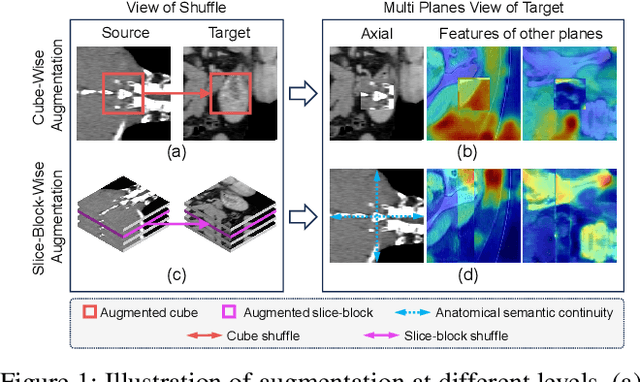
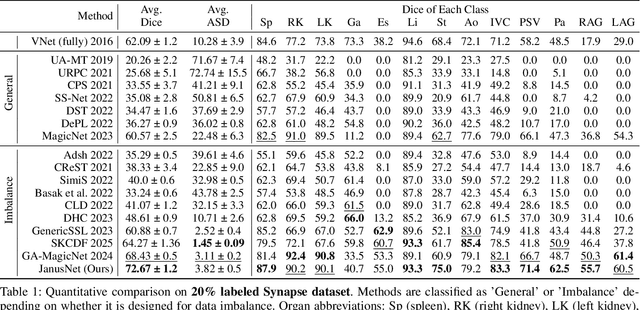
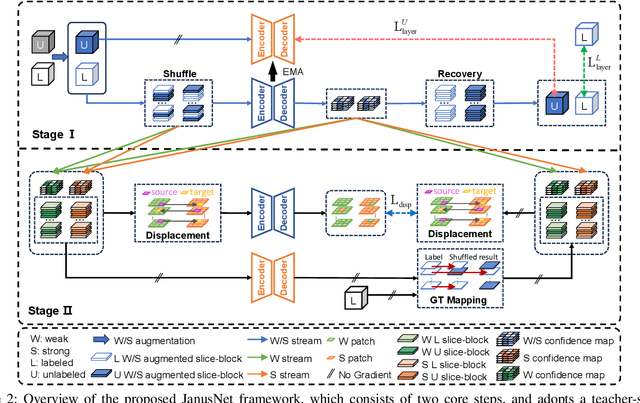
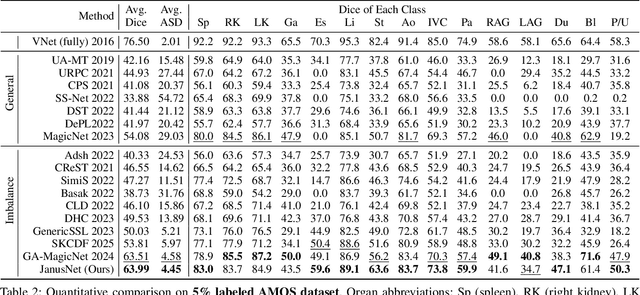
Limited by the scarcity of training samples and annotations, weakly supervised medical image segmentation often employs data augmentation to increase data diversity, while randomly mixing volumetric blocks has demonstrated strong performance. However, this approach disrupts the inherent anatomical continuity of 3D medical images along orthogonal axes, leading to severe structural inconsistencies and insufficient training in challenging regions, such as small-sized organs, etc. To better comply with and utilize human anatomical information, we propose JanusNet}, a data augmentation framework for 3D medical data that globally models anatomical continuity while locally focusing on hard-to-segment regions. Specifically, our Slice-Block Shuffle step performs aligned shuffling of same-index slice blocks across volumes along a random axis, while preserving the anatomical context on planes perpendicular to the perturbation axis. Concurrently, the Confidence-Guided Displacement step uses prediction reliability to replace blocks within each slice, amplifying signals from difficult areas. This dual-stage, axis-aligned framework is plug-and-play, requiring minimal code changes for most teacher-student schemes. Extensive experiments on the Synapse and AMOS datasets demonstrate that JanusNet significantly surpasses state-of-the-art methods, achieving, for instance, a 4% DSC gain on the Synapse dataset with only 20% labeled data.
M-Net: MRI Brain Tumor Sequential Segmentation Network via Mesh-Cast
Jul 28, 2025MRI tumor segmentation remains a critical challenge in medical imaging, where volumetric analysis faces unique computational demands due to the complexity of 3D data. The spatially sequential arrangement of adjacent MRI slices provides valuable information that enhances segmentation continuity and accuracy, yet this characteristic remains underutilized in many existing models. The spatial correlations between adjacent MRI slices can be regarded as "temporal-like" data, similar to frame sequences in video segmentation tasks. To bridge this gap, we propose M-Net, a flexible framework specifically designed for sequential image segmentation. M-Net introduces the novel Mesh-Cast mechanism, which seamlessly integrates arbitrary sequential models into the processing of both channel and temporal information, thereby systematically capturing the inherent "temporal-like" spatial correlations between MRI slices. Additionally, we define an MRI sequential input pattern and design a Two-Phase Sequential (TPS) training strategy, which first focuses on learning common patterns across sequences before refining slice-specific feature extraction. This approach leverages temporal modeling techniques to preserve volumetric contextual information while avoiding the high computational cost of full 3D convolutions, thereby enhancing the generalizability and robustness of M-Net in sequential segmentation tasks. Experiments on the BraTS2019 and BraTS2023 datasets demonstrate that M-Net outperforms existing methods across all key metrics, establishing itself as a robust solution for temporally-aware MRI tumor segmentation.
ReXGroundingCT: A 3D Chest CT Dataset for Segmentation of Findings from Free-Text Reports
Jul 29, 2025We present ReXGroundingCT, the first publicly available dataset to link free-text radiology findings with pixel-level segmentations in 3D chest CT scans that is manually annotated. While prior datasets have relied on structured labels or predefined categories, ReXGroundingCT captures the full expressiveness of clinical language represented in free text and grounds it to spatially localized 3D segmentation annotations in volumetric imaging. This addresses a critical gap in medical AI: the ability to connect complex, descriptive text, such as "3 mm nodule in the left lower lobe", to its precise anatomical location in three-dimensional space, a capability essential for grounded radiology report generation systems. The dataset comprises 3,142 non-contrast chest CT scans paired with standardized radiology reports from the CT-RATE dataset. Using a systematic three-stage pipeline, GPT-4 was used to extract positive lung and pleural findings, which were then manually segmented by expert annotators. A total of 8,028 findings across 16,301 entities were annotated, with quality control performed by board-certified radiologists. Approximately 79% of findings are focal abnormalities, while 21% are non-focal. The training set includes up to three representative segmentations per finding, while the validation and test sets contain exhaustive labels for each finding entity. ReXGroundingCT establishes a new benchmark for developing and evaluating sentence-level grounding and free-text medical segmentation models in chest CT. The dataset can be accessed at https://huggingface.co/datasets/rajpurkarlab/ReXGroundingCT.
Zero-Shot Gaze-based Volumetric Medical Image Segmentation
May 21, 2025Accurate segmentation of anatomical structures in volumetric medical images is crucial for clinical applications, including disease monitoring and cancer treatment planning. Contemporary interactive segmentation models, such as Segment Anything Model 2 (SAM-2) and its medical variant (MedSAM-2), rely on manually provided prompts like bounding boxes and mouse clicks. In this study, we introduce eye gaze as a novel informational modality for interactive segmentation, marking the application of eye-tracking for 3D medical image segmentation. We evaluate the performance of using gaze-based prompts with SAM-2 and MedSAM-2 using both synthetic and real gaze data. Compared to bounding boxes, gaze-based prompts offer a time-efficient interaction approach with slightly lower segmentation quality. Our findings highlight the potential of using gaze as a complementary input modality for interactive 3D medical image segmentation.