 Add to Chrome
 Add to Firefox
 Add to Edge
autonomous cars
Autonomous cars are self-driving vehicles that use artificial intelligence (AI) and sensors to navigate and operate without human intervention, using high-resolution cameras and lidars that detect what happens in the car's immediate surroundings. They have the potential to revolutionize transportation by improving safety, efficiency, and accessibility.
Papers and Code
Gaussian-Process-based Adaptive Tracking Control with Dynamic Active Learning for Autonomous Ground Vehicles
Jan 24, 2025
This article proposes an active-learning-based adaptive trajectory tracking control method for autonomous ground vehicles to compensate for modeling errors and unmodeled dynamics. The nominal vehicle model is decoupled into lateral and longitudinal subsystems, which are augmented with online Gaussian Processes (GPs), using measurement data. The estimated mean functions of the GPs are used to construct a feedback compensator, which, together with an LPV state feedback controller designed for the nominal system, gives the adaptive control structure. To assist exploration of the dynamics, the paper proposes a new, dynamic active learning method to collect the most informative samples to accelerate the training process. To analyze the performance of the overall learning tool-chain provided controller, a novel iterative, counterexample-based algorithm is proposed for calculating the induced L2 gain between the reference trajectory and the tracking error. The analysis can be executed for a set of possible realizations of the to-be-controlled system, giving robust performance certificate of the learning method under variation of the vehicle dynamics. The efficiency of the proposed control approach is shown on a high-fidelity physics simulator and in real experiments using a 1/10 scale F1TENTH electric car.

Explainable deep learning improves human mental models of self-driving cars
Nov 27, 2024Self-driving cars increasingly rely on deep neural networks to achieve human-like driving. However, the opacity of such black-box motion planners makes it challenging for the human behind the wheel to accurately anticipate when they will fail, with potentially catastrophic consequences. Here, we introduce concept-wrapper network (i.e., CW-Net), a method for explaining the behavior of black-box motion planners by grounding their reasoning in human-interpretable concepts. We deploy CW-Net on a real self-driving car and show that the resulting explanations refine the human driver's mental model of the car, allowing them to better predict its behavior and adjust their own behavior accordingly. Unlike previous work using toy domains or simulations, our study presents the first real-world demonstration of how to build authentic autonomous vehicles (AVs) that give interpretable, causally faithful explanations for their decisions, without sacrificing performance. We anticipate our method could be applied to other safety-critical systems with a human in the loop, such as autonomous drones and robotic surgeons. Overall, our study suggests a pathway to explainability for autonomous agents as a whole, which can help make them more transparent, their deployment safer, and their usage more ethical.
RL-RC-DoT: A Block-level RL agent for Task-Aware Video Compression
Jan 21, 2025Video encoders optimize compression for human perception by minimizing reconstruction error under bit-rate constraints. In many modern applications such as autonomous driving, an overwhelming majority of videos serve as input for AI systems performing tasks like object recognition or segmentation, rather than being watched by humans. It is therefore useful to optimize the encoder for a downstream task instead of for perceptual image quality. However, a major challenge is how to combine such downstream optimization with existing standard video encoders, which are highly efficient and popular. Here, we address this challenge by controlling the Quantization Parameters (QPs) at the macro-block level to optimize the downstream task. This granular control allows us to prioritize encoding for task-relevant regions within each frame. We formulate this optimization problem as a Reinforcement Learning (RL) task, where the agent learns to balance long-term implications of choosing QPs on both task performance and bit-rate constraints. Notably, our policy does not require the downstream task as an input during inference, making it suitable for streaming applications and edge devices such as vehicles. We demonstrate significant improvements in two tasks, car detection, and ROI (saliency) encoding. Our approach improves task performance for a given bit rate compared to traditional task agnostic encoding methods, paving the way for more efficient task-aware video compression.
Trainable Pointwise Decoder Module for Point Cloud Segmentation
Aug 02, 2024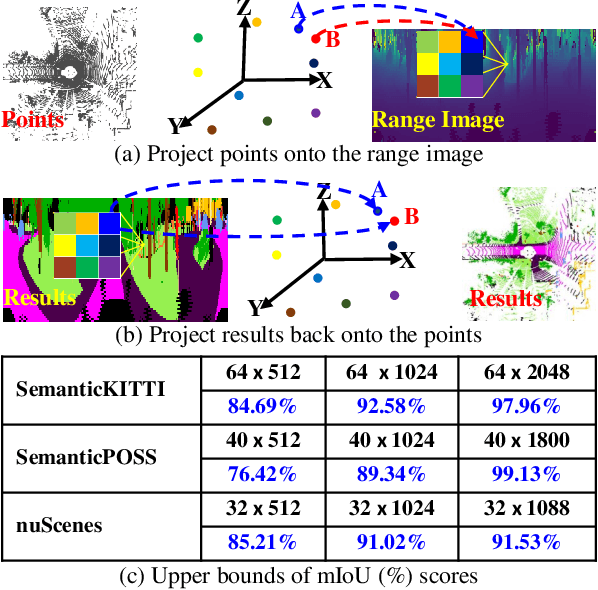
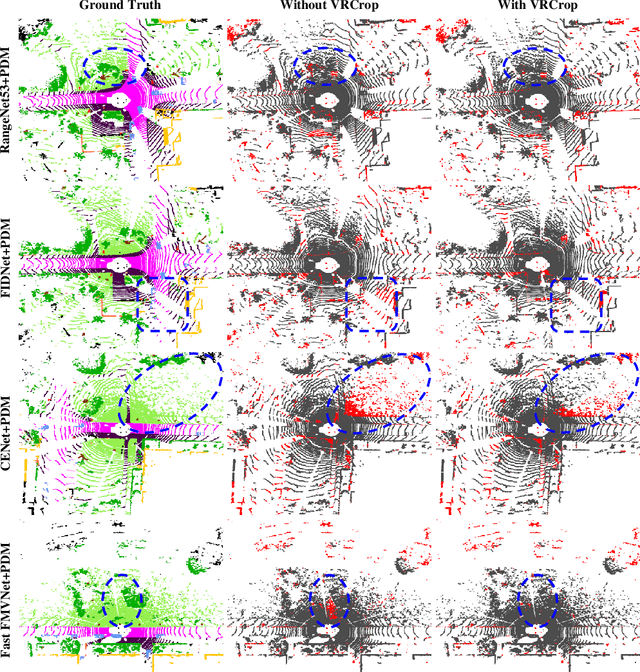
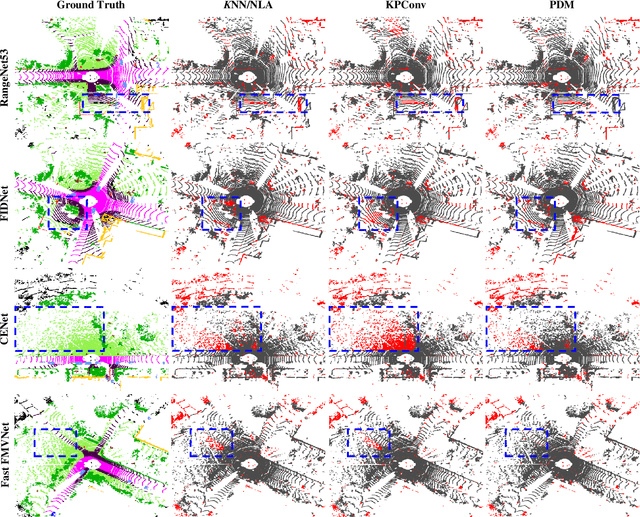
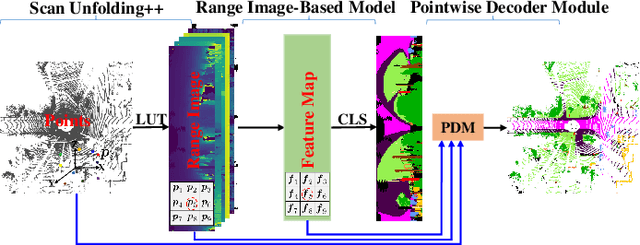
Point cloud segmentation (PCS) aims to make per-point predictions and enables robots and autonomous driving cars to understand the environment. The range image is a dense representation of a large-scale outdoor point cloud, and segmentation models built upon the image commonly execute efficiently. However, the projection of the point cloud onto the range image inevitably leads to dropping points because, at each image coordinate, only one point is kept despite multiple points being projected onto the same location. More importantly, it is challenging to assign correct predictions to the dropped points that belong to the classes different from the kept point class. Besides, existing post-processing methods, such as K-nearest neighbor (KNN) search and kernel point convolution (KPConv), cannot be trained with the models in an end-to-end manner or cannot process varying-density outdoor point clouds well, thereby enabling the models to achieve sub-optimal performance. To alleviate this problem, we propose a trainable pointwise decoder module (PDM) as the post-processing approach, which gathers weighted features from the neighbors and then makes the final prediction for the query point. In addition, we introduce a virtual range image-guided copy-rotate-paste (VRCrop) strategy in data augmentation. VRCrop constrains the total number of points and eliminates undesirable artifacts in the augmented point cloud. With PDM and VRCrop, existing range image-based segmentation models consistently perform better than their counterparts on the SemanticKITTI, SemanticPOSS, and nuScenes datasets.
Three Cars Approaching within 100m! Enhancing Distant Geometry by Tri-Axis Voxel Scanning for Camera-based Semantic Scene Completion
Nov 25, 2024Camera-based Semantic Scene Completion (SSC) is gaining attentions in the 3D perception field. However, properties such as perspective and occlusion lead to the underestimation of the geometry in distant regions, posing a critical issue for safety-focused autonomous driving systems. To tackle this, we propose ScanSSC, a novel camera-based SSC model composed of a Scan Module and Scan Loss, both designed to enhance distant scenes by leveraging context from near-viewpoint scenes. The Scan Module uses axis-wise masked attention, where each axis employing a near-to-far cascade masking that enables distant voxels to capture relationships with preceding voxels. In addition, the Scan Loss computes the cross-entropy along each axis between cumulative logits and corresponding class distributions in a near-to-far direction, thereby propagating rich context-aware signals to distant voxels. Leveraging the synergy between these components, ScanSSC achieves state-of-the-art performance, with IoUs of 44.54 and 48.29, and mIoUs of 17.40 and 20.14 on the SemanticKITTI and SSCBench-KITTI-360 benchmarks.
Real-Time 3D Object Detection Using InnovizOne LiDAR and Low-Power Hailo-8 AI Accelerator
Dec 07, 2024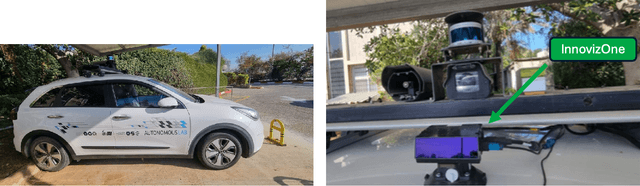
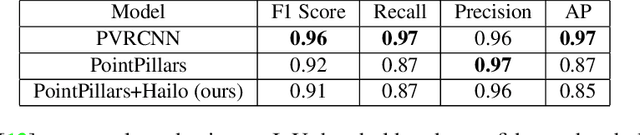
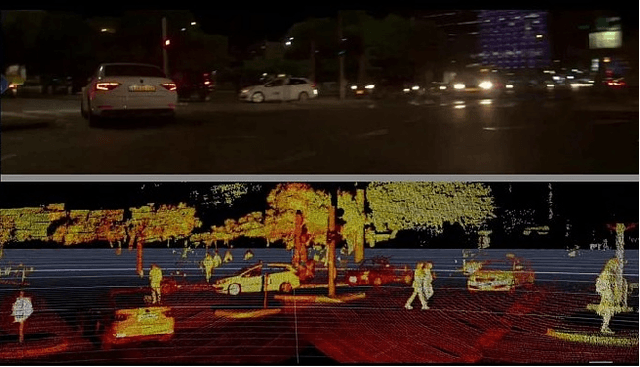
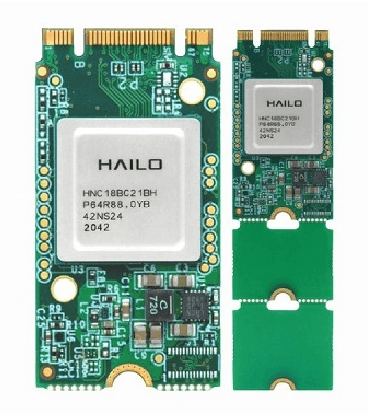
Object detection is a significant field in autonomous driving. Popular sensors for this task include cameras and LiDAR sensors. LiDAR sensors offer several advantages, such as insensitivity to light changes, like in a dark setting and the ability to provide 3D information in the form of point clouds, which include the ranges of objects. However, 3D detection methods, such as PointPillars, typically require high-power hardware. Additionally, most common spinning LiDARs are sparse and may not achieve the desired quality of object detection in front of the car. In this paper, we present the feasibility of performing real-time 3D object detection of cars using 3D point clouds from a LiDAR sensor, processed and deployed on a low-power Hailo-8 AI accelerator. The LiDAR sensor used in this study is the InnovizOne sensor, which captures objects in higher quality compared to spinning LiDAR techniques, especially for distant objects. We successfully achieved real-time inference at a rate of approximately 5Hz with a high accuracy of 0.91% F1 score, with only -0.2% degradation compared to running the same model on an NVIDIA GeForce RTX 2080 Ti. This work demonstrates that effective real-time 3D object detection can be achieved on low-cost, low-power hardware, representing a significant step towards more accessible autonomous driving technologies. The source code and the pre-trained models are available at https://github.com/AIROTAU/ PointPillarsHailoInnoviz/tree/main
Research on vehicle detection based on improved YOLOv8 network
Dec 31, 2024

The key to ensuring the safe obstacle avoidance function of autonomous driving systems lies in the use of extremely accurate vehicle recognition techniques. However, the variability of the actual road environment and the diverse characteristics of vehicles and pedestrians together constitute a huge obstacle to improving detection accuracy, posing a serious challenge to the realization of this goal. To address the above issues, this paper proposes an improved YOLOv8 vehicle detection method. Specifically, taking the YOLOv8n-seg model as the base model, firstly, the FasterNet network is used to replace the backbone network to achieve the purpose of reducing the computational complexity and memory while improving the detection accuracy and speed; secondly, the feature enhancement is achieved by adding the attention mechanism CBAM to the Neck; and lastly, the loss function CIoU is modified to WIoU, which optimizes the detection box localization while improving the segmentation accuracy. The results show that the improved model achieves 98.3%, 89.1% and 88.4% detection accuracy for car, Person and Motorcycle. Compared with the pre-improvement and YOLOv9 models in six metrics such as Precision.
GMS-VINS:Multi-category Dynamic Objects Semantic Segmentation for Enhanced Visual-Inertial Odometry Using a Promptable Foundation Model
Nov 28, 2024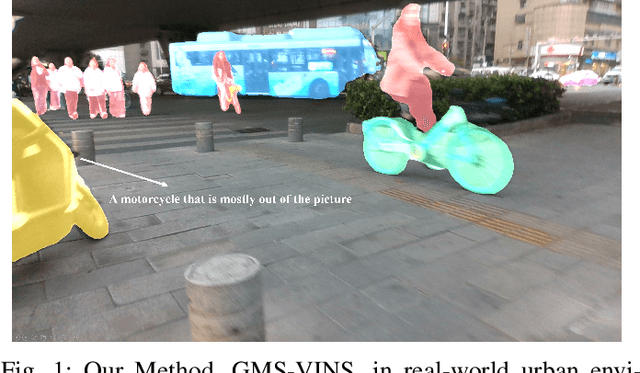

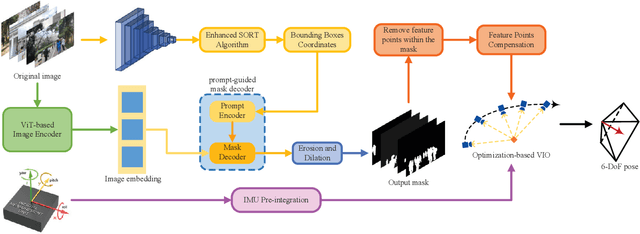
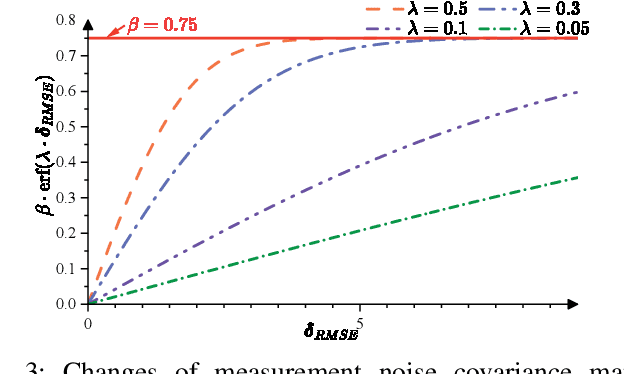
Visual-inertial odometry (VIO) is widely used in various fields, such as robots, drones, and autonomous vehicles, due to its low cost and complementary sensors. Most VIO methods presuppose that observed objects are static and time-invariant. However, real-world scenes often feature dynamic objects, compromising the accuracy of pose estimation. These moving entities include cars, trucks, buses, motorcycles, and pedestrians. The diversity and partial occlusion of these objects present a tough challenge for existing dynamic object removal techniques. To tackle this challenge, we introduce GMS-VINS, which integrates an enhanced SORT algorithm along with a robust multi-category segmentation framework into VIO, thereby improving pose estimation accuracy in environments with diverse dynamic objects and frequent occlusions. Leveraging the promptable foundation model, our solution efficiently tracks and segments a wide range of object categories. The enhanced SORT algorithm significantly improves the reliability of tracking multiple dynamic objects, especially in urban settings with partial occlusions or swift movements. We evaluated our proposed method using multiple public datasets representing various scenes, as well as in a real-world scenario involving diverse dynamic objects. The experimental results demonstrate that our proposed method performs impressively in multiple scenarios, outperforming other state-of-the-art methods. This highlights its remarkable generalization and adaptability in diverse dynamic environments, showcasing its potential to handle various dynamic objects in practical applications.
A Method for the Runtime Validation of AI-based Environment Perception in Automated Driving System
Dec 21, 2024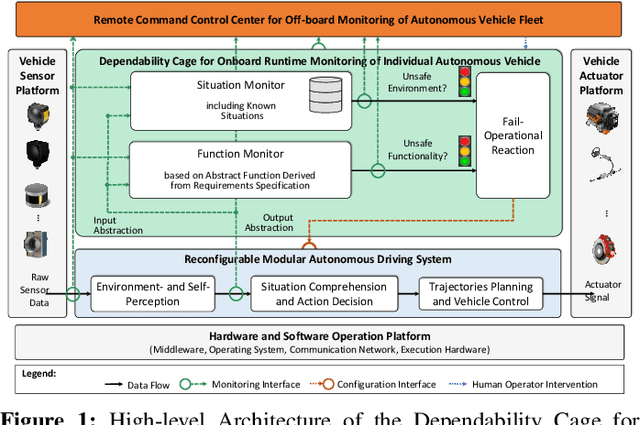
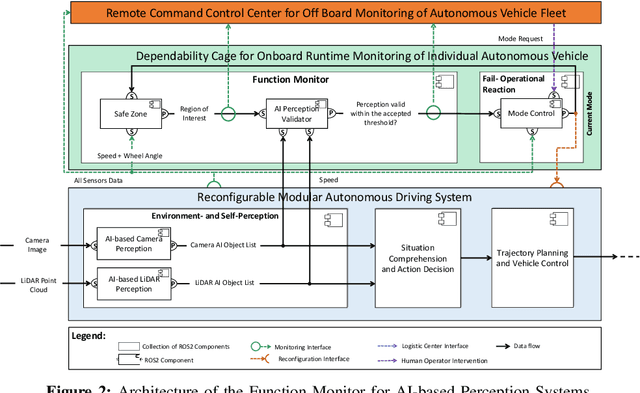
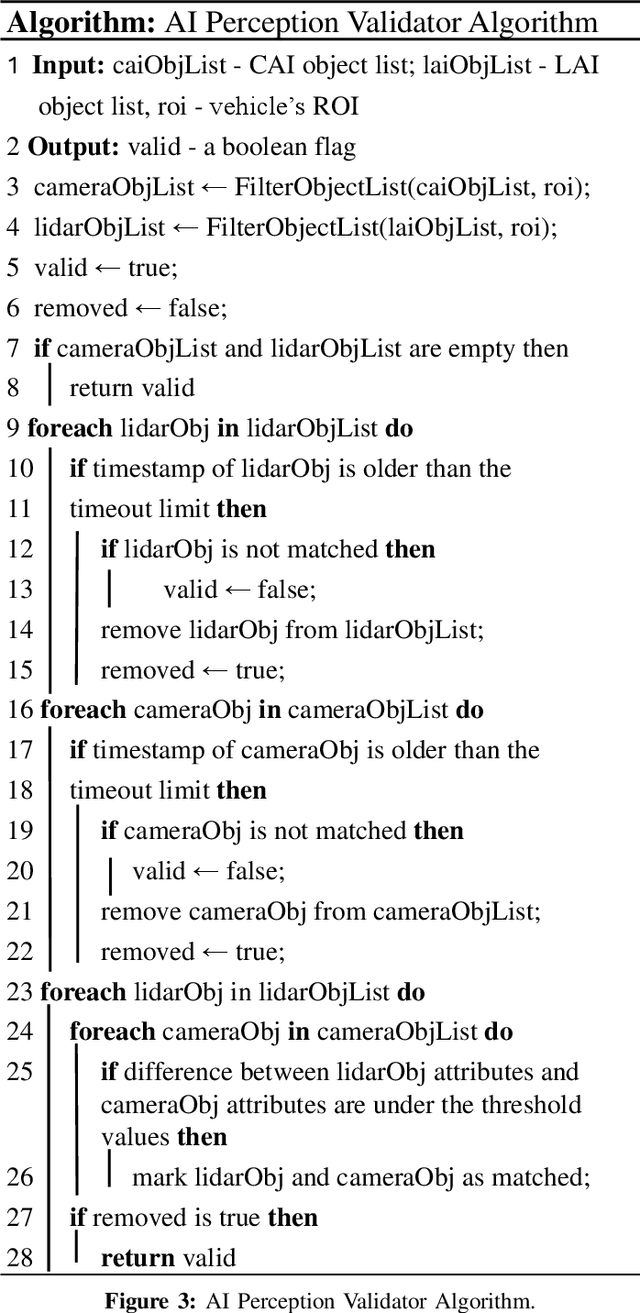
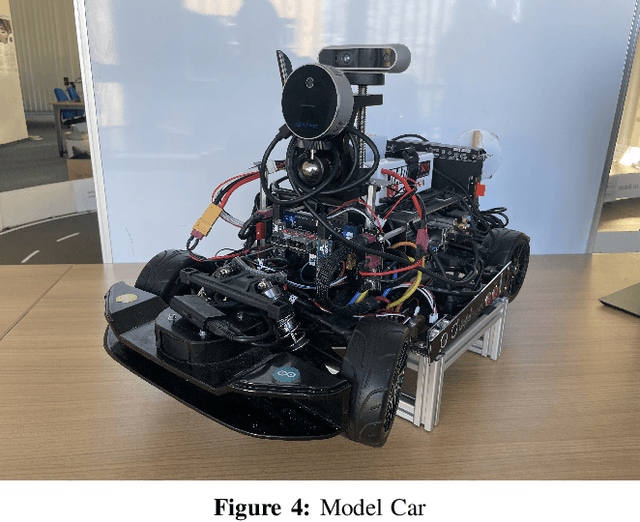
Environment perception is a fundamental part of the dynamic driving task executed by Autonomous Driving Systems (ADS). Artificial Intelligence (AI)-based approaches have prevailed over classical techniques for realizing the environment perception. Current safety-relevant standards for automotive systems, International Organization for Standardization (ISO) 26262 and ISO 21448, assume the existence of comprehensive requirements specifications. These specifications serve as the basis on which the functionality of an automotive system can be rigorously tested and checked for compliance with safety regulations. However, AI-based perception systems do not have complete requirements specification. Instead, large datasets are used to train AI-based perception systems. This paper presents a function monitor for the functional runtime monitoring of a two-folded AI-based environment perception for ADS, based respectively on camera and LiDAR sensors. To evaluate the applicability of the function monitor, we conduct a qualitative scenario-based evaluation in a controlled laboratory environment using a model car. The evaluation results then are discussed to provide insights into the monitor's performance and its suitability for real-world applications.
YOLOv11 for Vehicle Detection: Advancements, Performance, and Applications in Intelligent Transportation Systems
Oct 30, 2024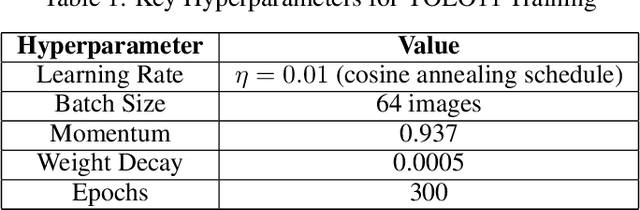
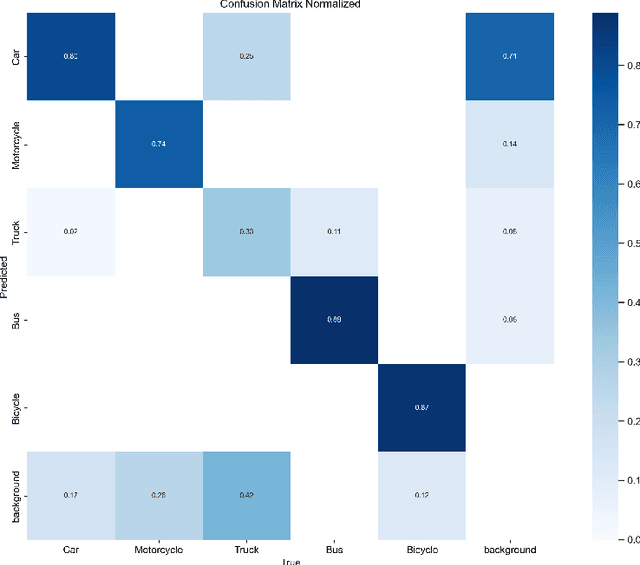
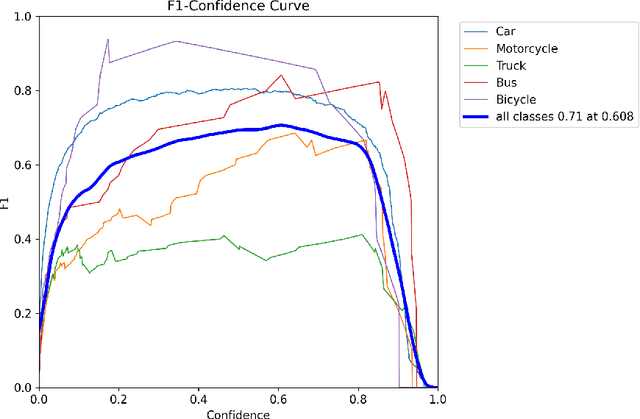

Accurate vehicle detection is essential for the development of intelligent transportation systems, autonomous driving, and traffic monitoring. This paper presents a detailed analysis of YOLO11, the latest advancement in the YOLO series of deep learning models, focusing exclusively on vehicle detection tasks. Building upon the success of its predecessors, YOLO11 introduces architectural improvements designed to enhance detection speed, accuracy, and robustness in complex environments. Using a comprehensive dataset comprising multiple vehicle types-cars, trucks, buses, motorcycles, and bicycles we evaluate YOLO11's performance using metrics such as precision, recall, F1 score, and mean average precision (mAP). Our findings demonstrate that YOLO11 surpasses previous versions (YOLOv8 and YOLOv10) in detecting smaller and more occluded vehicles while maintaining a competitive inference time, making it well-suited for real-time applications. Comparative analysis shows significant improvements in the detection of complex vehicle geometries, further contributing to the development of efficient and scalable vehicle detection systems. This research highlights YOLO11's potential to enhance autonomous vehicle performance and traffic monitoring systems, offering insights for future developments in the field.