 Add to Chrome
 Add to Firefox
 Add to Edge
Multi-Agent Orchestration with the Common-Sense Reasoning Capabilities of LLMs for Autonomous Driving
Aug 20, 2026
Autonomous vehicles require robust perception and decision-making capabilities to operate in diverse and unseen scenarios. While reinforcement learning and rule-based methods can provide effective control and safety mechanisms, their performance may degrade in situations requiring contextual reasoning. Large Language Models (LLMs) have demonstrated strong capabilities in understanding multimodal information and generating contextual reasoning, however, their use for direct vehicle control can introduce latency and hallucination risks. To address these limitations, a hybrid framework is proposed. This system uses an orchestrator to coordinate PPO-trained reinforcement learning and PID control, with LLM common-sense reasoning applied throughout the framework. LLM reasoning is further employed iteratively to refine the RL reward function for dynamic driving environments. The proposed framework is evaluated in highly randomized CARLA scenarios under diverse environmental and traffic conditions. The results demonstrate the potential of integrating LLM-based reasoning with conventional autonomous driving methods while retaining structured control and safety mechanism.

Human-in-the-loop Reasoning For Traffic Sign Detection: Collaborative Approach Yolo With Video-llava
Oct 07, 2024
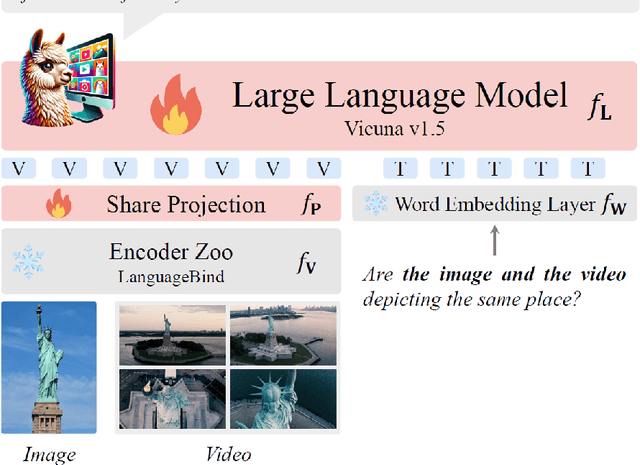
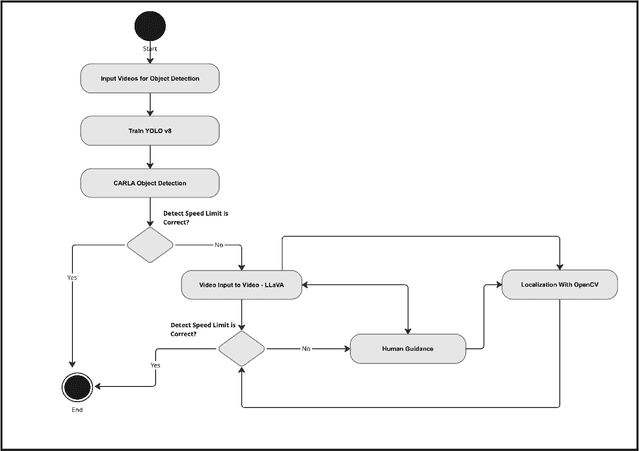
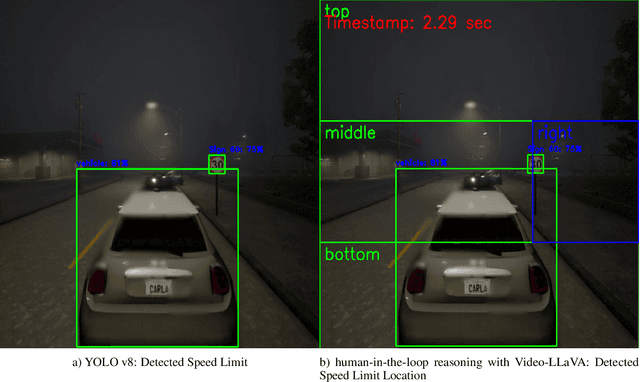
Traffic Sign Recognition (TSR) detection is a crucial component of autonomous vehicles. While You Only Look Once (YOLO) is a popular real-time object detection algorithm, factors like training data quality and adverse weather conditions (e.g., heavy rain) can lead to detection failures. These failures can be particularly dangerous when visual similarities between objects exist, such as mistaking a 30 km/h sign for a higher speed limit sign. This paper proposes a method that combines video analysis and reasoning, prompting with a human-in-the-loop guide large vision model to improve YOLOs accuracy in detecting road speed limit signs, especially in semi-real-world conditions. It is hypothesized that the guided prompting and reasoning abilities of Video-LLava can enhance YOLOs traffic sign detection capabilities. This hypothesis is supported by an evaluation based on human-annotated accuracy metrics within a dataset of recorded videos from the CARLA car simulator. The results demonstrate that a collaborative approach combining YOLO with Video-LLava and reasoning can effectively address challenging situations such as heavy rain and overcast conditions that hinder YOLOs detection capabilities.