 Add to Chrome
 Add to Firefox
 Add to Edge
photo
Papers and Code
Leveraging Vision-Language Pre-training for Human Activity Recognition in Still Images
Jun 16, 2025
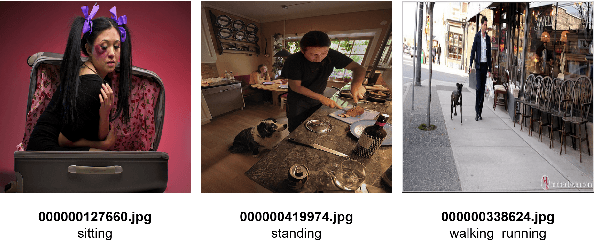

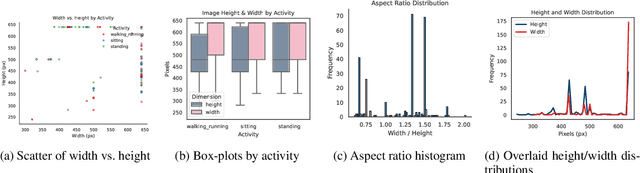
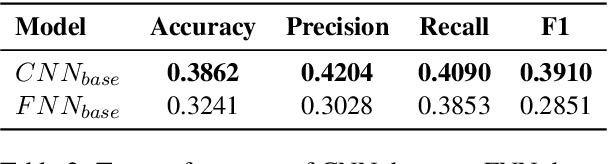
Recognising human activity in a single photo enables indexing, safety and assistive applications, yet lacks motion cues. Using 285 MSCOCO images labelled as walking, running, sitting, and standing, scratch CNNs scored 41% accuracy. Fine-tuning multimodal CLIP raised this to 76%, demonstrating that contrastive vision-language pre-training decisively improves still-image action recognition in real-world deployments.

UltraZoom: Generating Gigapixel Images from Regular Photos
Jun 16, 2025We present UltraZoom, a system for generating gigapixel-resolution images of objects from casually captured inputs, such as handheld phone photos. Given a full-shot image (global, low-detail) and one or more close-ups (local, high-detail), UltraZoom upscales the full image to match the fine detail and scale of the close-up examples. To achieve this, we construct a per-instance paired dataset from the close-ups and adapt a pretrained generative model to learn object-specific low-to-high resolution mappings. At inference, we apply the model in a sliding window fashion over the full image. Constructing these pairs is non-trivial: it requires registering the close-ups within the full image for scale estimation and degradation alignment. We introduce a simple, robust method for getting registration on arbitrary materials in casual, in-the-wild captures. Together, these components form a system that enables seamless pan and zoom across the entire object, producing consistent, photorealistic gigapixel imagery from minimal input.
WildCAT3D: Appearance-Aware Multi-View Diffusion in the Wild
Jun 16, 2025Despite recent advances in sparse novel view synthesis (NVS) applied to object-centric scenes, scene-level NVS remains a challenge. A central issue is the lack of available clean multi-view training data, beyond manually curated datasets with limited diversity, camera variation, or licensing issues. On the other hand, an abundance of diverse and permissively-licensed data exists in the wild, consisting of scenes with varying appearances (illuminations, transient occlusions, etc.) from sources such as tourist photos. To this end, we present WildCAT3D, a framework for generating novel views of scenes learned from diverse 2D scene image data captured in the wild. We unlock training on these data sources by explicitly modeling global appearance conditions in images, extending the state-of-the-art multi-view diffusion paradigm to learn from scene views of varying appearances. Our trained model generalizes to new scenes at inference time, enabling the generation of multiple consistent novel views. WildCAT3D provides state-of-the-art results on single-view NVS in object- and scene-level settings, while training on strictly less data sources than prior methods. Additionally, it enables novel applications by providing global appearance control during generation.
Restoring Gaussian Blurred Face Images for Deanonymization Attacks
Jun 14, 2025Gaussian blur is widely used to blur human faces in sensitive photos before the photos are posted on the Internet. However, it is unclear to what extent the blurred faces can be restored and used to re-identify the person, especially under a high-blurring setting. In this paper, we explore this question by developing a deblurring method called Revelio. The key intuition is to leverage a generative model's memorization effect and approximate the inverse function of Gaussian blur for face restoration. Compared with existing methods, we design the deblurring process to be identity-preserving. It uses a conditional Diffusion model for preliminary face restoration and then uses an identity retrieval model to retrieve related images to further enhance fidelity. We evaluate Revelio with large public face image datasets and show that it can effectively restore blurred faces, especially under a high-blurring setting. It has a re-identification accuracy of 95.9%, outperforming existing solutions. The result suggests that Gaussian blur should not be used for face anonymization purposes. We also demonstrate the robustness of this method against mismatched Gaussian kernel sizes and functions, and test preliminary countermeasures and adaptive attacks to inspire future work.
CLIP the Landscape: Automated Tagging of Crowdsourced Landscape Images
Jun 13, 2025We present a CLIP-based, multi-modal, multi-label classifier for predicting geographical context tags from landscape photos in the Geograph dataset--a crowdsourced image archive spanning the British Isles, including remote regions lacking POIs and street-level imagery. Our approach addresses a Kaggle competition\footnote{https://www.kaggle.com/competitions/predict-geographic-context-from-landscape-photos} task based on a subset of Geograph's 8M images, with strict evaluation: exact match accuracy is required across 49 possible tags. We show that combining location and title embeddings with image features improves accuracy over using image embeddings alone. We release a lightweight pipeline\footnote{https://github.com/SpaceTimeLab/ClipTheLandscape} that trains on a modest laptop, using pre-trained CLIP image and text embeddings and a simple classification head. Predicted tags can support downstream tasks such as building location embedders for GeoAI applications, enriching spatial understanding in data-sparse regions.
Deep Learning-based Multi Project InP Wafer Simulation for Unsupervised Surface Defect Detection
Jun 12, 2025Quality management in semiconductor manufacturing often relies on template matching with known golden standards. For Indium-Phosphide (InP) multi-project wafer manufacturing, low production scale and high design variability lead to such golden standards being typically unavailable. Defect detection, in turn, is manual and labor-intensive. This work addresses this challenge by proposing a methodology to generate a synthetic golden standard using Deep Neural Networks, trained to simulate photo-realistic InP wafer images from CAD data. We evaluate various training objectives and assess the quality of the simulated images on both synthetic data and InP wafer photographs. Our deep-learning-based method outperforms a baseline decision-tree-based approach, enabling the use of a 'simulated golden die' from CAD plans in any user-defined region of a wafer for more efficient defect detection. We apply our method to a template matching procedure, to demonstrate its practical utility in surface defect detection.
Text to Image for Multi-Label Image Recognition with Joint Prompt-Adapter Learning
Jun 12, 2025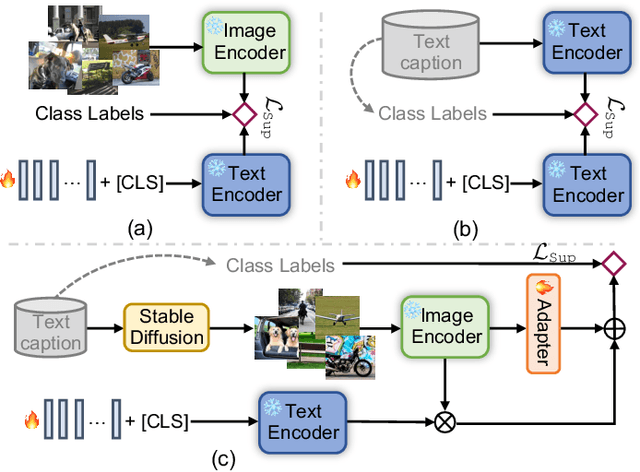
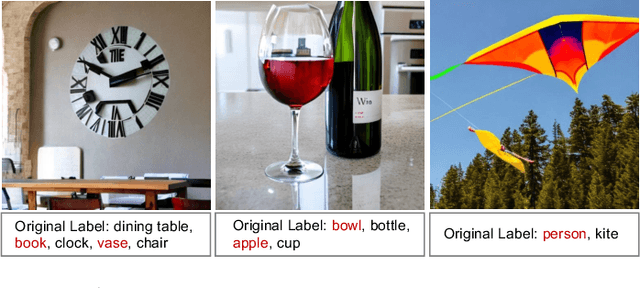
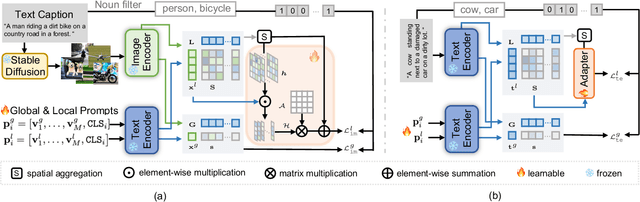
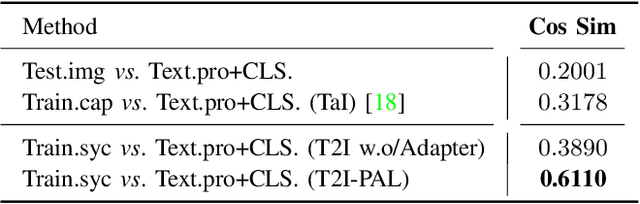
Benefited from image-text contrastive learning, pre-trained vision-language models, e.g., CLIP, allow to direct leverage texts as images (TaI) for parameter-efficient fine-tuning (PEFT). While CLIP is capable of making image features to be similar to the corresponding text features, the modality gap remains a nontrivial issue and limits image recognition performance of TaI. Using multi-label image recognition (MLR) as an example, we present a novel method, called T2I-PAL to tackle the modality gap issue when using only text captions for PEFT. The core design of T2I-PAL is to leverage pre-trained text-to-image generation models to generate photo-realistic and diverse images from text captions, thereby reducing the modality gap. To further enhance MLR, T2I-PAL incorporates a class-wise heatmap and learnable prototypes. This aggregates local similarities, making the representation of local visual features more robust and informative for multi-label recognition. For better PEFT, we further combine both prompt tuning and adapter learning to enhance classification performance. T2I-PAL offers significant advantages: it eliminates the need for fully semantically annotated training images, thereby reducing the manual annotation workload, and it preserves the intrinsic mode of the CLIP model, allowing for seamless integration with any existing CLIP framework. Extensive experiments on multiple benchmarks, including MS-COCO, VOC2007, and NUS-WIDE, show that our T2I-PAL can boost recognition performance by 3.47% in average above the top-ranked state-of-the-art methods.
Using Sign Language Production as Data Augmentation to enhance Sign Language Translation
Jun 11, 2025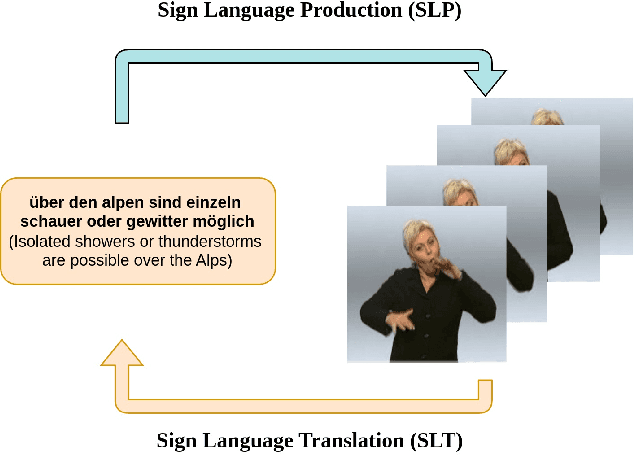
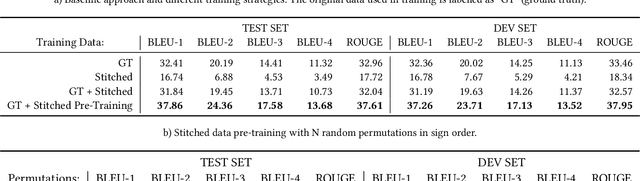
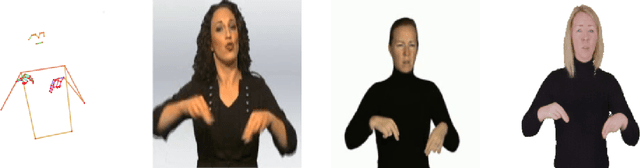
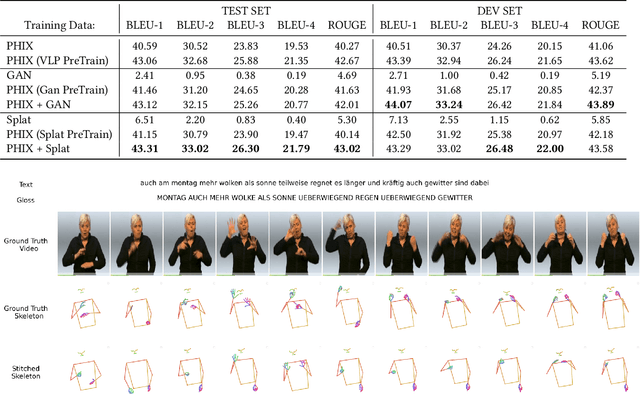
Machine learning models fundamentally rely on large quantities of high-quality data. Collecting the necessary data for these models can be challenging due to cost, scarcity, and privacy restrictions. Signed languages are visual languages used by the deaf community and are considered low-resource languages. Sign language datasets are often orders of magnitude smaller than their spoken language counterparts. Sign Language Production is the task of generating sign language videos from spoken language sentences, while Sign Language Translation is the reverse translation task. Here, we propose leveraging recent advancements in Sign Language Production to augment existing sign language datasets and enhance the performance of Sign Language Translation models. For this, we utilize three techniques: a skeleton-based approach to production, sign stitching, and two photo-realistic generative models, SignGAN and SignSplat. We evaluate the effectiveness of these techniques in enhancing the performance of Sign Language Translation models by generating variation in the signer's appearance and the motion of the skeletal data. Our results demonstrate that the proposed methods can effectively augment existing datasets and enhance the performance of Sign Language Translation models by up to 19%, paving the way for more robust and accurate Sign Language Translation systems, even in resource-constrained environments.
SAMSelect: A Spectral Index Search for Marine Debris Visualization using Segment Anything
Jun 10, 2025This work proposes SAMSelect, an algorithm to obtain a salient three-channel visualization for multispectral images. We develop SAMSelect and show its use for marine scientists visually interpreting floating marine debris in Sentinel-2 imagery. These debris are notoriously difficult to visualize due to their compositional heterogeneity in medium-resolution imagery. Out of these difficulties, a visual interpretation of imagery showing marine debris remains a common practice by domain experts, who select bands and spectral indices on a case-by-case basis informed by common practices and heuristics. SAMSelect selects the band or index combination that achieves the best classification accuracy on a small annotated dataset through the Segment Anything Model. Its central assumption is that the three-channel visualization achieves the most accurate segmentation results also provide good visual information for photo-interpretation. We evaluate SAMSelect in three Sentinel-2 scenes containing generic marine debris in Accra, Ghana, and Durban, South Africa, and deployed plastic targets from the Plastic Litter Project. This reveals the potential of new previously unused band combinations (e.g., a normalized difference index of B8, B2), which demonstrate improved performance compared to literature-based indices. We describe the algorithm in this paper and provide an open-source code repository that will be helpful for domain scientists doing visual photo interpretation, especially in the marine field.
SmartAvatar: Text- and Image-Guided Human Avatar Generation with VLM AI Agents
Jun 05, 2025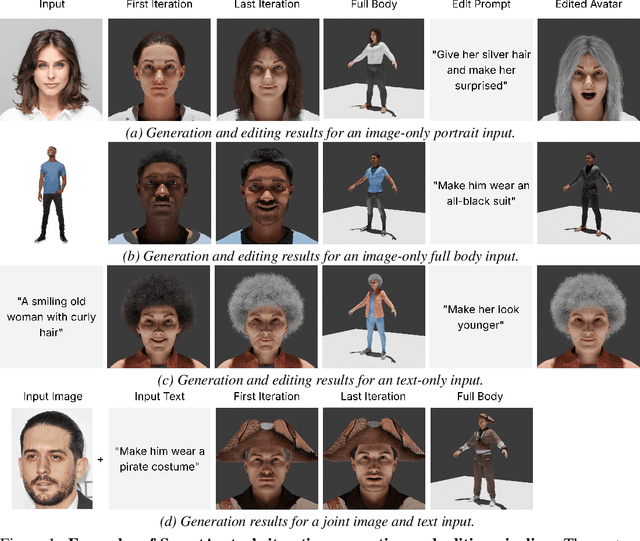
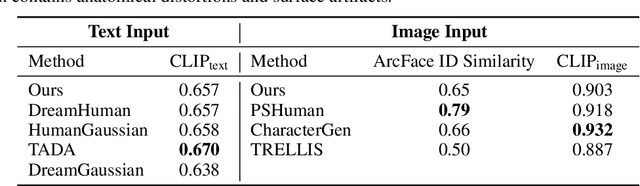
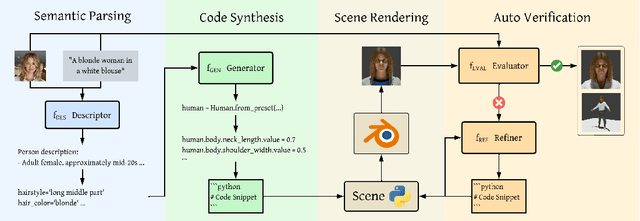
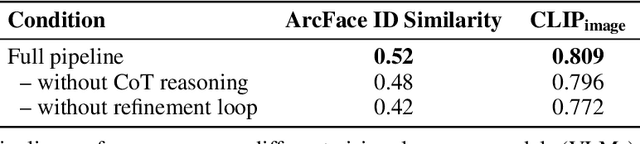
SmartAvatar is a vision-language-agent-driven framework for generating fully rigged, animation-ready 3D human avatars from a single photo or textual prompt. While diffusion-based methods have made progress in general 3D object generation, they continue to struggle with precise control over human identity, body shape, and animation readiness. In contrast, SmartAvatar leverages the commonsense reasoning capabilities of large vision-language models (VLMs) in combination with off-the-shelf parametric human generators to deliver high-quality, customizable avatars. A key innovation is an autonomous verification loop, where the agent renders draft avatars, evaluates facial similarity, anatomical plausibility, and prompt alignment, and iteratively adjusts generation parameters for convergence. This interactive, AI-guided refinement process promotes fine-grained control over both facial and body features, enabling users to iteratively refine their avatars via natural-language conversations. Unlike diffusion models that rely on static pre-trained datasets and offer limited flexibility, SmartAvatar brings users into the modeling loop and ensures continuous improvement through an LLM-driven procedural generation and verification system. The generated avatars are fully rigged and support pose manipulation with consistent identity and appearance, making them suitable for downstream animation and interactive applications. Quantitative benchmarks and user studies demonstrate that SmartAvatar outperforms recent text- and image-driven avatar generation systems in terms of reconstructed mesh quality, identity fidelity, attribute accuracy, and animation readiness, making it a versatile tool for realistic, customizable avatar creation on consumer-grade hardware.