 Add to Chrome
 Add to Firefox
 Add to Edge
Multi-Modal Conditioned High-Resolution Transformer for Urban Electromagnetic Field Map Prediction Download PDF
Jun 26, 2026
Predicting electromagnetic field (EMF) strength in urban environments is essential for cellular network planning but computationally expensive with physics-based simulators. We propose a multi-conditioned dense prediction framework that generates 500 500 EMF maps from building layout images and antenna configurations. Our architecture uses a High-Resolution Transformer (HRFormer) backbone with two complementary conditioning mechanisms: Feature-wise Linear Modulation (FiLM) injects scalar antenna parameters into all backbone stages, while cross-attention fuses 1-D radiation pattern tokens with spatial features at the deepest stage. We further introduce transmitter-relative spatial channels encoding distance, proximity, and bearing from the antenna, enabling coordinate-consistent test-time augmentation (TTA) that reduces test MAE by 6.3%. To address the prediction difficulty imbalance across EMF maps, we design a composite loss combining masked L1, multi-scale structural similarity (MS-SSIM), and a focal L1 term that upweights high-signal pixels, outperforming individual loss components in all metrics. Our best model achieves a test MAE of 0.0461, a 25.2% improvement over a plain UNet baseline and 31.8% over an HRFormer-only baseline.Do-

Enhancing Creativity in 3D Generative Design via a TRIZ-Inspired Text-to-CAD Framework
Jun 19, 2026Recent advances in large language models (LLMs) have demonstrated significant potential in supporting engineering design tasks, including computer-aided design (CAD) automation. However, most existing LLM-based 3D CAD generation approaches primarily focus on geometric precision and instruction-following performance, often overlooking the fundamental aspect of creative design exploration. This study presents a TRIZ-inspired text-to-CAD framework that leverages LLMs to generate high-quality, editable CAD models while systematically exploring creative design alternatives. The framework integrates the Theory of Inventive Problem Solving (TRIZ)-embedding deep human insights from extensive patent records-into LLM prompting strategies, enabling autonomous generation of innovative CAD variants that address technical contradictions. Through a comprehensive three-stage pipeline of design generation, enhancement, and optimization, the framework produces structurally diverse CAD models from well-crafted prompts. The present study implements and evaluates the first two stages, while positioning the design optimization stage as future work. A product design case study (chair) demonstrates that the TRIZ-inspired text-to-CAD framework generates multiple creative design alternatives by systematically applying TRIZ inventive principles such as segmentation, anti-weight, dynamics, and composite materials, achieving 4.0-14.7% mass reduction across all enhanced designs while maintaining structural integrity. The key findings suggest that integrating systematic innovation methodologies with LLM-based 3D CAD generation bridges the gap between precision-focused synthesis and creativity-focused exploration, advancing toward autonomous design systems where AI makes design decisions independently, supporting human decision-making in human-AI collaborative design for engineering applications.
DeepJEB++: Foundation Model-Driven Large-Scale 3D Engineering Dataset via 2D Latent Space Augmentation
Jun 11, 2026Data-driven engineering design is constrained by the lack of large-scale 3D datasets that pair geometry with physics-based performance labels. In particular, existing 3D data augmentation techniques have limitations in preserving subtle and diverse geometric variations, and it remains difficult to automate the subsequent simulation-labeling process, where boundary conditions vary depending on the generated geometry. We present DeepJEB++, a foundation-model-driven data-augmentation framework that expands a small seed set of jet engine brackets into a large, simulation-labeled 3D dataset under constrained resources. Our key idea is to augment in the data-rich 2D latent space, then transfer to 3D. In Stage 1, we fine-tune a pretrained 2D latent diffusion model on multi-view renders and synthesize novel views by latent interpolation, retaining manufacturable designs through a vision-language-model (VLM) quality filter. In Stage 2, the validated images are lifted to 3D meshes by a domain-adapted generative foundation model. In Stage 3, an automated pipeline recognizes the load and bolt interfaces on each mesh and assigns finite-element labels -- mass, stress, and displacement -- without manual intervention. We assess augmentation quality along three intrinsic axes: manufacturability, label fidelity against the SimJEB ground truth, and distributional consistency. Starting from fewer than 400 seed designs, DeepJEB++ yields 15,360 simulation-labeled 3D brackets -- a 40x expansion -- using a single GPU per stage. The dataset will be made publicly available to support reproducible engineering-AI research.
A Multi-Agent System for IPMSM Design Optimization via an FEA-AI Hybrid Approach
Jun 08, 2026Interior permanent magnet synchronous motor (IPMSM) design requires balancing conflicting objectives and multi-physics constraints, while modern optimization workflows face three bottlenecks: manual problem setup, high finite element analysis (FEA) cost, and unreliable surrogate-based search in sparse or out-of-distribution regions. To address these limitations, we propose an end-to-end automated IPMSM design optimization framework that integrates retrieval-augmented generation (RAG) for structured problem definition with an uncertainty-aware FEA-AI hybrid optimization pipeline. A Design agent, connected to a motor textbook through RAG, provides domain-knowledge-based options and engineering tips, and compiles an optimization card and a design-of-experiments plan for AI-model training. A Training agent automates electromagnetic FEA, records geometry-validation and solver-failure logs, analyzes failed geometries using ANOVA-based data analysis and LLM reasoning, and invokes a Design Sampling agent to redefine the design space and generate additional samples. An Optimization agent performs GA-based search with uncertainty-driven switching: low-uncertainty candidates are evaluated by AI-surrogate inference, whereas high-uncertainty and reliability-critical Pareto-front or top-K candidates are corrected by high-fidelity FEA and reused for iterative retraining. The framework converts manual, experience-dependent configuration into a reproducible workflow that balances computational cost and prediction reliability. Experimental results under a matched high-fidelity FEA budget show that the proposed hybrid approach achieves better objective performance while maintaining low and further reducible predictive uncertainty, outperforming FEA-only search, which is limited by early budget exhaustion, and AI-only search, which converges to a low-confidence optimum.
Three-dimensional Deep Shape Optimization with a Limited Dataset
Jun 14, 2025Generative models have attracted considerable attention for their ability to produce novel shapes. However, their application in mechanical design remains constrained due to the limited size and variability of available datasets. This study proposes a deep learning-based optimization framework specifically tailored for shape optimization with limited datasets, leveraging positional encoding and a Lipschitz regularization term to robustly learn geometric characteristics and maintain a meaningful latent space. Through extensive experiments, the proposed approach demonstrates robustness, generalizability and effectiveness in addressing typical limitations of conventional optimization frameworks. The validity of the methodology is confirmed through multi-objective shape optimization experiments conducted on diverse three-dimensional datasets, including wheels and cars, highlighting the model's versatility in producing practical and high-quality design outcomes even under data-constrained conditions.
DeepWheel: Generating a 3D Synthetic Wheel Dataset for Design and Performance Evaluation
Apr 16, 2025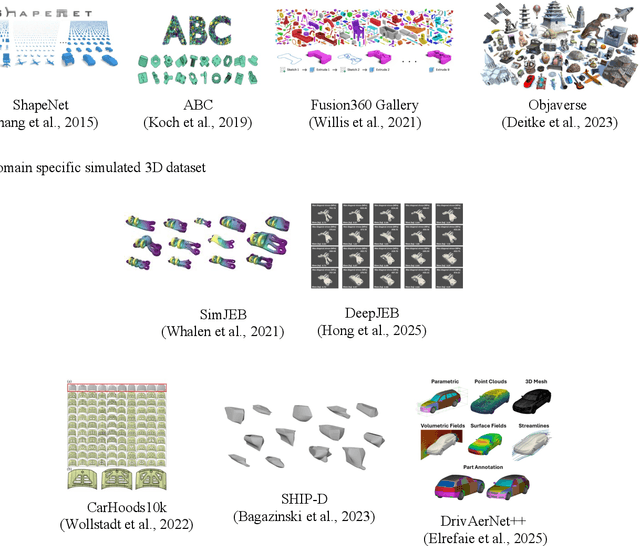
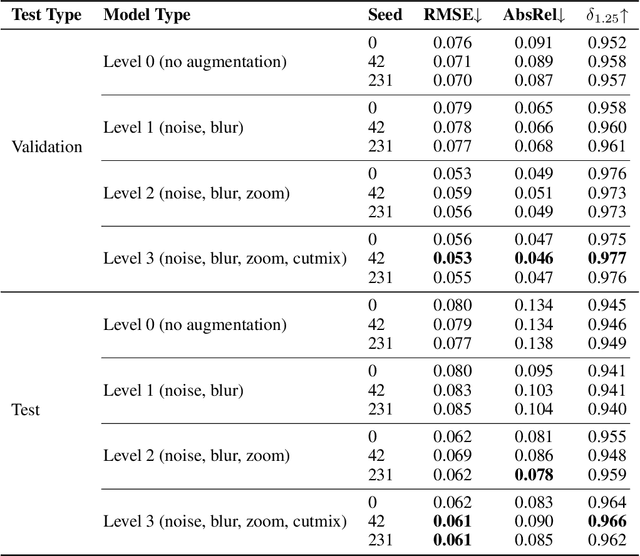
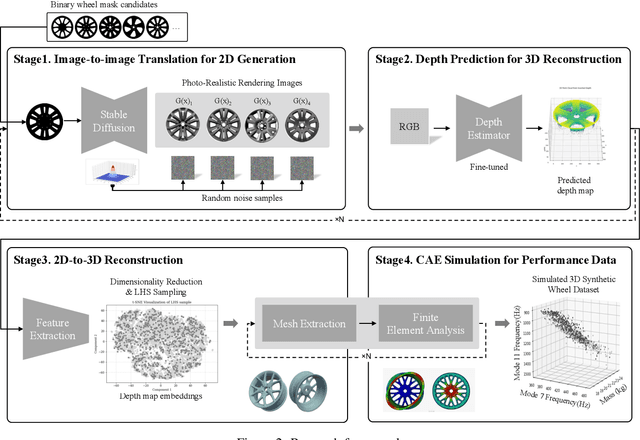
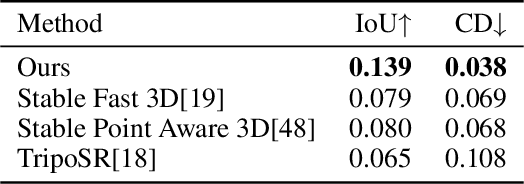
Data-driven design is emerging as a powerful strategy to accelerate engineering innovation. However, its application to vehicle wheel design remains limited due to the lack of large-scale, high-quality datasets that include 3D geometry and physical performance metrics. To address this gap, this study proposes a synthetic design-performance dataset generation framework using generative AI. The proposed framework first generates 2D rendered images using Stable Diffusion, and then reconstructs the 3D geometry through 2.5D depth estimation. Structural simulations are subsequently performed to extract engineering performance data. To further expand the design and performance space, topology optimization is applied, enabling the generation of a more diverse set of wheel designs. The final dataset, named DeepWheel, consists of over 6,000 photo-realistic images and 900 structurally analyzed 3D models. This multi-modal dataset serves as a valuable resource for surrogate model training, data-driven inverse design, and design space exploration. The proposed methodology is also applicable to other complex design domains. The dataset is released under the Creative Commons Attribution-NonCommercial 4.0 International(CC BY-NC 4.0) and is available on the https://www.smartdesignlab.org/datasets
PyTopo3D: A Python Framework for 3D SIMP-based Topology Optimization
Apr 08, 2025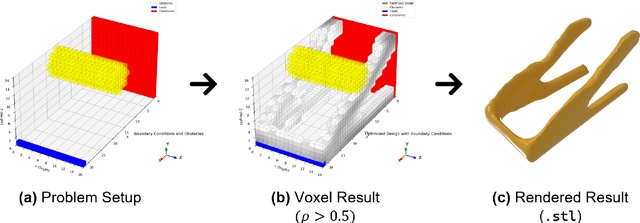
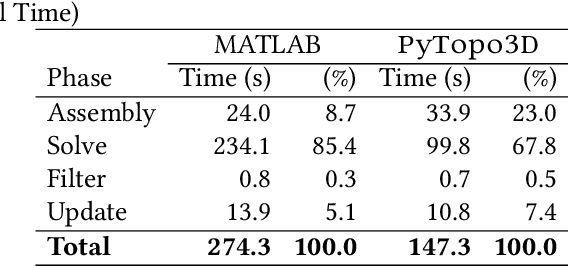
Three-dimensional topology optimization (TO) is a powerful technique in engineering design, but readily usable, open-source implementations remain limited within the popular Python scientific environment. This paper introduces PyTopo3D, a software framework developed to address this gap. PyTopo3D provides a feature-rich tool for 3D TO by implementing the well-established Solid Isotropic Material with Penalization (SIMP) method and an Optimality Criteria (OC) update scheme, adapted and significantly enhanced from the efficient MATLAB code by Liu and Tovar (2014). While building on proven methodology, PyTopo3D's primary contribution is its integration and extension within Python, leveraging sparse matrix operations, optional parallel solvers, and accelerated KD-Tree sensitivity filtering for performance. Crucially, it incorporates functionalities vital for practical engineering workflows, including the direct import of complex design domains and non-design obstacles via STL files, integrated 3D visualization of the optimization process, and direct STL export of optimized geometries for manufacturing or further analysis. PyTopo3D is presented as an accessible, performance-aware tool and citable reference designed to empower engineers, students, and researchers to more easily utilize 3D TO within their existing Python-based workflows.
Decoupled Dynamics Framework with Neural Fields for 3D Spatio-temporal Prediction of Vehicle Collisions
Mar 25, 2025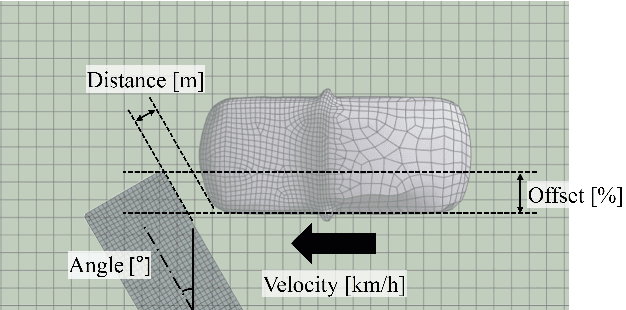
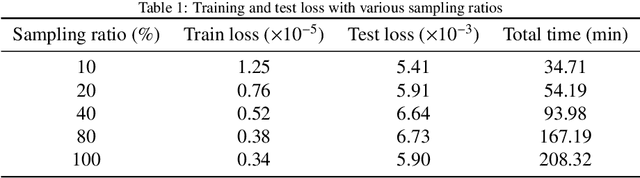
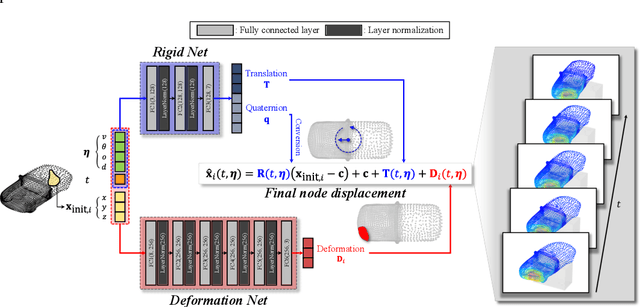
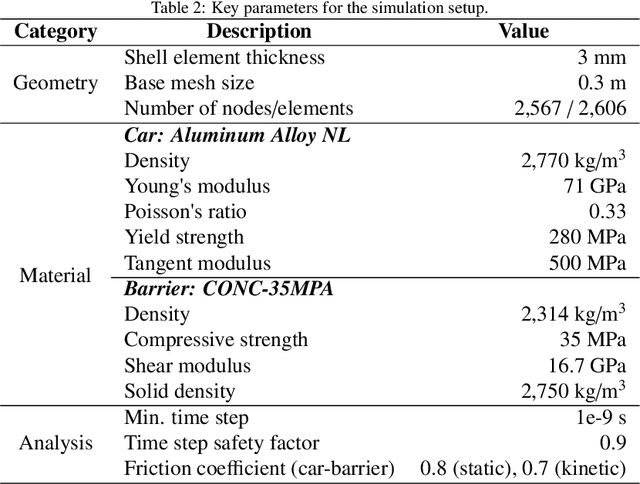
This study proposes a neural framework that predicts 3D vehicle collision dynamics by independently modeling global rigid-body motion and local structural deformation. Unlike approaches directly predicting absolute displacement, this method explicitly separates the vehicle's overall translation and rotation from its structural deformation. Two specialized networks form the core of the framework: a quaternion-based Rigid Net for rigid motion and a coordinate-based Deformation Net for local deformation. By independently handling fundamentally distinct physical phenomena, the proposed architecture achieves accurate predictions without requiring separate supervision for each component. The model, trained on only 10% of available simulation data, significantly outperforms baseline models, including single multi-layer perceptron (MLP) and deep operator networks (DeepONet), with prediction errors reduced by up to 83%. Extensive validation demonstrates strong generalization to collision conditions outside the training range, accurately predicting responses even under severe impacts involving extreme velocities and large impact angles. Furthermore, the framework successfully reconstructs high-resolution deformation details from low-resolution inputs without increased computational effort. Consequently, the proposed approach provides an effective, computationally efficient method for rapid and reliable assessment of vehicle safety across complex collision scenarios, substantially reducing the required simulation data and time while preserving prediction fidelity.
Point-DeepONet: A Deep Operator Network Integrating PointNet for Nonlinear Analysis of Non-Parametric 3D Geometries and Load Conditions
Dec 24, 2024Nonlinear structural analyses in engineering often require extensive finite element simulations, limiting their applicability in design optimization, uncertainty quantification, and real-time control. Conventional deep learning surrogates, such as convolutional neural networks (CNNs), physics-informed neural networks (PINNs), and fourier neural operators (FNOs), face challenges with complex non-parametric three-dimensional (3D) geometries, directionally varying loads, and high-fidelity predictions on unstructured meshes. This work presents Point-DeepONet, an operator-learning-based surrogate that integrates PointNet into the DeepONet framework. By directly processing non-parametric point clouds and incorporating signed distance functions (SDF) for geometric context, Point-DeepONet accurately predicts three-dimensional displacement and von Mises stress fields without mesh parameterization or retraining. Trained using only about 5,000 nodes (2.5% of the original 200,000-node mesh), Point-DeepONet can still predict the entire mesh at high fidelity, achieving a coefficient of determination reaching 0.987 for displacement and 0.923 for von Mises stress under a horizontal load case. Compared to nonlinear finite element analyses that require about 19.32 minutes per case, Point-DeepONet provides predictions in mere seconds-approximately 400 times faster-while maintaining excellent scalability and accuracy with increasing dataset sizes. These findings highlight the potential of Point-DeepONet to enable rapid, high-fidelity structural analyses, ultimately supporting more effective design exploration and informed decision-making in complex engineering workflows.
Towards Robust Spatio-Temporal Auto-Regressive Prediction: Adams-Bashforth Time Integration with Adaptive Multi-Step Rollout
Dec 07, 2024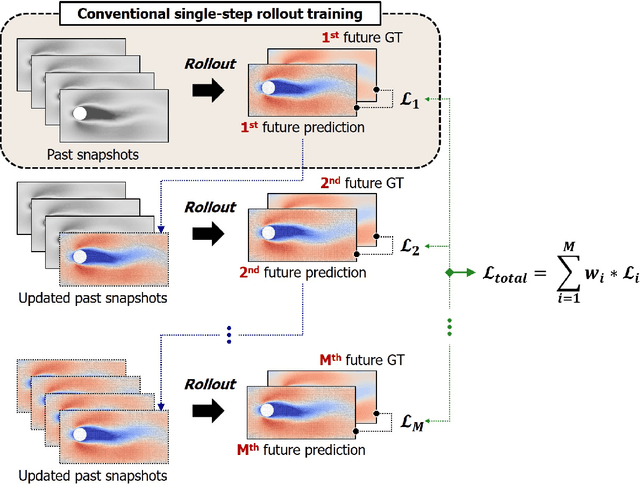

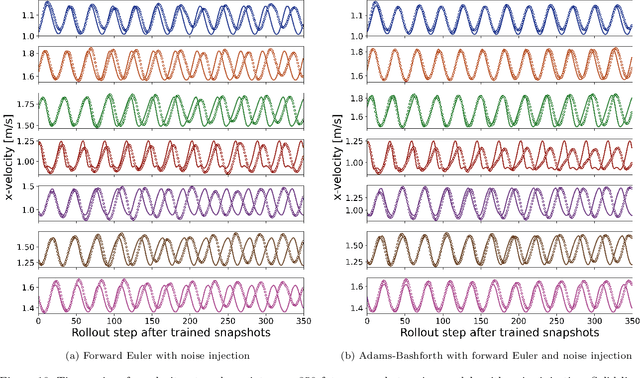
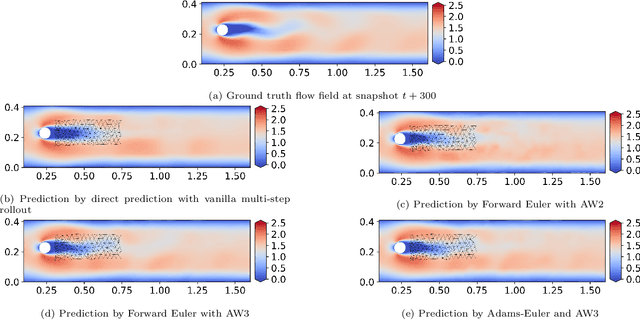
This study addresses the critical challenge of error accumulation in spatio-temporal auto-regressive predictions within scientific machine learning models by introducing innovative temporal integration schemes and adaptive multi-step rollout strategies. We present a comprehensive analysis of time integration methods, highlighting the adaptation of the two-step Adams-Bashforth scheme to enhance long-term prediction robustness in auto-regressive models. Additionally, we improve temporal prediction accuracy through a multi-step rollout strategy that incorporates multiple future time steps during training, supported by three newly proposed approaches that dynamically adjust the importance of each future step. By integrating the Adams-Bashforth scheme with adaptive multi-step strategies, our graph neural network-based auto-regressive model accurately predicts 350 future time steps, even under practical constraints such as limited training data and minimal model capacity -- achieving an error of only 1.6% compared to the vanilla auto-regressive approach. Moreover, our framework demonstrates an 83% improvement in rollout performance over the standard noise injection method, a standard technique for enhancing long-term rollout performance. Its effectiveness is further validated in more challenging scenarios with truncated meshes, showcasing its adaptability and robustness in practical applications. This work introduces a versatile framework for robust long-term spatio-temporal auto-regressive predictions, effectively mitigating error accumulation across various model types and engineering discipline.