 Add to Chrome
 Add to Firefox
 Add to Edge
V. Coco
Papers and Code
Mining Instance-Centric Vision-Language Contexts for Human-Object Interaction Detection
Apr 02, 2026
Human-Object Interaction (HOI) detection aims to localize human-object pairs and classify their interactions from a single image, a task that demands strong visual understanding and nuanced contextual reasoning. Recent approaches have leveraged Vision-Language Models (VLMs) to introduce semantic priors, significantly improving HOI detection performance. However, existing methods often fail to fully capitalize on the diverse contextual cues distributed across the entire scene. To overcome these limitations, we propose the Instance-centric Context Mining Network (InCoM-Net)-a novel framework that effectively integrates rich semantic knowledge extracted from VLMs with instance-specific features produced by an object detector. This design enables deeper interaction reasoning by modeling relationships not only within each detected instance but also across instances and their surrounding scene context. InCoM-Net comprises two core components: Instancecentric Context Refinement (ICR), which separately extracts intra-instance, inter-instance, and global contextual cues from VLM-derived features, and Progressive Context Aggregation (ProCA), which iteratively fuses these multicontext features with instance-level detector features to support high-level HOI reasoning. Extensive experiments on the HICO-DET and V-COCO benchmarks show that InCoM-Net achieves state-of-the-art performance, surpassing previous HOI detection methods. Code is available at https://github.com/nowuss/InCoM-Net.

Zero-shot HOI Detection with MLLM-based Detector-agnostic Interaction Recognition
Feb 16, 2026Zero-shot Human-object interaction (HOI) detection aims to locate humans and objects in images and recognize their interactions. While advances in open-vocabulary object detection provide promising solutions for object localization, interaction recognition (IR) remains challenging due to the combinatorial diversity of interactions. Existing methods, including two-stage methods, tightly couple IR with a specific detector and rely on coarse-grained vision-language model (VLM) features, which limit generalization to unseen interactions. In this work, we propose a decoupled framework that separates object detection from IR and leverages multi-modal large language models (MLLMs) for zero-shot IR. We introduce a deterministic generation method that formulates IR as a visual question answering task and enforces deterministic outputs, enabling training-free zero-shot IR. To further enhance performance and efficiency by fine-tuning the model, we design a spatial-aware pooling module that integrates appearance and pairwise spatial cues, and a one-pass deterministic matching method that predicts all candidate interactions in a single forward pass. Extensive experiments on HICO-DET and V-COCO demonstrate that our method achieves superior zero-shot performance, strong cross-dataset generalization, and the flexibility to integrate with any object detectors without retraining. The codes are publicly available at https://github.com/SY-Xuan/DA-HOI.
ARM: A Learnable, Plug-and-Play Module for CLIP-based Open-vocabulary Semantic Segmentation
Dec 30, 2025Open-vocabulary semantic segmentation (OVSS) is fundamentally hampered by the coarse, image-level representations of CLIP, which lack precise pixel-level details. Existing training-free methods attempt to resolve this by either importing priors from costly external foundation models (e.g., SAM, DINO) or by applying static, hand-crafted heuristics to CLIP's internal features. These approaches are either computationally expensive or sub-optimal. We propose the Attention Refinement Module (ARM), a lightweight, learnable module that effectively unlocks and refines CLIP's internal potential. Unlike static-fusion methods, ARM learns to adaptively fuse hierarchical features. It employs a semantically-guided cross-attention block, using robust deep features (K, V) to select and refine detail-rich shallow features (Q), followed by a self-attention block. The key innovation lies in a ``train once, use anywhere" paradigm. Trained once on a general-purpose dataset (e.g., COCO-Stuff), ARM acts as a universal plug-and-play post-processor for diverse training-free frameworks. Extensive experiments show that ARM consistently boosts baseline performance on multiple benchmarks with negligible inference overhead, establishing an efficient and effective paradigm for training-free OVSS.
Incremental Human-Object Interaction Detection with Invariant Relation Representation Learning
Oct 30, 2025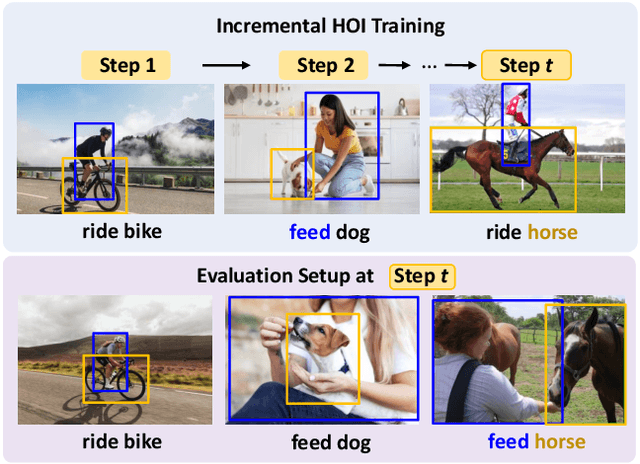
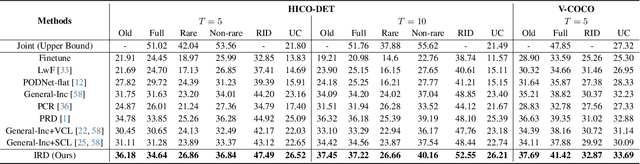
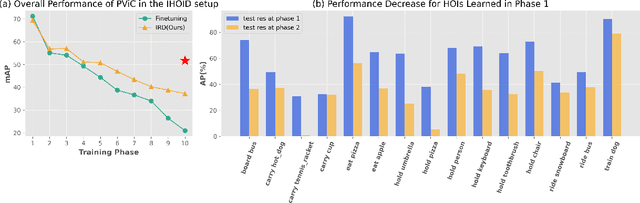
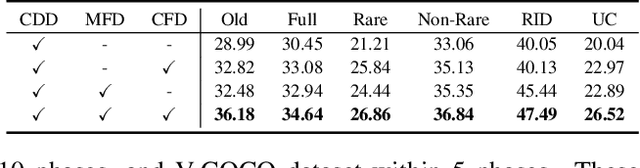
In open-world environments, human-object interactions (HOIs) evolve continuously, challenging conventional closed-world HOI detection models. Inspired by humans' ability to progressively acquire knowledge, we explore incremental HOI detection (IHOID) to develop agents capable of discerning human-object relations in such dynamic environments. This setup confronts not only the common issue of catastrophic forgetting in incremental learning but also distinct challenges posed by interaction drift and detecting zero-shot HOI combinations with sequentially arriving data. Therefore, we propose a novel exemplar-free incremental relation distillation (IRD) framework. IRD decouples the learning of objects and relations, and introduces two unique distillation losses for learning invariant relation features across different HOI combinations that share the same relation. Extensive experiments on HICO-DET and V-COCO datasets demonstrate the superiority of our method over state-of-the-art baselines in mitigating forgetting, strengthening robustness against interaction drift, and generalization on zero-shot HOIs. Code is available at \href{https://github.com/weiyana/ContinualHOI}{this HTTP URL}
Modeling the Multivariate Relationship with Contextualized Representations for Effective Human-Object Interaction Detection
Sep 16, 2025Human-Object Interaction (HOI) detection aims to simultaneously localize human-object pairs and recognize their interactions. While recent two-stage approaches have made significant progress, they still face challenges due to incomplete context modeling. In this work, we introduce a Contextualized Representation Learning Network that integrates both affordance-guided reasoning and contextual prompts with visual cues to better capture complex interactions. We enhance the conventional HOI detection framework by expanding it beyond simple human-object pairs to include multivariate relationships involving auxiliary entities like tools. Specifically, we explicitly model the functional role (affordance) of these auxiliary objects through triplet structures <human, tool, object>. This enables our model to identify tool-dependent interactions such as 'filling'. Furthermore, the learnable prompt is enriched with instance categories and subsequently integrated with contextual visual features using an attention mechanism. This process aligns language with image content at both global and regional levels. These contextualized representations equip the model with enriched relational cues for more reliable reasoning over complex, context-dependent interactions. Our proposed method demonstrates superior performance on both the HICO-Det and V-COCO datasets in most scenarios. Codes will be released upon acceptance.
Explicit Multimodal Graph Modeling for Human-Object Interaction Detection
Sep 16, 2025Transformer-based methods have recently become the prevailing approach for Human-Object Interaction (HOI) detection. However, the Transformer architecture does not explicitly model the relational structures inherent in HOI detection, which impedes the recognition of interactions. In contrast, Graph Neural Networks (GNNs) are inherently better suited for this task, as they explicitly model the relationships between human-object pairs. Therefore, in this paper, we propose \textbf{M}ultimodal \textbf{G}raph \textbf{N}etwork \textbf{M}odeling (MGNM) that leverages GNN-based relational structures to enhance HOI detection. Specifically, we design a multimodal graph network framework that explicitly models the HOI task in a four-stage graph structure. Furthermore, we introduce a multi-level feature interaction mechanism within our graph network. This mechanism leverages multi-level vision and language features to enhance information propagation across human-object pairs. Consequently, our proposed MGNM achieves state-of-the-art performance on two widely used benchmarks: HICO-DET and V-COCO. Moreover, when integrated with a more advanced object detector, our method demonstrates a significant performance gain and maintains an effective balance between rare and non-rare classes.
DQEN: Dual Query Enhancement Network for DETR-based HOI Detection
Aug 26, 2025Human-Object Interaction (HOI) detection focuses on localizing human-object pairs and recognizing their interactions. Recently, the DETR-based framework has been widely adopted in HOI detection. In DETR-based HOI models, queries with clear meaning are crucial for accurately detecting HOIs. However, prior works have typically relied on randomly initialized queries, leading to vague representations that limit the model's effectiveness. Meanwhile, humans in the HOI categories are fixed, while objects and their interactions are variable. Therefore, we propose a Dual Query Enhancement Network (DQEN) to enhance object and interaction queries. Specifically, object queries are enhanced with object-aware encoder features, enabling the model to focus more effectively on humans interacting with objects in an object-aware way. On the other hand, we design a novel Interaction Semantic Fusion module to exploit the HOI candidates that are promoted by the CLIP model. Semantic features are extracted to enhance the initialization of interaction queries, thereby improving the model's ability to understand interactions. Furthermore, we introduce an Auxiliary Prediction Unit aimed at improving the representation of interaction features. Our proposed method achieves competitive performance on both the HICO-Det and the V-COCO datasets. The source code is available at https://github.com/lzzhhh1019/DQEN.
QueryCraft: Transformer-Guided Query Initialization for Enhanced Human-Object Interaction Detection
Aug 12, 2025Human-Object Interaction (HOI) detection aims to localize human-object pairs and recognize their interactions in images. Although DETR-based methods have recently emerged as the mainstream framework for HOI detection, they still suffer from a key limitation: Randomly initialized queries lack explicit semantics, leading to suboptimal detection performance. To address this challenge, we propose QueryCraft, a novel plug-and-play HOI detection framework that incorporates semantic priors and guided feature learning through transformer-based query initialization. Central to our approach is \textbf{ACTOR} (\textbf{A}ction-aware \textbf{C}ross-modal \textbf{T}ransf\textbf{OR}mer), a cross-modal Transformer encoder that jointly attends to visual regions and textual prompts to extract action-relevant features. Rather than merely aligning modalities, ACTOR leverages language-guided attention to infer interaction semantics and produce semantically meaningful query representations. To further enhance object-level query quality, we introduce a \textbf{P}erceptual \textbf{D}istilled \textbf{Q}uery \textbf{D}ecoder (\textbf{PDQD}), which distills object category awareness from a pre-trained detector to serve as object query initiation. This dual-branch query initialization enables the model to generate more interpretable and effective queries for HOI detection. Extensive experiments on HICO-Det and V-COCO benchmarks demonstrate that our method achieves state-of-the-art performance and strong generalization. Code will be released upon publication.
Bilateral Collaboration with Large Vision-Language Models for Open Vocabulary Human-Object Interaction Detection
Jul 09, 2025Open vocabulary Human-Object Interaction (HOI) detection is a challenging task that detects all <human, verb, object> triplets of interest in an image, even those that are not pre-defined in the training set. Existing approaches typically rely on output features generated by large Vision-Language Models (VLMs) to enhance the generalization ability of interaction representations. However, the visual features produced by VLMs are holistic and coarse-grained, which contradicts the nature of detection tasks. To address this issue, we propose a novel Bilateral Collaboration framework for open vocabulary HOI detection (BC-HOI). This framework includes an Attention Bias Guidance (ABG) component, which guides the VLM to produce fine-grained instance-level interaction features according to the attention bias provided by the HOI detector. It also includes a Large Language Model (LLM)-based Supervision Guidance (LSG) component, which provides fine-grained token-level supervision for the HOI detector by the LLM component of the VLM. LSG enhances the ability of ABG to generate high-quality attention bias. We conduct extensive experiments on two popular benchmarks: HICO-DET and V-COCO, consistently achieving superior performance in the open vocabulary and closed settings. The code will be released in Github.
UncertainSAM: Fast and Efficient Uncertainty Quantification of the Segment Anything Model
May 08, 2025The introduction of the Segment Anything Model (SAM) has paved the way for numerous semantic segmentation applications. For several tasks, quantifying the uncertainty of SAM is of particular interest. However, the ambiguous nature of the class-agnostic foundation model SAM challenges current uncertainty quantification (UQ) approaches. This paper presents a theoretically motivated uncertainty quantification model based on a Bayesian entropy formulation jointly respecting aleatoric, epistemic, and the newly introduced task uncertainty. We use this formulation to train USAM, a lightweight post-hoc UQ method. Our model traces the root of uncertainty back to under-parameterised models, insufficient prompts or image ambiguities. Our proposed deterministic USAM demonstrates superior predictive capabilities on the SA-V, MOSE, ADE20k, DAVIS, and COCO datasets, offering a computationally cheap and easy-to-use UQ alternative that can support user-prompting, enhance semi-supervised pipelines, or balance the tradeoff between accuracy and cost efficiency.