 Add to Chrome
 Add to Firefox
 Add to Edge
URNet: A Unified Reparameterized Network for Efficient RGB-D Semantic Segmentation
Aug 06, 2026
Previous RGB-D semantic segmentation methods commonly employ dual encoders to separately process RGB and depth inputs, followed by dedicated modules for cross-modal feature fusion. However, such designs often inadequately capture depth representations and consequently limit effective cross-modal interaction, while the additional encoder branch introduces redundant computation that hinders lightweight execution. To tackle these challenges, we propose URNet, a Unified Reparameterized RGB-D Network that performs simultaneous multi-modal feature extraction and cross-modal fusion within a single encoder. Specifically, we adopt a reparameterization strategy to compact the network architecture and facilitate fast inference. Within each Reparameterized Block (RepBlock), a Linear Gated Attention (LGA) module is introduced to fully exploit complementary RGB and depth cues across different feature scales. Furthermore, considering that decoder design has been relatively underexplored in existing RGB-D segmentation models, we develop a concise yet effective universal decoder, termed the Pyramid Merging Decoder (PMD). Extensive experiments on multiple RGB-D segmentation benchmarks demonstrate that URNet achieves state-of-the-art performance while maintaining high efficiency. Code will be available at https://github.com/Wild-Stephen/URNet.

DF$^3$: World Modeling via Decoder-Free Feature Forecasting in Autonomous Navigation
Aug 03, 2026Forecasting future states from video sequences is a critical challenge for autonomous robotic systems and a fundamental objective of world modeling. Prior generative methods operating at the pixel level inevitably overemphasize task-irrelevant details, leading to prohibitive computational overhead. While latent-based approaches attempt to mitigate this by predicting features directly, the persistent reliance on heavy decoders for state-to-task mapping remains a computational bottleneck. In this work, we propose Decoder-Free Feature Forecasting (DF$^3$), a novel framework that models world evolution entirely within the latent space and directly derives task outputs, completely eliminating the need for a decoder. Specifically, DF$^3$ injects learnable spatial queries into the terminal blocks of a frozen vision foundation model to extract future state representations directly. By employing a lightweight, unified Motion-Aware Context Fusion (MACF) mechanism that seamlessly integrates coarse flow warping with fine-grained latent cross-correlation, these queries interact with historical token representations to explicitly align and forecast the feature of the next frame. Subsequently, a specialized set of task queries probes these forecasted features for the downstream task. Extensive experiments on public benchmarks and zero-shot deployment in a robotic simulator demonstrate that DF$^3$ achieves performance comparable to state-of-the-art methods while offering superior efficiency and flexibility for integrated perception and control.
RSGMamba: Reliability-Aware Self-Gated State Space Model for Multimodal Semantic Segmentation
Apr 14, 2026Multimodal semantic segmentation has emerged as a powerful paradigm for enhancing scene understanding by leveraging complementary information from multiple sensing modalities (e.g., RGB, depth, and thermal). However, existing cross-modal fusion methods often implicitly assume that all modalities are equally reliable, which can lead to feature degradation when auxiliary modalities are noisy, misaligned, or incomplete. In this paper, we revisit cross-modal fusion from the perspective of modality reliability and propose a novel framework termed the Reliability-aware Self-Gated State Space Model (RSGMamba). At the core of our method is the Reliability-aware Self-Gated Mamba Block (RSGMB), which explicitly models modality reliability and dynamically regulates cross-modal interactions through a self-gating mechanism. Unlike conventional fusion strategies that indiscriminately exchange information across modalities, RSGMB enables reliability-aware feature selection and enhancing informative feature aggregation. In addition, a lightweight Local Cross-Gated Modulation (LCGM) is incorporated to refine fine-grained spatial details, complementing the global modeling capability of RSGMB. Extensive experiments demonstrate that RSGMamba achieves state-of-the-art performance on both RGB-D and RGB-T semantic segmentation benchmarks, resulting 58.8% / 54.0% mIoU on NYUDepth V2 and SUN-RGBD (+0.4% / +0.7% over prior best), and 61.1% / 88.9% mIoU on MFNet and PST900 (up to +1.6%), with only 48.6M parameters, thereby validating the effectiveness and superiority of the proposed approach.
JointSplat: Probabilistic Joint Flow-Depth Optimization for Sparse-View Gaussian Splatting
Jun 04, 2025Reconstructing 3D scenes from sparse viewpoints is a long-standing challenge with wide applications. Recent advances in feed-forward 3D Gaussian sparse-view reconstruction methods provide an efficient solution for real-time novel view synthesis by leveraging geometric priors learned from large-scale multi-view datasets and computing 3D Gaussian centers via back-projection. Despite offering strong geometric cues, both feed-forward multi-view depth estimation and flow-depth joint estimation face key limitations: the former suffers from mislocation and artifact issues in low-texture or repetitive regions, while the latter is prone to local noise and global inconsistency due to unreliable matches when ground-truth flow supervision is unavailable. To overcome this, we propose JointSplat, a unified framework that leverages the complementarity between optical flow and depth via a novel probabilistic optimization mechanism. Specifically, this pixel-level mechanism scales the information fusion between depth and flow based on the matching probability of optical flow during training. Building upon the above mechanism, we further propose a novel multi-view depth-consistency loss to leverage the reliability of supervision while suppressing misleading gradients in uncertain areas. Evaluated on RealEstate10K and ACID, JointSplat consistently outperforms state-of-the-art (SOTA) methods, demonstrating the effectiveness and robustness of our proposed probabilistic joint flow-depth optimization approach for high-fidelity sparse-view 3D reconstruction.
S2AFormer: Strip Self-Attention for Efficient Vision Transformer
May 28, 2025Vision Transformer (ViT) has made significant advancements in computer vision, thanks to its token mixer's sophisticated ability to capture global dependencies between all tokens. However, the quadratic growth in computational demands as the number of tokens increases limits its practical efficiency. Although recent methods have combined the strengths of convolutions and self-attention to achieve better trade-offs, the expensive pairwise token affinity and complex matrix operations inherent in self-attention remain a bottleneck. To address this challenge, we propose S2AFormer, an efficient Vision Transformer architecture featuring novel Strip Self-Attention (SSA). We design simple yet effective Hybrid Perception Blocks (HPBs) to effectively integrate the local perception capabilities of CNNs with the global context modeling of Transformer's attention mechanisms. A key innovation of SSA lies in its reducing the spatial dimensions of $K$ and $V$ while compressing the channel dimensions of $Q$ and $K$. This design significantly reduces computational overhead while preserving accuracy, striking an optimal balance between efficiency and effectiveness. We evaluate the robustness and efficiency of S2AFormer through extensive experiments on multiple vision benchmarks, including ImageNet-1k for image classification, ADE20k for semantic segmentation, and COCO for object detection and instance segmentation. Results demonstrate that S2AFormer achieves significant accuracy gains with superior efficiency in both GPU and non-GPU environments, making it a strong candidate for efficient vision Transformers.
SCASeg: Strip Cross-Attention for Efficient Semantic Segmentation
Nov 26, 2024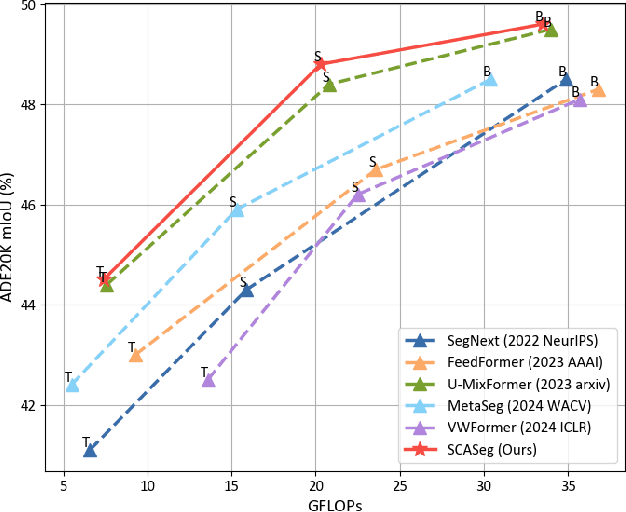
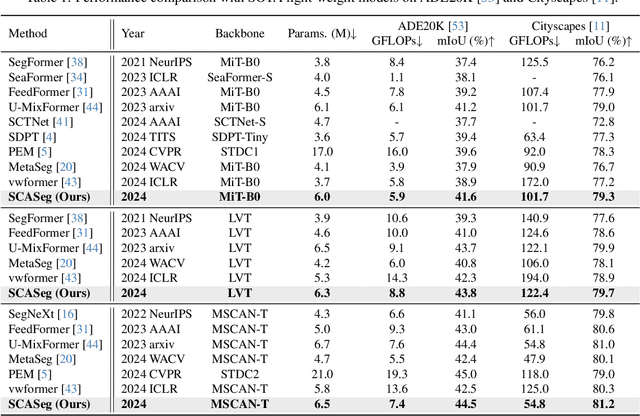
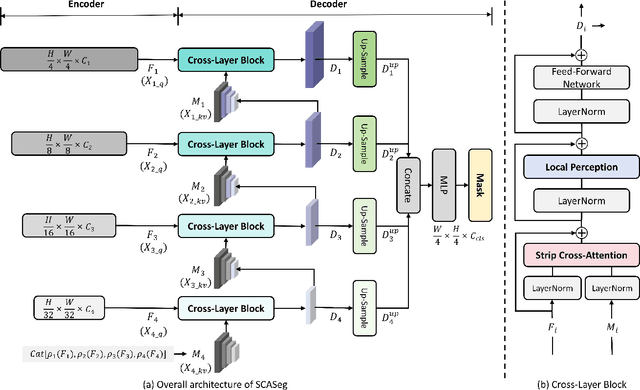
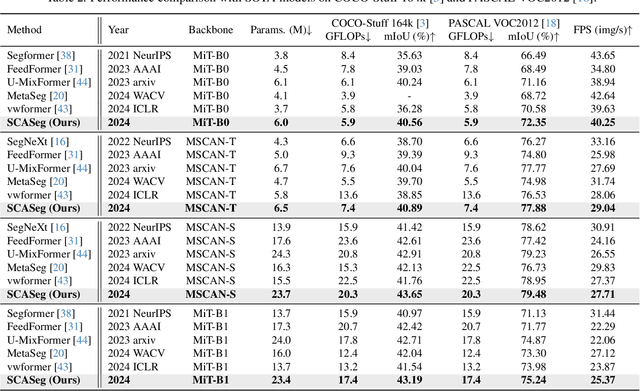
The Vision Transformer (ViT) has achieved notable success in computer vision, with its variants extensively validated across various downstream tasks, including semantic segmentation. However, designed as general-purpose visual encoders, ViT backbones often overlook the specific needs of task decoders, revealing opportunities to design decoders tailored to efficient semantic segmentation. This paper proposes Strip Cross-Attention (SCASeg), an innovative decoder head explicitly designed for semantic segmentation. Instead of relying on the simple conventional skip connections, we employ lateral connections between the encoder and decoder stages, using encoder features as Queries for the cross-attention modules. Additionally, we introduce a Cross-Layer Block that blends hierarchical feature maps from different encoder and decoder stages to create a unified representation for Keys and Values. To further boost computational efficiency, SCASeg compresses queries and keys into strip-like patterns to optimize memory usage and inference speed over the traditional vanilla cross-attention. Moreover, the Cross-Layer Block incorporates the local perceptual strengths of convolution, enabling SCASeg to capture both global and local context dependencies across multiple layers. This approach facilitates effective feature interaction at different scales, improving the overall performance. Experiments show that the adaptable decoder of SCASeg produces competitive performance across different setups, surpassing leading segmentation architectures on all benchmark datasets, including ADE20K, Cityscapes, COCO-Stuff 164k, and Pascal VOC2012, even under varying computational limitations.
Efficient Semantic Segmentation via Lightweight Multiple-Information Interaction Network
Oct 03, 2024Recently, the integration of the local modeling capabilities of Convolutional Neural Networks (CNNs) with the global dependency strengths of Transformers has created a sensation in the semantic segmentation community. However, substantial computational workloads and high hardware memory demands remain major obstacles to their further application in real-time scenarios. In this work, we propose a lightweight multiple-information interaction network for real-time semantic segmentation, called LMIINet, which effectively combines CNNs and Transformers while reducing redundant computations and memory footprint. It features Lightweight Feature Interaction Bottleneck (LFIB) modules comprising efficient convolutions that enhance context integration. Additionally, improvements are made to the Flatten Transformer by enhancing local and global feature interaction to capture detailed semantic information. The incorporation of a combination coefficient learning scheme in both LFIB and Transformer blocks facilitates improved feature interaction. Extensive experiments demonstrate that LMIINet excels in balancing accuracy and efficiency. With only 0.72M parameters and 11.74G FLOPs, LMIINet achieves 72.0% mIoU at 100 FPS on the Cityscapes test set and 69.94% mIoU at 160 FPS on the CamVid test dataset using a single RTX2080Ti GPU.
ReviveDiff: A Universal Diffusion Model for Restoring Images in Adverse Weather Conditions
Sep 27, 2024

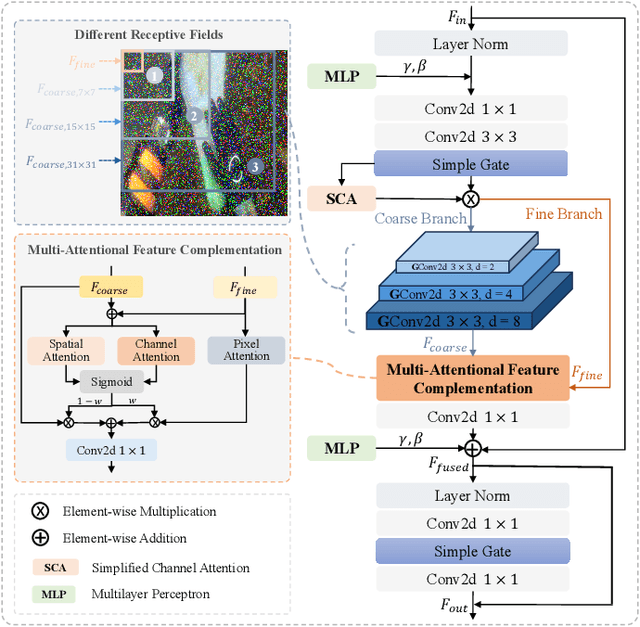

Images captured in challenging environments--such as nighttime, foggy, rainy weather, and underwater--often suffer from significant degradation, resulting in a substantial loss of visual quality. Effective restoration of these degraded images is critical for the subsequent vision tasks. While many existing approaches have successfully incorporated specific priors for individual tasks, these tailored solutions limit their applicability to other degradations. In this work, we propose a universal network architecture, dubbed "ReviveDiff", which can address a wide range of degradations and bring images back to life by enhancing and restoring their quality. Our approach is inspired by the observation that, unlike degradation caused by movement or electronic issues, quality degradation under adverse conditions primarily stems from natural media (such as fog, water, and low luminance), which generally preserves the original structures of objects. To restore the quality of such images, we leveraged the latest advancements in diffusion models and developed ReviveDiff to restore image quality from both macro and micro levels across some key factors determining image quality, such as sharpness, distortion, noise level, dynamic range, and color accuracy. We rigorously evaluated ReviveDiff on seven benchmark datasets covering five types of degrading conditions: Rainy, Underwater, Low-light, Smoke, and Nighttime Hazy. Our experimental results demonstrate that ReviveDiff outperforms the state-of-the-art methods both quantitatively and visually.
MacFormer: Semantic Segmentation with Fine Object Boundaries
Aug 11, 2024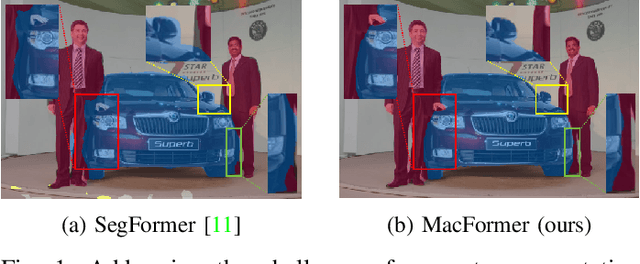
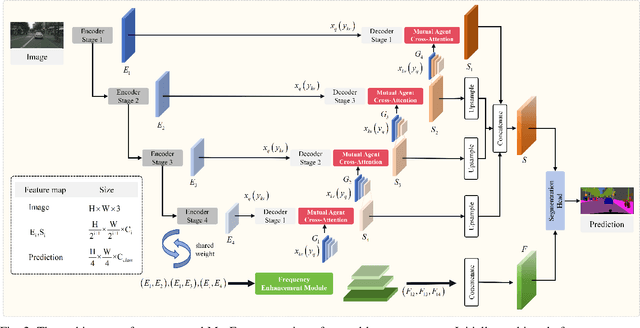

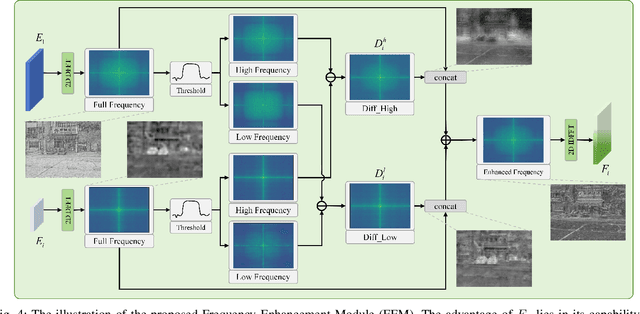
Semantic segmentation involves assigning a specific category to each pixel in an image. While Vision Transformer-based models have made significant progress, current semantic segmentation methods often struggle with precise predictions in localized areas like object boundaries. To tackle this challenge, we introduce a new semantic segmentation architecture, ``MacFormer'', which features two key components. Firstly, using learnable agent tokens, a Mutual Agent Cross-Attention (MACA) mechanism effectively facilitates the bidirectional integration of features across encoder and decoder layers. This enables better preservation of low-level features, such as elementary edges, during decoding. Secondly, a Frequency Enhancement Module (FEM) in the decoder leverages high-frequency and low-frequency components to boost features in the frequency domain, benefiting object boundaries with minimal computational complexity increase. MacFormer is demonstrated to be compatible with various network architectures and outperforms existing methods in both accuracy and efficiency on benchmark datasets ADE20K and Cityscapes under different computational constraints.
HAFormer: Unleashing the Power of Hierarchy-Aware Features for Lightweight Semantic Segmentation
Jul 11, 2024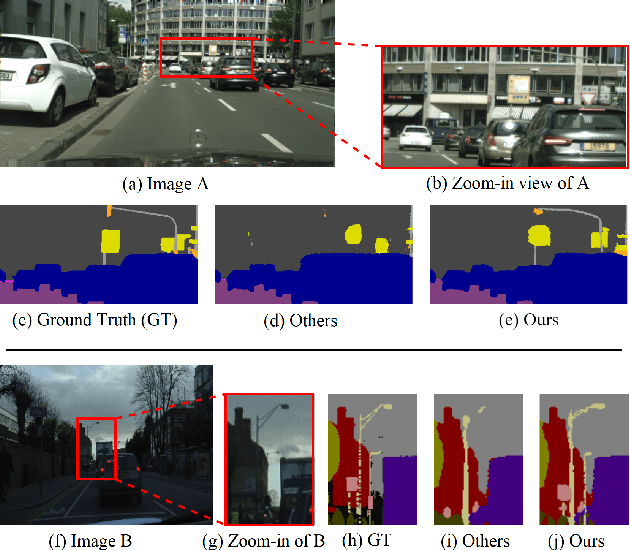


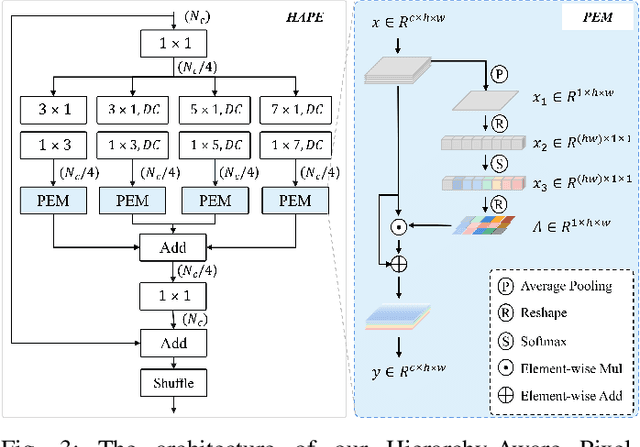
Both Convolutional Neural Networks (CNNs) and Transformers have shown great success in semantic segmentation tasks. Efforts have been made to integrate CNNs with Transformer models to capture both local and global context interactions. However, there is still room for enhancement, particularly when considering constraints on computational resources. In this paper, we introduce HAFormer, a model that combines the hierarchical features extraction ability of CNNs with the global dependency modeling capability of Transformers to tackle lightweight semantic segmentation challenges. Specifically, we design a Hierarchy-Aware Pixel-Excitation (HAPE) module for adaptive multi-scale local feature extraction. During the global perception modeling, we devise an Efficient Transformer (ET) module streamlining the quadratic calculations associated with traditional Transformers. Moreover, a correlation-weighted Fusion (cwF) module selectively merges diverse feature representations, significantly enhancing predictive accuracy. HAFormer achieves high performance with minimal computational overhead and compact model size, achieving 74.2% mIoU on Cityscapes and 71.1% mIoU on CamVid test datasets, with frame rates of 105FPS and 118FPS on a single 2080Ti GPU. The source codes are available at https://github.com/XU-GITHUB-curry/HAFormer.