 Add to Chrome
 Add to Firefox
 Add to Edge
Underwater 3D Scene Reconstruction
Papers and Code
Spatiotemporal Degradation-Aware 3D Gaussian Splatting for Realistic Underwater Scene Reconstruction
Apr 26, 2026
Reconstructing realistic underwater scenes from underwater video remains a meaningful yet challenging task in the multimedia domain. The inherent spatiotemporal degradations in underwater imaging, including caustics, flickering, attenuation, and backscattering, frequently result in inaccurate geometry and appearance in existing 3D reconstruction methods. While a few recent works have explored underwater degradation-aware reconstruction, they often address either spatial or temporal degradation alone, falling short in more real-world underwater scenarios where both types of degradation occur. We propose MarineSTD-GS, a novel 3D Gaussian Splatting-based framework that explicitly models both temporal and spatial degradations for realistic underwater scene reconstruction. Specifically, we introduce two paired Gaussian primitives: Intrinsic Gaussians represent the true scene, while Degraded Gaussians render the degraded observations. The color of each Degraded Gaussian is physically derived from its paired Intrinsic Gaussian via a Spatiotemporal Degradation Modeling (SDM) module, enabling self-supervised disentanglement of realistic appearance from degraded images. To ensure stable training and accurate geometry, we further propose a Depth-Guided Geometry Loss and a Multi-Stage Optimization strategy. We also construct a simulated benchmark with diverse spatial and temporal degradations and ground-truth appearances for comprehensive evaluation. Experiments on both simulated and real-world datasets show that MarineSTD-GS robustly handles spatiotemporal degradations and outperforms existing methods in novel view synthesis with realistic, water-free scene appearances.
* 12 pages, 10 figures, 6 tables. Author version of the paper published in Proceedings of ACM Multimedia 2025

BALTIC: A Benchmark and Cross-Domain Strategy for 3D Reconstruction Across Air and Underwater Domains Under Varying Illumination
Apr 21, 2026Robust 3D reconstruction across varying environmental conditions remains a critical challenge for robotic perception, particularly when transitioning between air and water. To address this, we introduce BALTIC, a controlled benchmark designed to systematically evaluate modern 3D reconstruction methods under variations in medium and lighting. The benchmark comprises 13 datasets spanning two media (air and water) and three lighting conditions (ambient, artificial, and mixed), with additional variations in motion type, scanning pattern, and initialization trajectory, resulting in a diverse set of sequences. Our experimental setup features a custom water tank equipped with a monocular camera and an HTC Vive tracker, enabling accurate ground-truth pose estimation. We further investigate cross-domain reconstruction by augmenting underwater image sequences with a small number of in-air views captured under similar lighting conditions. We evaluate Structure-from-Motion reconstruction using COLMAP in terms of both trajectory accuracy and scene geometry, and use these reconstructions as input to Neural Radiance Fields and 3D Gaussian Splatting methods. The resulting models are assessed against ground-truth trajectories and in-air references, while rendered outputs are compared using perceptual and photometric metrics. Additionally, we perform a color restoration analysis to evaluate radiometric consistency across domains. Our results show that under controlled, texture-consistent conditions, Gaussian Splatting with simple preprocessing (e.g., white balance correction) can achieve performance comparable to specialized underwater methods, although its robustness decreases in more complex and heterogeneous real-world environments
ReefMapGS: Enabling Large-Scale Underwater Reconstruction by Closing the Loop Between Multimodal SLAM and Gaussian Splatting
Apr 13, 20263D Gaussian Splatting is a powerful visual representation, providing high-quality and efficient 3D scene reconstruction, but it is crucially dependent on accurate camera poses typically obtained from computationally intensive processes like structure-from-motion that are unsuitable for field robot applications. However, in these domains, multimodal sensor data from acoustic, inertial, pressure, and visual sensors are available and suitable for pose-graph optimization-based SLAM methods that can estimate the vehicle's trajectory and thus our needed camera poses while providing uncertainty. We propose a 3DGS-based incremental reconstruction framework, ReefMapGS, that builds an initial model from a high certainty region and progressively expands to incorporate the whole scene. We reconstruct the scene incrementally by interleaving local tracking of new image observations with optimization of the underlying 3DGS scene. These refined poses are integrated back into the pose-graph to globally optimize the whole trajectory. We show COLMAP-free 3D reconstruction of two underwater reef sites with complex geometry as well as more accurate global pose estimation of our AUV over survey trajectories spanning up to 700 m.
OceanSplat: Object-aware Gaussian Splatting with Trinocular View Consistency for Underwater Scene Reconstruction
Jan 08, 2026We introduce OceanSplat, a novel 3D Gaussian Splatting-based approach for accurately representing 3D geometry in underwater scenes. To overcome multi-view inconsistencies caused by underwater optical degradation, our method enforces trinocular view consistency by rendering horizontally and vertically translated camera views relative to each input view and aligning them via inverse warping. Furthermore, these translated camera views are used to derive a synthetic epipolar depth prior through triangulation, which serves as a self-supervised depth regularizer. These geometric constraints facilitate the spatial optimization of 3D Gaussians and preserve scene structure in underwater environments. We also propose a depth-aware alpha adjustment that modulates the opacity of 3D Gaussians during early training based on their $z$-component and viewing direction, deterring the formation of medium-induced primitives. With our contributions, 3D Gaussians are disentangled from the scattering medium, enabling robust representation of object geometry and significantly reducing floating artifacts in reconstructed underwater scenes. Experiments on real-world underwater and simulated scenes demonstrate that OceanSplat substantially outperforms existing methods for both scene reconstruction and restoration in scattering media.
SurfSLAM: Sim-to-Real Underwater Stereo Reconstruction For Real-Time SLAM
Jan 15, 2026Localization and mapping are core perceptual capabilities for underwater robots. Stereo cameras provide a low-cost means of directly estimating metric depth to support these tasks. However, despite recent advances in stereo depth estimation on land, computing depth from image pairs in underwater scenes remains challenging. In underwater environments, images are degraded by light attenuation, visual artifacts, and dynamic lighting conditions. Furthermore, real-world underwater scenes frequently lack rich texture useful for stereo depth estimation and 3D reconstruction. As a result, stereo estimation networks trained on in-air data cannot transfer directly to the underwater domain. In addition, there is a lack of real-world underwater stereo datasets for supervised training of neural networks. Poor underwater depth estimation is compounded in stereo-based Simultaneous Localization and Mapping (SLAM) algorithms, making it a fundamental challenge for underwater robot perception. To address these challenges, we propose a novel framework that enables sim-to-real training of underwater stereo disparity estimation networks using simulated data and self-supervised finetuning. We leverage our learned depth predictions to develop \algname, a novel framework for real-time underwater SLAM that fuses stereo cameras with IMU, barometric, and Doppler Velocity Log (DVL) measurements. Lastly, we collect a challenging real-world dataset of shipwreck surveys using an underwater robot. Our dataset features over 24,000 stereo pairs, along with high-quality, dense photogrammetry models and reference trajectories for evaluation. Through extensive experiments, we demonstrate the advantages of the proposed training approach on real-world data for improving stereo estimation in the underwater domain and for enabling accurate trajectory estimation and 3D reconstruction of complex shipwreck sites.
UW-3DGS: Underwater 3D Reconstruction with Physics-Aware Gaussian Splatting
Aug 08, 2025Underwater 3D scene reconstruction faces severe challenges from light absorption, scattering, and turbidity, which degrade geometry and color fidelity in traditional methods like Neural Radiance Fields (NeRF). While NeRF extensions such as SeaThru-NeRF incorporate physics-based models, their MLP reliance limits efficiency and spatial resolution in hazy environments. We introduce UW-3DGS, a novel framework adapting 3D Gaussian Splatting (3DGS) for robust underwater reconstruction. Key innovations include: (1) a plug-and-play learnable underwater image formation module using voxel-based regression for spatially varying attenuation and backscatter; and (2) a Physics-Aware Uncertainty Pruning (PAUP) branch that adaptively removes noisy floating Gaussians via uncertainty scoring, ensuring artifact-free geometry. The pipeline operates in training and rendering stages. During training, noisy Gaussians are optimized end-to-end with underwater parameters, guided by PAUP pruning and scattering modeling. In rendering, refined Gaussians produce clean Unattenuated Radiance Images (URIs) free from media effects, while learned physics enable realistic Underwater Images (UWIs) with accurate light transport. Experiments on SeaThru-NeRF and UWBundle datasets show superior performance, achieving PSNR of 27.604, SSIM of 0.868, and LPIPS of 0.104 on SeaThru-NeRF, with ~65% reduction in floating artifacts.
Plenodium: UnderWater 3D Scene Reconstruction with Plenoptic Medium Representation
May 27, 2025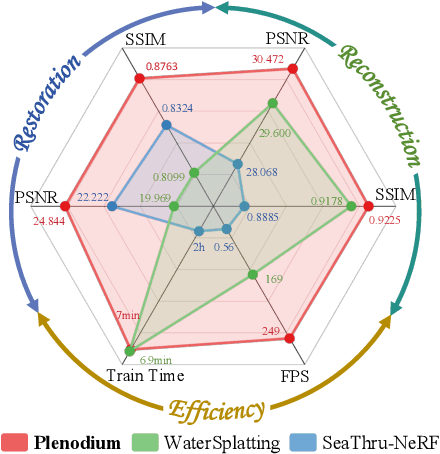
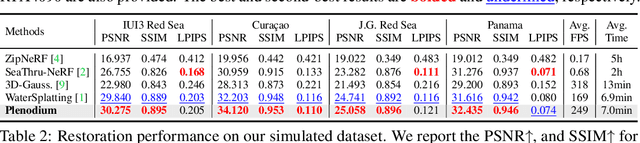
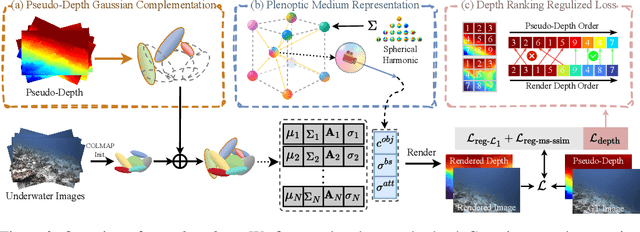
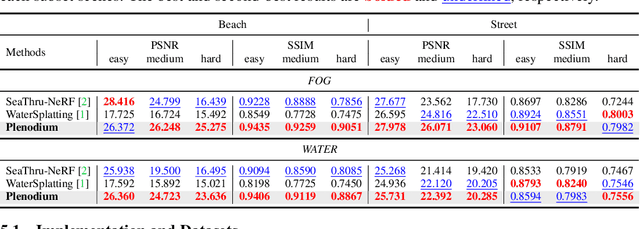
We present Plenodium (plenoptic medium), an effective and efficient 3D representation framework capable of jointly modeling both objects and participating media. In contrast to existing medium representations that rely solely on view-dependent modeling, our novel plenoptic medium representation incorporates both directional and positional information through spherical harmonics encoding, enabling highly accurate underwater scene reconstruction. To address the initialization challenge in degraded underwater environments, we propose the pseudo-depth Gaussian complementation to augment COLMAP-derived point clouds with robust depth priors. In addition, a depth ranking regularized loss is developed to optimize the geometry of the scene and improve the ordinal consistency of the depth maps. Extensive experiments on real-world underwater datasets demonstrate that our method achieves significant improvements in 3D reconstruction. Furthermore, we conduct a simulated dataset with ground truth and the controllable scattering medium to demonstrate the restoration capability of our method in underwater scenarios. Our code and dataset are available at https://plenodium.github.io/.
3D-UIR: 3D Gaussian for Underwater 3D Scene Reconstruction via Physics Based Appearance-Medium Decoupling
May 29, 2025Novel view synthesis for underwater scene reconstruction presents unique challenges due to complex light-media interactions. Optical scattering and absorption in water body bring inhomogeneous medium attenuation interference that disrupts conventional volume rendering assumptions of uniform propagation medium. While 3D Gaussian Splatting (3DGS) offers real-time rendering capabilities, it struggles with underwater inhomogeneous environments where scattering media introduce artifacts and inconsistent appearance. In this study, we propose a physics-based framework that disentangles object appearance from water medium effects through tailored Gaussian modeling. Our approach introduces appearance embeddings, which are explicit medium representations for backscatter and attenuation, enhancing scene consistency. In addition, we propose a distance-guided optimization strategy that leverages pseudo-depth maps as supervision with depth regularization and scale penalty terms to improve geometric fidelity. By integrating the proposed appearance and medium modeling components via an underwater imaging model, our approach achieves both high-quality novel view synthesis and physically accurate scene restoration. Experiments demonstrate our significant improvements in rendering quality and restoration accuracy over existing methods. The project page is available at https://bilityniu.github.io/3D-UIR.
TUGS: Physics-based Compact Representation of Underwater Scenes by Tensorized Gaussian
May 12, 2025Underwater 3D scene reconstruction is crucial for undewater robotic perception and navigation. However, the task is significantly challenged by the complex interplay between light propagation, water medium, and object surfaces, with existing methods unable to model their interactions accurately. Additionally, expensive training and rendering costs limit their practical application in underwater robotic systems. Therefore, we propose Tensorized Underwater Gaussian Splatting (TUGS), which can effectively solve the modeling challenges of the complex interactions between object geometries and water media while achieving significant parameter reduction. TUGS employs lightweight tensorized higher-order Gaussians with a physics-based underwater Adaptive Medium Estimation (AME) module, enabling accurate simulation of both light attenuation and backscatter effects in underwater environments. Compared to other NeRF-based and GS-based methods designed for underwater, TUGS is able to render high-quality underwater images with faster rendering speeds and less memory usage. Extensive experiments on real-world underwater datasets have demonstrated that TUGS can efficiently achieve superior reconstruction quality using a limited number of parameters, making it particularly suitable for memory-constrained underwater UAV applications
RUSplatting: Robust 3D Gaussian Splatting for Sparse-View Underwater Scene Reconstruction
May 21, 2025Reconstructing high-fidelity underwater scenes remains a challenging task due to light absorption, scattering, and limited visibility inherent in aquatic environments. This paper presents an enhanced Gaussian Splatting-based framework that improves both the visual quality and geometric accuracy of deep underwater rendering. We propose decoupled learning for RGB channels, guided by the physics of underwater attenuation, to enable more accurate colour restoration. To address sparse-view limitations and improve view consistency, we introduce a frame interpolation strategy with a novel adaptive weighting scheme. Additionally, we introduce a new loss function aimed at reducing noise while preserving edges, which is essential for deep-sea content. We also release a newly collected dataset, Submerged3D, captured specifically in deep-sea environments. Experimental results demonstrate that our framework consistently outperforms state-of-the-art methods with PSNR gains up to 1.90dB, delivering superior perceptual quality and robustness, and offering promising directions for marine robotics and underwater visual analytics.