 Add to Chrome
 Add to Firefox
 Add to Edge
FilmBench: A Film-Grade Benchmark for Cinematic Video Generation
Jul 27, 2026
Progress in video generation keeps narrowing the visual gap between AI-generated and professionally produced footage, yet most benchmarks still draw prompts from web sources or LLM templates and score them with untrained, generic multimodal models. More fundamentally, their evaluation taxonomies remain rudimentary (overall visual quality, coarse text alignment and temporal smoothness) rather than the professional Cinematic Language criteria by which films are actually made and judged, so they assess basic video plausibility rather than film-grade craft. We introduce FilmBench, a text-to-video (T2V) and reference-to-video (R2V) benchmark grounded in the professional Cinematic Language of the film- academy tradition and co-developed with directors and faculty from the Beijing Film Academy and the Hujing Digital Media & Entertainment Group film studio. It rests on three choices. First, prompts are reverse-engineered from clips of award-winning films spanning 20 cinematic genres and chosen by professional directors, so every prompt is anchored to a verified live-action reference; the prompts follow real shot lists, and most script multiple shots (1,056 of the 1,169 prompts are multi-shot), unlike prior single-clip benchmarks. Second, evaluation follows a three-level Cinematic taxonomy of 3 axes, 12 components and 35 (T2V) +3 (R2V-only) sub-metrics. Third, we develop an in-house expert-grade automatic evaluation agent and open-source its core suite of Cinematic Language operators (FilmOps). Benchmarking leading video generation models (9 for T2V, 7 for R2V), the evaluator reproduces the human model ranking at model-level Spearman \r{ho} = 0.95 (T2V) and 0.96 (R2V). Scores fall well below prior web-style benchmarks, with two consistent gaps in dynamic aesthetics and a marked single- to multi-shot performance drop that widens for weaker models.

Rethinking Conditional Generation for Underwater Salient Object Detection
Jul 02, 2026Salient Object Detection in underwater images remains challenging due to low contrast, uneven illumination, and color distortion caused by scattering and absorption effects, which limit the effectiveness of conventional SOD methods in underwater environments. To address these challenges, we propose a Degradation-aware Conditional Generation Network (DCGNet), specifically designed to construct reliable conditional features for underwater saliency generation. First, we design a Dynamic Multi-Granularity module (DMG) grounded in the human visual system to robustly detect salient objects of varying scales with blurred boundaries. Then, we develop an Underwater Physics-Prior module (UPP), which utilizes pseudo-depth guidance to estimate underwater light attenuation and backscatter, thereby restoring degradation-aware RGB features and mitigating color distortion and boundary ambiguity. Based on the physics-guided representation, we introduce an Underwater Spatial Gaussian module (USG), which constructs a spatial Gaussian saliency prior from the strongest guided response to enhance object-centered salient regions and suppress cluttered underwater backgrounds. In addition, a lightweight timestep-adaptive Diffusion Transformer (DiT) bottleneck is inserted into the denoising decoder to refine fused features at different diffusion timesteps. Comprehensive experiments on USOD10K, USOD, CSOD10K, MAS3K, and RMAS demonstrate that DCGNet significantly outperforms existing state-of-the-art methods, verifying its potential for complex underwater visual applications.
Nemotron 3 Ultra: Open, Efficient Mixture-of-Experts Hybrid Mamba-Transformer Model for Agentic Reasoning
Jun 12, 2026We introduce Nemotron 3 Ultra, a 550 billion total and 55 billion active parameter Mixture-of-Experts Hybrid Mamba-Attention language model. We pre-trained Nemotron 3 Ultra on 20 trillion text tokens, then extended the context length to 1M tokens, and post-trained using Supervised Fine Tuning (SFT), Reinforcement Learning (RL), and Multi-teacher On-Policy Distillation (MOPD). Nemotron 3 Ultra is our most capable model yet, employing multiple key technologies - LatentMoE, Multi Token Prediction (MTP), NVFP4 pre-training, multi-environment RLVR, MOPD, and reasoning budget control. Nemotron 3 Ultra achieves up to ~6x higher inference throughput as compared to state-of-the-art publicly available LLMs while attaining on-par accuracy. The state-of-the-art accuracy, high inference throughput, and 1M token context length make Nemotron 3 Ultra ideal for long-running autonomous agentic tasks. We open-source the base, post-trained, and quantized checkpoints, along with the training data and recipe on HuggingFace.
Gradient Perturbation: Learning to Perturb Gradients for Adaptive Training
May 28, 2026Deep neural network training involves both forward propagation (from features through logits to loss) and backward propagation (from loss through gradients to parameter updates). While perturbations along the forward chain, including feature perturbation, logit perturbation, and label perturbation, have been extensively studied, the backward chain's gradient perturbation has received little systematic investigation. In this paper, we establish a unified framework for gradient perturbation, revealing that existing methods such as Sharpness-Aware Minimization (SAM), gradient clipping, and gradient noise injection can all be interpreted as imposing specific forms of gradient perturbation. Analogous to the recently proposed Logit Perturbation Learning (LPL), we conjecture that amplifying the gradient norm for a class acts as positive augmentation (enhancing learning), while dampening it acts as negative augmentation (suppressing overfitting). Based on these observations, we propose Learning to Perturb Gradients (LPG), which adaptively perturbs logit-level gradients at the class level to achieve category-aware training. We also establish theoretical connections between gradient perturbation bounds and generalization guarantees via PAC-Bayesian analysis. Experiments on balanced classification, long-tail classification, and noisy label learning demonstrate that LPG consistently outperforms existing methods and can be combined with them as a plug-in module.
Learning to Perturb Hidden Representations for Generalizable Deep Learning
May 28, 2026Deep neural networks process data through a cascade of representations: input features, hidden activations, logits, and loss. While perturbations at the input, logit, and label levels have been systematically studied, the intermediate hidden activations, which constitute the bulk of the network's computation, have received no unified perturbation analysis. In this paper, we establish a unified framework for hidden activation perturbation, revealing that Dropout, Manifold Mixup, adversarial feature perturbation, and related methods all impose specific forms of activation perturbation but with class-agnostic or random strategies. We conjecture that expansive perturbation (increasing activation norm) acts as positive augmentation, while contractive perturbation (decreasing activation norm) acts as negative augmentation, and that the perturbation layer determines whether the effect resembles input-level augmentation (shallow layers) or logit-level manipulation (deep layers). We propose Learning to Perturb Activations (LPA), which adaptively perturbs activations at a selected hidden layer with class-level perturbations learned via PGD. We further provide theoretical analysis connecting activation perturbation to flat minima and perturbation amplification through layers. Experiments on balanced classification, long-tail classification, and domain generalization demonstrate that LPA consistently outperforms existing methods and provides complementary benefits to logit perturbation methods such as LPL.
Clustering based on Stochastic Dominance with application for risk averters and risk seekers
May 23, 2026Stochastic Dominance (SD) theory provides a rigorous framework for selecting superior assets tailored to the asset allocation needs of investors with varying risk preferences (i.e., risk-averse, risk-seeking, and risk-neutral). However, traditional stock clustering methods typically rely on geometric metrics such as Euclidean distance, which often fail to effectively capture the intrinsic risk dominance relationships among assets. To address this limitation, this paper proposes an innovative clustering analysis framework based on SD test statistics. Methodologically, this study deeply integrates SD theory with machine learning algorithms. Transcending the limitations of traditional reliance on geometric distance, we innovatively utilize test statistics from first-, second-, and third-order SD to construct a "Stochastic Dominance Coefficient Matrix." Building upon this matrix, we modify the classic K-means and Hierarchical Clustering algorithms. Specifically, we derive 12 distinct algorithm variants tailored to different orders of SD relationships. Simultaneously, we construct the SD-SC coefficient and the SD-DBI index as specialized validity indices to evaluate the clustering performance. Empirically, we analyze constituent stock data from a representative developed market (the US NASDAQ Index) and an emerging market (China's CSI 100 Index). The results verify the effectiveness and robustness of the proposed method. Furthermore, we apply the clustering results to the modification of the Single Index Model and the construction of Global Minimum Variance Portfolios (GMVP). The findings demonstrate that the proposed method effectively facilitates customized asset allocation for investors, holding significant theoretical value and practical implications.
DongYuan: An LLM-Based Framework for Integrative Chinese and Western Medicine Spleen-Stomach Disorders Diagnosis
Mar 30, 2026The clinical burden of spleen-stomach disorders is substantial. While large language models (LLMs) offer new potential for medical applications, they face three major challenges in the context of integrative Chinese and Western medicine (ICWM): a lack of high-quality data, the absence of models capable of effectively integrating the reasoning logic of traditional Chinese medicine (TCM) syndrome differentiation with that of Western medical (WM) disease diagnosis, and the shortage of a standardized evaluation benchmark. To address these interrelated challenges, we propose DongYuan, an ICWM spleen-stomach diagnostic framework. Specifically, three ICWM datasets (SSDF-Syndrome, SSDF-Dialogue, and SSDF-PD) were curated to fill the gap in high-quality data for spleen-stomach disorders. We then developed SSDF-Core, a core diagnostic LLM that acquires robust ICWM reasoning capabilities through a two-stage training regimen of supervised fine-tuning. tuning (SFT) and direct preference optimization (DPO), and complemented it with SSDF-Navigator, a pluggable consultation navigation model designed to optimize clinical inquiry strategies. Additionally, we established SSDF-Bench, a comprehensive evaluation benchmark focused on ICWM diagnosis of spleen-stomach disorders. Experimental results demonstrate that SSDF-Core significantly outperforms 12 mainstream baselines on SSDF-Bench. DongYuan lays a solid methodological foundation and provides practical technical references for the future development of intelligent ICWM diagnostic systems.
PerformRecast: Expression and Head Pose Disentanglement for Portrait Video Editing
Mar 20, 2026This paper primarily investigates the task of expression-only portrait video performance editing based on a driving video, which plays a crucial role in animation and film industries. Most existing research mainly focuses on portrait animation, which aims to animate a static portrait image according to the facial motion from the driving video. As a consequence, it remains challenging for them to disentangle the facial expression from head pose rotation and thus lack the ability to edit facial expression independently. In this paper, we propose PerformRecast, a versatile expression-only video editing method which is dedicated to recast the performance in existing film and animation. The key insight of our method comes from the characteristics of 3D Morphable Face Model (3DMM), which models the face identity, facial expression and head pose of 3D face mesh with separate parameters. Therefore, we improve the keypoints transformation formula in previous methods to make it more consistent with 3DMM model, which achieves a better disentanglement and provides users with much more fine-grained control. Furthermore, to avoid the misalignment around the boundary of face in generated results, we decouple the facial and non-facial regions of input portrait images and pre-train a teacher model to provide separate supervision for them. Extensive experiments show that our method produces high-quality results which are more faithful to the driving video, outperforming existing methods in both controllability and efficiency. Our code, data and trained models are available at https://youku-aigc.github.io/PerformRecast.
Fine-Tuning Diffusion-Based Recommender Systems via Reinforcement Learning with Reward Function Optimization
Nov 10, 2025Diffusion models recently emerged as a powerful paradigm for recommender systems, offering state-of-the-art performance by modeling the generative process of user-item interactions. However, training such models from scratch is both computationally expensive and yields diminishing returns once convergence is reached. To remedy these challenges, we propose ReFiT, a new framework that integrates Reinforcement learning (RL)-based Fine-Tuning into diffusion-based recommender systems. In contrast to prior RL approaches for diffusion models depending on external reward models, ReFiT adopts a task-aligned design: it formulates the denoising trajectory as a Markov decision process (MDP) and incorporates a collaborative signal-aware reward function that directly reflects recommendation quality. By tightly coupling the MDP structure with this reward signal, ReFiT empowers the RL agent to exploit high-order connectivity for fine-grained optimization, while avoiding the noisy or uninformative feedback common in naive reward designs. Leveraging policy gradient optimization, ReFiT maximizes exact log-likelihood of observed interactions, thereby enabling effective post hoc fine-tuning of diffusion recommenders. Comprehensive experiments on wide-ranging real-world datasets demonstrate that the proposed ReFiT framework (a) exhibits substantial performance gains over strong competitors (up to 36.3% on sequential recommendation), (b) demonstrates strong efficiency with linear complexity in the number of users or items, and (c) generalizes well across multiple diffusion-based recommendation scenarios. The source code and datasets are publicly available at https://anonymous.4open.science/r/ReFiT-4C60.
WaterFlow: Explicit Physics-Prior Rectified Flow for Underwater Saliency Mask Generation
Oct 14, 2025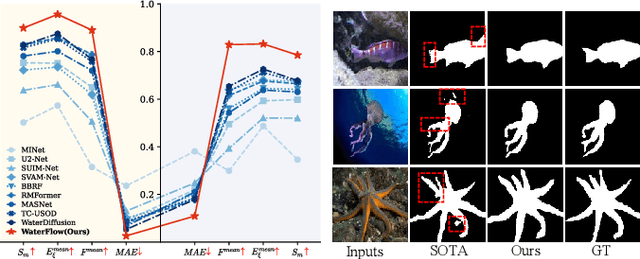
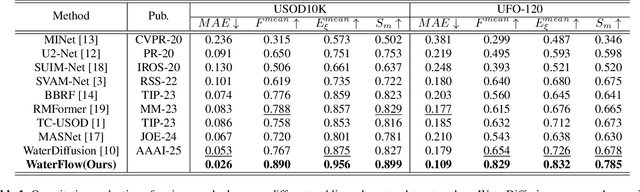
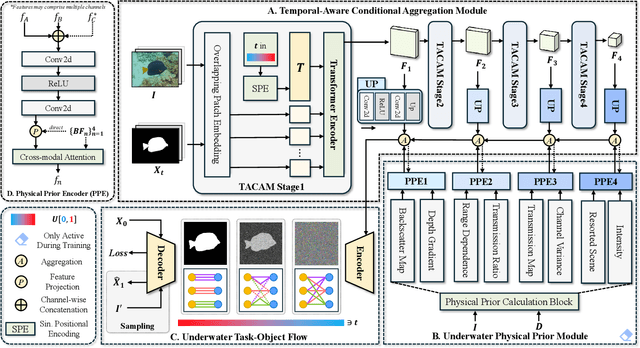
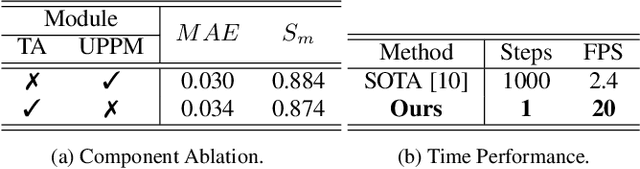
Underwater Salient Object Detection (USOD) faces significant challenges, including underwater image quality degradation and domain gaps. Existing methods tend to ignore the physical principles of underwater imaging or simply treat degradation phenomena in underwater images as interference factors that must be eliminated, failing to fully exploit the valuable information they contain. We propose WaterFlow, a rectified flow-based framework for underwater salient object detection that innovatively incorporates underwater physical imaging information as explicit priors directly into the network training process and introduces temporal dimension modeling, significantly enhancing the model's capability for salient object identification. On the USOD10K dataset, WaterFlow achieves a 0.072 gain in S_m, demonstrating the effectiveness and superiority of our method. The code will be published after the acceptance.