 Add to Chrome
 Add to Firefox
 Add to Edge
Svhn Image Classification
Papers and Code
ERDE: Entropy-Regularized Distillation for Early-exit
Oct 06, 2025
Although deep neural networks and in particular Convolutional Neural Networks have demonstrated state-of-the-art performance in image classification with relatively high efficiency, they still exhibit high computational costs, often rendering them impractical for real-time and edge applications. Therefore, a multitude of compression techniques have been developed to reduce these costs while maintaining accuracy. In addition, dynamic architectures have been introduced to modulate the level of compression at execution time, which is a desirable property in many resource-limited application scenarios. The proposed method effectively integrates two well-established optimization techniques: early exits and knowledge distillation, where a reduced student early-exit model is trained from a more complex teacher early-exit model. The primary contribution of this research lies in the approach for training the student early-exit model. In comparison to the conventional Knowledge Distillation loss, our approach incorporates a new entropy-based loss for images where the teacher's classification was incorrect. The proposed method optimizes the trade-off between accuracy and efficiency, thereby achieving significant reductions in computational complexity without compromising classification performance. The validity of this approach is substantiated by experimental results on image classification datasets CIFAR10, CIFAR100 and SVHN, which further opens new research perspectives for Knowledge Distillation in other contexts.

CoSwin: Convolution Enhanced Hierarchical Shifted Window Attention For Small-Scale Vision
Sep 10, 2025Vision Transformers (ViTs) have achieved impressive results in computer vision by leveraging self-attention to model long-range dependencies. However, their emphasis on global context often comes at the expense of local feature extraction in small datasets, particularly due to the lack of key inductive biases such as locality and translation equivariance. To mitigate this, we propose CoSwin, a novel feature-fusion architecture that augments the hierarchical shifted window attention with localized convolutional feature learning. Specifically, CoSwin integrates a learnable local feature enhancement module into each attention block, enabling the model to simultaneously capture fine-grained spatial details and global semantic structure. We evaluate CoSwin on multiple image classification benchmarks including CIFAR-10, CIFAR-100, MNIST, SVHN, and Tiny ImageNet. Our experimental results show consistent performance gains over state-of-the-art convolutional and transformer-based models. Notably, CoSwin achieves improvements of 2.17% on CIFAR-10, 4.92% on CIFAR-100, 0.10% on MNIST, 0.26% on SVHN, and 4.47% on Tiny ImageNet over the baseline Swin Transformer. These improvements underscore the effectiveness of local-global feature fusion in enhancing the generalization and robustness of transformers for small-scale vision. Code and pretrained weights available at https://github.com/puskal-khadka/coswin
Nearest Neighbor Projection Removal Adversarial Training
Sep 10, 2025Deep neural networks have exhibited impressive performance in image classification tasks but remain vulnerable to adversarial examples. Standard adversarial training enhances robustness but typically fails to explicitly address inter-class feature overlap, a significant contributor to adversarial susceptibility. In this work, we introduce a novel adversarial training framework that actively mitigates inter-class proximity by projecting out inter-class dependencies from adversarial and clean samples in the feature space. Specifically, our approach first identifies the nearest inter-class neighbors for each adversarial sample and subsequently removes projections onto these neighbors to enforce stronger feature separability. Theoretically, we demonstrate that our proposed logits correction reduces the Lipschitz constant of neural networks, thereby lowering the Rademacher complexity, which directly contributes to improved generalization and robustness. Extensive experiments across standard benchmarks including CIFAR-10, CIFAR-100, and SVHN show that our method demonstrates strong performance that is competitive with leading adversarial training techniques, highlighting significant achievements in both robust and clean accuracy. Our findings reveal the importance of addressing inter-class feature proximity explicitly to bolster adversarial robustness in DNNs.
Feature-based Graph Attention Networks Improve Online Continual Learning
Feb 13, 2025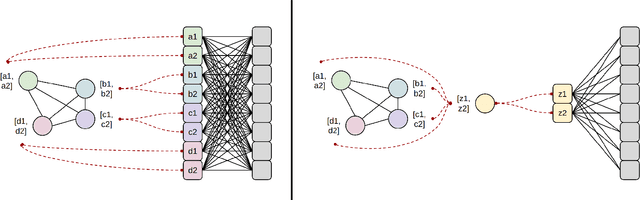
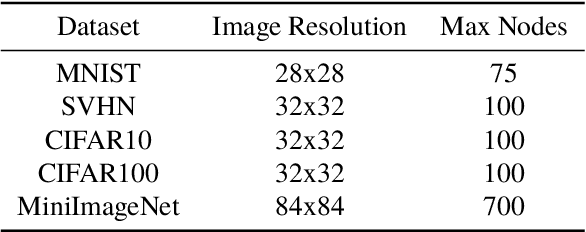
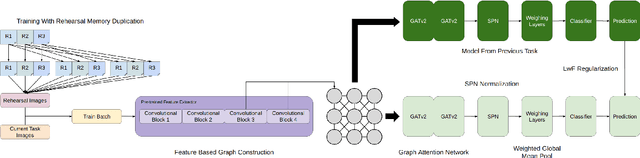
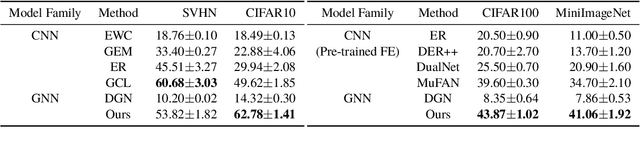
Online continual learning for image classification is crucial for models to adapt to new data while retaining knowledge of previously learned tasks. This capability is essential to address real-world challenges involving dynamic environments and evolving data distributions. Traditional approaches predominantly employ Convolutional Neural Networks, which are limited to processing images as grids and primarily capture local patterns rather than relational information. Although the emergence of transformer architectures has improved the ability to capture relationships, these models often require significantly larger resources. In this paper, we present a novel online continual learning framework based on Graph Attention Networks (GATs), which effectively capture contextual relationships and dynamically update the task-specific representation via learned attention weights. Our approach utilizes a pre-trained feature extractor to convert images into graphs using hierarchical feature maps, representing information at varying levels of granularity. These graphs are then processed by a GAT and incorporate an enhanced global pooling strategy to improve classification performance for continual learning. In addition, we propose the rehearsal memory duplication technique that improves the representation of the previous tasks while maintaining the memory budget. Comprehensive evaluations on benchmark datasets, including SVHN, CIFAR10, CIFAR100, and MiniImageNet, demonstrate the superiority of our method compared to the state-of-the-art methods.
Leveraging Foundation Models for Efficient Federated Learning in Resource-restricted Edge Networks
Sep 14, 2024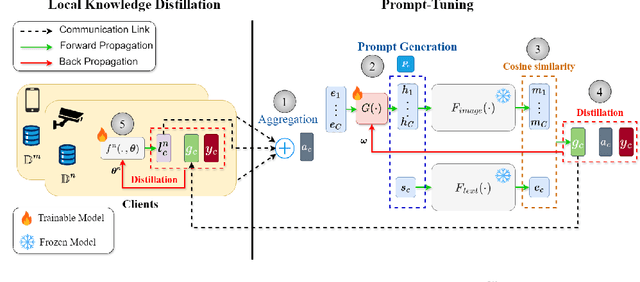

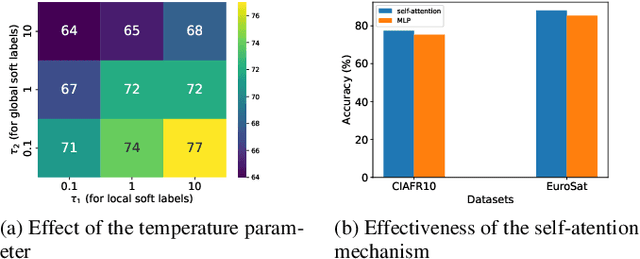
Recently pre-trained Foundation Models (FMs) have been combined with Federated Learning (FL) to improve training of downstream tasks while preserving privacy. However, deploying FMs over edge networks with resource-constrained Internet of Things (IoT) devices is under-explored. This paper proposes a novel framework, namely, Federated Distilling knowledge to Prompt (FedD2P), for leveraging the robust representation abilities of a vision-language FM without deploying it locally on edge devices. This framework distills the aggregated knowledge of IoT devices to a prompt generator to efficiently adapt the frozen FM for downstream tasks. To eliminate the dependency on a public dataset, our framework leverages perclass local knowledge from IoT devices and linguistic descriptions of classes to train the prompt generator. Our experiments on diverse image classification datasets CIFAR, OxfordPets, SVHN, EuroSAT, and DTD show that FedD2P outperforms the baselines in terms of model performance.
KANICE: Kolmogorov-Arnold Networks with Interactive Convolutional Elements
Oct 22, 2024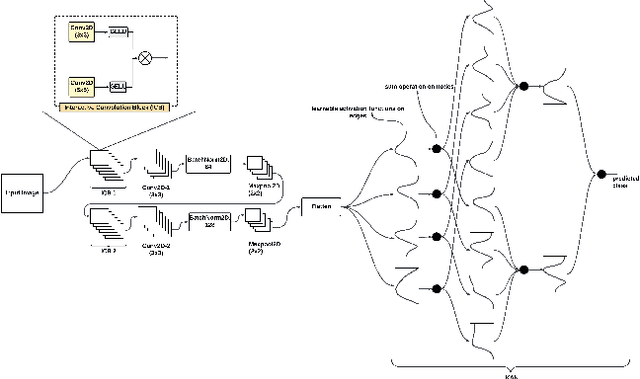


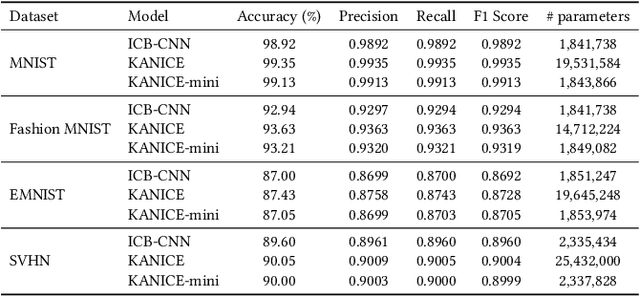
We introduce KANICE (Kolmogorov-Arnold Networks with Interactive Convolutional Elements), a novel neural architecture that combines Convolutional Neural Networks (CNNs) with Kolmogorov-Arnold Network (KAN) principles. KANICE integrates Interactive Convolutional Blocks (ICBs) and KAN linear layers into a CNN framework. This leverages KANs' universal approximation capabilities and ICBs' adaptive feature learning. KANICE captures complex, non-linear data relationships while enabling dynamic, context-dependent feature extraction based on the Kolmogorov-Arnold representation theorem. We evaluated KANICE on four datasets: MNIST, Fashion-MNIST, EMNIST, and SVHN, comparing it against standard CNNs, CNN-KAN hybrids, and ICB variants. KANICE consistently outperformed baseline models, achieving 99.35% accuracy on MNIST and 90.05% on the SVHN dataset. Furthermore, we introduce KANICE-mini, a compact variant designed for efficiency. A comprehensive ablation study demonstrates that KANICE-mini achieves comparable performance to KANICE with significantly fewer parameters. KANICE-mini reached 90.00% accuracy on SVHN with 2,337,828 parameters, compared to KANICE's 25,432,000. This study highlights the potential of KAN-based architectures in balancing performance and computational efficiency in image classification tasks. Our work contributes to research in adaptive neural networks, integrates mathematical theorems into deep learning architectures, and explores the trade-offs between model complexity and performance, advancing computer vision and pattern recognition. The source code for this paper is publicly accessible through our GitHub repository (https://github.com/m-ferdaus/kanice).
Failure-Proof Non-Contrastive Self-Supervised Learning
Oct 07, 2024We identify sufficient conditions to avoid known failure modes, including representation, dimensional, cluster and intracluster collapses, occurring in non-contrastive self-supervised learning. Based on these findings, we propose a principled design for the projector and loss function. We theoretically demonstrate that this design introduces an inductive bias that promotes learning representations that are both decorrelated and clustered without explicit enforcing these properties and leading to improved generalization. To the best of our knowledge, this is the first solution that achieves robust training with respect to these failure modes while guaranteeing enhanced generalization performance in downstream tasks. We validate our theoretical findings on image datasets including SVHN, CIFAR10, CIFAR100 and ImageNet-100, and show that our solution, dubbed FALCON, outperforms existing feature decorrelation and cluster-based self-supervised learning methods in terms of generalization to clustering and linear classification tasks.
Kolmogorov-Arnold Network Autoencoders
Oct 02, 2024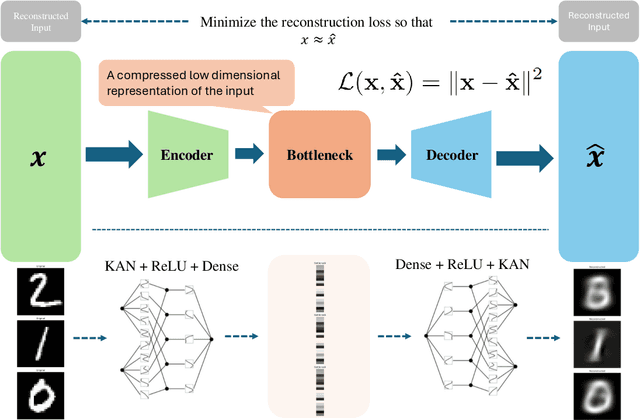
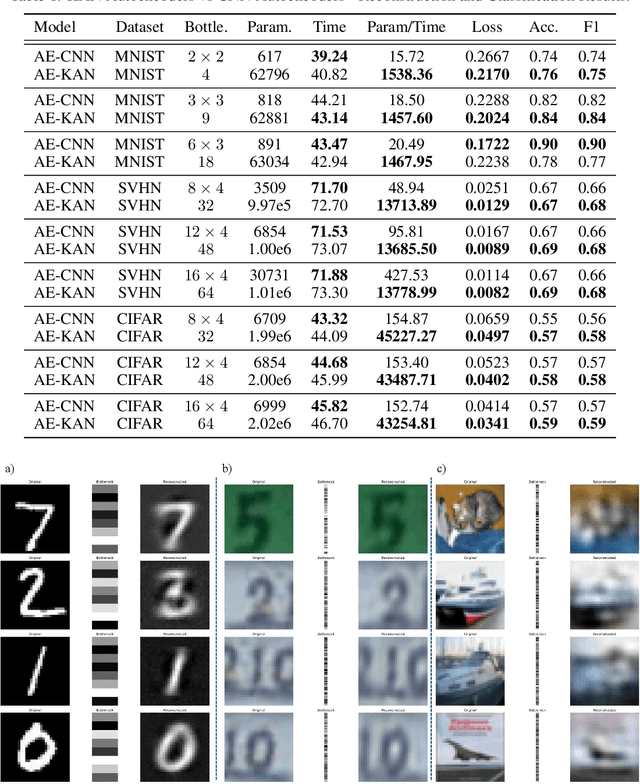

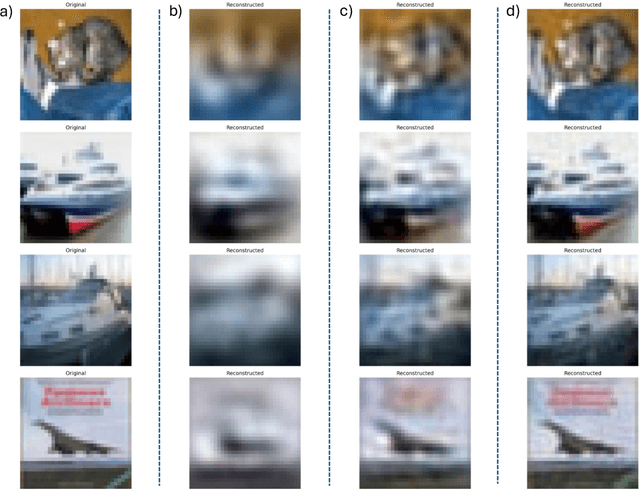
Deep learning models have revolutionized various domains, with Multi-Layer Perceptrons (MLPs) being a cornerstone for tasks like data regression and image classification. However, a recent study has introduced Kolmogorov-Arnold Networks (KANs) as promising alternatives to MLPs, leveraging activation functions placed on edges rather than nodes. This structural shift aligns KANs closely with the Kolmogorov-Arnold representation theorem, potentially enhancing both model accuracy and interpretability. In this study, we explore the efficacy of KANs in the context of data representation via autoencoders, comparing their performance with traditional Convolutional Neural Networks (CNNs) on the MNIST, SVHN, and CIFAR-10 datasets. Our results demonstrate that KAN-based autoencoders achieve competitive performance in terms of reconstruction accuracy, thereby suggesting their viability as effective tools in data analysis tasks.
Momentum Auxiliary Network for Supervised Local Learning
Jul 09, 2024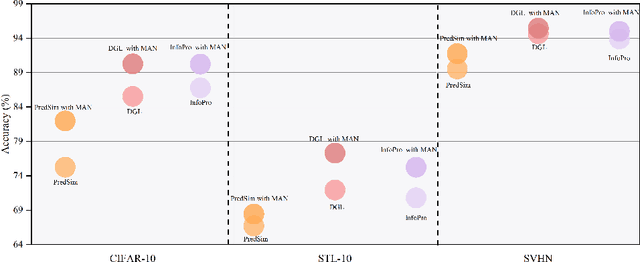
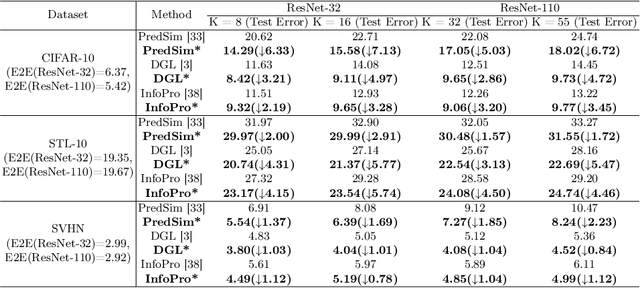
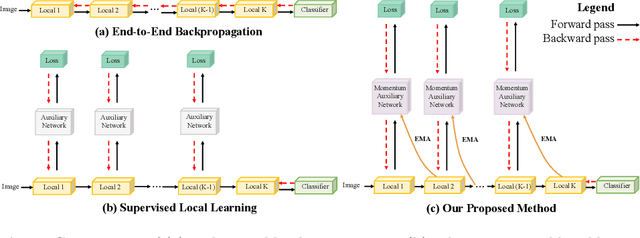
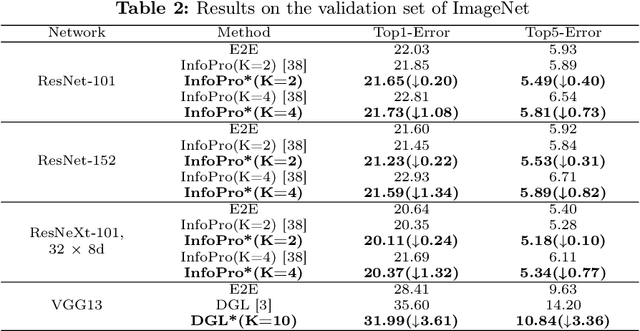
Deep neural networks conventionally employ end-to-end backpropagation for their training process, which lacks biological credibility and triggers a locking dilemma during network parameter updates, leading to significant GPU memory use. Supervised local learning, which segments the network into multiple local blocks updated by independent auxiliary networks. However, these methods cannot replace end-to-end training due to lower accuracy, as gradients only propagate within their local block, creating a lack of information exchange between blocks. To address this issue and establish information transfer across blocks, we propose a Momentum Auxiliary Network (MAN) that establishes a dynamic interaction mechanism. The MAN leverages an exponential moving average (EMA) of the parameters from adjacent local blocks to enhance information flow. This auxiliary network, updated through EMA, helps bridge the informational gap between blocks. Nevertheless, we observe that directly applying EMA parameters has certain limitations due to feature discrepancies among local blocks. To overcome this, we introduce learnable biases, further boosting performance. We have validated our method on four image classification datasets (CIFAR-10, STL-10, SVHN, ImageNet), attaining superior performance and substantial memory savings. Notably, our method can reduce GPU memory usage by more than 45\% on the ImageNet dataset compared to end-to-end training, while achieving higher performance. The Momentum Auxiliary Network thus offers a new perspective for supervised local learning. Our code is available at: https://github.com/JunhaoSu0/MAN.
Improving Quaternion Neural Networks with Quaternionic Activation Functions
Jun 24, 2024In this paper, we propose novel quaternion activation functions where we modify either the quaternion magnitude or the phase, as an alternative to the commonly used split activation functions. We define criteria that are relevant for quaternion activation functions, and subsequently we propose our novel activation functions based on this analysis. Instead of applying a known activation function like the ReLU or Tanh on the quaternion elements separately, these activation functions consider the quaternion properties and respect the quaternion space $\mathbb{H}$. In particular, all quaternion components are utilized to calculate all output components, carrying out the benefit of the Hamilton product in e.g. the quaternion convolution to the activation functions. The proposed activation functions can be incorporated in arbitrary quaternion valued neural networks trained with gradient descent techniques. We further discuss the derivatives of the proposed activation functions where we observe beneficial properties for the activation functions affecting the phase. Specifically, they prove to be sensitive on basically the whole input range, thus improved gradient flow can be expected. We provide an elaborate experimental evaluation of our proposed quaternion activation functions including comparison with the split ReLU and split Tanh on two image classification tasks using the CIFAR-10 and SVHN dataset. There, especially the quaternion activation functions affecting the phase consistently prove to provide better performance.