 Add to Chrome
 Add to Firefox
 Add to Edge
PACE: Persona Adaptation through Conversational Elicitation in Human-Robot Interaction
Jul 21, 2026
Equipping humanoid robots with coherent and adaptable personas is crucial for fostering natural, engaging, and trustworthy human-robot interaction (HRI). However, existing approaches often rely on static, hard-coded identities that lack the flexibility to adapt to individual user contexts. In this paper, we present PACE (Persona Adaptation through Conversational Elicitation), a novel framework for the interactive generation and deployment of structured personas on the Ameca humanoid robot. Our system introduces an Interactive Persona Elicitation Pipeline, enabling the robot to dynamically synthesize a tailored, psychologically grounded identity through user Q&A. This elicitation process feeds into a persona prompt compilation phase, generating a structured persona prompt built upon multi-perspective dimensions. We detail the Embodied System Integration required to translate this structured specification into expressive, multimodal humanoid behaviors. Through a comprehensive empirical HRI evaluation, we assess the impact of dynamically generated personas on user trust, perceived anthropomorphism, persona consistency, personal relevance, and interaction quality compared to a generic baseline. These contributions establish a scalable pathway for deploying personalized, interactive, and reliable identities in embodied humanoid assistants. Video demo is available at: https://lipzh5.github.io/PACE/

FORGE: Fused On-Register Gradient Elimination for Memory-Efficient LLM Training
Jun 22, 2026Reverse-mode differentiation computes every weight gradient, writes it to memory, and only then lets the optimizer read it back. This two-phase schedule sets the memory ceiling of modern training: at the seam between the phases, every layer's gradient is live at once. We argue that this materialized gradient is an artifact of how differentiation is staged, not a quantity that learning requires -- and we eliminate it. FORGE folds the optimizer step into the backward pass and applies it one tile at a time, entirely in registers, so each gradient tile is consumed the instant it is produced and never becomes a tensor. The fusion changes only when the update happens, not what it computes: in full precision the fused step is provably exact -- the identical optimizer update, for every element-wise rule -- and that exactness survives tensor- and sequence-parallel sharding; in the bf16 and 8-bit regimes used in practice it is faithful rather than bit-identical, its deviation bounded and, for the weight store, rendered unbiased by stochastic rounding. Because each gradient tile is born and consumed in the same registers, it is never converted down to bf16 to be stored and read back; FORGE thus preserves the full-precision fidelity that both bf16 and 8-bit optimizers lose to that conversion. Nor is the method tied to one architecture or one optimizer: linear layers are ubiquitous, and FORGE reclaims the gradient memory of any of them under any element-wise rule. Empirically FORGE more than halves the memory of an optimizer step and, at the small batch sizes typical of fine-tuning and continued pretraining, runs about 1.5x faster; integrated into tensor-parallel Megatron-LM it fits 8B training at four times the micro-batch a standard optimizer allows on the same GPUs.
The Periodic Table of LLM Reasoning: A Structured Survey of Reasoning Paradigms, Methods, and Failure Modes
Jun 09, 2026Large Language Models (LLMs) have achieved strong performance across natural language processing tasks, yet reliable reasoning remains an open challenge. Although modern LLMs show progress in structured inference, multi-step problem solving, and contextual understanding, their reasoning behavior is often inconsistent and sensitive to prompting strategies, task design, and model scale. This survey provides a systematic analysis of more than 300 recent papers from arXiv, Semantic Scholar, Google Scholar, Papers with Code, and the ACL Anthology to examine how reasoning capabilities emerge in LLMs and where they fail. We make three main contributions. First, we introduce a structured taxonomy of LLM reasoning research, covering Chain-of-Thought reasoning, multi-hop reasoning, mathematical reasoning, common sense reasoning, visual and temporal reasoning, code and algorithmic reasoning, retrieval-augmented reasoning, tool-augmented and agentic reasoning, and reinforcement learning-based reasoning. Second, we analyze methodological trends across these paradigms, including prompting methods, model architectures, training objectives, reward modeling, and evaluation benchmarks. Third, we synthesize recurring limitations and failure modes, such as reasoning hallucinations, brittle multi-step inference, weak causal abstraction, and poor cross-domain generalization. By organizing a rapidly expanding literature, this survey offers a unified view of the current capabilities and limitations of reasoning in LLMs. We also identify emerging research directions, including meta-reasoning, self-evolving reasoning frameworks, multimodal reasoning, and socially grounded reasoning. Overall, this work aims to serve as a reference for developing more robust, interpretable, and generalizable reasoning systems in future language models.
IRIS: Interleaved Reinforcement with Incremental Staged Curriculum for Cross-Lingual Mathematical Reasoning
Apr 27, 2026Curriculum learning helps language models tackle complex reasoning by gradually increasing task difficulty. However, it often fails to generate consistent step-by-step reasoning, especially in multilingual and low-resource settings where cross-lingual transfer from English to Indian languages remains limited. We propose IRIS: Interleaved Reinforcement with Incremental Staged Curriculum, a two-axis framework that combines Supervised Fine-Tuning on progressively harder problems (vertical axis) with Reverse Curriculum Reinforcement Learning to reduce reliance on step-by-step guidance (horizontal axis). We design a composite reward combining correctness, step-wise alignment, continuity, and numeric incentives, optimized via Group Relative Policy Optimization (GRPO). We release CL-Math, a dataset of 29k problems with step-level annotations in English, Hindi, and Marathi. Across standard benchmarks and curated multilingual test sets, IRIS consistently improves performance, with strong results on math reasoning tasks and substantial gains in low-resource and bilingual settings, alongside modest improvements in high-resource languages.
Better and Worse with Scale: How Contextual Entrainment Diverges with Model Size
Apr 14, 2026Larger language models become simultaneously better and worse at handling contextual information -- better at ignoring false claims, worse at ignoring irrelevant tokens. We formalize this apparent paradox through the first scaling laws for contextual entrainment, the tendency of models to favor tokens that appeared in context regardless of relevance. Analyzing the Cerebras-GPT (111M-13B) and Pythia (410M-12B) model families, we find entrainment follows predictable power-law scaling, but with opposite trends depending on context type: semantic contexts show decreasing entrainment with scale, while non-semantic contexts show increasing entrainment. Concretely, the largest models are four times more resistant to counterfactual misinformation than the smallest, yet simultaneously twice as prone to copying arbitrary tokens. These diverging trends, which replicate across model families, suggest that semantic filtering and mechanical copying are functionally distinct behaviors that scale in opposition -- scaling alone does not resolve context sensitivity, it reshapes it.
DAST: A Dual-Stream Voice Anonymization Attacker with Staged Training
Mar 16, 2026Voice anonymization masks vocal traits while preserving linguistic content, which may still leak speaker-specific patterns. To assess and strengthen privacy evaluation, we propose a dual-stream attacker that fuses spectral and self-supervised learning features via parallel encoders with a three-stage training strategy. Stage I establishes foundational speaker-discriminative representations. Stage II leverages the shared identity-transformation characteristics of voice conversion and anonymization, exposing the model to diverse converted speech to build cross-system robustness. Stage III provides lightweight adaptation to target anonymized data. Results on the VoicePrivacy Attacker Challenge (VPAC) dataset demonstrate that Stage II is the primary driver of generalization, enabling strong attacking performance on unseen anonymization datasets. With Stage III, fine-tuning on only 10\% of the target anonymization dataset surpasses current state-of-the-art attackers in terms of EER.
A Vision-Language Foundation Model for Zero-shot Clinical Collaboration and Automated Concept Discovery in Dermatology
Feb 11, 2026Medical foundation models have shown promise in controlled benchmarks, yet widespread deployment remains hindered by reliance on task-specific fine-tuning. Here, we introduce DermFM-Zero, a dermatology vision-language foundation model trained via masked latent modelling and contrastive learning on over 4 million multimodal data points. We evaluated DermFM-Zero across 20 benchmarks spanning zero-shot diagnosis and multimodal retrieval, achieving state-of-the-art performance without task-specific adaptation. We further evaluated its zero-shot capabilities in three multinational reader studies involving over 1,100 clinicians. In primary care settings, AI assistance enabled general practitioners to nearly double their differential diagnostic accuracy across 98 skin conditions. In specialist settings, the model significantly outperformed board-certified dermatologists in multimodal skin cancer assessment. In collaborative workflows, AI assistance enabled non-experts to surpass unassisted experts while improving management appropriateness. Finally, we show that DermFM-Zero's latent representations are interpretable: sparse autoencoders unsupervisedly disentangle clinically meaningful concepts that outperform predefined-vocabulary approaches and enable targeted suppression of artifact-induced biases, enhancing robustness without retraining. These findings demonstrate that a foundation model can provide effective, safe, and transparent zero-shot clinical decision support.
ReLA: Representation Learning and Aggregation for Job Scheduling with Reinforcement Learning
Jan 08, 2026Job scheduling is widely used in real-world manufacturing systems to assign ordered job operations to machines under various constraints. Existing solutions remain limited by long running time or insufficient schedule quality, especially when problem scale increases. In this paper, we propose ReLA, a reinforcement-learning (RL) scheduler built on structured representation learning and aggregation. ReLA first learns diverse representations from scheduling entities, including job operations and machines, using two intra-entity learning modules with self-attention and convolution and one inter-entity learning module with cross-attention. These modules are applied in a multi-scale architecture, and their outputs are aggregated to support RL decision-making. Across experiments on small, medium, and large job instances, ReLA achieves the best makespan in most tested settings over the latest solutions. On non-large instances, ReLA reduces the optimality gap of the SOTA baseline by 13.0%, while on large-scale instances it reduces the gap by 78.6%, with the average optimality gaps lowered to 7.3% and 2.1%, respectively. These results confirm that ReLA's learned representations and aggregation provide strong decision support for RL scheduling, and enable fast job completion and decision-making for real-world applications.
SegReConcat: A Data Augmentation Method for Voice Anonymization Attack
Aug 26, 2025Anonymization of voice seeks to conceal the identity of the speaker while maintaining the utility of speech data. However, residual speaker cues often persist, which pose privacy risks. We propose SegReConcat, a data augmentation method for attacker-side enhancement of automatic speaker verification systems. SegReConcat segments anonymized speech at the word level, rearranges segments using random or similarity-based strategies to disrupt long-term contextual cues, and concatenates them with the original utterance, allowing an attacker to learn source speaker traits from multiple perspectives. The proposed method has been evaluated in the VoicePrivacy Attacker Challenge 2024 framework across seven anonymization systems, SegReConcat improves de-anonymization on five out of seven systems.
Feature-based Graph Attention Networks Improve Online Continual Learning
Feb 13, 2025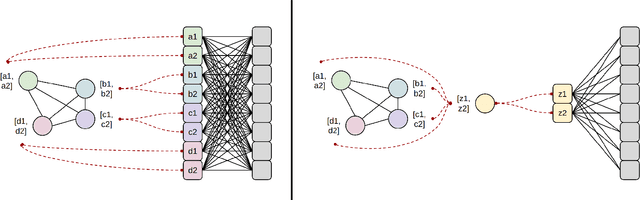
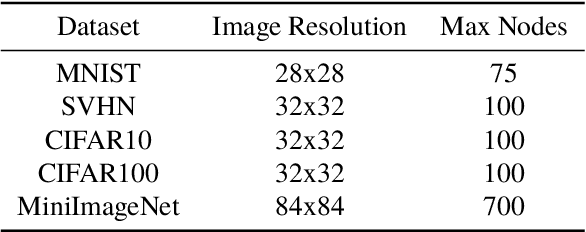
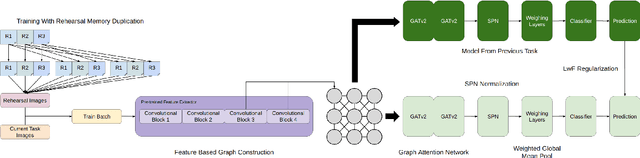
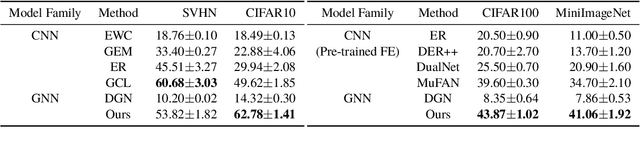
Online continual learning for image classification is crucial for models to adapt to new data while retaining knowledge of previously learned tasks. This capability is essential to address real-world challenges involving dynamic environments and evolving data distributions. Traditional approaches predominantly employ Convolutional Neural Networks, which are limited to processing images as grids and primarily capture local patterns rather than relational information. Although the emergence of transformer architectures has improved the ability to capture relationships, these models often require significantly larger resources. In this paper, we present a novel online continual learning framework based on Graph Attention Networks (GATs), which effectively capture contextual relationships and dynamically update the task-specific representation via learned attention weights. Our approach utilizes a pre-trained feature extractor to convert images into graphs using hierarchical feature maps, representing information at varying levels of granularity. These graphs are then processed by a GAT and incorporate an enhanced global pooling strategy to improve classification performance for continual learning. In addition, we propose the rehearsal memory duplication technique that improves the representation of the previous tasks while maintaining the memory budget. Comprehensive evaluations on benchmark datasets, including SVHN, CIFAR10, CIFAR100, and MiniImageNet, demonstrate the superiority of our method compared to the state-of-the-art methods.