 Add to Chrome
 Add to Firefox
 Add to Edge
Vestibular reservoir computing
Apr 10, 2026
Reservoir computing (RC) is a computational framework known for its training efficiency, making it ideal for physical hardware implementations. However, realizing the complex interconnectivity of traditional reservoirs in physical systems remains a significant challenge. This paper proposes a physical RC scheme inspired by the biological vestibular system. To overcome hardware complexity, we introduce a designed uncoupled topology and demonstrate that it achieves performance comparable to fully coupled networks. We theoretically analyze the difference between these topologies by deriving a memory capacity formula for linear reservoirs, identifying specific conditions where both configurations yield equivalent memory. These analytical results are demonstrated to approximately hold for nonlinear reservoir systems. Furthermore, we systematically examine the impact of reservoir size on predictive statistics and memory capacity. Our findings suggest that uncoupled reservoir architectures offer a mathematically sound and practically feasible pathway for efficient physical reservoir computing.

Unsupervised learning for anticipating critical transitions
Jan 02, 2025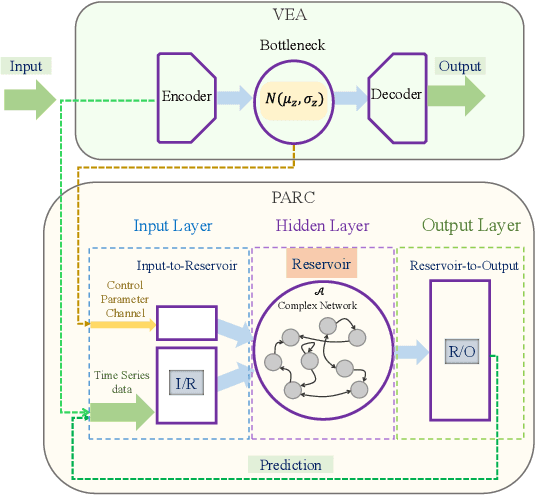
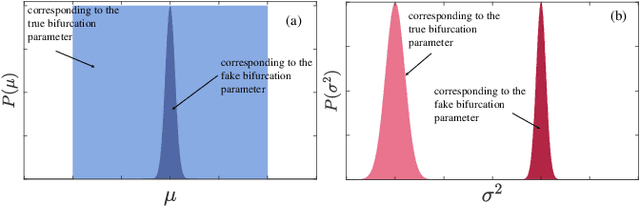
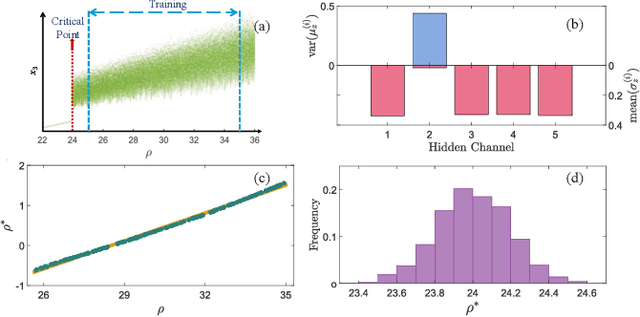
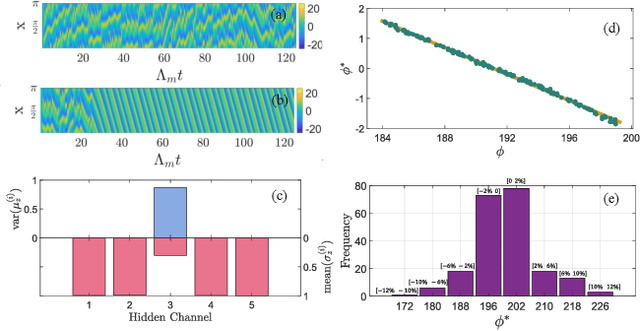
For anticipating critical transitions in complex dynamical systems, the recent approach of parameter-driven reservoir computing requires explicit knowledge of the bifurcation parameter. We articulate a framework combining a variational autoencoder (VAE) and reservoir computing to address this challenge. In particular, the driving factor is detected from time series using the VAE in an unsupervised-learning fashion and the extracted information is then used as the parameter input to the reservoir computer for anticipating the critical transition. We demonstrate the power of the unsupervised learning scheme using prototypical dynamical systems including the spatiotemporal Kuramoto-Sivashinsky system. The scheme can also be extended to scenarios where the target system is driven by several independent parameters or with partial state observations.
Kolmogorov-Arnold Network Autoencoders
Oct 02, 2024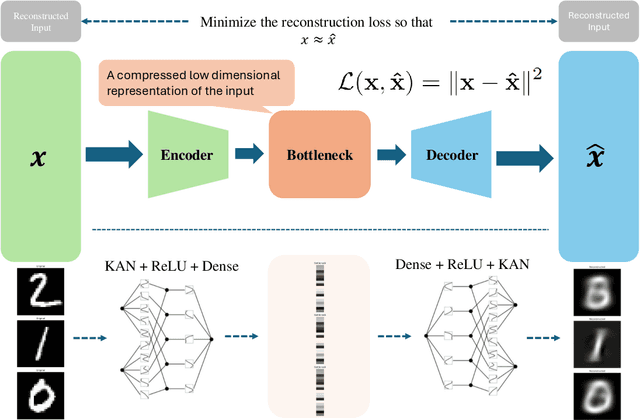
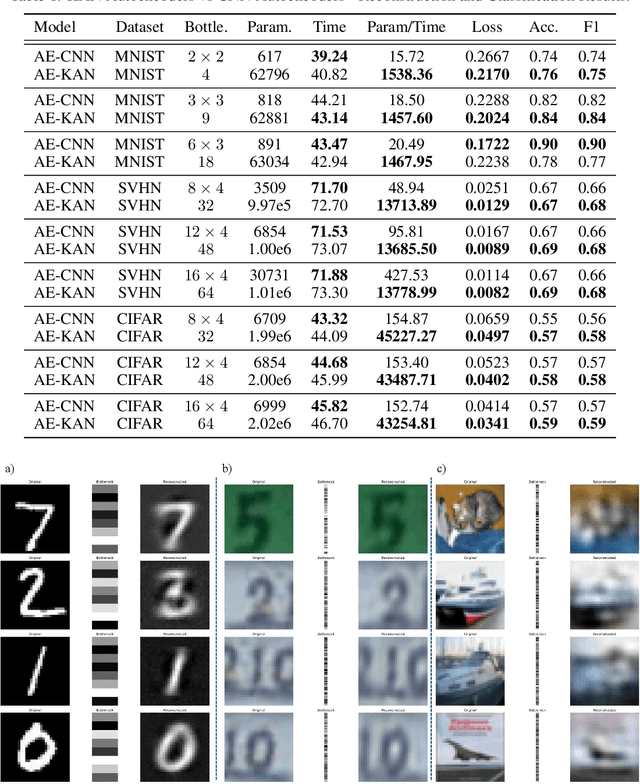

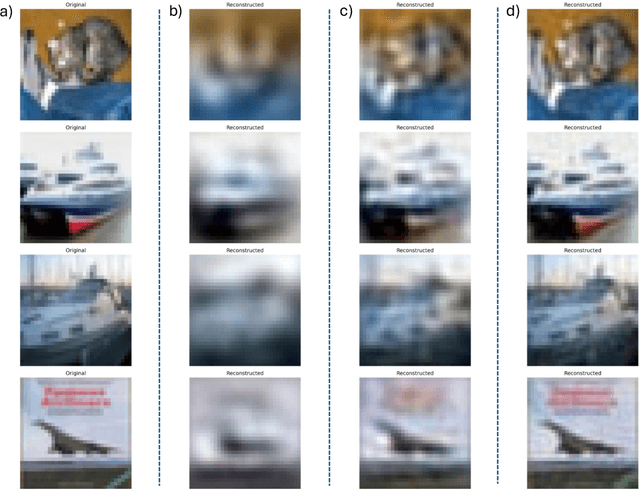
Deep learning models have revolutionized various domains, with Multi-Layer Perceptrons (MLPs) being a cornerstone for tasks like data regression and image classification. However, a recent study has introduced Kolmogorov-Arnold Networks (KANs) as promising alternatives to MLPs, leveraging activation functions placed on edges rather than nodes. This structural shift aligns KANs closely with the Kolmogorov-Arnold representation theorem, potentially enhancing both model accuracy and interpretability. In this study, we explore the efficacy of KANs in the context of data representation via autoencoders, comparing their performance with traditional Convolutional Neural Networks (CNNs) on the MNIST, SVHN, and CIFAR-10 datasets. Our results demonstrate that KAN-based autoencoders achieve competitive performance in terms of reconstruction accuracy, thereby suggesting their viability as effective tools in data analysis tasks.
Machine-learning prediction of tipping and collapse of the Atlantic Meridional Overturning Circulation
Feb 21, 2024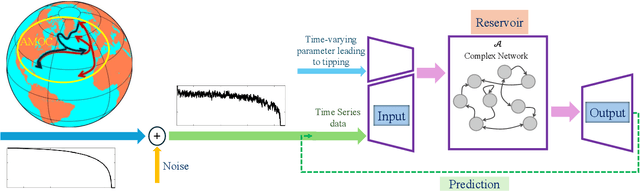
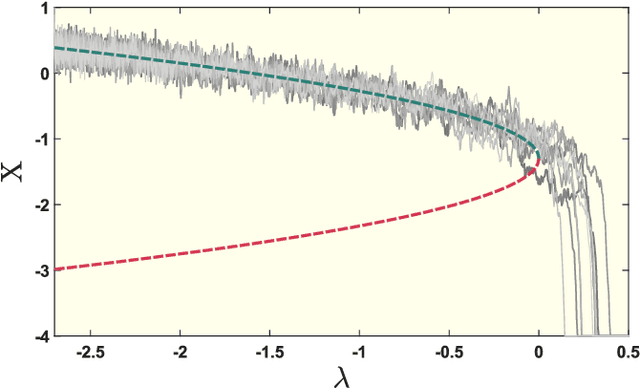
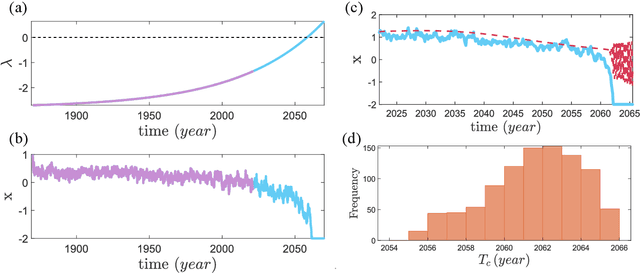
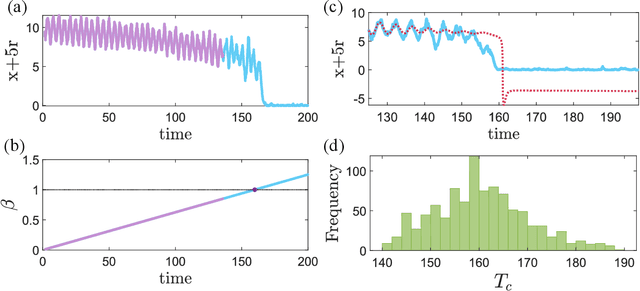
Recent research on the Atlantic Meridional Overturning Circulation (AMOC) raised concern about its potential collapse through a tipping point due to the climate-change caused increase in the freshwater input into the North Atlantic. The predicted time window of collapse is centered about the middle of the century and the earliest possible start is approximately two years from now. More generally, anticipating a tipping point at which the system transitions from one stable steady state to another is relevant to a broad range of fields. We develop a machine-learning approach to predicting tipping in noisy dynamical systems with a time-varying parameter and test it on a number of systems including the AMOC, ecological networks, an electrical power system, and a climate model. For the AMOC, our prediction based on simulated fingerprint data and real data of the sea surface temperature places the time window of a potential collapse between the years 2040 and 2065.