 Add to Chrome
 Add to Firefox
 Add to Edge
Privacy-Preserving Federated Action Recognition via Differentially Private Selective Tuning and Efficient Communication
Mar 22, 2026
Federated video action recognition enables collaborative model training without sharing raw video data, yet remains vulnerable to two key challenges: \textit{model exposure} and \textit{communication overhead}. Gradients exchanged between clients and the server can leak private motion patterns, while full-model synchronization of high-dimensional video networks causes significant bandwidth and communication costs. To address these issues, we propose \textit{Federated Differential Privacy with Selective Tuning and Efficient Communication for Action Recognition}, namely \textit{FedDP-STECAR}. Our \textit{FedDP-STECAR} framework selectively fine-tunes and perturbs only a small subset of task-relevant layers under Differential Privacy (DP), reducing the surface of information leakage while preserving temporal coherence in video features. By transmitting only the tuned layers during aggregation, communication traffic is reduced by over 99\% compared to full-model updates. Experiments on the UCF-101 dataset using the MViT-B-16x4 transformer show that \textit{FedDP-STECAR} achieves up to \textbf{70.2\% higher accuracy} under strict privacy ($ε=0.65$) in centralized settings and \textbf{48\% faster training} with \textbf{73.1\% accuracy} in federated setups, enabling scalable and privacy-preserving video action recognition. Code available at https://github.com/izakariyya/mvit-federated-videodp

Leveraging Foundation Models for Efficient Federated Learning in Resource-restricted Edge Networks
Sep 14, 2024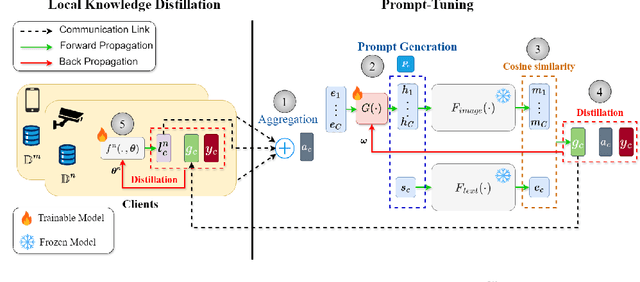

Recently pre-trained Foundation Models (FMs) have been combined with Federated Learning (FL) to improve training of downstream tasks while preserving privacy. However, deploying FMs over edge networks with resource-constrained Internet of Things (IoT) devices is under-explored. This paper proposes a novel framework, namely, Federated Distilling knowledge to Prompt (FedD2P), for leveraging the robust representation abilities of a vision-language FM without deploying it locally on edge devices. This framework distills the aggregated knowledge of IoT devices to a prompt generator to efficiently adapt the frozen FM for downstream tasks. To eliminate the dependency on a public dataset, our framework leverages perclass local knowledge from IoT devices and linguistic descriptions of classes to train the prompt generator. Our experiments on diverse image classification datasets CIFAR, OxfordPets, SVHN, EuroSAT, and DTD show that FedD2P outperforms the baselines in terms of model performance.