 Add to Chrome
 Add to Firefox
 Add to Edge
Ssds
Papers and Code
Co-Design of Memory-Storage Systems for Workload Awareness with Interpretable Models
Mar 16, 2026
Solid-state storage architectures based on NAND or emerging memory devices (SSD), are fundamentally architected and optimized for both reliability and performance. Achieving these simultaneous goals requires co-design of memory components with firmware-architected Error Management (EM) algorithms for density- and performance-scaled memory technologies. We describe a Machine Learning (ML) for systems methodology and modeling for co-designing the EM subsystem together with the natural variance inherent to scaled silicon process of memory components underlying SSD technology. The modeling analyzes NAND memory components and EM algorithms interacting with comprehensive suite of synthetic (stress-focused and JEDEC) and emulation (YCSB and similar) workloads across Flash Translation abstraction layers, by leveraging a statistically interpretable and intuitively explainable ML algorithm. The generalizable co-design framework evaluates several thousand datacenter SSDs spanning multiple generations of memory and storage technology. Consequently, the modeling framework enables continuous, holistic, data-driven design towards generational architectural advancements. We additionally demonstrate that the framework enables Representation Learning of the EM-workload domain for enhancement of the architectural design-space across broad spectrum of workloads.

Fairness over Equality: Correcting Social Incentives in Asymmetric Sequential Social Dilemmas
Feb 17, 2026Sequential Social Dilemmas (SSDs) provide a key framework for studying how cooperation emerges when individual incentives conflict with collective welfare. In Multi-Agent Reinforcement Learning, these problems are often addressed by incorporating intrinsic drives that encourage prosocial or fair behavior. However, most existing methods assume that agents face identical incentives in the dilemma and require continuous access to global information about other agents to assess fairness. In this work, we introduce asymmetric variants of well-known SSD environments and examine how natural differences between agents influence cooperation dynamics. Our findings reveal that existing fairness-based methods struggle to adapt under asymmetric conditions by enforcing raw equality that wrongfully incentivize defection. To address this, we propose three modifications: (i) redefining fairness by accounting for agents' reward ranges, (ii) introducing an agent-based weighting mechanism to better handle inherent asymmetries, and (iii) localizing social feedback to make the methods effective under partial observability without requiring global information sharing. Experimental results show that in asymmetric scenarios, our method fosters faster emergence of cooperative policies compared to existing approaches, without sacrificing scalability or practicality.
KORAL: Knowledge Graph Guided LLM Reasoning for SSD Operational Analysis
Feb 10, 2026Solid State Drives (SSDs) are critical to datacenters, consumer platforms, and mission-critical systems. Yet diagnosing their performance and reliability is difficult because data are fragmented and time-disjoint, and existing methods demand large datasets and expert input while offering only limited insights. Degradation arises not only from shifting workloads and evolving architectures but also from environmental factors such as temperature, humidity, and vibration. We present KORAL, a knowledge driven reasoning framework that integrates Large Language Models (LLMs) with a structured Knowledge Graph (KG) to generate insights into SSD operations. Unlike traditional approaches that require extensive expert input and large datasets, KORAL generates a Data KG from fragmented telemetry and integrates a Literature KG that already organizes knowledge from literature, reports, and traces. This turns unstructured sources into a queryable graph and telemetry into structured knowledge, and both the Graphs guide the LLM to deliver evidence-based, explainable analysis aligned with the domain vocabulary and constraints. Evaluation using real production traces shows that the KORAL delivers expert-level diagnosis and recommendations, supported by grounded explanations that improve reasoning transparency, guide operator decisions, reduce manual effort, and provide actionable insights to improve service quality. To our knowledge, this is the first end-to-end system that combines LLMs and KGs for full-spectrum SSD reasoning including Descriptive, Predictive, Prescriptive, and What-if analysis. We release the generated SSD-specific KG to advance reproducible research in knowledge-based storage system analysis. GitHub Repository: https://github.com/Damrl-lab/KORAL
Emergent Cooperation in Quantum Multi-Agent Reinforcement Learning Using Communication
Jan 26, 2026Emergent cooperation in classical Multi-Agent Reinforcement Learning has gained significant attention, particularly in the context of Sequential Social Dilemmas (SSDs). While classical reinforcement learning approaches have demonstrated capability for emergent cooperation, research on extending these methods to Quantum Multi-Agent Reinforcement Learning remains limited, particularly through communication. In this paper, we apply communication approaches to quantum Q-Learning agents: the Mutual Acknowledgment Token Exchange (MATE) protocol, its extension Mutually Endorsed Distributed Incentive Acknowledgment Token Exchange (MEDIATE), the peer rewarding mechanism Gifting, and Reinforced Inter-Agent Learning (RIAL). We evaluate these approaches in three SSDs: the Iterated Prisoner's Dilemma, Iterated Stag Hunt, and Iterated Game of Chicken. Our experimental results show that approaches using MATE with temporal-difference measure (MATE\textsubscript{TD}), AutoMATE, MEDIATE-I, and MEDIATE-S achieved high cooperation levels across all dilemmas, demonstrating that communication is a viable mechanism for fostering emergent cooperation in Quantum Multi-Agent Reinforcement Learning.
FaTRQ: Tiered Residual Quantization for LLM Vector Search in Far-Memory-Aware ANNS Systems
Jan 15, 2026Approximate Nearest-Neighbor Search (ANNS) is a key technique in retrieval-augmented generation (RAG), enabling rapid identification of the most relevant high-dimensional embeddings from massive vector databases. Modern ANNS engines accelerate this process using prebuilt indexes and store compressed vector-quantized representations in fast memory. However, they still rely on a costly second-pass refinement stage that reads full-precision vectors from slower storage like SSDs. For modern text and multimodal embeddings, these reads now dominate the latency of the entire query. We propose FaTRQ, a far-memory-aware refinement system using tiered memory that eliminates the need to fetch full vectors from storage. It introduces a progressive distance estimator that refines coarse scores using compact residuals streamed from far memory. Refinement stops early once a candidate is provably outside the top-k. To support this, we propose tiered residual quantization, which encodes residuals as ternary values stored efficiently in far memory. A custom accelerator is deployed in a CXL Type-2 device to perform low-latency refinement locally. Together, FaTRQ improves the storage efficiency by 2.4$\times$ and improves the throughput by up to 9$ \times$ than SOTA GPU ANNS system.
Accelerating Storage-Based Training for Graph Neural Networks
Jan 06, 2026Graph neural networks (GNNs) have achieved breakthroughs in various real-world downstream tasks due to their powerful expressiveness. As the scale of real-world graphs has been continuously growing, a storage-based approach to GNN training has been studied, which leverages external storage (e.g., NVMe SSDs) to handle such web-scale graphs on a single machine. Although such storage-based GNN training methods have shown promising potential in large-scale GNN training, we observed that they suffer from a severe bottleneck in data preparation since they overlook a critical challenge: how to handle a large number of small storage I/Os. To address the challenge, in this paper, we propose a novel storage-based GNN training framework, named AGNES, that employs a method of block-wise storage I/O processing to fully utilize the I/O bandwidth of high-performance storage devices. Moreover, to further enhance the efficiency of each storage I/O, AGNES employs a simple yet effective strategy, hyperbatch-based processing based on the characteristics of real-world graphs. Comprehensive experiments on five real-world graphs reveal that AGNES consistently outperforms four state-of-the-art methods, by up to 4.1X faster than the best competitor. Our code is available at https://github.com/Bigdasgit/agnes-kdd26.
MatKV: Trading Compute for Flash Storage in LLM Inference
Dec 20, 2025We observe two major trends in LLM-based generative AI: (1) inference is becoming the dominant factor in terms of cost and power consumption, surpassing training, and (2) retrieval augmented generation (RAG) is becoming prevalent. When processing long inputs in RAG, the prefill phase of computing the key-value vectors of input text is energy-intensive and time-consuming even with high-end GPUs. Thus, it is crucial to make the prefill phase in RAG inference efficient. To address this issue, we propose MatKV, a scheme that precomputes the key-value vectors (KVs) of RAG objects (e.g., documents), materializes them in inexpensive but fast and power-efficient flash storage, and reuses them at inference time instead of recomputing the KVs using costly and power-inefficient GPU. Experimental results using Hugging Face's Transformers library across state-of-the-art GPUs and flash memory SSDs confirm that, compared to full KV computation on GPUs, MatKV reduces both inference time and power consumption by half for RAG workloads, without severely impacting accuracy in the question-answering task. Furthermore, we demonstrate that MatKV enables additional optimizations in two ways. First, a GPU can decode text while simultaneously loading the materialized KVs for the next instance, reducing load latency. Second, since decoding speed is less sensitive to GPU performance than KV computation, low-end GPUs can be leveraged for decoding without significantly compromising speed once the materialized KVs are loaded into GPU memory. These findings underscore MatKV's potential to make large-scale generative AI applications more cost-effective, power-efficient, and accessible across a wider range of tasks and hardware environments.
Cost-Efficient LLM Training with Lifetime-Aware Tensor Offloading via GPUDirect Storage
Jun 06, 2025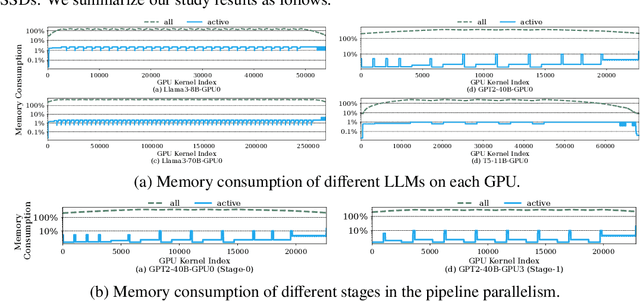
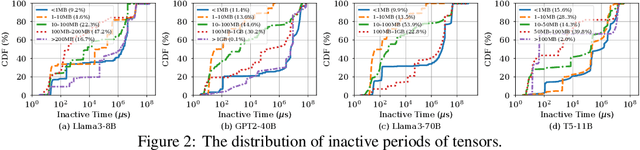
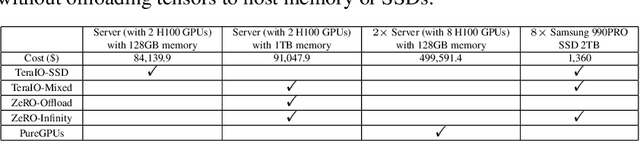
We present the design and implementation of a new lifetime-aware tensor offloading framework for GPU memory expansion using low-cost PCIe-based solid-state drives (SSDs). Our framework, TERAIO, is developed explicitly for large language model (LLM) training with multiple GPUs and multiple SSDs. Its design is driven by our observation that the active tensors take only a small fraction (1.7% on average) of allocated GPU memory in each LLM training iteration, the inactive tensors are usually large and will not be used for a long period of time, creating ample opportunities for offloading/prefetching tensors to/from slow SSDs without stalling the GPU training process. TERAIO accurately estimates the lifetime (active period of time in GPU memory) of each tensor with the profiling of the first few iterations in the training process. With the tensor lifetime analysis, TERAIO will generate an optimized tensor offloading/prefetching plan and integrate it into the compiled LLM program via PyTorch. TERAIO has a runtime tensor migration engine to execute the offloading/prefetching plan via GPUDirect storage, which allows direct tensor migration between GPUs and SSDs for alleviating the CPU bottleneck and maximizing the SSD bandwidth utilization. In comparison with state-of-the-art studies such as ZeRO-Offload and ZeRO-Infinity, we show that TERAIO improves the training performance of various LLMs by 1.47x on average, and achieves 80.7% of the ideal performance assuming unlimited GPU memory.
Harnessing Your DRAM and SSD for Sustainable and Accessible LLM Inference with Mixed-Precision and Multi-level Caching
Oct 23, 2024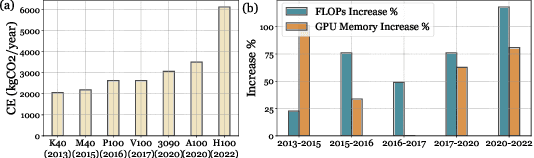
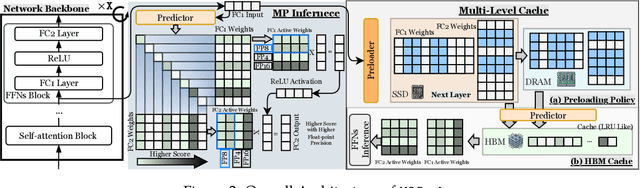
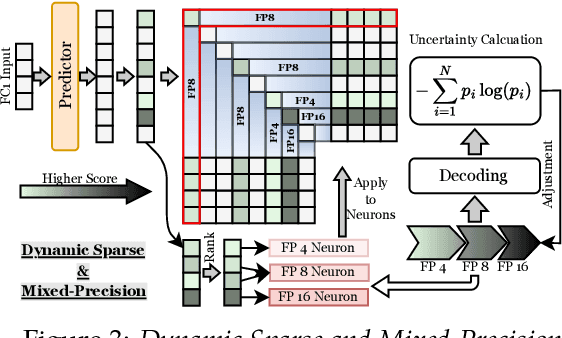
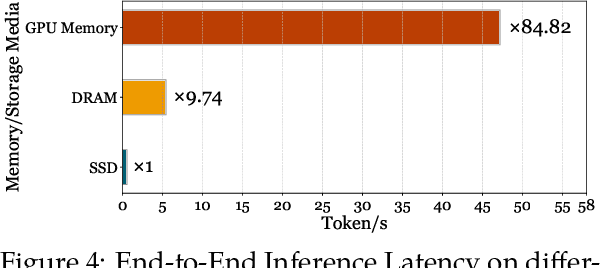
Although Large Language Models (LLMs) have demonstrated remarkable capabilities, their massive parameter counts and associated extensive computing make LLMs' deployment the main part of carbon emission from nowadays AI applications. Compared to modern GPUs like H$100$, it would be significantly carbon-sustainable if we could leverage old-fashioned GPUs such as M$40$ (as shown in Figure 1, M$40$ only has one third carbon emission of H$100$'s) for LLM servings. However, the limited High Bandwidth Memory (HBM) available on such GPU often cannot support the loading of LLMs due to the gigantic model size and intermediate activation data, making their serving challenging. For instance, a LLaMA2 model with $70$B parameters typically requires $128$GB for inference, which substantially surpasses $24$GB HBM in a $3090$ GPU and remains infeasible even considering the additional $64$GB DRAM. To address this challenge, this paper proposes a mixed-precision with a model modularization algorithm to enable LLM inference on outdated hardware with resource constraints. (The precision denotes the numerical precision like FP16, INT8, INT4) and multi-level caching (M2Cache).) Specifically, our M2Cache first modulizes neurons in LLM and creates their importance ranking. Then, it adopts a dynamic sparse mixed-precision quantization mechanism in weight space to reduce computational demands and communication overhead at each decoding step. It collectively lowers the operational carbon emissions associated with LLM inference. Moreover, M2Cache introduces a three-level cache management system with HBM, DRAM, and SSDs that complements the dynamic sparse mixed-precision inference. To enhance communication efficiency, M2Cache maintains a neuron-level mixed-precision LRU cache in HBM, a larger layer-aware cache in DRAM, and a full model in SSD.
Can DeepFake Speech be Reliably Detected?
Oct 09, 2024
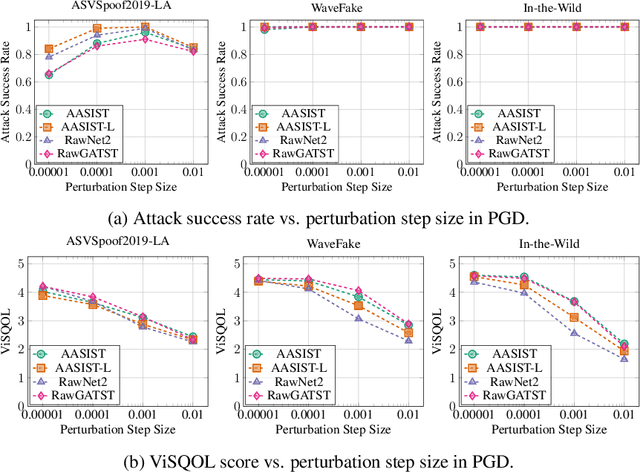
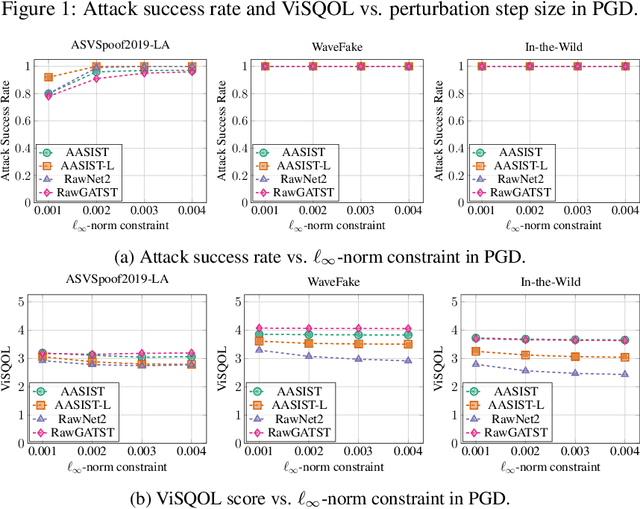

Recent advances in text-to-speech (TTS) systems, particularly those with voice cloning capabilities, have made voice impersonation readily accessible, raising ethical and legal concerns due to potential misuse for malicious activities like misinformation campaigns and fraud. While synthetic speech detectors (SSDs) exist to combat this, they are vulnerable to ``test domain shift", exhibiting decreased performance when audio is altered through transcoding, playback, or background noise. This vulnerability is further exacerbated by deliberate manipulation of synthetic speech aimed at deceiving detectors. This work presents the first systematic study of such active malicious attacks against state-of-the-art open-source SSDs. White-box attacks, black-box attacks, and their transferability are studied from both attack effectiveness and stealthiness, using both hardcoded metrics and human ratings. The results highlight the urgent need for more robust detection methods in the face of evolving adversarial threats.