 Add to Chrome
 Add to Firefox
 Add to Edge
Reinforcement Learning for Parameterized Quantum State Preparation: A Comparative Study
Feb 18, 2026
We extend directed quantum circuit synthesis (DQCS) with reinforcement learning from purely discrete gate selection to parameterized quantum state preparation with continuous single-qubit rotations \(R_x\), \(R_y\), and \(R_z\). We compare two training regimes: a one-stage agent that jointly selects the gate type, the affected qubit(s), and the rotation angle; and a two-stage variant that first proposes a discrete circuit and subsequently optimizes the rotation angles with Adam using parameter-shift gradients. Using Gymnasium and PennyLane, we evaluate Proximal Policy Optimization (PPO) and Advantage Actor--Critic (A2C) on systems comprising two to ten qubits and on targets of increasing complexity with \(λ\) ranging from one to five. Whereas A2C does not learn effective policies in this setting, PPO succeeds under stable hyperparameters (one-stage: learning rate approximately \(5\times10^{-4}\) with a self-fidelity-error threshold of 0.01; two-stage: learning rate approximately \(10^{-4}\)). Both approaches reliably reconstruct computational basis states (between 83\% and 99\% success) and Bell states (between 61\% and 77\% success). However, scalability saturates for \(λ\) of approximately three to four and does not extend to ten-qubit targets even at \(λ=2\). The two-stage method offers only marginal accuracy gains while requiring around three times the runtime. For practicality under a fixed compute budget, we therefore recommend the one-stage PPO policy, provide explicit synthesized circuits, and contrast with a classical variational baseline to outline avenues for improved scalability.

Emergent Cooperation in Quantum Multi-Agent Reinforcement Learning Using Communication
Jan 26, 2026Emergent cooperation in classical Multi-Agent Reinforcement Learning has gained significant attention, particularly in the context of Sequential Social Dilemmas (SSDs). While classical reinforcement learning approaches have demonstrated capability for emergent cooperation, research on extending these methods to Quantum Multi-Agent Reinforcement Learning remains limited, particularly through communication. In this paper, we apply communication approaches to quantum Q-Learning agents: the Mutual Acknowledgment Token Exchange (MATE) protocol, its extension Mutually Endorsed Distributed Incentive Acknowledgment Token Exchange (MEDIATE), the peer rewarding mechanism Gifting, and Reinforced Inter-Agent Learning (RIAL). We evaluate these approaches in three SSDs: the Iterated Prisoner's Dilemma, Iterated Stag Hunt, and Iterated Game of Chicken. Our experimental results show that approaches using MATE with temporal-difference measure (MATE\textsubscript{TD}), AutoMATE, MEDIATE-I, and MEDIATE-S achieved high cooperation levels across all dilemmas, demonstrating that communication is a viable mechanism for fostering emergent cooperation in Quantum Multi-Agent Reinforcement Learning.
Quantum King-Ring Domination in Chess: A QAOA Approach
Jan 01, 2026The Quantum Approximate Optimization Algorithm (QAOA) is extensively benchmarked on synthetic random instances such as MaxCut, TSP, and SAT problems, but these lack semantic structure and human interpretability, offering limited insight into performance on real-world problems with meaningful constraints. We introduce Quantum King-Ring Domination (QKRD), a NISQ-scale benchmark derived from chess tactical positions that provides 5,000 structured instances with one-hot constraints, spatial locality, and 10--40 qubit scale. The benchmark pairs human-interpretable coverage metrics with intrinsic validation against classical heuristics, enabling algorithmic conclusions without external oracles. Using QKRD, we systematically evaluate QAOA design choices and find that constraint-preserving mixers (XY, domain-wall) converge approximately 13 steps faster than standard mixers (p<10^{-7}, d\approx0.5) while eliminating penalty tuning, warm-start strategies reduce convergence by 45 steps (p<10^{-127}, d=3.35) with energy improvements exceeding d=8, and Conditional Value-at-Risk (CVaR) optimization yields an informative negative result with worse energy (p<10^{-40}, d=1.21) and no coverage benefit. Intrinsic validation shows QAOA outperforms greedy heuristics by 12.6\% and random selection by 80.1\%. Our results demonstrate that structured benchmarks reveal advantages of problem-informed QAOA techniques obscured in random instances. We release all code, data, and experimental artifacts for reproducible NISQ algorithm research.
Weight Re-Mapping for Variational Quantum Algorithms
Jun 09, 2023Inspired by the remarkable success of artificial neural networks across a broad spectrum of AI tasks, variational quantum circuits (VQCs) have recently seen an upsurge in quantum machine learning applications. The promising outcomes shown by VQCs, such as improved generalization and reduced parameter training requirements, are attributed to the robust algorithmic capabilities of quantum computing. However, the current gradient-based training approaches for VQCs do not adequately accommodate the fact that trainable parameters (or weights) are typically used as angles in rotational gates. To address this, we extend the concept of weight re-mapping for VQCs, as introduced by K\"olle et al. (2023). This approach unambiguously maps the weights to an interval of length $2\pi$, mirroring data rescaling techniques in conventional machine learning that have proven to be highly beneficial in numerous scenarios. In our study, we employ seven distinct weight re-mapping functions to assess their impact on eight classification datasets, using variational classifiers as a representative example. Our results indicate that weight re-mapping can enhance the convergence speed of the VQC. We assess the efficacy of various re-mapping functions across all datasets and measure their influence on the VQC's average performance. Our findings indicate that weight re-mapping not only consistently accelerates the convergence of VQCs, regardless of the specific re-mapping function employed, but also significantly increases accuracy in certain cases.
Improving Convergence for Quantum Variational Classifiers using Weight Re-Mapping
Dec 22, 2022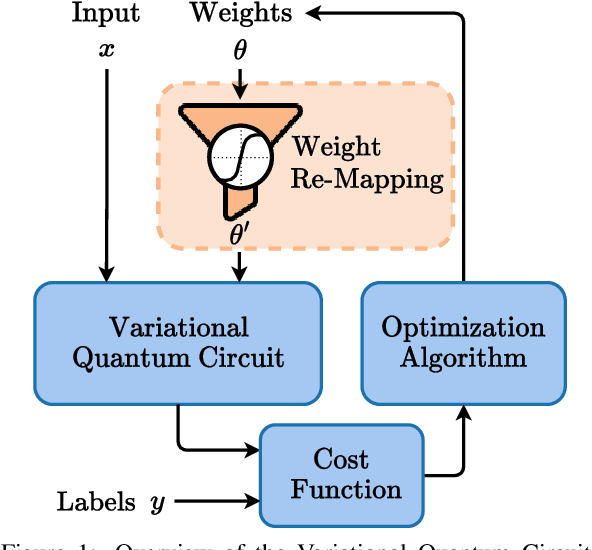
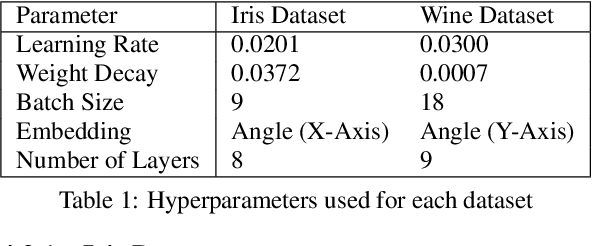


In recent years, quantum machine learning has seen a substantial increase in the use of variational quantum circuits (VQCs). VQCs are inspired by artificial neural networks, which achieve extraordinary performance in a wide range of AI tasks as massively parameterized function approximators. VQCs have already demonstrated promising results, for example, in generalization and the requirement for fewer parameters to train, by utilizing the more robust algorithmic toolbox available in quantum computing. A VQCs' trainable parameters or weights are usually used as angles in rotational gates and current gradient-based training methods do not account for that. We introduce weight re-mapping for VQCs, to unambiguously map the weights to an interval of length $2\pi$, drawing inspiration from traditional ML, where data rescaling, or normalization techniques have demonstrated tremendous benefits in many circumstances. We employ a set of five functions and evaluate them on the Iris and Wine datasets using variational classifiers as an example. Our experiments show that weight re-mapping can improve convergence in all tested settings. Additionally, we were able to demonstrate that weight re-mapping increased test accuracy for the Wine dataset by $10\%$ over using unmodified weights.