 Add to Chrome
 Add to Firefox
 Add to Edge
VIRST: Video-Instructed Reasoning Assistant for SpatioTemporal Segmentation
Mar 28, 2026
Referring Video Object Segmentation (RVOS) aims to segment target objects in videos based on natural language descriptions. However, fixed keyframe-based approaches that couple a vision language model with a separate propagation module often fail to capture rapidly changing spatiotemporal dynamics and to handle queries requiring multi-step reasoning, leading to sharp performance drops on motion-intensive and reasoning-oriented videos beyond static RVOS benchmarks. To address these limitations, we propose VIRST (Video-Instructed Reasoning Assistant for Spatio-Temporal Segmentation), an end-to-end framework that unifies global video reasoning and pixel-level mask prediction within a single model. VIRST bridges semantic and segmentation representations through the Spatio-Temporal Fusion (STF), which fuses segmentation-aware video features into the vision-language backbone, and employs the Temporal Dynamic Anchor Updater to maintain temporally adjacent anchor frames that provide stable temporal cues under large motion, occlusion, and reappearance. This unified design achieves state-of-the-art results across diverse RVOS benchmarks under realistic and challenging conditions, demonstrating strong generalization to both referring and reasoning oriented settings. The code and checkpoints are available at https://github.com/AIDASLab/VIRST.

MEDIC-AD: Towards Medical Vision-Language Model's Clinical Intelligence
Mar 28, 2026Lesion detection, symptom tracking, and visual explainability are central to real-world medical image analysis, yet current medical Vision-Language Models (VLMs) still lack mechanisms that translate their broad knowledge into clinically actionable outputs. To bridge this gap, we present MEDIC-AD, a clinically oriented VLM that strengthens these three capabilities through a stage-wise framework. First, learnable anomaly-aware tokens (<Ano>) encourage the model to focus on abnormal regions and build more discriminative lesion centered representations. Second, inter image difference tokens (<Diff>) explicitly encode temporal changes between studies, allowing the model to distinguish worsening, improvement, and stability in disease burden. Finally, a dedicated explainability stage trains the model to generate heatmaps that highlight lesion-related regions, offering clear visual evidence that is consistent with the model's reasoning. Through our staged design, MEDIC-AD steadily boosts performance across anomaly detection, symptom tracking, and anomaly segmentation, achieving state-of-the-art results compared with both closed source and medical-specialized baselines. Evaluations on real longitudinal clinical data collected from real hospital workflows further show that MEDIC-AD delivers stable predictions and clinically faithful explanations in practical patient-monitoring and decision-support workflows
3rd Place of MeViS-Audio Track of the 5th PVUW: VIRST-Audio
Mar 24, 2026Audio-based Referring Video Object Segmentation (ARVOS) requires grounding audio queries into pixel-level object masks over time, posing challenges in bridging acoustic signals with spatio-temporal visual representations. In this report, we present VIRST-Audio, a practical framework built upon a pretrained RVOS model integrated with a vision-language architecture. Instead of relying on audio-specific training, we convert input audio into text using an ASR module and perform segmentation using text-based supervision, enabling effective transfer from text-based reasoning to audio-driven scenarios. To improve robustness, we further incorporate an existence-aware gating mechanism that estimates whether the referred target object is present in the video and suppresses predictions when it is absent, reducing hallucinated masks and stabilizing segmentation behavior. We evaluate our approach on the MeViS-Audio track of the 5th PVUW Challenge, where VIRST-Audio achieves 3rd place, demonstrating strong generalization and reliable performance in audio-based referring video segmentation.
RFEval: Benchmarking Reasoning Faithfulness under Counterfactual Reasoning Intervention in Large Reasoning Models
Feb 19, 2026Large Reasoning Models (LRMs) exhibit strong performance, yet often produce rationales that sound plausible but fail to reflect their true decision process, undermining reliability and trust. We introduce a formal framework for reasoning faithfulness, defined by two testable conditions: stance consistency (a coherent stance linking reasoning to answer) and causal influence (the stated reasoning causally drives the answer under output-level interventions), explicitly decoupled from accuracy. To operationalize this, we present RFEval, a benchmark of 7,186 instances across seven tasks that probes faithfulness via controlled, output-level counterfactual interventions. Evaluating twelve open-source LRMs, we find unfaithfulness in 49.7% of outputs, predominantly from stance inconsistency. Failures are concentrated in brittle, convergent domains such as math and code, and correlate more with post-training regimes than with scale: within-family ablations indicate that adding current RL-style objectives on top of supervised fine-tuning can reduce reasoning faithfulness, even when accuracy is maintained. Crucially, accuracy is neither a sufficient nor a reliable proxy for faithfulness: once controlling for model and task, the accuracy-faithfulness link is weak and statistically insignificant. Our work establishes a rigorous methodology for auditing LRM reliability and shows that trustworthy AI requires optimizing not only for correct outcomes but also for the structural integrity of the reasoning process. Our code and dataset can be found at project page: $\href{https://aidaslab.github.io/RFEval/}{https://aidaslab.github.io/RFEval/}$
MATA: Multi-Agent Framework for Reliable and Flexible Table Question Answering
Feb 10, 2026Recent advances in Large Language Models (LLMs) have significantly improved table understanding tasks such as Table Question Answering (TableQA), yet challenges remain in ensuring reliability, scalability, and efficiency, especially in resource-constrained or privacy-sensitive environments. In this paper, we introduce MATA, a multi-agent TableQA framework that leverages multiple complementary reasoning paths and a set of tools built with small language models. MATA generates candidate answers through diverse reasoning styles for a given table and question, then refines or selects the optimal answer with the help of these tools. Furthermore, it incorporates an algorithm designed to minimize expensive LLM agent calls, enhancing overall efficiency. MATA maintains strong performance with small, open-source models and adapts easily across various LLM types. Extensive experiments on two benchmarks of varying difficulty with ten different LLMs demonstrate that MATA achieves state-of-the-art accuracy and highly efficient reasoning while avoiding excessive LLM inference. Our results highlight that careful orchestration of multiple reasoning pathways yields scalable and reliable TableQA. The code is available at https://github.com/AIDAS-Lab/MATA.
VALUEFLOW: Toward Pluralistic and Steerable Value-based Alignment in Large Language Models
Feb 03, 2026Aligning Large Language Models (LLMs) with the diverse spectrum of human values remains a central challenge: preference-based methods often fail to capture deeper motivational principles. Value-based approaches offer a more principled path, yet three gaps persist: extraction often ignores hierarchical structure, evaluation detects presence but not calibrated intensity, and the steerability of LLMs at controlled intensities remains insufficiently understood. To address these limitations, we introduce VALUEFLOW, the first unified framework that spans extraction, evaluation, and steering with calibrated intensity control. The framework integrates three components: (i) HIVES, a hierarchical value embedding space that captures intra- and cross-theory value structure; (ii) the Value Intensity DataBase (VIDB), a large-scale resource of value-labeled texts with intensity estimates derived from ranking-based aggregation; and (iii) an anchor-based evaluator that produces consistent intensity scores for model outputs by ranking them against VIDB panels. Using VALUEFLOW, we conduct a comprehensive large-scale study across ten models and four value theories, identifying asymmetries in steerability and composition laws for multi-value control. This paper establishes a scalable infrastructure for evaluating and controlling value intensity, advancing pluralistic alignment of LLMs.
MatKV: Trading Compute for Flash Storage in LLM Inference
Dec 20, 2025We observe two major trends in LLM-based generative AI: (1) inference is becoming the dominant factor in terms of cost and power consumption, surpassing training, and (2) retrieval augmented generation (RAG) is becoming prevalent. When processing long inputs in RAG, the prefill phase of computing the key-value vectors of input text is energy-intensive and time-consuming even with high-end GPUs. Thus, it is crucial to make the prefill phase in RAG inference efficient. To address this issue, we propose MatKV, a scheme that precomputes the key-value vectors (KVs) of RAG objects (e.g., documents), materializes them in inexpensive but fast and power-efficient flash storage, and reuses them at inference time instead of recomputing the KVs using costly and power-inefficient GPU. Experimental results using Hugging Face's Transformers library across state-of-the-art GPUs and flash memory SSDs confirm that, compared to full KV computation on GPUs, MatKV reduces both inference time and power consumption by half for RAG workloads, without severely impacting accuracy in the question-answering task. Furthermore, we demonstrate that MatKV enables additional optimizations in two ways. First, a GPU can decode text while simultaneously loading the materialized KVs for the next instance, reducing load latency. Second, since decoding speed is less sensitive to GPU performance than KV computation, low-end GPUs can be leveraged for decoding without significantly compromising speed once the materialized KVs are loaded into GPU memory. These findings underscore MatKV's potential to make large-scale generative AI applications more cost-effective, power-efficient, and accessible across a wider range of tasks and hardware environments.
Don't Let It Fade: Preserving Edits in Diffusion Language Models via Token Timestep Allocation
Oct 30, 2025While diffusion language models (DLMs) enable fine-grained refinement, their practical controllability remains fragile. We identify and formally characterize a central failure mode called update forgetting, in which uniform and context agnostic updates induce token level fluctuations across timesteps, erasing earlier semantic edits and disrupting the cumulative refinement process, thereby degrading fluency and coherence. As this failure originates in uniform and context agnostic updates, effective control demands explicit token ordering. We propose Token Timestep Allocation (TTA), which realizes soft and semantic token ordering via per token timestep schedules: critical tokens are frozen early, while uncertain tokens receive continued refinement. This timestep based ordering can be instantiated as either a fixed policy or an adaptive policy driven by task signals, thereby supporting a broad spectrum of refinement strategies. Because it operates purely at inference time, it applies uniformly across various DLMs and naturally extends to diverse supervision sources. Empirically, TTA improves controllability and fluency: on sentiment control, it yields more than 20 percent higher accuracy and nearly halves perplexity using less than one fifth the steps; in detoxification, it lowers maximum toxicity (12.2 versus 14.5) and perplexity (26.0 versus 32.0). Together, these results demonstrate that softened ordering via timestep allocation is the critical lever for mitigating update forgetting and achieving stable and controllable diffusion text generation.
SECOND: Mitigating Perceptual Hallucination in Vision-Language Models via Selective and Contrastive Decoding
Jun 10, 2025Despite significant advancements in Vision-Language Models (VLMs), the performance of existing VLMs remains hindered by object hallucination, a critical challenge to achieving accurate visual understanding. To address this issue, we propose SECOND: Selective and Contrastive Decoding, a novel approach that enables VLMs to effectively leverage multi-scale visual information with an object-centric manner, closely aligning with human visual perception. SECOND progressively selects and integrates multi-scale visual information, facilitating a more precise interpretation of images. By contrasting these visual information iteratively, SECOND significantly reduces perceptual hallucinations and outperforms a wide range of benchmarks. Our theoretical analysis and experiments highlight the largely unexplored potential of multi-scale application in VLMs, showing that prioritizing and contrasting across scales outperforms existing methods.
MathReader : Text-to-Speech for Mathematical Documents
Jan 13, 2025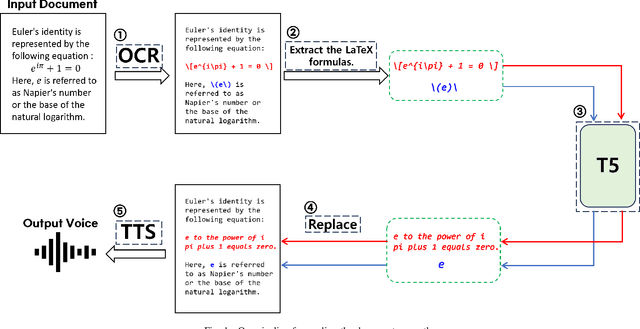
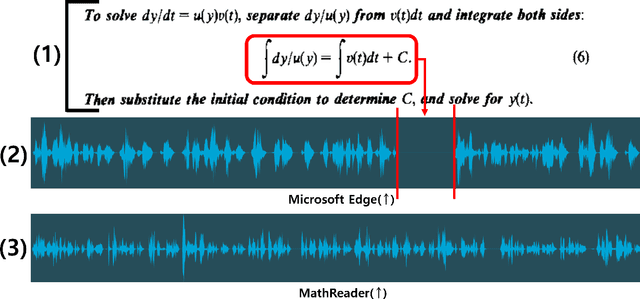

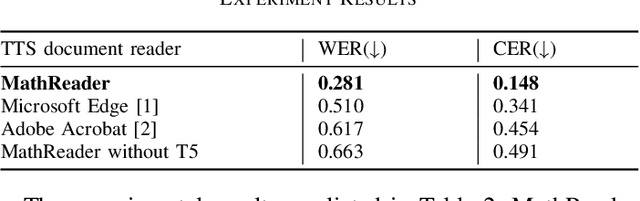
TTS (Text-to-Speech) document reader from Microsoft, Adobe, Apple, and OpenAI have been serviced worldwide. They provide relatively good TTS results for general plain text, but sometimes skip contents or provide unsatisfactory results for mathematical expressions. This is because most modern academic papers are written in LaTeX, and when LaTeX formulas are compiled, they are rendered as distinctive text forms within the document. However, traditional TTS document readers output only the text as it is recognized, without considering the mathematical meaning of the formulas. To address this issue, we propose MathReader, which effectively integrates OCR, a fine-tuned T5 model, and TTS. MathReader demonstrated a lower Word Error Rate (WER) than existing TTS document readers, such as Microsoft Edge and Adobe Acrobat, when processing documents containing mathematical formulas. MathReader reduced the WER from 0.510 to 0.281 compared to Microsoft Edge, and from 0.617 to 0.281 compared to Adobe Acrobat. This will significantly contribute to alleviating the inconvenience faced by users who want to listen to documents, especially those who are visually impaired. The code is available at https://github.com/hyeonsieun/MathReader.