 Add to Chrome
 Add to Firefox
 Add to Edge
Safe Control Gym
Papers and Code
Action-Conditioned Risk Gating for Safety-Critical Control under Partial Observability
May 14, 2026
Many safety-critical control problems are modeled as risk-sensitive partially observable Markov decision processes, where the controller must make decisions from incomplete observations while balancing task performance against safety risk. Although belief-space planning provides a principled solution, maintaining and planning over beliefs can be computationally costly and sensitive to model specification in practical domains. We propose a lightweight risk-gated reinforcement learning approximation for risk-sensitive control under partial observability. The method constructs a compact finite-history proxy state and learns an action-conditioned predictor of near-term safety violation. This predicted candidate-action risk is used in two complementary ways: as a risk penalty during value learning, and as a decision-time gate that interpolates between optimistic and conservative ensemble value estimates. As a result, low-risk actions are evaluated closer to reward-seeking estimates, while high-risk actions are evaluated more conservatively. We evaluate the approach in two safety-critical partially observable domains: automated glucose regulation and safety-constrained navigation. Across adult and adolescent glucose-control cohorts, the method improves overall glycemic tradeoffs and substantially reduces runtime relative to a belief-space planning baseline. On Safety-Gym navigation benchmarks, it achieves a more favorable reward-cost balance than unconstrained RL and several standard safe-RL baselines. These results suggest that action-conditioned near-term risk can provide an effective local signal for approximate risk-sensitive POMDP control when full belief-space planning is impractical.

Fuz-RL: A Fuzzy-Guided Robust Framework for Safe Reinforcement Learning under Uncertainty
Feb 24, 2026Safe Reinforcement Learning (RL) is crucial for achieving high performance while ensuring safety in real-world applications. However, the complex interplay of multiple uncertainty sources in real environments poses significant challenges for interpretable risk assessment and robust decision-making. To address these challenges, we propose Fuz-RL, a fuzzy measure-guided robust framework for safe RL. Specifically, our framework develops a novel fuzzy Bellman operator for estimating robust value functions using Choquet integrals. Theoretically, we prove that solving the Fuz-RL problem (in Constrained Markov Decision Process (CMDP) form) is equivalent to solving distributionally robust safe RL problems (in robust CMDP form), effectively avoiding min-max optimization. Empirical analyses on safe-control-gym and safety-gymnasium scenarios demonstrate that Fuz-RL effectively integrates with existing safe RL baselines in a model-free manner, significantly improving both safety and control performance under various types of uncertainties in observation, action, and dynamics.
Severe Domain Shift in Skeleton-Based Action Recognition:A Study of Uncertainty Failure in Real-World Gym Environments
Mar 16, 2026The practical deployment gap -- transitioning from controlled multi-view 3D skeleton capture to unconstrained monocular 2D pose estimation -- introduces a compound domain shift whose safety implications remain critically underexplored. We present a systematic study of this severe domain shift using a novel Gym2D dataset (style/viewpoint shift) and the UCF101 dataset (semantic shift). Our Skeleton Transformer achieves 63.2% cross-subject accuracy on NTU-120 but drops to 1.6% under zero-shot transfer to the Gym domain and 1.16% on UCF101. Critically, we demonstrate that high Out-Of-Distribution (OOD) detection AUROC does not guarantee safe selective classification. Standard uncertainty methods fail to detect this performance drop: the model remains confidently incorrect with 99.6% risk even at 50% coverage across both OOD datasets. While energy-based scoring (AUROC >= 0.91) and Mahalanobis distance provide reliable distributional detection signals, such high AUROC scores coexist with poor risk-coverage behavior when making decisions. A lightweight finetuned gating mechanism restores calibration and enables graceful abstention, substantially reducing the rate of confident wrong predictions. Our work challenges standard deployment assumptions, providing a principled safety analysis of both semantic and geometric skeleton recognition deployment.
Lyapunov Constrained Soft Actor-Critic (LC-SAC) using Koopman Operator Theory for Quadrotor Trajectory Tracking
Feb 04, 2026Reinforcement Learning (RL) has achieved remarkable success in solving complex sequential decision-making problems. However, its application to safety-critical physical systems remains constrained by the lack of stability guarantees. Standard RL algorithms prioritize reward maximization, often yielding policies that may induce oscillations or unbounded state divergence. There has significant work in incorporating Lyapunov-based stability guarantees in RL algorithms with key challenges being selecting a candidate Lyapunov function, computational complexity by using excessive function approximators and conservative policies by incorporating stability criterion in the learning process. In this work we propose a novel Lyapunov-constrained Soft Actor-Critic (LC-SAC) algorithm using Koopman operator theory. We propose use of extended dynamic mode decomposition (EDMD) to produce a linear approximation of the system and use this approximation to derive a closed form solution for candidate Lyapunov function. This derived Lyapunov function is incorporated in the SAC algorithm to further provide guarantees for a policy that stabilizes the nonlinear system. The results are evaluated trajectory tracking of a 2D Quadrotor environment based on safe-control-gym. The proposed algorithm shows training convergence and decaying violations for Lyapunov stability criterion compared to baseline vanilla SAC algorithm. GitHub Repository: https://github.com/DhruvKushwaha/LC-SAC-Quadrotor-Trajectory-Tracking
Safe and Efficient CAV Lane Changing using Decentralised Safety Shields
Apr 30, 2025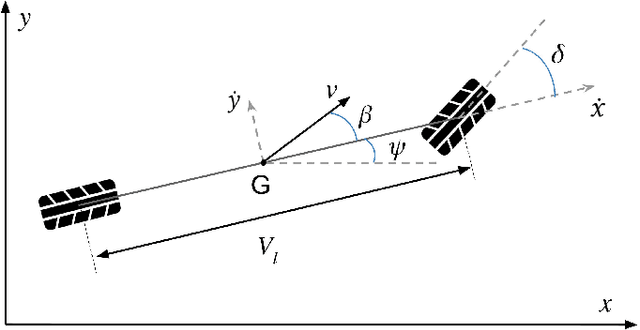
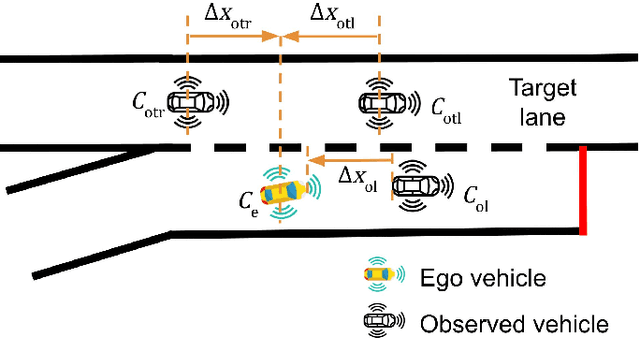
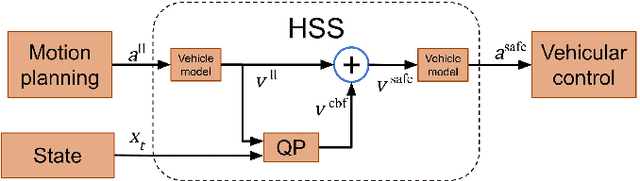
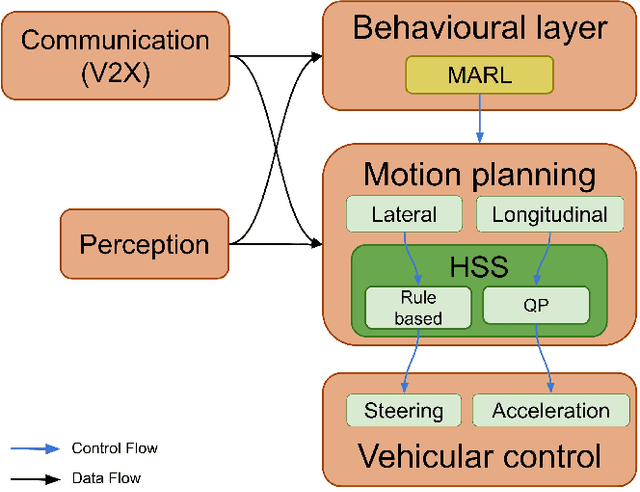
Lane changing is a complex decision-making problem for Connected and Autonomous Vehicles (CAVs) as it requires balancing traffic efficiency with safety. Although traffic efficiency can be improved by using vehicular communication for training lane change controllers using Multi-Agent Reinforcement Learning (MARL), ensuring safety is difficult. To address this issue, we propose a decentralised Hybrid Safety Shield (HSS) that combines optimisation and a rule-based approach to guarantee safety. Our method applies control barrier functions to constrain longitudinal and lateral control inputs of a CAV to ensure safe manoeuvres. Additionally, we present an architecture to integrate HSS with MARL, called MARL-HSS, to improve traffic efficiency while ensuring safety. We evaluate MARL-HSS using a gym-like environment that simulates an on-ramp merging scenario with two levels of traffic densities, such as light and moderate densities. The results show that HSS provides a safety guarantee by strictly enforcing a dynamic safety constraint defined on a time headway, even in moderate traffic density that offers challenging lane change scenarios. Moreover, the proposed method learns stable policies compared to the baseline, a state-of-the-art MARL lane change controller without a safety shield. Further policy evaluation shows that our method achieves a balance between safety and traffic efficiency with zero crashes and comparable average speeds in light and moderate traffic densities.
Omni-Perception: Omnidirectional Collision Avoidance for Legged Locomotion in Dynamic Environments
May 25, 2025Agile locomotion in complex 3D environments requires robust spatial awareness to safely avoid diverse obstacles such as aerial clutter, uneven terrain, and dynamic agents. Depth-based perception approaches often struggle with sensor noise, lighting variability, computational overhead from intermediate representations (e.g., elevation maps), and difficulties with non-planar obstacles, limiting performance in unstructured environments. In contrast, direct integration of LiDAR sensing into end-to-end learning for legged locomotion remains underexplored. We propose Omni-Perception, an end-to-end locomotion policy that achieves 3D spatial awareness and omnidirectional collision avoidance by directly processing raw LiDAR point clouds. At its core is PD-RiskNet (Proximal-Distal Risk-Aware Hierarchical Network), a novel perception module that interprets spatio-temporal LiDAR data for environmental risk assessment. To facilitate efficient policy learning, we develop a high-fidelity LiDAR simulation toolkit with realistic noise modeling and fast raycasting, compatible with platforms such as Isaac Gym, Genesis, and MuJoCo, enabling scalable training and effective sim-to-real transfer. Learning reactive control policies directly from raw LiDAR data enables the robot to navigate complex environments with static and dynamic obstacles more robustly than approaches relying on intermediate maps or limited sensing. We validate Omni-Perception through real-world experiments and extensive simulation, demonstrating strong omnidirectional avoidance capabilities and superior locomotion performance in highly dynamic environments. We will open-source our code and models.
Robotic Control Optimization Through Kernel Selection in Safe Bayesian Optimization
Nov 12, 2024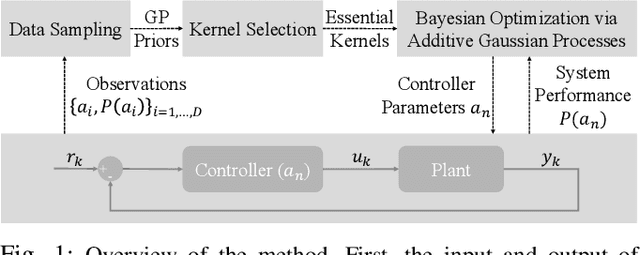
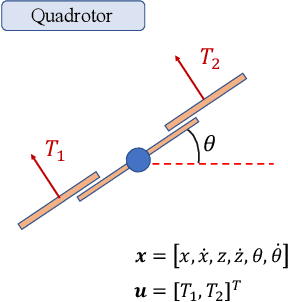
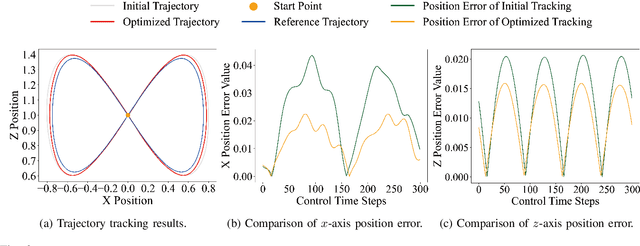
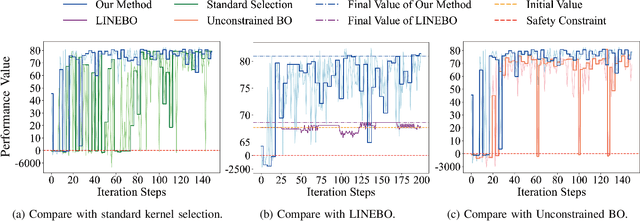
Control system optimization has long been a fundamental challenge in robotics. While recent advancements have led to the development of control algorithms that leverage learning-based approaches, such as SafeOpt, to optimize single feedback controllers, scaling these methods to high-dimensional complex systems with multiple controllers remains an open problem. In this paper, we propose a novel learning-based control optimization method, which enhances the additive Gaussian process-based Safe Bayesian Optimization algorithm to efficiently tackle high-dimensional problems through kernel selection. We use PID controller optimization in drones as a representative example and test the method on Safe Control Gym, a benchmark designed for evaluating safe control techniques. We show that the proposed method provides a more efficient and optimal solution for high-dimensional control optimization problems, demonstrating significant improvements over existing techniques.
An End-to-End Collaborative Learning Approach for Connected Autonomous Vehicles in Occluded Scenarios
Dec 11, 2024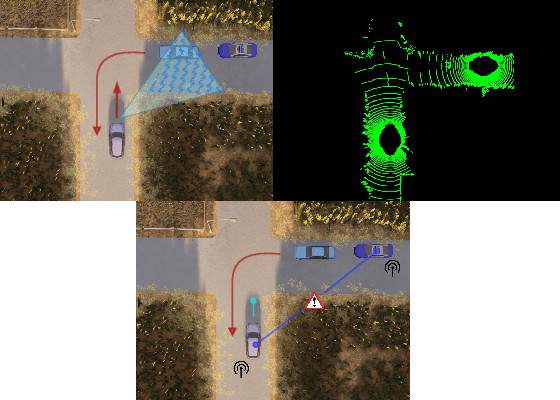
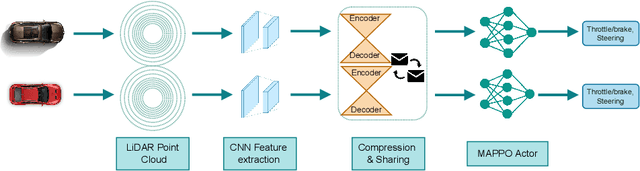
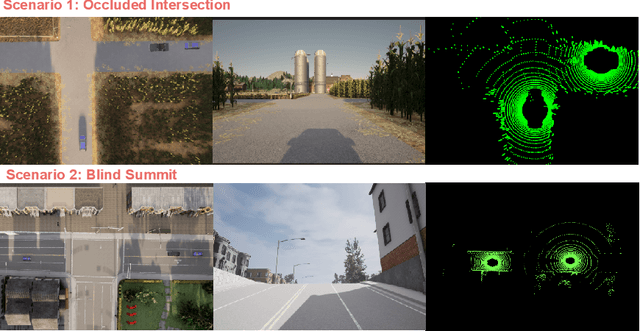
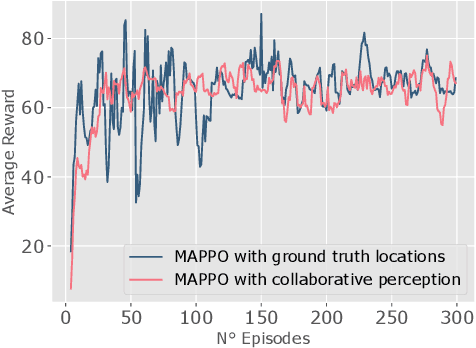
Collaborative navigation becomes essential in situations of occluded scenarios in autonomous driving where independent driving policies are likely to lead to collisions. One promising approach to address this issue is through the use of Vehicle-to-Vehicle (V2V) networks that allow for the sharing of perception information with nearby agents, preventing catastrophic accidents. In this article, we propose a collaborative control method based on a V2V network for sharing compressed LiDAR features and employing Proximal Policy Optimisation to train safe and efficient navigation policies. Unlike previous approaches that rely on expert data (behaviour cloning), our proposed approach learns the multi-agent policies directly from experience in the occluded environment, while effectively meeting bandwidth limitations. The proposed method first prepossesses LiDAR point cloud data to obtain meaningful features through a convolutional neural network and then shares them with nearby CAVs to alert for potentially dangerous situations. To evaluate the proposed method, we developed an occluded intersection gym environment based on the CARLA autonomous driving simulator, allowing real-time data sharing among agents. Our experimental results demonstrate the consistent superiority of our collaborative control method over an independent reinforcement learning method and a cooperative early fusion method.
MAGICS: Adversarial RL with Minimax Actors Guided by Implicit Critic Stackelberg for Convergent Neural Synthesis of Robot Safety
Sep 20, 2024While robust optimal control theory provides a rigorous framework to compute robot control policies that are provably safe, it struggles to scale to high-dimensional problems, leading to increased use of deep learning for tractable synthesis of robot safety. Unfortunately, existing neural safety synthesis methods often lack convergence guarantees and solution interpretability. In this paper, we present Minimax Actors Guided by Implicit Critic Stackelberg (MAGICS), a novel adversarial reinforcement learning (RL) algorithm that guarantees local convergence to a minimax equilibrium solution. We then build on this approach to provide local convergence guarantees for a general deep RL-based robot safety synthesis algorithm. Through both simulation studies on OpenAI Gym environments and hardware experiments with a 36-dimensional quadruped robot, we show that MAGICS can yield robust control policies outperforming the state-of-the-art neural safety synthesis methods.
Disturbance Observer-based Control Barrier Functions with Residual Model Learning for Safe Reinforcement Learning
Oct 09, 2024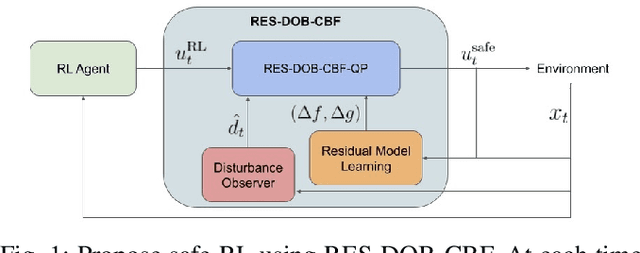


Reinforcement learning (RL) agents need to explore their environment to learn optimal behaviors and achieve maximum rewards. However, exploration can be risky when training RL directly on real systems, while simulation-based training introduces the tricky issue of the sim-to-real gap. Recent approaches have leveraged safety filters, such as control barrier functions (CBFs), to penalize unsafe actions during RL training. However, the strong safety guarantees of CBFs rely on a precise dynamic model. In practice, uncertainties always exist, including internal disturbances from the errors of dynamics and external disturbances such as wind. In this work, we propose a new safe RL framework based on disturbance rejection-guarded learning, which allows for an almost model-free RL with an assumed but not necessarily precise nominal dynamic model. We demonstrate our results on the Safety-gym benchmark for Point and Car robots on all tasks where we can outperform state-of-the-art approaches that use only residual model learning or a disturbance observer (DOB). We further validate the efficacy of our framework using a physical F1/10 racing car. Videos: https://sites.google.com/view/res-dob-cbf-rl