 Add to Chrome
 Add to Firefox
 Add to Edge
A Collaborative Safety Shield for Safe and Efficient CAV Lane Changes in Congested On-Ramp Merging
Feb 10, 2026
Lane changing in dense traffic is a significant challenge for Connected and Autonomous Vehicles (CAVs). Existing lane change controllers primarily either ensure safety or collaboratively improve traffic efficiency, but do not consider these conflicting objectives together. To address this, we propose the Multi-Agent Safety Shield (MASS), designed using Control Barrier Functions (CBFs) to enable safe and collaborative lane changes. The MASS enables collaboration by capturing multi-agent interactions among CAVs through interaction topologies constructed as a graph using a simple algorithm. Further, a state-of-the-art Multi-Agent Reinforcement Learning (MARL) lane change controller is extended by integrating MASS to ensure safety and defining a customised reward function to prioritise efficiency improvements. As a result, we propose a lane change controller, known as MARL-MASS, and evaluate it in a congested on-ramp merging simulation. The results demonstrate that MASS enables collaborative lane changes with safety guarantees by strictly respecting the safety constraints. Moreover, the proposed custom reward function improves the stability of MARL policies trained with a safety shield. Overall, by encouraging the exploration of a collaborative lane change policy while respecting safety constraints, MARL-MASS effectively balances the trade-off between ensuring safety and improving traffic efficiency in congested traffic. The code for MARL-MASS is available with an open-source licence at https://github.com/hkbharath/MARL-MASS

Safe and Efficient CAV Lane Changing using Decentralised Safety Shields
Apr 30, 2025
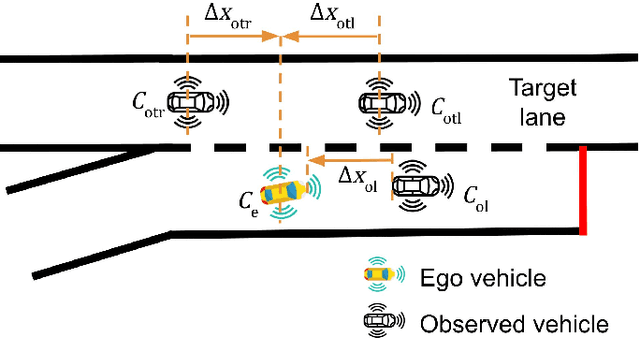
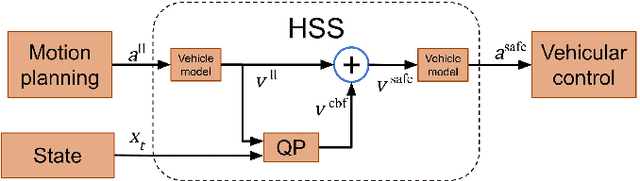
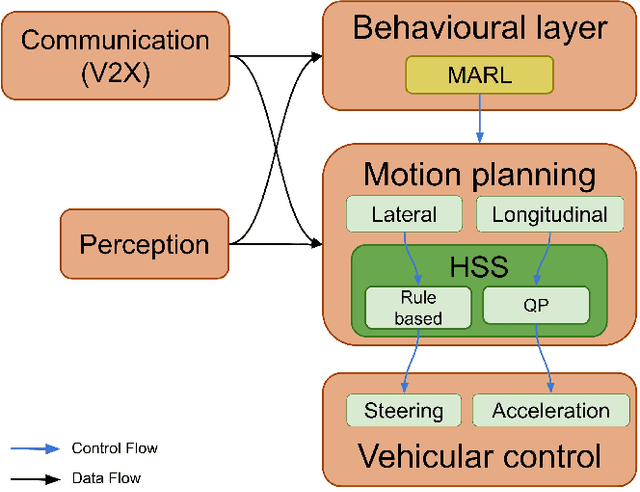
Lane changing is a complex decision-making problem for Connected and Autonomous Vehicles (CAVs) as it requires balancing traffic efficiency with safety. Although traffic efficiency can be improved by using vehicular communication for training lane change controllers using Multi-Agent Reinforcement Learning (MARL), ensuring safety is difficult. To address this issue, we propose a decentralised Hybrid Safety Shield (HSS) that combines optimisation and a rule-based approach to guarantee safety. Our method applies control barrier functions to constrain longitudinal and lateral control inputs of a CAV to ensure safe manoeuvres. Additionally, we present an architecture to integrate HSS with MARL, called MARL-HSS, to improve traffic efficiency while ensuring safety. We evaluate MARL-HSS using a gym-like environment that simulates an on-ramp merging scenario with two levels of traffic densities, such as light and moderate densities. The results show that HSS provides a safety guarantee by strictly enforcing a dynamic safety constraint defined on a time headway, even in moderate traffic density that offers challenging lane change scenarios. Moreover, the proposed method learns stable policies compared to the baseline, a state-of-the-art MARL lane change controller without a safety shield. Further policy evaluation shows that our method achieves a balance between safety and traffic efficiency with zero crashes and comparable average speeds in light and moderate traffic densities.