 Add to Chrome
 Add to Firefox
 Add to Edge
Multi Speaker Source Separation
Papers and Code
HRTF-guided Binaural Target Speaker Extraction with Real-World Validation
Mar 17, 2026
This paper presents a Head-Related Transfer Function (HRTF)-guided framework for binaural Target Speaker Extraction (TSE) from mixtures of concurrent sources. Unlike conventional TSE methods based on Direction of Arrival (DOA) estimation or enrollment signals, which often distort perceived spatial location, the proposed approach leverages the listener's HRTF as an explicit spatial prior. The proposed framework is built upon a multi-channel deep blind source separation backbone, adapted to the binaural TSE setting. It is trained on measured HRTFs from a diverse population, enabling cross-listener generalization rather than subject-specific tuning. By conditioning the extraction on HRTF-derived spatial information, the method preserves binaural cues while enhancing speech quality and intelligibility. The performance of the proposed framework is validated through simulations and real recordings obtained from a head and torso simulator (HATS).

Moving Speaker Separation via Parallel Spectral-Spatial Processing
Feb 25, 2026Multi-channel speech separation in dynamic environments is challenging as time-varying spatial and spectral features evolve at different temporal scales. Existing methods typically employ sequential architectures, forcing a single network stream to simultaneously model both feature types, creating an inherent modeling conflict. In this paper, we propose a dual-branch parallel spectral-spatial (PS2) architecture that separately processes spectral and spatial features through parallel streams. The spectral branch uses a bi-directional long short-term memory (BLSTM)-based frequency module, a Mamba-based temporal module, and a self-attention module to model spectral features. The spatial branch employs bi-directional gated recurrent unit (BGRU) networks to process spatial features that encode the evolving geometric relationships between sources and microphones. Features from both branches are integrated through a cross-attention fusion mechanism that adaptively weights their contributions. Experimental results demonstrate that the PS2 outperforms existing state-of-the-art (SOTA) methods by 1.6-2.2 dB in scale-invariant signal-to-distortion ratio (SI-SDR) for moving speaker scenarios, with robust separation quality under different reverberation times (RT60), noise levels, and source movement speeds. Even with fast source movements, the proposed model maintains SI-SDR improvements of over 13 dB. These improvements are consistently observed across multiple datasets, including WHAMR! and our generated WSJ0-Demand-6ch-Move dataset.
Brain-Informed Speech Separation for Cochlear Implants
Jan 29, 2026We propose a brain-informed speech separation method for cochlear implants (CIs) that uses electroencephalography (EEG)-derived attention cues to guide enhancement toward the attended speaker. An attention-guided network fuses audio mixtures with EEG features through a lightweight fusion layer, producing attended-source electrodograms for CI stimulation while resolving the label-permutation ambiguity of audio-only separators. Robustness to degraded attention cues is improved with a mixed curriculum that varies cue quality during training, yielding stable gains even when EEG-speech correlation is moderate. In multi-talker conditions, the model achieves higher signal-to-interference ratio improvements than an audio-only electrodogram baseline while remaining slightly smaller (167k vs. 171k parameters). With 2 ms algorithmic latency and comparable cost, the approach highlights the promise of coupling auditory and neural cues for cognitively adaptive CI processing.
DNN-Based Online Source Counting Based on Spatial Generalized Magnitude Squared Coherence
Jan 28, 2026The number of active sound sources is a key parameter in many acoustic signal processing tasks, such as source localization, source separation, and multi-microphone speech enhancement. This paper proposes a novel method for online source counting by detecting changes in the number of active sources based on spatial coherence. The proposed method exploits the fact that a single coherent source in spatially white background noise yields high spatial coherence, whereas only noise results in low spatial coherence. By applying a spatial whitening operation, the source counting problem is reformulated as a change detection task, aiming to identify the time frames when the number of active sources changes. The method leverages the generalized magnitude-squared coherence as a measure to quantify spatial coherence, providing features for a compact neural network trained to detect source count changes framewise. Simulation results with binaural hearing aids in reverberant acoustic scenes with up to 4 speakers and background noise demonstrate the effectiveness of the proposed method for online source counting.
Neural Multi-Speaker Voice Cloning for Nepali in Low-Resource Settings
Jan 26, 2026This research presents a few-shot voice cloning system for Nepali speakers, designed to synthesize speech in a specific speaker's voice from Devanagari text using minimal data. Voice cloning in Nepali remains largely unexplored due to its low-resource nature. To address this, we constructed separate datasets: untranscribed audio for training a speaker encoder and paired text-audio data for training a Tacotron2-based synthesizer. The speaker encoder, optimized with Generative End2End loss, generates embeddings that capture the speaker's vocal identity, validated through Uniform Manifold Approximation and Projection (UMAP) for dimension reduction visualizations. These embeddings are fused with Tacotron2's text embeddings to produce mel-spectrograms, which are then converted into audio using a WaveRNN vocoder. Audio data were collected from various sources, including self-recordings, and underwent thorough preprocessing for quality and alignment. Training was performed using mel and gate loss functions under multiple hyperparameter settings. The system effectively clones speaker characteristics even for unseen voices, demonstrating the feasibility of few-shot voice cloning for the Nepali language and establishing a foundation for personalized speech synthesis in low-resource scenarios.
MeanFlow-TSE: One-Step Generative Target Speaker Extraction with Mean Flow
Dec 21, 2025Target speaker extraction (TSE) aims to isolate a desired speaker's voice from a multi-speaker mixture using auxiliary information such as a reference utterance. Although recent advances in diffusion and flow-matching models have improved TSE performance, these methods typically require multi-step sampling, which limits their practicality in low-latency settings. In this work, we propose MeanFlow-TSE, a one-step generative TSE framework trained with mean-flow objectives, enabling fast and high-quality generation without iterative refinement. Building on the AD-FlowTSE paradigm, our method defines a flow between the background and target source that is governed by the mixing ratio (MR). Experiments on the Libri2Mix corpus show that our approach outperforms existing diffusion- and flow-matching-based TSE models in separation quality and perceptual metrics while requiring only a single inference step. These results demonstrate that mean-flow-guided one-step generation offers an effective and efficient alternative for real-time target speaker extraction. Code is available at https://github.com/rikishimizu/MeanFlow-TSE.
QuarkAudio Technical Report
Dec 23, 2025Many existing audio processing and generation models rely on task-specific architectures, resulting in fragmented development efforts and limited extensibility. It is therefore promising to design a unified framework capable of handling multiple tasks, while providing robust instruction and audio understanding and high-quality audio generation. This requires a compatible paradigm design, a powerful backbone, and a high-fidelity audio reconstruction module. To meet these requirements, this technical report introduces QuarkAudio, a decoder-only autoregressive (AR) LM-based generative framework that unifies multiple tasks. The framework includes a unified discrete audio tokenizer, H-Codec, which incorporates self-supervised learning (SSL) representations into the tokenization and reconstruction process. We further propose several improvements to H-Codec, such as a dynamic frame-rate mechanism and extending the audio sampling rate to 48 kHz. QuarkAudio unifies tasks by using task-specific conditional information as the conditioning sequence of the decoder-only LM, and predicting discrete target audio tokens in an AR manner. The framework supports a wide range of audio processing and generation tasks, including speech restoration (SR), target speaker extraction (TSE), speech separation (SS), voice conversion (VC), and language-queried audio source separation (LASS). In addition, we extend downstream tasks to universal free-form audio editing guided by natural language instructions (including speech semantic editing and audio event editing). Experimental results show that H-Codec achieves high-quality audio reconstruction with a low frame rate, improving both the efficiency and performance of downstream audio generation, and that QuarkAudio delivers competitive or comparable performance to state-of-the-art task-specific or multi-task systems across multiple tasks.
Source Separation for A Cappella Music
Sep 30, 2025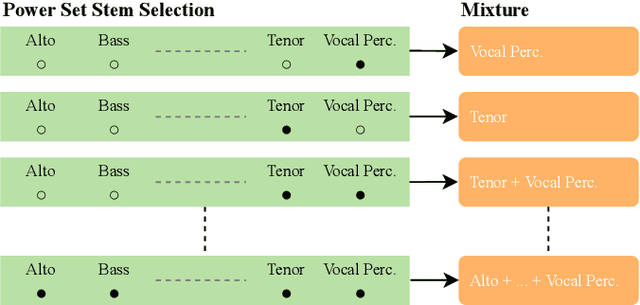
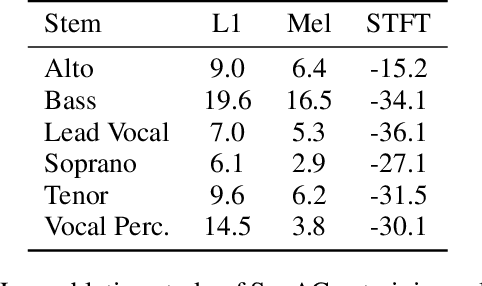
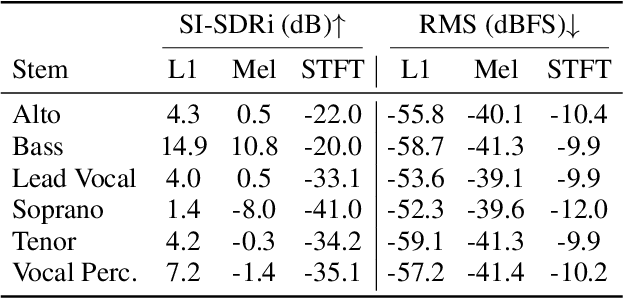
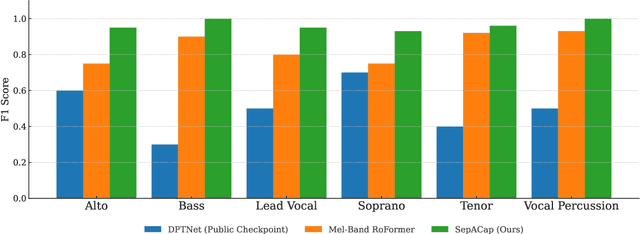
In this work, we study the task of multi-singer separation in a cappella music, where the number of active singers varies across mixtures. To address this, we use a power set-based data augmentation strategy that expands limited multi-singer datasets into exponentially more training samples. To separate singers, we introduce SepACap, an adaptation of SepReformer, a state-of-the-art speaker separation model architecture. We adapt the model with periodic activations and a composite loss function that remains effective when stems are silent, enabling robust detection and separation. Experiments on the JaCappella dataset demonstrate that our approach achieves state-of-the-art performance in both full-ensemble and subset singer separation scenarios, outperforming spectrogram-based baselines while generalizing to realistic mixtures with varying numbers of singers.
Multi-agent Auditory Scene Analysis
Jul 03, 2025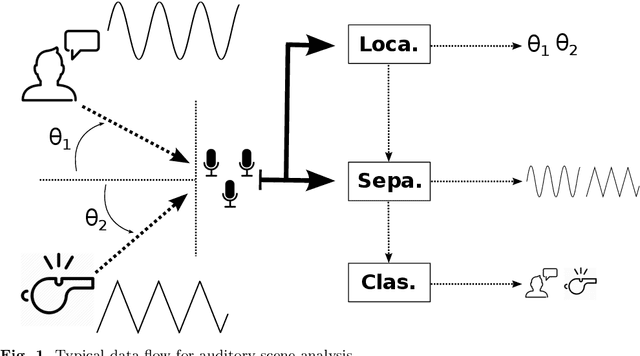
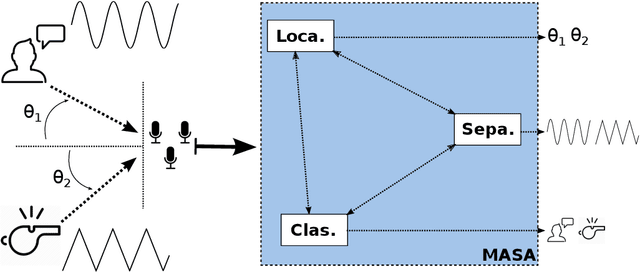
Auditory scene analysis (ASA) aims to retrieve information from the acoustic environment, by carrying out three main tasks: sound source location, separation, and classification. These tasks are traditionally executed with a linear data flow, where the sound sources are first located; then, using their location, each source is separated into its own audio stream; from each of which, information is extracted that is relevant to the application scenario (audio event detection, speaker identification, emotion classification, etc.). However, running these tasks linearly increases the overall response time, while making the last tasks (separation and classification) highly sensitive to errors of the first task (location). A considerable amount of effort and computational complexity has been employed in the state-of-the-art to develop techniques that are the least error-prone possible. However, doing so gives rise to an ASA system that is non-viable in many applications that require a small computational footprint and a low response time, such as bioacoustics, hearing-aid design, search and rescue, human-robot interaction, etc. To this effect, in this work, a multi-agent approach is proposed to carry out ASA where the tasks are run in parallel, with feedback loops between them to compensate for local errors, such as: using the quality of the separation output to correct the location error; and using the classification result to reduce the localization's sensitivity towards interferences. The result is a multi-agent auditory scene analysis (MASA) system that is robust against local errors, without a considerable increase in complexity, and with a low response time. The complete proposed MASA system is provided as a framework that uses open-source tools for sound acquisition and reproduction (JACK) and inter-agent communication (ROS2), allowing users to add their own agents.
ClearerVoice-Studio: Bridging Advanced Speech Processing Research and Practical Deployment
Jun 24, 2025This paper introduces ClearerVoice-Studio, an open-source, AI-powered speech processing toolkit designed to bridge cutting-edge research and practical application. Unlike broad platforms like SpeechBrain and ESPnet, ClearerVoice-Studio focuses on interconnected speech tasks of speech enhancement, separation, super-resolution, and multimodal target speaker extraction. A key advantage is its state-of-the-art pretrained models, including FRCRN with 3 million uses and MossFormer with 2.5 million uses, optimized for real-world scenarios. It also offers model optimization tools, multi-format audio support, the SpeechScore evaluation toolkit, and user-friendly interfaces, catering to researchers, developers, and end-users. Its rapid adoption attracting 3000 GitHub stars and 239 forks highlights its academic and industrial impact. This paper details ClearerVoice-Studio's capabilities, architectures, training strategies, benchmarks, community impact, and future plan. Source code is available at https://github.com/modelscope/ClearerVoice-Studio.