 Add to Chrome
 Add to Firefox
 Add to Edge
Cocktail-Talker: Multi-Speaker Dialog Modeling in Noisy Social Environments with Turn Action GRPO
Jul 30, 2026
Spoken dialog systems are typically designed for clean, dyadic interactions in which a single user and an assistant take turns speaking. Real-world social conversations, however, are often more ambiguous: multiple speakers may participate in the same conversation amid irrelevant speech and background noise. Each utterance may be directed to the assistant, addressed to another speaker, or completely irrelevant. In such settings, the assistant must decide not only what to say, but also whether to speak at all. In this paper, we introduce Cocktail-Talker, a speech LLM framework for multi-speaker spoken dialog modeling in noisy social environments. We model the assistant's behavior with three action tokens: <|respond|>, <|listen|>, and <|ignore|>, placed before a response or silence. Cocktail-Talker is trained via supervised finetuning and reinforcement learning to generate the appropriate action token and, only in <|respond|> mode, a speech response. To prepare the training data, we develop Cocktail-DialogGen, an LLM-based data pipeline that simulates realistic multi-speaker dialogs with speaker roles across diverse social settings. Together, these components take a step toward spoken dialog systems that interact more naturally and selectively in complex social environments.

Sympatheia: Emotionally Adaptive Voice Assistant with Continuous Affect Conditioning
May 30, 2026Empathetic spoken dialogue systems must infer a user's emotional state to respond appropriately, yet everyday speech often carries weak, neutral, or ambiguous affective cues. To address this, we introduce Sympatheia, a speech-to-speech dialogue framework conditioned on affect inferred from the user's speech and, when available, explicit affect specifications provided as a continuous valence--arousal (VA) control signal by a multimodal sensing module or user interface. To train our model, we construct Sympatheia-18k, an emotion-conditioned synthetic spoken dialogue corpus with 12 emotion anchors. This dataset includes an emotional split for learning affective speech behavior, and a neutral split that pairs emotionally neutral queries with multiple emotion-conditioned responses to isolate explicit emotion control in emotionally ambiguous cases. Empirical results show that Sympatheia outperforms speech conversational baselines in generating responses whose semantic content and spoken delivery are both emotionally appropriate. We further show that the same VA interface can integrate emotion estimates from diverse sensing modules, including facial expression, biosignals, and textual affect descriptions, improving response alignment when speech alone provides limited emotional evidence. These results suggest that continuous affect conditioning is an effective practical step for building emotionally adaptive voice assistants.
AVMeme Exam: A Multimodal Multilingual Multicultural Benchmark for LLMs' Contextual and Cultural Knowledge and Thinking
Jan 25, 2026Internet audio-visual clips convey meaning through time-varying sound and motion, which extend beyond what text alone can represent. To examine whether AI models can understand such signals in human cultural contexts, we introduce AVMeme Exam, a human-curated benchmark of over one thousand iconic Internet sounds and videos spanning speech, songs, music, and sound effects. Each meme is paired with a unique Q&A assessing levels of understanding from surface content to context and emotion to usage and world knowledge, along with metadata such as original year, transcript, summary, and sensitivity. We systematically evaluate state-of-the-art multimodal large language models (MLLMs) alongside human participants using this benchmark. Our results reveal a consistent limitation: current models perform poorly on textless music and sound effects, and struggle to think in context and in culture compared to surface content. These findings highlight a key gap in human-aligned multimodal intelligence and call for models that can perceive contextually and culturally beyond the surface of what they hear and see. Project page: avmemeexam.github.io/public
MeanFlow-TSE: One-Step Generative Target Speaker Extraction with Mean Flow
Dec 21, 2025Target speaker extraction (TSE) aims to isolate a desired speaker's voice from a multi-speaker mixture using auxiliary information such as a reference utterance. Although recent advances in diffusion and flow-matching models have improved TSE performance, these methods typically require multi-step sampling, which limits their practicality in low-latency settings. In this work, we propose MeanFlow-TSE, a one-step generative TSE framework trained with mean-flow objectives, enabling fast and high-quality generation without iterative refinement. Building on the AD-FlowTSE paradigm, our method defines a flow between the background and target source that is governed by the mixing ratio (MR). Experiments on the Libri2Mix corpus show that our approach outperforms existing diffusion- and flow-matching-based TSE models in separation quality and perceptual metrics while requiring only a single inference step. These results demonstrate that mean-flow-guided one-step generation offers an effective and efficient alternative for real-time target speaker extraction. Code is available at https://github.com/rikishimizu/MeanFlow-TSE.
XCOMPS: A Multilingual Benchmark of Conceptual Minimal Pairs
Feb 27, 2025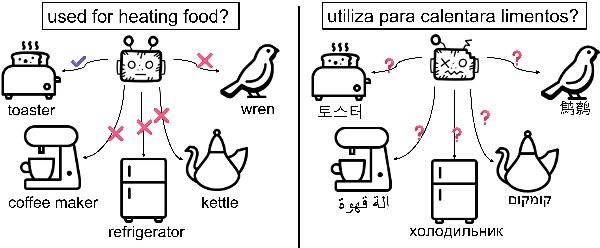
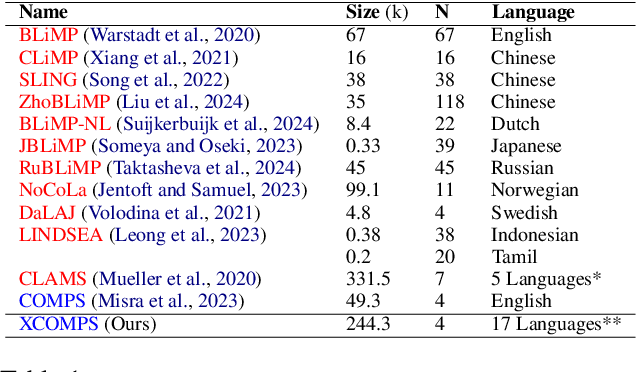

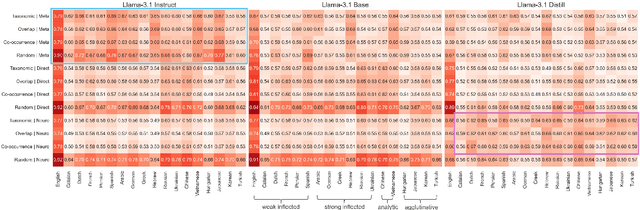
We introduce XCOMPS in this work, a multilingual conceptual minimal pair dataset covering 17 languages. Using this dataset, we evaluate LLMs' multilingual conceptual understanding through metalinguistic prompting, direct probability measurement, and neurolinguistic probing. By comparing base, instruction-tuned, and knowledge-distilled models, we find that: 1) LLMs exhibit weaker conceptual understanding for low-resource languages, and accuracy varies across languages despite being tested on the same concept sets. 2) LLMs excel at distinguishing concept-property pairs that are visibly different but exhibit a marked performance drop when negative pairs share subtle semantic similarities. 3) Instruction tuning improves performance in concept understanding but does not enhance internal competence; knowledge distillation can enhance internal competence in conceptual understanding for low-resource languages with limited gains in explicit task performance. 4) More morphologically complex languages yield lower concept understanding scores and require deeper layers for conceptual reasoning.
Unveil Sleep Spindles with Concentration of Frequency and Time
Oct 27, 2023
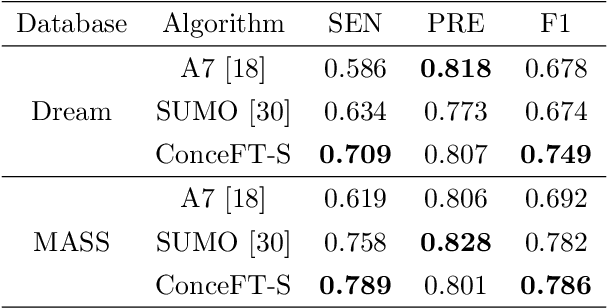
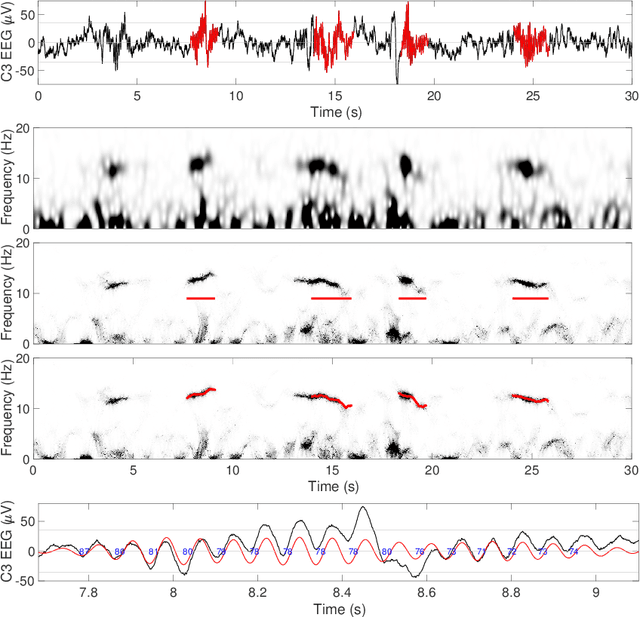
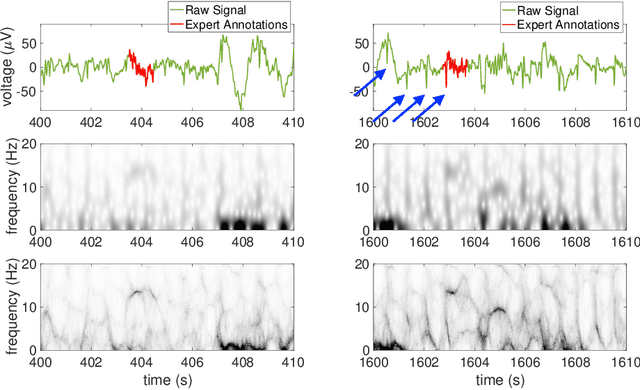
Objective: Sleep spindles contain crucial brain dynamics information. We introduce the novel non-linear time-frequency analysis tool 'Concentration of Frequency and Time' (ConceFT) to create an interpretable automated algorithm for sleep spindle annotation in EEG data and to measure spindle instantaneous frequencies (IFs). Methods: ConceFT effectively reduces stochastic EEG influence, enhancing spindle visibility in the time-frequency representation. Our automated spindle detection algorithm, ConceFT-Spindle (ConceFT-S), is compared to A7 (non-deep learning) and SUMO (deep learning) using Dream and MASS benchmark databases. We also quantify spindle IF dynamics. Results: ConceFT-S achieves F1 scores of 0.749 in Dream and 0.786 in MASS, which is equivalent to or surpass A7 and SUMO with statistical significance. We reveal that spindle IF is generally nonlinear. Conclusion: ConceFT offers an accurate, interpretable EEG-based sleep spindle detection algorithm and enables spindle IF quantification.