 Add to Chrome
 Add to Firefox
 Add to Edge
When Detectors Forget Forensics: Blocking Semantic Shortcuts for Generalizable AI-Generated Image Detection
Mar 10, 2026
AI-generated image detection has become increasingly important with the rapid advancement of generative AI. However, detectors built on Vision Foundation Models (VFMs, \emph{e.g.}, CLIP) often struggle to generalize to images created using unseen generation pipelines. We identify, for the first time, a key failure mechanism, termed \emph{semantic fallback}, where VFM-based detectors rely on dominant pre-trained semantic priors (such as identity) rather than forgery-specific traces under distribution shifts. To address this issue, we propose \textbf{Geometric Semantic Decoupling (GSD)}, a parameter-free module that explicitly removes semantic components from learned representations by leveraging a frozen VFM as a semantic guide with a trainable VFM as an artifact detector. GSD estimates semantic directions from batch-wise statistics and projects them out via a geometric constraint, forcing the artifact detector to rely on semantic-invariant forensic evidence. Extensive experiments demonstrate that our method consistently outperforms state-of-the-art approaches, achieving 94.4\% video-level AUC (+\textbf{1.2\%}) in cross-dataset evaluation, improving robustness to unseen manipulations (+\textbf{3.0\%} on DF40), and generalizing beyond faces to the detection of synthetic images of general scenes, including UniversalFakeDetect (+\textbf{0.9\%}) and GenImage (+\textbf{1.7\%}).

QuarkAudio Technical Report
Dec 23, 2025Many existing audio processing and generation models rely on task-specific architectures, resulting in fragmented development efforts and limited extensibility. It is therefore promising to design a unified framework capable of handling multiple tasks, while providing robust instruction and audio understanding and high-quality audio generation. This requires a compatible paradigm design, a powerful backbone, and a high-fidelity audio reconstruction module. To meet these requirements, this technical report introduces QuarkAudio, a decoder-only autoregressive (AR) LM-based generative framework that unifies multiple tasks. The framework includes a unified discrete audio tokenizer, H-Codec, which incorporates self-supervised learning (SSL) representations into the tokenization and reconstruction process. We further propose several improvements to H-Codec, such as a dynamic frame-rate mechanism and extending the audio sampling rate to 48 kHz. QuarkAudio unifies tasks by using task-specific conditional information as the conditioning sequence of the decoder-only LM, and predicting discrete target audio tokens in an AR manner. The framework supports a wide range of audio processing and generation tasks, including speech restoration (SR), target speaker extraction (TSE), speech separation (SS), voice conversion (VC), and language-queried audio source separation (LASS). In addition, we extend downstream tasks to universal free-form audio editing guided by natural language instructions (including speech semantic editing and audio event editing). Experimental results show that H-Codec achieves high-quality audio reconstruction with a low frame rate, improving both the efficiency and performance of downstream audio generation, and that QuarkAudio delivers competitive or comparable performance to state-of-the-art task-specific or multi-task systems across multiple tasks.
Robust Watermarks Leak: Channel-Aware Feature Extraction Enables Adversarial Watermark Manipulation
Feb 10, 2025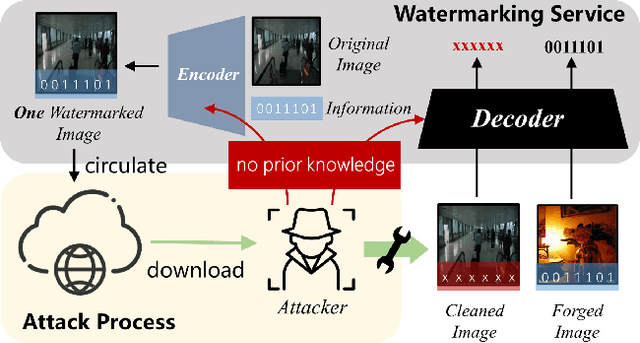
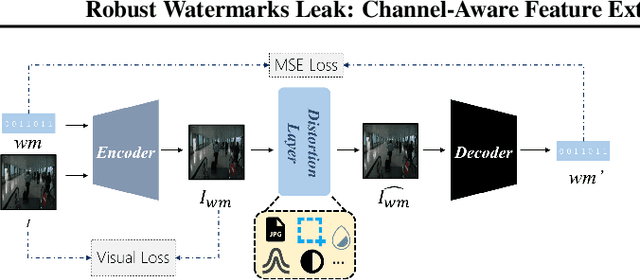
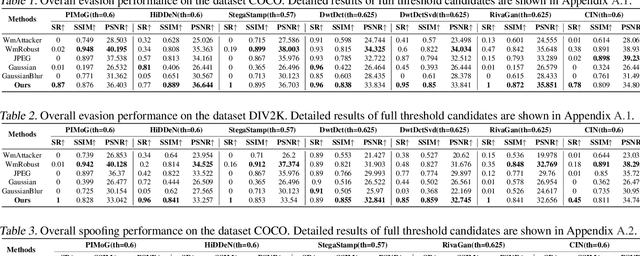
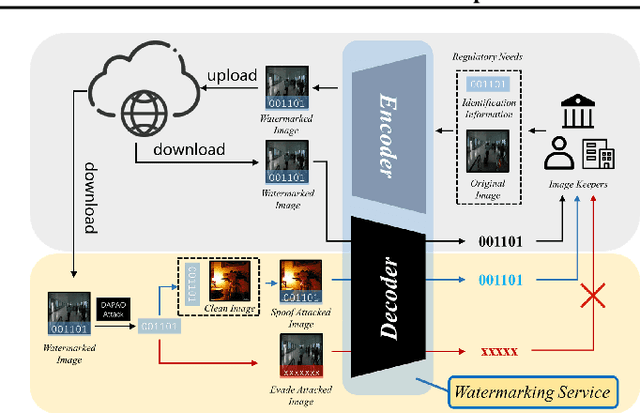
Watermarking plays a key role in the provenance and detection of AI-generated content. While existing methods prioritize robustness against real-world distortions (e.g., JPEG compression and noise addition), we reveal a fundamental tradeoff: such robust watermarks inherently improve the redundancy of detectable patterns encoded into images, creating exploitable information leakage. To leverage this, we propose an attack framework that extracts leakage of watermark patterns through multi-channel feature learning using a pre-trained vision model. Unlike prior works requiring massive data or detector access, our method achieves both forgery and detection evasion with a single watermarked image. Extensive experiments demonstrate that our method achieves a 60\% success rate gain in detection evasion and 51\% improvement in forgery accuracy compared to state-of-the-art methods while maintaining visual fidelity. Our work exposes the robustness-stealthiness paradox: current "robust" watermarks sacrifice security for distortion resistance, providing insights for future watermark design.