 Add to Chrome
 Add to Firefox
 Add to Edge
Mammogram
Papers and Code
Cross-Modal Clinical Knowledge Integration for Mammography Report Generation
May 29, 2026
Breast cancer is a major global health concern, and mammography screening plays a central role in early detection. The large volume of screening examinations creates a substantial workload for radiologists, making accurate and consistent report generation a critical clinical challenge. Existing automated mammography report generation methods primarily focus on direct visual-to-text mapping, while overlooking the structured clinical reasoning process followed by radiologists in real-world practice. To address this limitation, we propose MammoRG, a mammography report generation framework that explicitly simulates the clinical reporting workflow by following the BI-RADS guideline and incorporating prior clinical knowledge to produce diagnostic reports. Specifically, MammoRG adopts a two-stage training framework. In the first stage, the model learns to integrate clinically relevant prior knowledge from a patient's four-view mammograms through classification-based supervision. In the second stage, a terminology-aware supervised fine-tuning strategy is introduced to model mammography-specific clinical terms as atomic semantic units, enabling the generation of high-quality reports with improved clinical consistency. To facilitate clinical efficacy evaluation of generated reports, we further develop MammoRGTool, a dedicated mammography report parsing tool that extracts structured clinical information from free-text reports. Extensive experiments demonstrate that MammoRG consistently outperforms existing methods across multiple clinical efficacy metrics, particularly in diagnosis-related BI-RADS F1, where it surpasses the second-best model by 2.73%, 2.04%, 1.90%, and 3.27% on the internal, external 1, external 2, and VinDr-Mammo datasets, respectively.

MAM-CLIP: Vision-Language Pretraining on Mammography Atlases for BI-RADS Classification
May 19, 2026Deep learning methods have demonstrated promising results in predicting BI-RADS scores from mammography images. However, the interpretation of these images can vary, leading to discrepancies even among radiologists. Given the inherent complexity of mammograms, training classification models solely on image labels often yields limited performance. To address this challenge, we curated 2313 mammogram images and their corresponding captions from two mammography atlases. Our proposed approach employs a multi-modal model that uses a pretrained PubMedBERT as the language component. By training this model on image-text pairs with contrastive learning, we enable the vision encoder to absorb the rich information contained in the captions, thereby improving its understanding of mammography findings. We then fine-tune the vision encoder on two datasets for BI-RADS prediction, achieving superior performance compared with models trained without this pretraining, particularly when labeled samples are scarce. The improvement in the 3-class average F1 score ranges from +1% to +14%: a +1% increase with 40K training samples, and a +14% increase with 1K samples. Furthermore, our experiments reveal that 2K image-text pairs from mammography atlases can be more informative than 2K labeled samples for label prediction, with an average margin of +1.1% when more than 10K training samples are available. Overall, our work provides a vision-language model for mammography and highlights the value of textual information from mammography atlases. In addition, we publicly release preprocessed mammography images of the TEKNOFEST dataset. The training code, pre-trained model weights, data extraction scripts, and the released dataset are publicly available at: https://github.com/igulluk/MAM-CLIP
Attend what matters: Leveraging vision foundational models for breast cancer classification using mammograms
Apr 21, 2026Vision Transformers $(\texttt{ViT})$ have become the architecture of choice for many computer vision tasks, yet their performance in computer-aided diagnostics remains limited. Focusing on breast cancer detection from mammograms, we identify two main causes for this shortfall. First, medical images are high-resolution with small abnormalities, leading to an excessive number of tokens and making it difficult for the softmax-based attention to localize and attend to relevant regions. Second, medical image classification is inherently fine-grained, with low inter-class and high intra-class variability, where standard cross-entropy training is insufficient. To overcome these challenges, we propose a framework with three key components: (1) Region of interest $(\texttt{RoI})$ based token reduction using an object detection model to guide attention; (2) contrastive learning between selected $\texttt{RoI}$ to enhance fine-grained discrimination through hard-negative based training; and (3) a $\texttt{DINOv2}$ pretrained $\texttt{ViT}$ that captures localization-aware, fine-grained features instead of global $\texttt{CLIP}$ representations. Experiments on public mammography datasets demonstrate that our method achieves superior performance over existing baselines, establishing its effectiveness and potential clinical utility for large-scale breast cancer screening. Our code is available for reproducibility here: https://aih-iitd.github.io/publications/attend-what-matters
MC-GenRef: Annotation-free mammography microcalcification segmentation with generative posterior refinement
Apr 06, 2026Microcalcification (MC) analysis is clinically important in screening mammography because clustered puncta can be an early sign of malignancy, yet dense MC segmentation remains challenging: targets are extremely small and sparse, dense pixel-level labels are expensive and ambiguous, and cross-site shift often induces texture-driven false positives and missed puncta in dense tissue. We propose MC-GenRef, a real dense-label-free framework that combines high-fidelity synthetic supervision with test-time generative posterior refinement (TT-GPR). During training, real negative mammogram patches are used as backgrounds, and physically plausible MC patterns are injected through a lightweight image formation model with local contrast modulation and blur, yielding exact image-mask pairs without real dense annotation. Using only these synthetic labeled pairs, MC-GenRef trains a base segmentor and a seed-conditioned rectified-flow (RF) generator that serves as a controllable generative prior. During inference, TT-GPR treats segmentation as approximate posterior inference: it derives a sparse seed from the current prediction, forms seed-consistent RF projections, converts them into case-specific surrogate targets through the frozen segmentor, and iteratively refines the logits with overlap-consistent and edge-aware regularization. On INbreast, the synthetic-only initializer achieved the best Dice without real dense annotations, while TT-GPR improved miss-sensitive performance to Recall and FNR, with strong class-balanced behavior (Bal.Acc., G-Mean). On an external private Yonsei cohort ( n=50 ), TT-GPR consistently improved the synthetic-only initializer under cross-site shift, increasing Dice and Recall while reducing FNR. These results suggest that test-time generative posterior refinement is a practical route to reduce MC misses and improve robustness without additional real dense labeling.
Simultaneous Dual-View Mammogram Synthesis Using Denoising Diffusion Probabilistic Models
Apr 06, 2026Breast cancer screening relies heavily on mammography, where the craniocaudal (CC) and mediolateral oblique (MLO) views provide complementary information for diagnosis. However, many datasets lack complete paired views, limiting the development of algorithms that depend on cross-view consistency. To address this gap, we propose a three-channel denoising diffusion probabilistic model capable of simultaneously generating CC and MLO views of a single breast. In this configuration, the two mammographic views are stored in separate channels, while a third channel encodes their absolute difference to guide the model toward learning coherent anatomical relationships between projections. A pretrained DDPM from Hugging Face was fine-tuned on a private screening dataset and used to synthesize dual-view pairs. Evaluation included geometric consistency via automated breast mask segmentation and distributional comparison with real images, along with qualitative inspection of cross-view alignment. The results show that the difference-based encoding helps preserve the global breast structure across views, producing synthetic CC-MLO pairs that resemble real acquisitions. This work demonstrates the feasibility of simultaneous dual-view mammogram synthesis using a difference-guided DDPM, highlighting its potential for dataset augmentation and future cross-view-aware AI applications in breast imaging.
* Accepted and presented at SPIE Medical Imaging 2025 (Vancouver, Canada)
MammoWise: Multi-Model Local RAG Pipeline for Mammography Report Generation
Feb 25, 2026Screening mammography is high volume, time sensitive, and documentation heavy. Radiologists must translate subtle visual findings into consistent BI-RADS assessments, breast density categories, and structured narrative reports. While recent Vision Language Models (VLMs) enable image-to-text reporting, many rely on closed cloud systems or tightly coupled architectures that limit privacy, reproducibility, and adaptability. We present MammoWise, a local multi-model pipeline that transforms open source VLMs into mammogram report generators and multi-task classifiers. MammoWise supports any Ollama-hosted VLM and mammography dataset, and enables zero-shot, few-shot, and Chain-of-Thought prompting, with optional multimodal Retrieval Augmented Generation (RAG) using a vector database for case-specific context. We evaluate MedGemma, LLaVA-Med, and Qwen2.5-VL on VinDr-Mammo and DMID datasets, assessing report quality (BERTScore, ROUGE-L), BI-RADS classification, breast density, and key findings. Report generation is consistently strong and improves with few-shot prompting and RAG. Classification is feasible but sensitive to model and dataset choice. Parameter-efficient fine-tuning (QLoRA) of MedGemma improves reliability, achieving BI-RADS accuracy of 0.7545, density accuracy of 0.8840, and calcification accuracy of 0.9341 while preserving report quality. MammoWise provides a practical and extensible framework for deploying local VLMs for mammography reporting within a unified and reproducible workflow.
MamaDino: A Hybrid Vision Model for Breast Cancer 3-Year Risk Prediction
Feb 14, 2026Breast cancer screening programmes increasingly seek to move from one-size-fits-all interval to risk-adapted and personalized strategies. Deep learning (DL) has enabled image-based risk models with stronger 1- to 5-year prediction than traditional clinical models, but leading systems (e.g., Mirai) typically use convolutional backbones, very high-resolution inputs (>1M pixels) and simple multi-view fusion, with limited explicit modelling of contralateral asymmetry. We hypothesised that combining complementary inductive biases (convolutional and transformer-based) with explicit contralateral asymmetry modelling would allow us to match state-of-the-art 3-year risk prediction performance even when operating on substantially lower-resolution mammograms, indicating that using less detailed images in a more structured way can recover state-of-the-art accuracy. We present MamaDino, a mammography-aware multi-view attentional DINO model. MamaDino fuses frozen self-supervised DINOv3 ViT-S features with a trainable CNN encoder at 512x512 resolution, and aggregates bilateral breast information via a BilateralMixer to output a 3-year breast cancer risk score. We train on 53,883 women from OPTIMAM (UK) and evaluate on matched 3-year case-control cohorts: an in-distribution test set from four screening sites and an external out-of-distribution cohort from an unseen site. At breast-level, MamaDino matches Mirai on both internal and external tests while using ~13x fewer input pixels. Adding the BilateralMixer improves discrimination to AUC 0.736 (vs 0.713) in-distribution and 0.677 (vs 0.666) out-of-distribution, with consistent performance across age, ethnicity, scanner, tumour type and grade. These findings demonstrate that explicit contralateral modelling and complementary inductive biases enable predictions that match Mirai, despite operating on substantially lower-resolution mammograms.
Visualizing the Invisible: Enhancing Radiologist Performance in Breast Mammography via Task-Driven Chromatic Encoding
Feb 07, 2026Purpose:Mammography screening is less sensitive in dense breasts, where tissue overlap and subtle findings increase perceptual difficulty. We present MammoColor, an end-to-end framework with a Task-Driven Chromatic Encoding (TDCE) module that converts single-channel mammograms into TDCE-encoded views for visual augmentation. Materials and Methods:MammoColor couples a lightweight TDCE module with a BI-RADS triage classifier and was trained end-to-end on VinDr-Mammo. Performance was evaluated on an internal test set, two public datasets (CBIS-DDSM and INBreast), and three external clinical cohorts. We also conducted a multi-reader, multi-case (MRMC) observer study with a washout period, comparing (1) grayscale-only, (2) TDCE-only, and (3) side-by-side grayscale+TDCE. Results:On VinDr-Mammo, MammoColor improved AUC from 0.7669 to 0.8461 (P=0.004). Gains were larger in dense breasts (AUC 0.749 to 0.835). In the MRMC study, TDCE-encoded images improved specificity (0.90 to 0.96; P=0.052) with comparable sensitivity. Conclusion:TDCE provides a task-optimized chromatic representation that may improve perceptual salience and reduce false-positive recalls in mammography triage.
MGRegBench: A Novel Benchmark Dataset with Anatomical Landmarks for Mammography Image Registration
Dec 19, 2025Robust mammography registration is essential for clinical applications like tracking disease progression and monitoring longitudinal changes in breast tissue. However, progress has been limited by the absence of public datasets and standardized benchmarks. Existing studies are often not directly comparable, as they use private data and inconsistent evaluation frameworks. To address this, we present MGRegBench, a public benchmark dataset for mammogram registration. It comprises over 5,000 image pairs, with 100 containing manual anatomical landmarks and segmentation masks for rigorous evaluation. This makes MGRegBench one of the largest public 2D registration datasets with manual annotations. Using this resource, we benchmarked diverse registration methods including classical (ANTs), learning-based (VoxelMorph, TransMorph), implicit neural representation (IDIR), a classic mammography-specific approach, and a recent state-of-the-art deep learning method MammoRegNet. The implementations were adapted to this modality from the authors' implementations or re-implemented from scratch. Our contributions are: (1) the first public dataset of this scale with manual landmarks and masks for mammography registration; (2) the first like-for-like comparison of diverse methods on this modality; and (3) an extensive analysis of deep learning-based registration. We publicly release our code and data to establish a foundational resource for fair comparisons and catalyze future research. The source code and data are at https://github.com/KourtKardash/MGRegBench.
A Bayesian Model for Multi-stage Censoring
Nov 18, 2025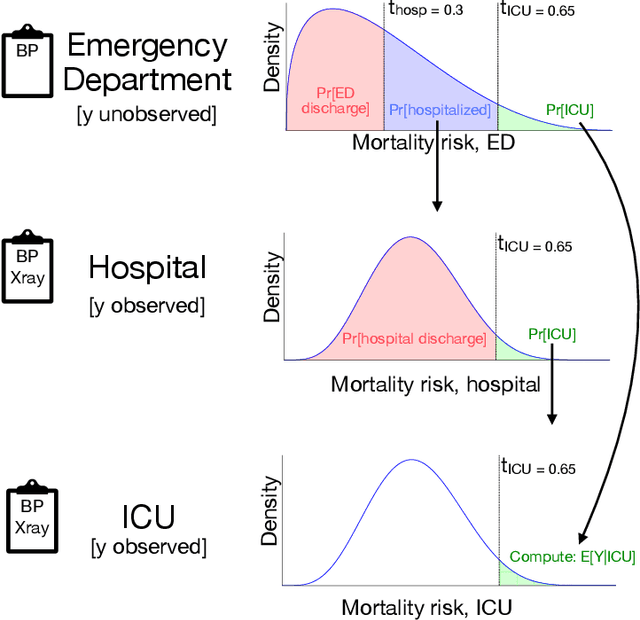
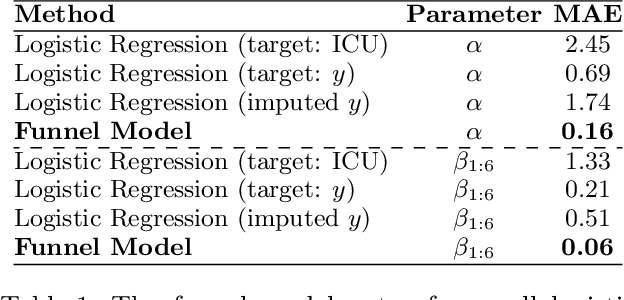
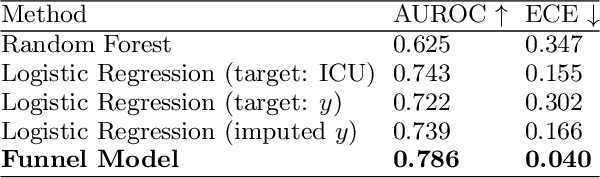
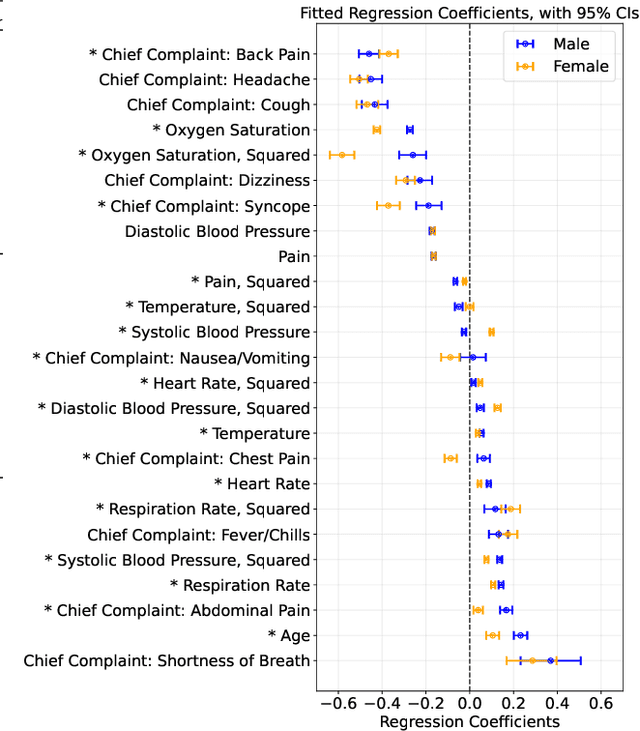
Many sequential decision settings in healthcare feature funnel structures characterized by a series of stages, such as screenings or evaluations, where the number of patients who advance to each stage progressively decreases and decisions become increasingly costly. For example, an oncologist may first conduct a breast exam, followed by a mammogram for patients with concerning exams, followed by a biopsy for patients with concerning mammograms. A key challenge is that the ground truth outcome, such as the biopsy result, is only revealed at the end of this funnel. The selective censoring of the ground truth can introduce statistical biases in risk estimation, especially in underserved patient groups, whose outcomes are more frequently censored. We develop a Bayesian model for funnel decision structures, drawing from prior work on selective labels and censoring. We first show in synthetic settings that our model is able to recover the true parameters and predict outcomes for censored patients more accurately than baselines. We then apply our model to a dataset of emergency department visits, where in-hospital mortality is observed only for those who are admitted to either the hospital or ICU. We find that there are gender-based differences in hospital and ICU admissions. In particular, our model estimates that the mortality risk threshold to admit women to the ICU is higher for women (5.1%) than for men (4.5%).