 Add to Chrome
 Add to Firefox
 Add to Edge
Universal Approximation of Continuous Functionals on Compact Subsets via Linear Measurements and Scalar Nonlinearities
Feb 03, 2026
We study universal approximation of continuous functionals on compact subsets of products of Hilbert spaces. We prove that any such functional can be uniformly approximated by models that first take finitely many continuous linear measurements of the inputs and then combine these measurements through continuous scalar nonlinearities. We also extend the approximation principle to maps with values in a Banach space, yielding finite-rank approximations. These results provide a compact-set justification for the common ``measure, apply scalar nonlinearities, then combine'' design pattern used in operator learning and imaging.

MGRegBench: A Novel Benchmark Dataset with Anatomical Landmarks for Mammography Image Registration
Dec 19, 2025Robust mammography registration is essential for clinical applications like tracking disease progression and monitoring longitudinal changes in breast tissue. However, progress has been limited by the absence of public datasets and standardized benchmarks. Existing studies are often not directly comparable, as they use private data and inconsistent evaluation frameworks. To address this, we present MGRegBench, a public benchmark dataset for mammogram registration. It comprises over 5,000 image pairs, with 100 containing manual anatomical landmarks and segmentation masks for rigorous evaluation. This makes MGRegBench one of the largest public 2D registration datasets with manual annotations. Using this resource, we benchmarked diverse registration methods including classical (ANTs), learning-based (VoxelMorph, TransMorph), implicit neural representation (IDIR), a classic mammography-specific approach, and a recent state-of-the-art deep learning method MammoRegNet. The implementations were adapted to this modality from the authors' implementations or re-implemented from scratch. Our contributions are: (1) the first public dataset of this scale with manual landmarks and masks for mammography registration; (2) the first like-for-like comparison of diverse methods on this modality; and (3) an extensive analysis of deep learning-based registration. We publicly release our code and data to establish a foundational resource for fair comparisons and catalyze future research. The source code and data are at https://github.com/KourtKardash/MGRegBench.
3D Inception-based CNN with sMRI and MD-DTI data fusion for Alzheimer's Disease diagnostics
Jul 17, 2018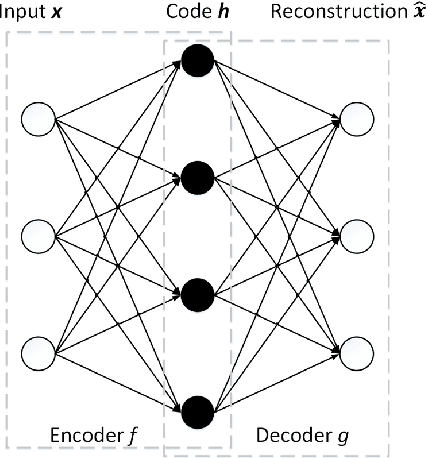
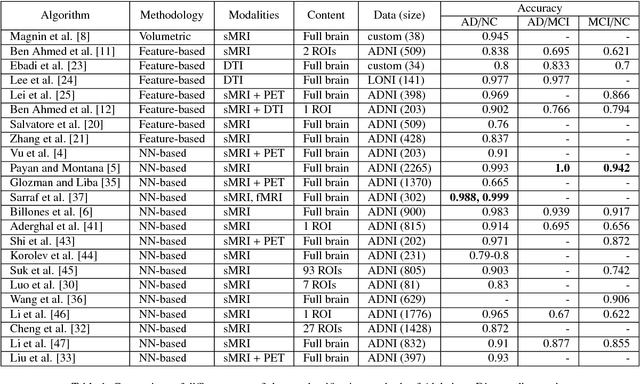
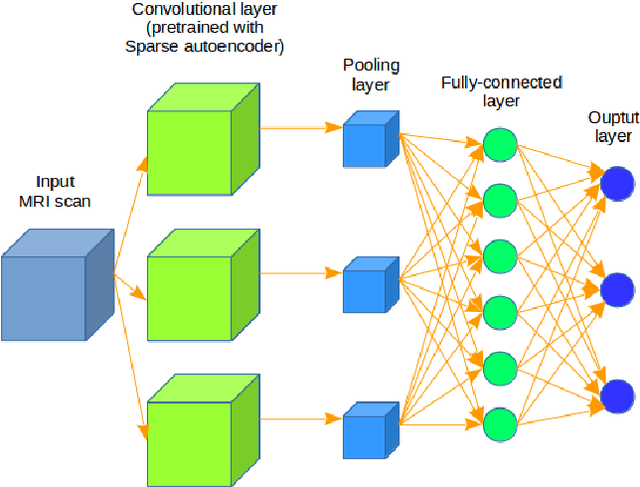
In the last decade, computer-aided early diagnostics of Alzheimer's Disease (AD) and its prodromal form, Mild Cognitive Impairment (MCI), has been the subject of extensive research. Some recent studies have shown promising results in the AD and MCI determination using structural and functional Magnetic Resonance Imaging (sMRI, fMRI), Positron Emission Tomography (PET) and Diffusion Tensor Imaging (DTI) modalities. Furthermore, fusion of imaging modalities in a supervised machine learning framework has shown promising direction of research. In this paper we first review major trends in automatic classification methods such as feature extraction based methods as well as deep learning approaches in medical image analysis applied to the field of Alzheimer's Disease diagnostics. Then we propose our own design of a 3D Inception-based Convolutional Neural Network (CNN) for Alzheimer's Disease diagnostics. The network is designed with an emphasis on the interior resource utilization and uses sMRI and DTI modalities fusion on hippocampal ROI. The comparison with the conventional AlexNet-based network using data from the Alzheimer's Disease Neuroimaging Initiative (ADNI) dataset (http://adni.loni.usc.edu) demonstrates significantly better performance of the proposed 3D Inception-based CNN.
3D CNN-based classification using sMRI and MD-DTI images for Alzheimer disease studies
Jan 18, 2018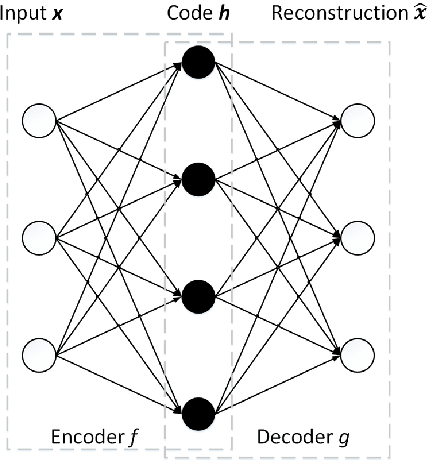
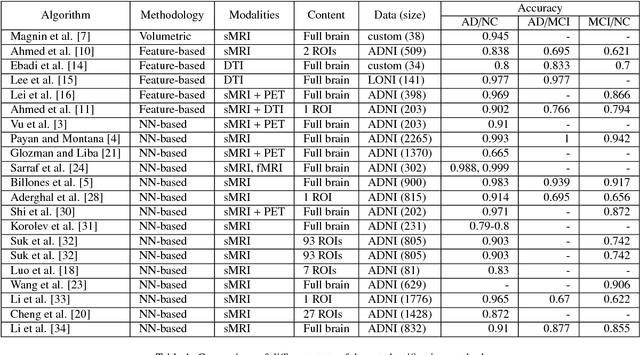
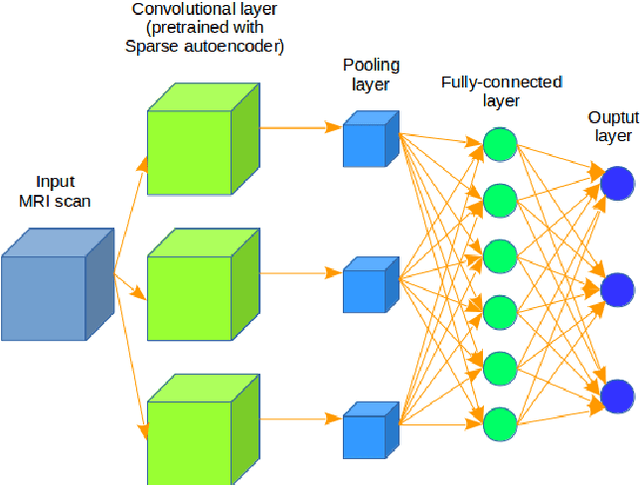
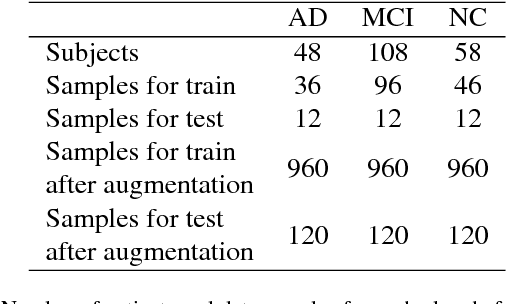
Computer-aided early diagnosis of Alzheimers Disease (AD) and its prodromal form, Mild Cognitive Impairment (MCI), has been the subject of extensive research in recent years. Some recent studies have shown promising results in the AD and MCI determination using structural and functional Magnetic Resonance Imaging (sMRI, fMRI), Positron Emission Tomography (PET) and Diffusion Tensor Imaging (DTI) modalities. Furthermore, fusion of imaging modalities in a supervised machine learning framework has shown promising direction of research. In this paper we first review major trends in automatic classification methods such as feature extraction based methods as well as deep learning approaches in medical image analysis applied to the field of Alzheimer's Disease diagnostics. Then we propose our own algorithm for Alzheimer's Disease diagnostics based on a convolutional neural network and sMRI and DTI modalities fusion on hippocampal ROI using data from the Alzheimers Disease Neuroimaging Initiative (ADNI) database (http://adni.loni.usc.edu). Comparison with a single modality approach shows promising results. We also propose our own method of data augmentation for balancing classes of different size and analyze the impact of the ROI size on the classification results as well.