 Add to Chrome
 Add to Firefox
 Add to Edge
Fish Detection
Papers and Code
Video-based Locomotion Analysis for Fish Health Monitoring
Mar 05, 2026
Monitoring the health conditions of fish is essential, as it enables the early detection of disease, safeguards animal welfare, and contributes to sustainable aquaculture practices. Physiological and pathological conditions of cultivated fish can be inferred by analyzing locomotion activities. In this paper, we present a system that estimates the locomotion activities from videos using multi object tracking. The core of our approach is a YOLOv11 detector embedded in a tracking-by-detection framework. We investigate various configurations of the YOLOv11-architecture as well as extensions that incorporate multiple frames to improve detection accuracy. Our system is evaluated on a manually annotated dataset of Sulawesi ricefish recorded in a home-aquarium-like setup, demonstrating its ability to reliably measure swimming direction and speed for fish health monitoring. The dataset will be made publicly available upon publication.

eLasmobranc Dataset: An Image Dataset for Elasmobranch Species Recognition and Biodiversity Monitoring
Mar 11, 2026Elasmobranch populations are experiencing significant global declines, and several species are currently classified as threatened. Reliable monitoring and species-level identification are essential to support conservation and spatial planning initiatives such as Important Shark and Ray Areas (ISRAs). However, existing visual datasets are predominantly detection-oriented, underwater-acquired, or limited to coarse-grained categories, restricting their applicability to fine-grained morphological classification. We present the eLasmobranc Dataset, a curated and publicly available image collection from seven ecologically relevant elasmobranch species inhabiting the eastern Spanish Mediterranean coast, a region where two ISRAs have been identified. Images were obtained through dedicated data collection, including field campaigns and collaborations with local fish markets and projects, as well as from open-access public sources. The dataset was constructed predominantly from images acquired outside the aquatic environment under standardized protocols to ensure clear visualization of diagnostic morphological traits. It integrates expert-validated species annotations, structured spatial and temporal metadata, and complementary species-level information. The eLasmobranc Dataset is specifically designed to support supervised species-level classification, population studies, and the development of artificial intelligence systems for biodiversity monitoring. By combining morphological clarity, taxonomic reliability, and public accessibility, the dataset addresses a critical gap in fine-grained elasmobranch identification and promotes reproducible research in conservation-oriented computer vision. The dataset is publicly available at https://zenodo.org/records/18549737.
FinSight-Net:A Physics-Aware Decoupled Network with Frequency-Domain Compensation for Underwater Fish Detection in Smart Aquaculture
Feb 23, 2026Underwater fish detection (UFD) is a core capability for smart aquaculture and marine ecological monitoring. While recent detectors improve accuracy by stacking feature extractors or introducing heavy attention modules, they often incur substantial computational overhead and, more importantly, neglect the physics that fundamentally limits UFD: wavelength-dependent absorption and turbidity-induced scattering significantly degrade contrast, blur fine structures, and introduce backscattering noise, leading to unreliable localization and recognition. To address these challenges, we propose FinSight-Net, an efficient and physics-aware detection framework tailored for complex aquaculture environments. FinSight-Net introduces a Multi-Scale Decoupled Dual-Stream Processing (MS-DDSP) bottleneck that explicitly targets frequency-specific information loss via heterogeneous convolutional branches, suppressing backscattering artifacts while compensating distorted biological cues through scale-aware and channel-weighted pathways. We further design an Efficient Path Aggregation FPN (EPA-FPN) as a detail-filling mechanism: it restores high-frequency spatial information typically attenuated in deep layers by establishing long-range skip connections and pruning redundant fusion routes, enabling robust detection of non-rigid fish targets under severe blur and turbidity. Extensive experiments on DeepFish, AquaFishSet, and our challenging UW-BlurredFish benchmark demonstrate that FinSight-Net achieves state-of-the-art performance. In particular, on UW-BlurredFish, FinSight-Net reaches 92.8% mAP, outperforming YOLOv11s by 4.8% while reducing parameters by 29.0%, providing a strong and lightweight solution for real-time automated monitoring in smart aquaculture.
Context-Aware Autoencoders for Anomaly Detection in Maritime Surveillance
Jan 27, 2026The detection of anomalies is crucial to ensuring the safety and security of maritime vessel traffic surveillance. Although autoencoders are popular for anomaly detection, their effectiveness in identifying collective and contextual anomalies is limited, especially in the maritime domain, where anomalies depend on vessel-specific contexts derived from self-reported AIS messages. To address these limitations, we propose a novel solution: the context-aware autoencoder. By integrating context-specific thresholds, our method improves detection accuracy and reduces computational cost. We compare four context-aware autoencoder variants and a conventional autoencoder using a case study focused on fishing status anomalies in maritime surveillance. Results demonstrate the significant impact of context on reconstruction loss and anomaly detection. The context-aware autoencoder outperforms others in detecting anomalies in time series data. By incorporating context-specific thresholds and recognizing the importance of context in anomaly detection, our approach offers a promising solution to improve accuracy in maritime vessel traffic surveillance systems.
FishDet-M: A Unified Large-Scale Benchmark for Robust Fish Detection and CLIP-Guided Model Selection in Diverse Aquatic Visual Domains
Jul 23, 2025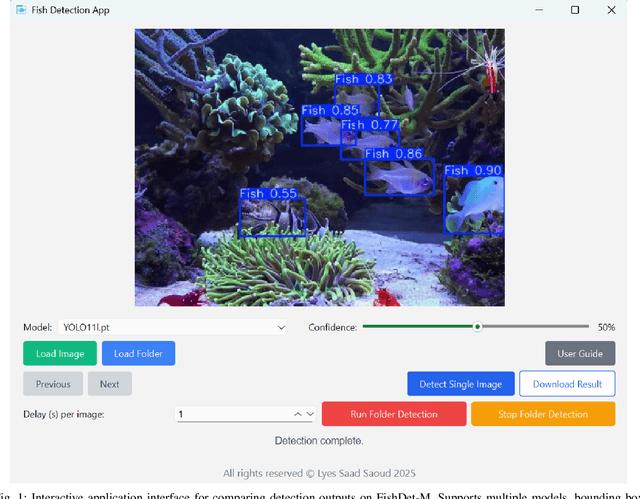
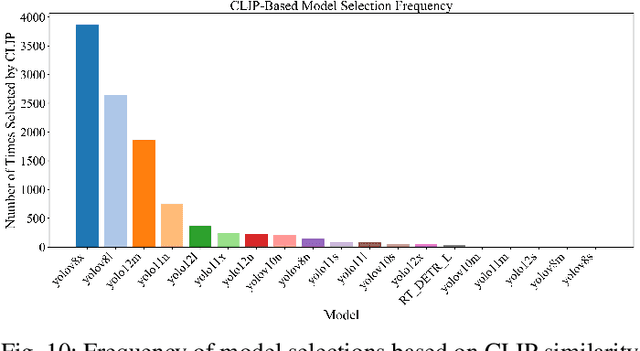

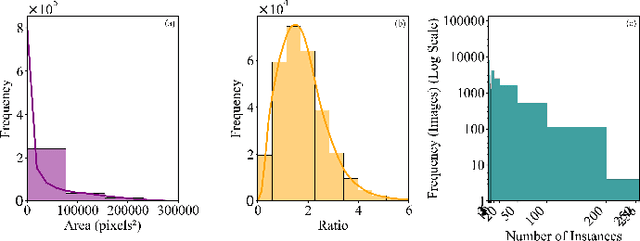
Accurate fish detection in underwater imagery is essential for ecological monitoring, aquaculture automation, and robotic perception. However, practical deployment remains limited by fragmented datasets, heterogeneous imaging conditions, and inconsistent evaluation protocols. To address these gaps, we present \textit{FishDet-M}, the largest unified benchmark for fish detection, comprising 13 publicly available datasets spanning diverse aquatic environments including marine, brackish, occluded, and aquarium scenes. All data are harmonized using COCO-style annotations with both bounding boxes and segmentation masks, enabling consistent and scalable cross-domain evaluation. We systematically benchmark 28 contemporary object detection models, covering the YOLOv8 to YOLOv12 series, R-CNN based detectors, and DETR based models. Evaluations are conducted using standard metrics including mAP, mAP@50, and mAP@75, along with scale-specific analyses (AP$_S$, AP$_M$, AP$_L$) and inference profiling in terms of latency and parameter count. The results highlight the varying detection performance across models trained on FishDet-M, as well as the trade-off between accuracy and efficiency across models of different architectures. To support adaptive deployment, we introduce a CLIP-based model selection framework that leverages vision-language alignment to dynamically identify the most semantically appropriate detector for each input image. This zero-shot selection strategy achieves high performance without requiring ensemble computation, offering a scalable solution for real-time applications. FishDet-M establishes a standardized and reproducible platform for evaluating object detection in complex aquatic scenes. All datasets, pretrained models, and evaluation tools are publicly available to facilitate future research in underwater computer vision and intelligent marine systems.
A Framework for Multi-View Multiple Object Tracking using Single-View Multi-Object Trackers on Fish Data
May 22, 2025Multi-object tracking (MOT) in computer vision has made significant advancements, yet tracking small fish in underwater environments presents unique challenges due to complex 3D motions and data noise. Traditional single-view MOT models often fall short in these settings. This thesis addresses these challenges by adapting state-of-the-art single-view MOT models, FairMOT and YOLOv8, for underwater fish detecting and tracking in ecological studies. The core contribution of this research is the development of a multi-view framework that utilizes stereo video inputs to enhance tracking accuracy and fish behavior pattern recognition. By integrating and evaluating these models on underwater fish video datasets, the study aims to demonstrate significant improvements in precision and reliability compared to single-view approaches. The proposed framework detects fish entities with a relative accuracy of 47% and employs stereo-matching techniques to produce a novel 3D output, providing a more comprehensive understanding of fish movements and interactions
Fishing for Phishers: Learning-Based Phishing Detection in Ethereum Transactions
Apr 24, 2025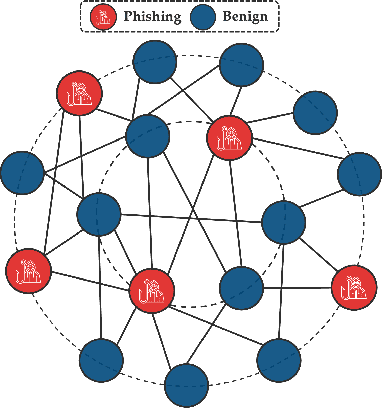
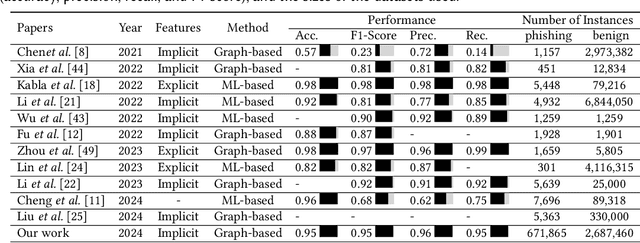
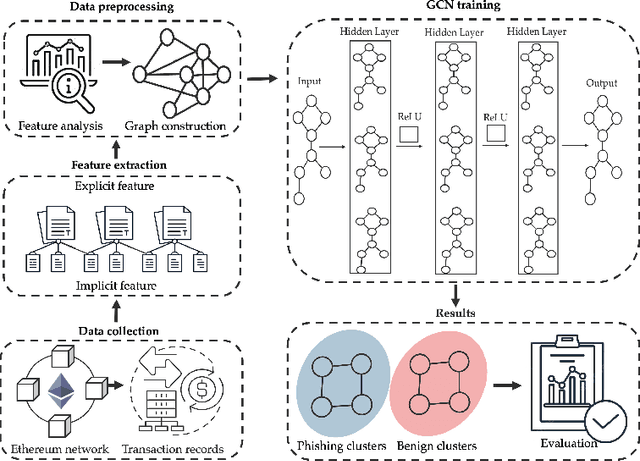
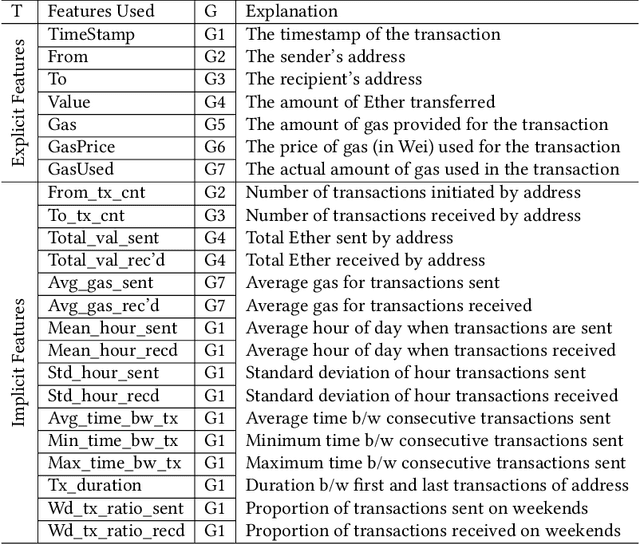
Phishing detection on Ethereum has increasingly leveraged advanced machine learning techniques to identify fraudulent transactions. However, limited attention has been given to understanding the effectiveness of feature selection strategies and the role of graph-based models in enhancing detection accuracy. In this paper, we systematically examine these issues by analyzing and contrasting explicit transactional features and implicit graph-based features, both experimentally and analytically. We explore how different feature sets impact the performance of phishing detection models, particularly in the context of Ethereum's transactional network. Additionally, we address key challenges such as class imbalance and dataset composition and their influence on the robustness and precision of detection methods. Our findings demonstrate the advantages and limitations of each feature type, while also providing a clearer understanding of how feature affect model resilience and generalization in adversarial environments.
A computer vision method to estimate ventilation rate of Atlantic salmon in sea fish farms
Apr 28, 2025The increasing demand for aquaculture production necessitates the development of innovative, intelligent tools to effectively monitor and manage fish health and welfare. While non-invasive video monitoring has become a common practice in finfish aquaculture, existing intelligent monitoring methods predominantly focus on assessing body condition or fish swimming patterns and are often developed and evaluated in controlled tank environments, without demonstrating their applicability to real-world aquaculture settings in open sea farms. This underscores the necessity for methods that can monitor physiological traits directly within the production environment of sea fish farms. To this end, we have developed a computer vision method for monitoring ventilation rates of Atlantic salmon (Salmo salar), which was specifically designed for videos recorded in the production environment of commercial sea fish farms using the existing infrastructure. Our approach uses a fish head detection model, which classifies the mouth state as either open or closed using a convolutional neural network. This is followed with multiple object tracking to create temporal sequences of fish swimming across the field of view of the underwater video camera to estimate ventilation rates. The method demonstrated high efficiency, achieving a Pearson correlation coefficient of 0.82 between ground truth and predicted ventilation rates in a test set of 100 fish collected independently of the training data. By accurately identifying pens where fish exhibit signs of respiratory distress, our method offers broad applicability and the potential to transform fish health and welfare monitoring in finfish aquaculture.
Towards Physics-informed Diffusion for Anomaly Detection in Trajectories
Jun 08, 2025Given trajectory data, a domain-specific study area, and a user-defined threshold, we aim to find anomalous trajectories indicative of possible GPS spoofing (e.g., fake trajectory). The problem is societally important to curb illegal activities in international waters, such as unauthorized fishing and illicit oil transfers. The problem is challenging due to advances in AI generated in deep fakes generation (e.g., additive noise, fake trajectories) and lack of adequate amount of labeled samples for ground-truth verification. Recent literature shows promising results for anomalous trajectory detection using generative models despite data sparsity. However, they do not consider fine-scale spatiotemporal dependencies and prior physical knowledge, resulting in higher false-positive rates. To address these limitations, we propose a physics-informed diffusion model that integrates kinematic constraints to identify trajectories that do not adhere to physical laws. Experimental results on real-world datasets in the maritime and urban domains show that the proposed framework results in higher prediction accuracy and lower estimation error rate for anomaly detection and trajectory generation methods, respectively. Our implementation is available at https://github.com/arunshar/Physics-Informed-Diffusion-Probabilistic-Model.
CBIL: Collective Behavior Imitation Learning for Fish from Real Videos
Mar 31, 2025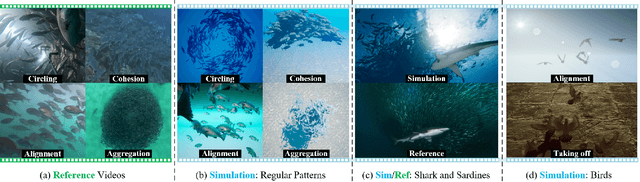
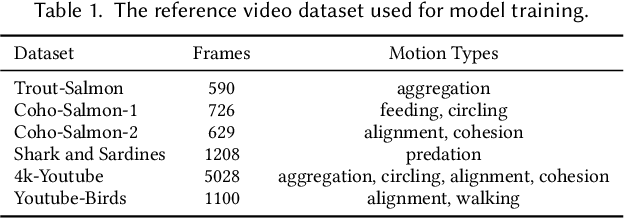
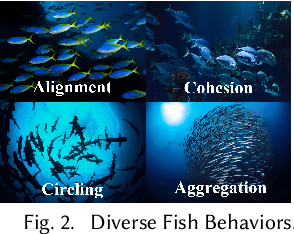
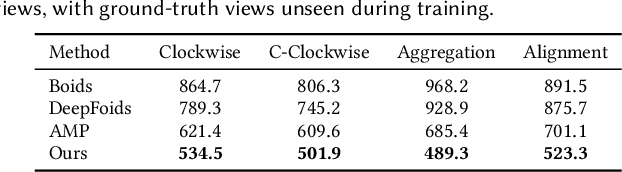
Reproducing realistic collective behaviors presents a captivating yet formidable challenge. Traditional rule-based methods rely on hand-crafted principles, limiting motion diversity and realism in generated collective behaviors. Recent imitation learning methods learn from data but often require ground truth motion trajectories and struggle with authenticity, especially in high-density groups with erratic movements. In this paper, we present a scalable approach, Collective Behavior Imitation Learning (CBIL), for learning fish schooling behavior directly from videos, without relying on captured motion trajectories. Our method first leverages Video Representation Learning, where a Masked Video AutoEncoder (MVAE) extracts implicit states from video inputs in a self-supervised manner. The MVAE effectively maps 2D observations to implicit states that are compact and expressive for following the imitation learning stage. Then, we propose a novel adversarial imitation learning method to effectively capture complex movements of the schools of fish, allowing for efficient imitation of the distribution for motion patterns measured in the latent space. It also incorporates bio-inspired rewards alongside priors to regularize and stabilize training. Once trained, CBIL can be used for various animation tasks with the learned collective motion priors. We further show its effectiveness across different species. Finally, we demonstrate the application of our system in detecting abnormal fish behavior from in-the-wild videos.