 Add to Chrome
 Add to Firefox
 Add to Edge
DarkVesselNet: Multi-Modal Remote Sensing and Trajectory Reasoning for Dark Vessel Detection
May 30, 2026
Dark vessel detection requires fusing what vessels report through AIS with what satellites observe through radar and optical sensors. DarkVesselNet is a multi-modal remote sensing stack that combines Sentinel-1 SAR, Sentinel-2 optical imagery, geospatial foundation model backbones, AIS trajectory reasoning, TGARD-style gap detection, and a Pi-DPM-inspired anomaly head. The repository exposes the system as a tested Python package and a public Hugging Face Space. The paper presents the sensor stack, backbone abstraction, fusion path, anomaly head, and current validation. The evidence currently available is software-grounded: tests for SAR speckle filtering, optical band ratios, Haversine distance, TGARD gap emission, sensor coregistration, backbone token shapes, and differentiable anomaly scoring.

GeoSAM-3D: Geodesic Prompt Propagation for Open-Vocabulary 3D Scene Segmentation from Monocular Video
May 30, 2026Open-vocabulary 3D scene segmentation usually assumes RGB-D video, calibrated multi-view imagery, or a reconstructed mesh. GeoSAM-3D studies a lighter setting: a user uploads a short monocular video, clicks or names an object in one frame, and receives a propagated 3D mask over a Gaussian scene. The implementation combines frozen image and video foundation models with a monocular 3D Gaussian Splatting reconstruction and a differentiable graph-geodesic propagation kernel over Gaussian centroids. The central design choice is to propagate prompts by heat-kernel distance on the reconstructed scene graph, rather than by Euclidean nearest neighbors in 3D. This preserves continuity around curved surfaces and reduces leakage across nearby but disconnected objects. This paper describes the repository state, the mathematical kernel implemented in geosam3d.propagate, the feature head trained from Segment Anything masks, and the validation already present in the codebase. The evaluation protocol separates implementation validation, graph propagation quality, leakage control, and interactive latency.
Spatial Atlas: Compute-Grounded Reasoning for Spatial-Aware Research Agent Benchmarks
Apr 13, 2026We introduce compute-grounded reasoning (CGR), a design paradigm for spatial-aware research agents in which every answerable sub-problem is resolved by deterministic computation before a language model is asked to generate. Spatial Atlas instantiates CGR as a single Agent-to-Agent (A2A) server that handles two challenging benchmarks: FieldWorkArena, a multimodal spatial question-answering benchmark spanning factory, warehouse, and retail environments, and MLE-Bench, a suite of 75 Kaggle machine learning competitions requiring end-to-end ML engineering. A structured spatial scene graph engine extracts entities and relations from vision descriptions, computes distances and safety violations deterministically, then feeds computed facts to large language models, thereby avoiding hallucinated spatial reasoning. Entropy-guided action selection maximizes information gain per step and routes queries across a three-tier frontier model stack (OpenAI + Anthropic). A self-healing ML pipeline with strategy-aware code generation, a score-driven iterative refinement loop, and a prompt-based leak audit registry round out the system. We evaluate across both benchmarks and show that CGR yields competitive accuracy while maintaining interpretability through structured intermediate representations and deterministic spatial computations.
Towards Fine-Tuning-Based Site Calibration for Knowledge-Guided Machine Learning: A Summary of Results
Dec 17, 2025Accurate and cost-effective quantification of the agroecosystem carbon cycle at decision-relevant scales is essential for climate mitigation and sustainable agriculture. However, both transfer learning and the exploitation of spatial variability in this field are challenging, as they involve heterogeneous data and complex cross-scale dependencies. Conventional approaches often rely on location-independent parameterizations and independent training, underutilizing transfer learning and spatial heterogeneity in the inputs, and limiting their applicability in regions with substantial variability. We propose FTBSC-KGML (Fine-Tuning-Based Site Calibration-Knowledge-Guided Machine Learning), a pretraining- and fine-tuning-based, spatial-variability-aware, and knowledge-guided machine learning framework that augments KGML-ag with a pretraining-fine-tuning process and site-specific parameters. Using a pretraining-fine-tuning process with remote-sensing GPP, climate, and soil covariates collected across multiple midwestern sites, FTBSC-KGML estimates land emissions while leveraging transfer learning and spatial heterogeneity. A key component is a spatial-heterogeneity-aware transfer-learning scheme, which is a globally pretrained model that is fine-tuned at each state or site to learn place-aware representations, thereby improving local accuracy under limited data without sacrificing interpretability. Empirically, FTBSC-KGML achieves lower validation error and greater consistency in explanatory power than a purely global model, thereby better capturing spatial variability across states. This work extends the prior SDSA-KGML framework.
Critical Insights into Leading Conversational AI Models
Oct 26, 2025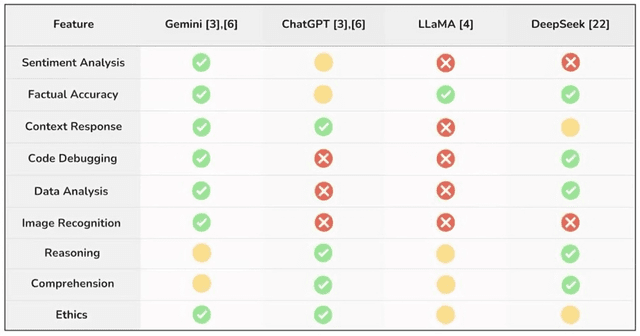
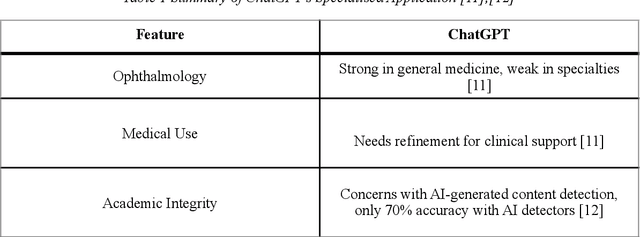
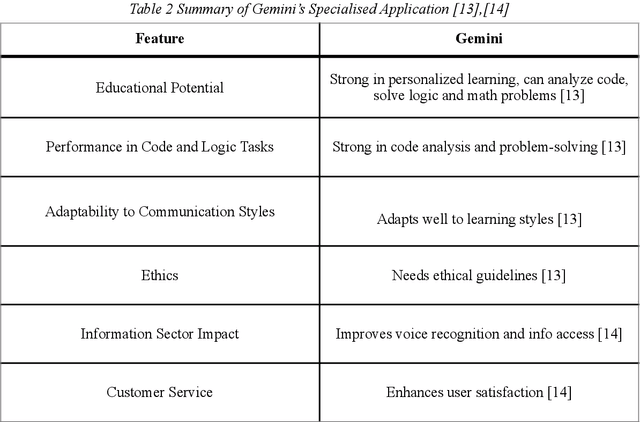
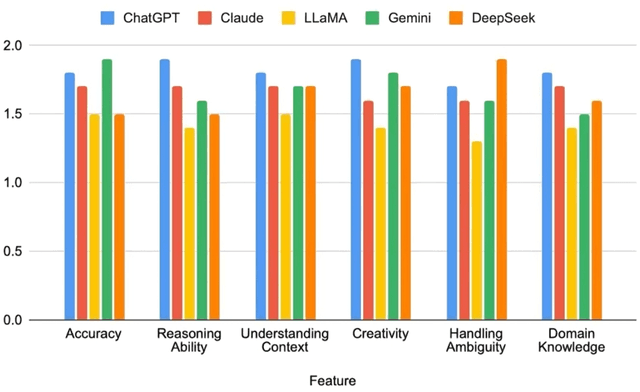
Big Language Models (LLMs) are changing the way businesses use software, the way people live their lives and the way industries work. Companies like Google, High-Flyer, Anthropic, OpenAI and Meta are making better LLMs. So, it's crucial to look at how each model is different in terms of performance, moral behaviour and usability, as these differences are based on the different ideas that built them. This study compares five top LLMs: Google's Gemini, High-Flyer's DeepSeek, Anthropic's Claude, OpenAI's GPT models and Meta's LLaMA. It performs this by analysing three important factors: Performance and Accuracy, Ethics and Bias Mitigation and Usability and Integration. It was found that Claude has good moral reasoning, Gemini is better at multimodal capabilities and has strong ethical frameworks. DeepSeek is great at reasoning based on facts, LLaMA is good for open applications and ChatGPT delivers balanced performance with a focus on usage. It was concluded that these models are different in terms of how well they work, how easy they are to use and how they treat people ethically, making it a point that each model should be utilised by the user in a way that makes the most of its strengths.
Towards Physics-informed Diffusion for Anomaly Detection in Trajectories
Jun 08, 2025Given trajectory data, a domain-specific study area, and a user-defined threshold, we aim to find anomalous trajectories indicative of possible GPS spoofing (e.g., fake trajectory). The problem is societally important to curb illegal activities in international waters, such as unauthorized fishing and illicit oil transfers. The problem is challenging due to advances in AI generated in deep fakes generation (e.g., additive noise, fake trajectories) and lack of adequate amount of labeled samples for ground-truth verification. Recent literature shows promising results for anomalous trajectory detection using generative models despite data sparsity. However, they do not consider fine-scale spatiotemporal dependencies and prior physical knowledge, resulting in higher false-positive rates. To address these limitations, we propose a physics-informed diffusion model that integrates kinematic constraints to identify trajectories that do not adhere to physical laws. Experimental results on real-world datasets in the maritime and urban domains show that the proposed framework results in higher prediction accuracy and lower estimation error rate for anomaly detection and trajectory generation methods, respectively. Our implementation is available at https://github.com/arunshar/Physics-Informed-Diffusion-Probabilistic-Model.
Towards Physics-Guided Foundation Models
Feb 20, 2025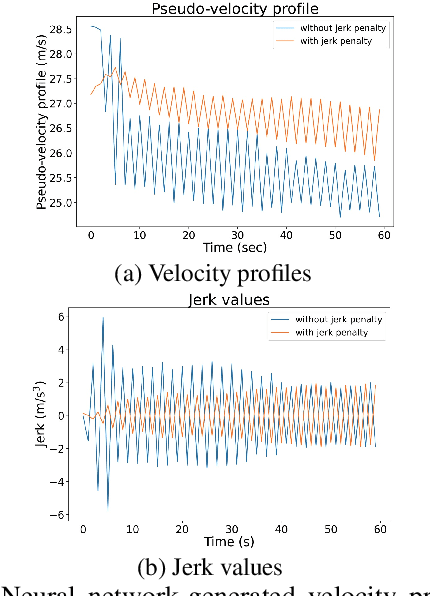
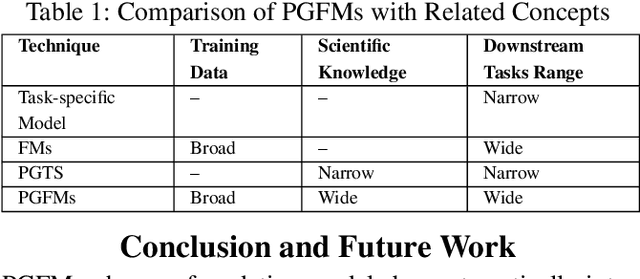
Traditional foundation models are pre-trained on broad datasets to reduce the training resources (e.g., time, energy, labeled samples) needed for fine-tuning a wide range of downstream tasks. However, traditional foundation models struggle with out-of-distribution prediction and can produce outputs that are unrealistic and physically infeasible. We propose the notation of physics-guided foundation models (PGFM), that is, foundation models integrated with broad or general domain (e.g., scientific) physical knowledge applicable to a wide range of downstream tasks.
Spatial Distribution-Shift Aware Knowledge-Guided Machine Learning
Feb 20, 2025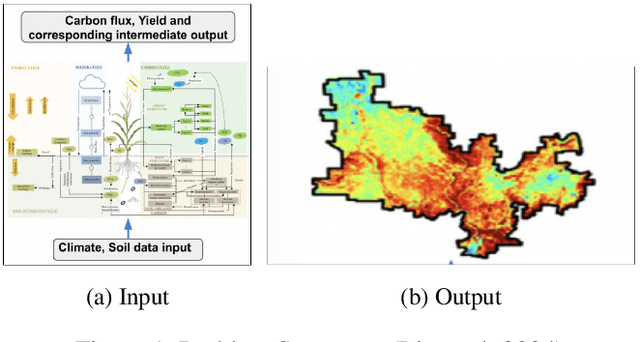

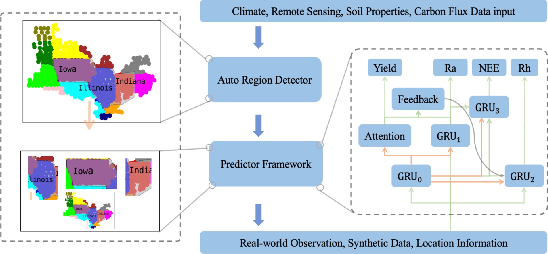
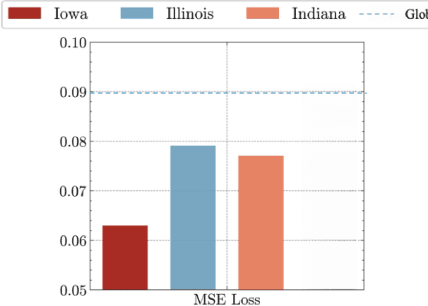
Given inputs of diverse soil characteristics and climate data gathered from various regions, we aimed to build a model to predict accurate land emissions. The problem is important since accurate quantification of the carbon cycle in agroecosystems is crucial for mitigating climate change and ensuring sustainable food production. Predicting accurate land emissions is challenging since calibrating the heterogeneous nature of soil properties, moisture, and environmental conditions is hard at decision-relevant scales. Traditional approaches do not adequately estimate land emissions due to location-independent parameters failing to leverage the spatial heterogeneity and also require large datasets. To overcome these limitations, we proposed Spatial Distribution-Shift Aware Knowledge-Guided Machine Learning (SDSA-KGML), which leverages location-dependent parameters that account for significant spatial heterogeneity in soil moisture from multiple sites within the same region. Experimental results demonstrate that SDSA-KGML models achieve higher local accuracy for the specified states in the Midwest Region.
Spatially-Delineated Domain-Adapted AI Classification: An Application for Oncology Data
Jan 20, 2025
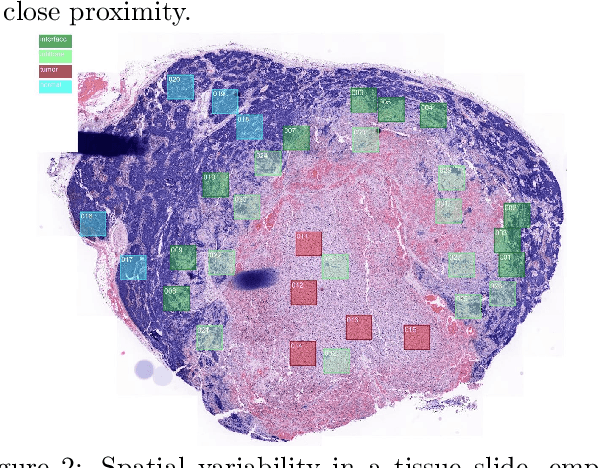

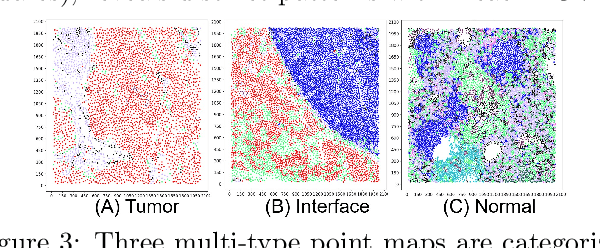
Given multi-type point maps from different place-types (e.g., tumor regions), our objective is to develop a classifier trained on the source place-type to accurately distinguish between two classes of the target place-type based on their point arrangements. This problem is societally important for many applications, such as generating clinical hypotheses for designing new immunotherapies for cancer treatment. The challenge lies in the spatial variability, the inherent heterogeneity and variation observed in spatial properties or arrangements across different locations (i.e., place-types). Previous techniques focus on self-supervised tasks to learn domain-invariant features and mitigate domain differences; however, they often neglect the underlying spatial arrangements among data points, leading to significant discrepancies across different place-types. We explore a novel multi-task self-learning framework that targets spatial arrangements, such as spatial mix-up masking and spatial contrastive predictive coding, for spatially-delineated domain-adapted AI classification. Experimental results on real-world datasets (e.g., oncology data) show that the proposed framework provides higher prediction accuracy than baseline methods.
Towards Kriging-informed Conditional Diffusion for Regional Sea-Level Data Downscaling
Oct 21, 2024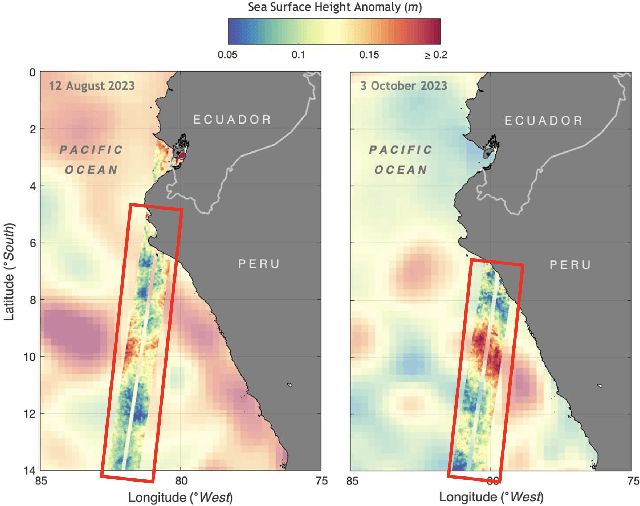
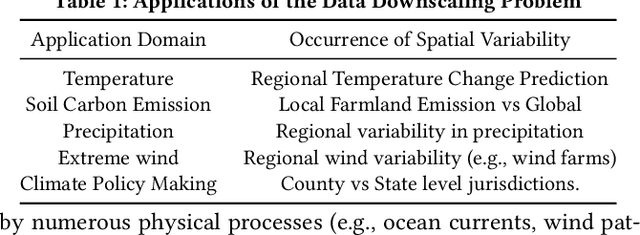
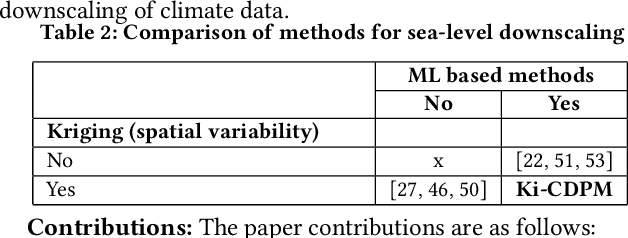
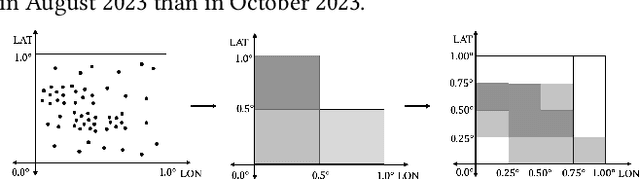
Given coarser-resolution projections from global climate models or satellite data, the downscaling problem aims to estimate finer-resolution regional climate data, capturing fine-scale spatial patterns and variability. Downscaling is any method to derive high-resolution data from low-resolution variables, often to provide more detailed and local predictions and analyses. This problem is societally crucial for effective adaptation, mitigation, and resilience against significant risks from climate change. The challenge arises from spatial heterogeneity and the need to recover finer-scale features while ensuring model generalization. Most downscaling methods \cite{Li2020} fail to capture the spatial dependencies at finer scales and underperform on real-world climate datasets, such as sea-level rise. We propose a novel Kriging-informed Conditional Diffusion Probabilistic Model (Ki-CDPM) to capture spatial variability while preserving fine-scale features. Experimental results on climate data show that our proposed method is more accurate than state-of-the-art downscaling techniques.