 Add to Chrome
 Add to Firefox
 Add to Edge
Dialog Learning
Papers and Code
Advancing Improvisation in Human-Robot Construction Collaboration: Taxonomy and Research Roadmap
Jan 23, 2026
The construction industry faces productivity stagnation, skilled labor shortages, and safety concerns. While robotic automation offers solutions, construction robots struggle to adapt to unstructured, dynamic sites. Central to this is improvisation, adapting to unexpected situations through creative problem-solving, which remains predominantly human. In construction's unpredictable environments, collaborative human-robot improvisation is essential for workflow continuity. This research develops a six-level taxonomy classifying human-robot collaboration (HRC) based on improvisation capabilities. Through systematic review of 214 articles (2010-2025), we categorize construction robotics across: Manual Work (Level 0), Human-Controlled Execution (Level 1), Adaptive Manipulation (Level 2), Imitation Learning (Level 3), Human-in-Loop BIM Workflow (Level 4), Cloud-Based Knowledge Integration (Level 5), and True Collaborative Improvisation (Level 6). Analysis reveals current research concentrates at lower levels, with critical gaps in experiential learning and limited progression toward collaborative improvisation. A five-dimensional radar framework illustrates progressive evolution of Planning, Cognitive Role, Physical Execution, Learning Capability, and Improvisation, demonstrating how complementary human-robot capabilities create team performance exceeding individual contributions. The research identifies three fundamental barriers: technical limitations in grounding and dialogic reasoning, conceptual gaps between human improvisation and robotics research, and methodological challenges. We recommend future research emphasizing improved human-robot communication via Augmented/Virtual Reality interfaces, large language model integration, and cloud-based knowledge systems to advance toward true collaborative improvisation.

ConvoLearn: A Dataset of Constructivist Tutor-Student Dialogue
Jan 13, 2026In educational applications, LLMs exhibit several fundamental pedagogical limitations, such as their tendency to reveal solutions rather than support dialogic learning. We introduce ConvoLearn (https://huggingface.co/datasets/masharma/convolearn ), a dataset grounded in knowledge building theory that operationalizes six core pedagogical dimensions: cognitive engagement, formative assessment, accountability, cultural responsiveness, metacognition, and power dynamics. We construct a semi-synthetic dataset of 1250 tutor-student dialogues (20 turns each) in middle school Earth Science through controlled interactions between human teachers and a simulated student. Using QLoRA, we demonstrate that training on this dataset meaningfully shifts LLM behavior toward knowledge-building strategies. Human evaluation by 31 teachers shows our fine-tuned Mistral 7B (M = 4.10, SD = 1.03) significantly outperforms both its base version (M = 2.59, SD = 1.11) and Claude Sonnet 4.5 (M = 2.87, SD = 1.29) overall. This work establishes a potential framework to guide future development and evaluation of constructivist AI tutors.
Disagreement as Data: Reasoning Trace Analytics in Multi-Agent Systems
Jan 18, 2026Learning analytics researchers often analyze qualitative student data such as coded annotations or interview transcripts to understand learning processes. With the rise of generative AI, fully automated and human-AI workflows have emerged as promising methods for analysis. However, methodological standards to guide such workflows remain limited. In this study, we propose that reasoning traces generated by large language model (LLM) agents, especially within multi-agent systems, constitute a novel and rich form of process data to enhance interpretive practices in qualitative coding. We apply cosine similarity to LLM reasoning traces to systematically detect, quantify, and interpret disagreements among agents, reframing disagreement as a meaningful analytic signal. Analyzing nearly 10,000 instances of agent pairs coding human tutoring dialog segments, we show that LLM agents' semantic reasoning similarity robustly differentiates consensus from disagreement and correlates with human coding reliability. Qualitative analysis guided by this metric reveals nuanced instructional sub-functions within codes and opportunities for conceptual codebook refinement. By integrating quantitative similarity metrics with qualitative review, our method has the potential to improve and accelerate establishing inter-rater reliability during coding by surfacing interpretive ambiguity, especially when LLMs collaborate with humans. We discuss how reasoning-trace disagreements represent a valuable new class of analytic signals advancing methodological rigor and interpretive depth in educational research.
Long-term Task-oriented Agent: Proactive Long-term Intent Maintenance in Dynamic Environments
Jan 14, 2026Current large language model agents predominantly operate under a reactive paradigm, responding only to immediate user queries within short-term sessions. This limitation hinders their ability to maintain long-term user's intents and dynamically adapt to evolving external environments. In this paper, we propose a novel interaction paradigm for proactive Task-oriented Agents capable of bridging the gap between relatively static user's needs and a dynamic environment. We formalize proactivity through two key capabilities, (i) Intent-Conditioned Monitoring: The agent autonomously formulates trigger conditions based on dialog history; (ii) Event-Triggered Follow-up: The agent actively engages the user upon detecting useful environmental updates. We introduce a high-quality data synthesis pipeline to construct complex, multi-turn dialog data in a dynamic environment. Furthermore, we attempt to address the lack of evaluation criteria of task-oriented interaction in a dynamic environment by proposing a new benchmark, namely ChronosBench. We evaluated some leading close-source and open-source models at present and revealed their flaws in long-term task-oriented interaction. Furthermore, our fine-tuned model trained using synthetic data for supervised learning achieves a task completion rate of 85.19% for complex tasks including shifts in user intent, outperforming other models under test. And the result validated the effectiveness of our data-driven strategy.
Cyber Humanism in Education: Reclaiming Agency through AI and Learning Sciences
Dec 18, 2025Generative Artificial Intelligence (GenAI) is rapidly reshaping how knowledge is produced and validated in education. Rather than adding another digital tool, large language models reconfigure reading, writing, and coding into hybrid human-AI workflows, raising concerns about epistemic automation, cognitive offloading, and the de-professiona\-lisation of teachers. This paper proposes \emph{Cyber Humanism in Education} as a framework for reclaiming human agency in this landscape. We conceptualise AI-enabled learning environments as socio-technical infrastructures co-authored by humans and machines, and position educators and learners as epistemic agents and \emph{algorithmic citizens} who have both the right and the responsibility to shape these infrastructures. We articulate three pillars for cyber-humanist design, \emph{reflexive competence}, \emph{algorithmic citizenship}, and \emph{dialogic design}, and relate them to major international digital and AI competence frameworks. We then present higher-education case studies that operationalise these ideas through \emph{prompt-based learning} and a new \emph{Conversational AI Educator} certification within the EPICT ecosystem. The findings show how such practices can strengthen epistemic agency while surfacing tensions around workload, equity, and governance, and outline implications for the future of AI-rich, human-centred education.
Memory-T1: Reinforcement Learning for Temporal Reasoning in Multi-session Agents
Dec 23, 2025Temporal reasoning over long, multi-session dialogues is a critical capability for conversational agents. However, existing works and our pilot study have shown that as dialogue histories grow in length and accumulate noise, current long-context models struggle to accurately identify temporally pertinent information, significantly impairing reasoning performance. To address this, we introduce Memory-T1, a framework that learns a time-aware memory selection policy using reinforcement learning (RL). It employs a coarse-to-fine strategy, first pruning the dialogue history into a candidate set using temporal and relevance filters, followed by an RL agent that selects the precise evidence sessions. The RL training is guided by a multi-level reward function optimizing (i) answer accuracy, (ii) evidence grounding, and (iii) temporal consistency. In particular, the temporal consistency reward provides a dense signal by evaluating alignment with the query time scope at both the session-level (chronological proximity) and the utterance-level (chronological fidelity), enabling the agent to resolve subtle chronological ambiguities. On the Time-Dialog benchmark, Memory-T1 boosts a 7B model to an overall score of 67.0\%, establishing a new state-of-the-art performance for open-source models and outperforming a 14B baseline by 10.2\%. Ablation studies show temporal consistency and evidence grounding rewards jointly contribute to a 15.0\% performance gain. Moreover, Memory-T1 maintains robustness up to 128k tokens, where baseline models collapse, proving effectiveness against noise in extensive dialogue histories. The code and datasets are publicly available at https://github.com/Elvin-Yiming-Du/Memory-T1/
Report from Workshop on Dialogue alongside Artificial Intelligence
Nov 11, 2025Educational dialogue -- the collaborative exchange of ideas through talk -- is widely recognized as a catalyst for deeper learning and critical thinking in and across contexts. At the same time, artificial intelligence (AI) has rapidly emerged as a powerful force in education, with the potential to address major challenges, personalize learning, and innovate teaching practices. However, these advances come with significant risks: rapid AI development can undermine human agency, exacerbate inequities, and outpace our capacity to guide its use with sound policy. Human learning presupposes cognitive efforts and social interaction (dialogues). In response to this evolving landscape, an international workshop titled "Educational Dialogue: Moving Thinking Forward" convened 19 leading researchers from 11 countries in Cambridge (September 1-3, 2025) to examine the intersection of AI and educational dialogue. This AI-focused strand of the workshop centered on three critical questions: (1) When is AI truly useful in education, and when might it merely replace human effort at the expense of learning? (2) Under what conditions can AI use lead to better dialogic teaching and learning? (3) Does the AI-human partnership risk outpacing and displacing human educational work, and what are the implications? These questions framed two days of presentations and structured dialogue among participants.
IDALC: A Semi-Supervised Framework for Intent Detection and Active Learning based Correction
Nov 08, 2025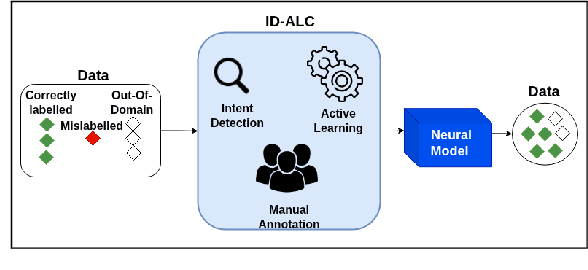
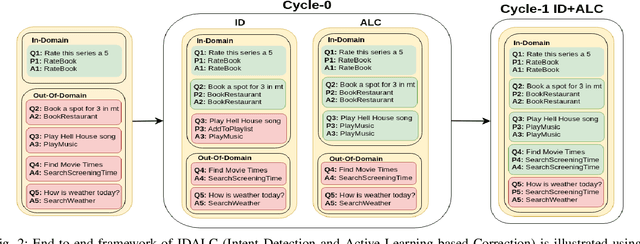
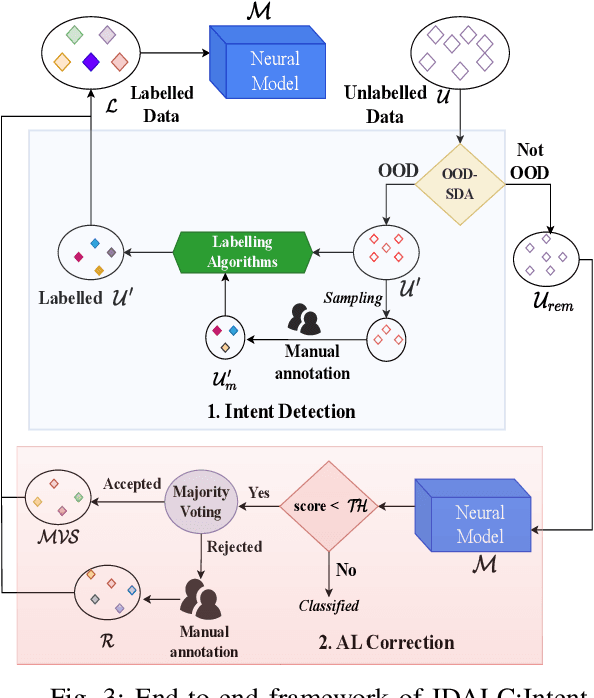
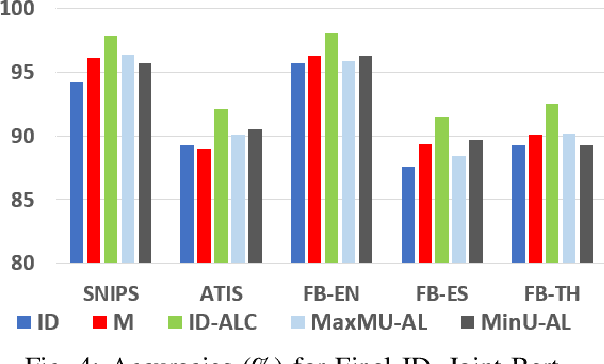
Voice-controlled dialog systems have become immensely popular due to their ability to perform a wide range of actions in response to diverse user queries. These agents possess a predefined set of skills or intents to fulfill specific user tasks. But every system has its own limitations. There are instances where, even for known intents, if any model exhibits low confidence, it results in rejection of utterances that necessitate manual annotation. Additionally, as time progresses, there may be a need to retrain these agents with new intents from the system-rejected queries to carry out additional tasks. Labeling all these emerging intents and rejected utterances over time is impractical, thus calling for an efficient mechanism to reduce annotation costs. In this paper, we introduce IDALC (Intent Detection and Active Learning based Correction), a semi-supervised framework designed to detect user intents and rectify system-rejected utterances while minimizing the need for human annotation. Empirical findings on various benchmark datasets demonstrate that our system surpasses baseline methods, achieving a 5-10% higher accuracy and a 4-8% improvement in macro-F1. Remarkably, we maintain the overall annotation cost at just 6-10% of the unlabelled data available to the system. The overall framework of IDALC is shown in Fig. 1
* Paper accepted in IEEE Transactions on Artificial Intelligence (October 2025)
TeachLM: Post-Training LLMs for Education Using Authentic Learning Data
Oct 06, 2025The promise of generative AI to revolutionize education is constrained by the pedagogical limits of large language models (LLMs). A major issue is the lack of access to high-quality training data that reflect the learning of actual students. Prompt engineering has emerged as a stopgap, but the ability of prompts to encode complex pedagogical strategies in rule-based natural language is inherently limited. To address this gap we introduce TeachLM - an LLM optimized for teaching through parameter-efficient fine-tuning of state-of-the-art models. TeachLM is trained on a dataset comprised of 100,000 hours of one-on-one, longitudinal student-tutor interactions maintained by Polygence, which underwent a rigorous anonymization process to protect privacy. We use parameter-efficient fine-tuning to develop an authentic student model that enables the generation of high-fidelity synthetic student-tutor dialogues. Building on this capability, we propose a novel multi-turn evaluation protocol that leverages synthetic dialogue generation to provide fast, scalable, and reproducible assessments of the dialogical capabilities of LLMs. Our evaluations demonstrate that fine-tuning on authentic learning data significantly improves conversational and pedagogical performance - doubling student talk time, improving questioning style, increasing dialogue turns by 50%, and greater personalization of instruction.
Building Task Bots with Self-learning for Enhanced Adaptability, Extensibility, and Factuality
Aug 27, 2025Developing adaptable, extensible, and accurate task bots with minimal or zero human intervention is a significant challenge in dialog research. This thesis examines the obstacles and potential solutions for creating such bots, focusing on innovative techniques that enable bots to learn and adapt autonomously in constantly changing environments.