 Add to Chrome
 Add to Firefox
 Add to Edge
Logit-Origin Centering for Singleton Test-Time Adaptation
Aug 02, 2026
Tabular data is used extensively in many real-world use cases. Deep learning models have been developed to deal with tabular data, but generally perform poorly when the test data distribution differs from that of the training data. Researchers have proposed test-time adaptation approaches to deal with this problem. The fully test-time adaptation (FTTA) setting involves adapting deployed classifiers to shifted target distributions using only unlabeled test data. Leading FTTA methods inherit a batch-dependent approach from computer vision literature. This paper demonstrates for the first time that such approaches degrade sharply in strict streaming regimes where examples arrive and must be classified one at a time. This occurs because at a batch size of one, batch-level statistics become unavailable or poorly estimated. We argue that singleton tabular FTTA is not merely a small-batch variant of ordinary FTTA, but a distinct identifiability problem where only the location of the model's score stream remains directly observable. To address this, we propose Prequential Logit-Origin Centering (PLOC), a lightweight approach that keeps the source model frozen and shifts the logit space at each step. PLOC stores only a single running number (the mean of past logits), requires no labels, estimates no priors, and bypasses weight updates entirely. A deferred variant applies a static shift that preserves the source ranking, and thus the AUROC, exactly. Evaluated across five tabular benchmarks, three architectures (MLP, FT-Transformer, and TabTransformer), and five independent source checkpoints, PLOC significantly outperforms strong tabular and entropy-based baselines.

Dimensionality and Measurement Precision in HLE's Multiple-Choice Subset
Jul 29, 2026Humanity's Last Exam (HLE) is widely used to evaluate frontier language models. HLE organizes its questions into eight subject-domain categories, whose subscores are often interpreted as evidence of distinct capabilities. However, no study has assessed whether these labels correspond to empirically separable latent constructs, nor whether the benchmark effectively differentiates between models of similar ability. We evaluate 29 LLMs on the text-only multiple-choice subset of HLE ($J = 428$ items) and apply psychometric methods to assess both the dimensionality of the benchmark and the distribution of its measurement precision. Fitting a two-parameter logistic IRT model, we find convergent evidence that HLE measures a single general reasoning factor: McDonald's $ω_h = 0.998$, domain labels explain only 3.5\% of item response variance, within- and between-domain residual correlations are nearly identical (Cohen's $d = 0.016$), and domain-specific ability estimates are near-redundant with the total score ($r \geq 0.81$). A separate analysis of the test information function reveals that measurement precision concentrates at moderate ability levels and drops sharply above $θ= 0$, where frontier models sit. These findings suggest that HLE's domain subscores do not warrant distinct capability interpretations and that the benchmark's ability to discriminate among the strongest models is limited.
Beyond the Simplex: Balanced Prototype Geometry for Scorer-Agnostic Open-Set Recognition
Jun 01, 2026Open-set recognition (OSR) requires a classifier to reject inputs from unseen classes which is essential in safety-critical settings such as medical imaging. Simplex based methods, which fix class prototypes at the vertices of a regular simplex and then reject via a distance-ratio score, perform well empirically but lack theoretical justification, and existing analysis applies only when the embedding dimension d is at least C-1, which is the regime in which a regular simplex exists. We give a theoretical account of simplex-ratio OSR that holds in every embedding dimension, including d < C-1. Our analysis centers on balanced equal-norm codes: prototype configurations with equal lengths and zero sum, which exist for all d >= 2 and include the regular simplex as a special case. For these codes we show that an auxiliary squared ratio score has sublevel sets that are exact unions of Euclidean balls, which in turn bracket the acceptance region of the operational score; and we prove a sharp dichotomy: the prototypes attain one-distance symmetry, behaving like a regular simplex, if and only if d >= C-1, with controlled degradation governed by an explicit defect parameter below that threshold. We further show the false-acceptance rate decays exponentially in d under natural isotropy assumptions, and that the operational score is globally Lipschitz with compact acceptance regions. Empirically, we study balanced prototype geometry as both an analytic tool and a representation-learning prior, rather than as a stand-alone state-of-the-art detector. Across CIFAR and MedMNIST open-set splits, the geometry provides useful structure, but OSR performance remains strongly dependent on the scoring rule: raw ratio scores typically underperform nearest-neighbor and logit-based alternatives.
ConvoLearn: A Dataset of Constructivist Tutor-Student Dialogue
Jan 13, 2026In educational applications, LLMs exhibit several fundamental pedagogical limitations, such as their tendency to reveal solutions rather than support dialogic learning. We introduce ConvoLearn (https://huggingface.co/datasets/masharma/convolearn ), a dataset grounded in knowledge building theory that operationalizes six core pedagogical dimensions: cognitive engagement, formative assessment, accountability, cultural responsiveness, metacognition, and power dynamics. We construct a semi-synthetic dataset of 1250 tutor-student dialogues (20 turns each) in middle school Earth Science through controlled interactions between human teachers and a simulated student. Using QLoRA, we demonstrate that training on this dataset meaningfully shifts LLM behavior toward knowledge-building strategies. Human evaluation by 31 teachers shows our fine-tuned Mistral 7B (M = 4.10, SD = 1.03) significantly outperforms both its base version (M = 2.59, SD = 1.11) and Claude Sonnet 4.5 (M = 2.87, SD = 1.29) overall. This work establishes a potential framework to guide future development and evaluation of constructivist AI tutors.
OpenMedLM: Prompt engineering can out-perform fine-tuning in medical question-answering with open-source large language models
Feb 29, 2024LLMs have become increasingly capable at accomplishing a range of specialized-tasks and can be utilized to expand equitable access to medical knowledge. Most medical LLMs have involved extensive fine-tuning, leveraging specialized medical data and significant, thus costly, amounts of computational power. Many of the top performing LLMs are proprietary and their access is limited to very few research groups. However, open-source (OS) models represent a key area of growth for medical LLMs due to significant improvements in performance and an inherent ability to provide the transparency and compliance required in healthcare. We present OpenMedLM, a prompting platform which delivers state-of-the-art (SOTA) performance for OS LLMs on medical benchmarks. We evaluated a range of OS foundation LLMs (7B-70B) on four medical benchmarks (MedQA, MedMCQA, PubMedQA, MMLU medical-subset). We employed a series of prompting strategies, including zero-shot, few-shot, chain-of-thought (random selection and kNN selection), and ensemble/self-consistency voting. We found that OpenMedLM delivers OS SOTA results on three common medical LLM benchmarks, surpassing the previous best performing OS models that leveraged computationally costly extensive fine-tuning. The model delivers a 72.6% accuracy on the MedQA benchmark, outperforming the previous SOTA by 2.4%, and achieves 81.7% accuracy on the MMLU medical-subset, establishing itself as the first OS LLM to surpass 80% accuracy on this benchmark. Our results highlight medical-specific emergent properties in OS LLMs which have not yet been documented to date elsewhere, and showcase the benefits of further leveraging prompt engineering to improve the performance of accessible LLMs for medical applications.
Problems with automating translation of movie/TV show subtitles
Sep 04, 2019
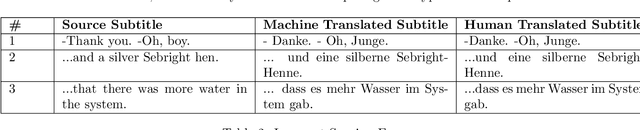
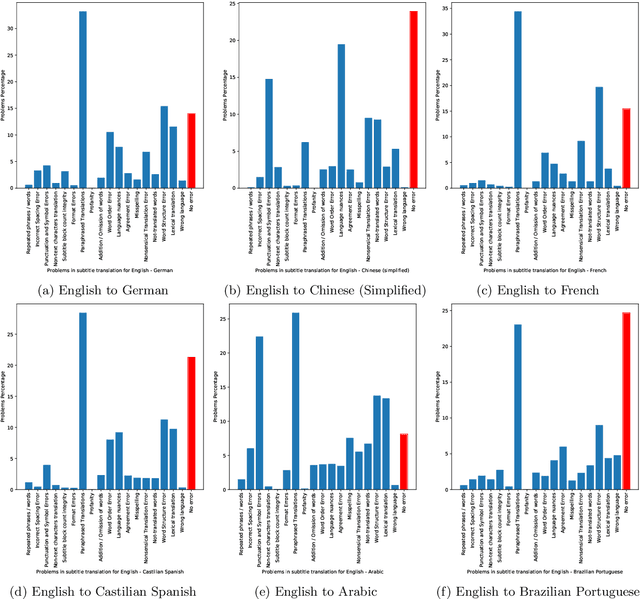

We present 27 problems encountered in automating the translation of movie/TV show subtitles. We categorize each problem in one of the three categories viz. problems directly related to textual translation, problems related to subtitle creation guidelines, and problems due to adaptability of machine translation (MT) engines. We also present the findings of a translation quality evaluation experiment where we share the frequency of 16 key problems. We show that the systems working at the frontiers of Natural Language Processing do not perform well for subtitles and require some post-processing solutions for redressal of these problems
Smaller Models, Better Generalization
Aug 29, 2019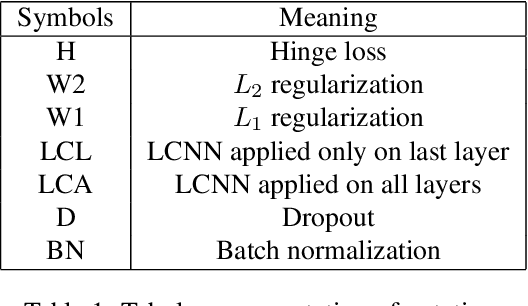
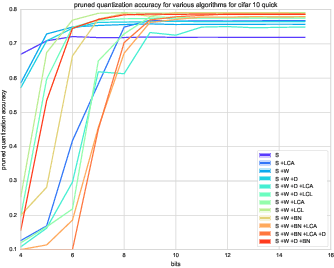

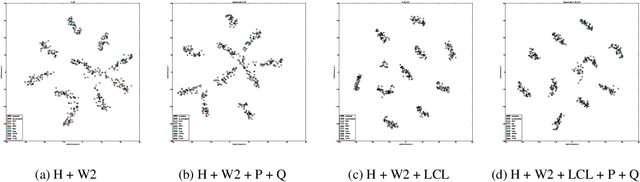
Reducing network complexity has been a major research focus in recent years with the advent of mobile technology. Convolutional Neural Networks that perform various vision tasks without memory overhaul is the need of the hour. This paper focuses on qualitative and quantitative analysis of reducing the network complexity using an upper bound on the Vapnik-Chervonenkis dimension, pruning, and quantization. We observe a general trend in improvement of accuracies as we quantize the models. We propose a novel loss function that helps in achieving considerable sparsity at comparable accuracies to that of dense models. We compare various regularizations prevalent in the literature and show the superiority of our method in achieving sparser models that generalize well.
Effect of Various Regularizers on Model Complexities of Neural Networks in Presence of Input Noise
Jan 31, 2019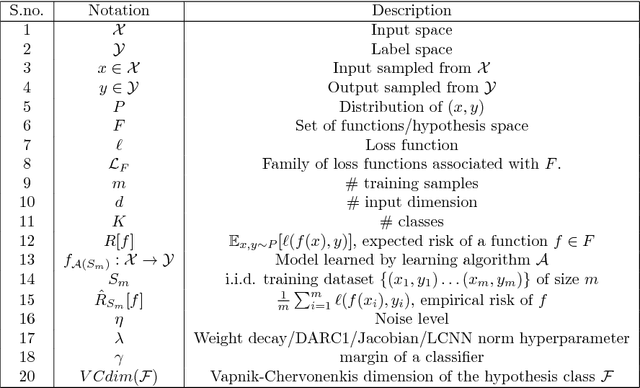
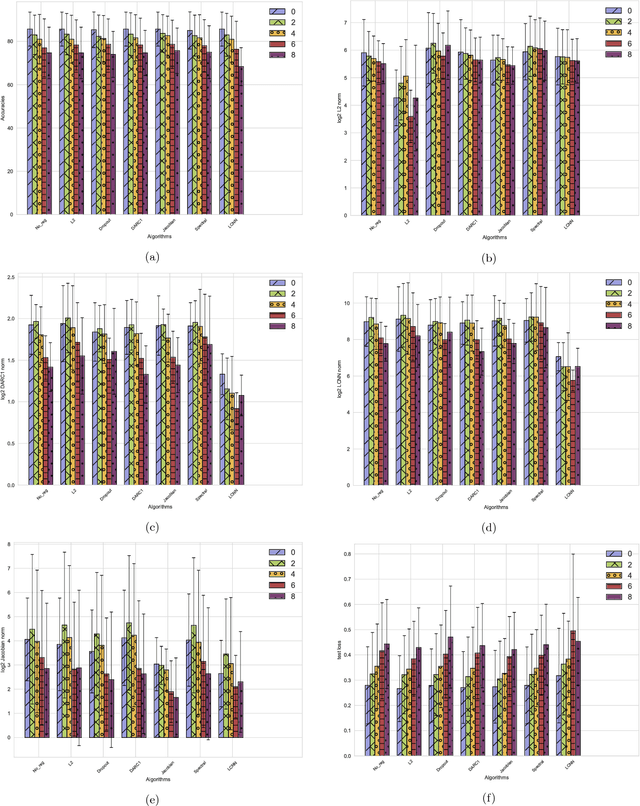
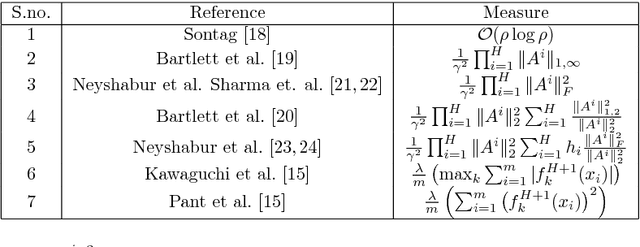
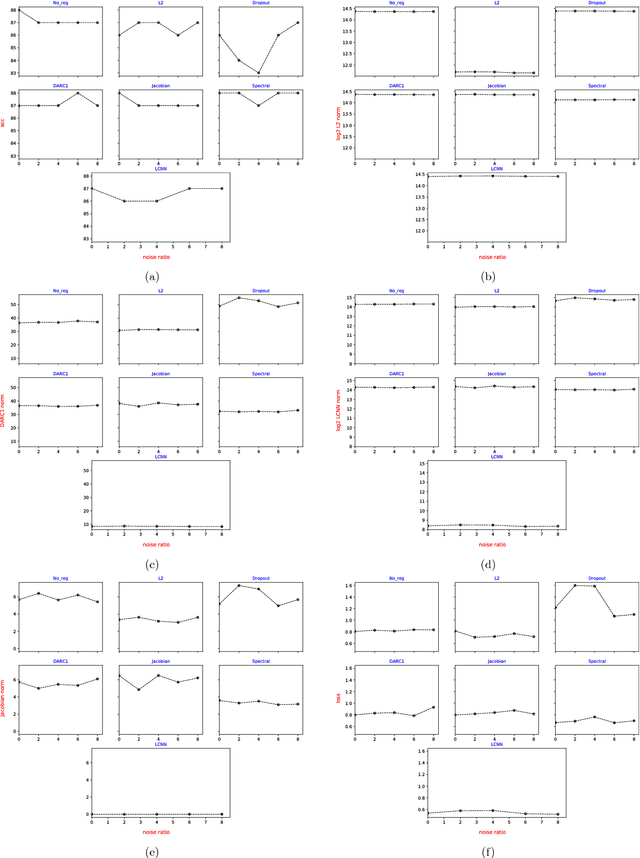
Deep neural networks are over-parameterized, which implies that the number of parameters are much larger than the number of samples used to train the network. Even in such a regime deep architectures do not overfit. This phenomenon is an active area of research and many theories have been proposed trying to understand this peculiar observation. These include the Vapnik Chervonenkis (VC) dimension bounds and Rademacher complexity bounds which show that the capacity of the network is characterized by the norm of weights rather than the number of parameters. However, the effect of input noise on these measures for shallow and deep architectures has not been studied. In this paper, we analyze the effects of various regularization schemes on the complexity of a neural network which we characterize with the loss, $L_2$ norm of the weights, Rademacher complexities (Directly Approximately Regularizing Complexity-DARC1), VC dimension based Low Complexity Neural Network (LCNN) when subject to varying degrees of Gaussian input noise. We show that $L_2$ regularization leads to a simpler hypothesis class and better generalization followed by DARC1 regularizer, both for shallow as well as deeper architectures. Jacobian regularizer works well for shallow architectures with high level of input noises. Spectral normalization attains highest test set accuracies both for shallow and deeper architectures. We also show that Dropout alone does not perform well in presence of input noise. Finally, we show that deeper architectures are robust to input noise as opposed to their shallow counterparts.
Radius-margin bounds for deep neural networks
Nov 03, 2018Explaining the unreasonable effectiveness of deep learning has eluded researchers around the globe. Various authors have described multiple metrics to evaluate the capacity of deep architectures. In this paper, we allude to the radius margin bounds described for a support vector machine (SVM) with hinge loss, apply the same to the deep feed-forward architectures and derive the Vapnik-Chervonenkis (VC) bounds which are different from the earlier bounds proposed in terms of number of weights of the network. In doing so, we also relate the effectiveness of techniques like Dropout and Dropconnect in bringing down the capacity of the network. Finally, we describe the effect of maximizing the input as well as the output margin to achieve an input noise-robust deep architecture.
Scalable Twin Neural Networks for Classification of Unbalanced Data
Jan 27, 2018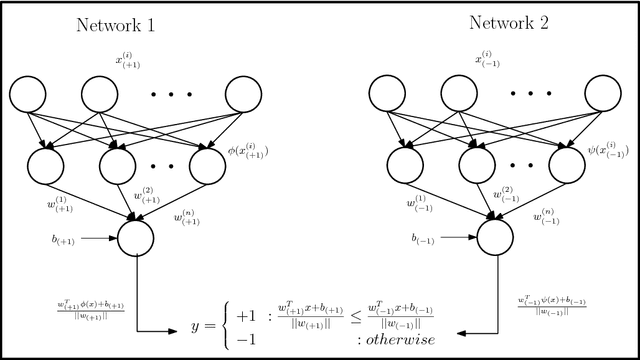
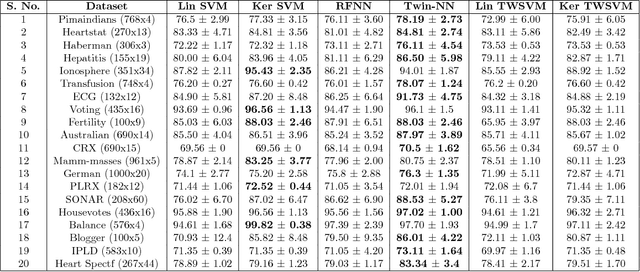
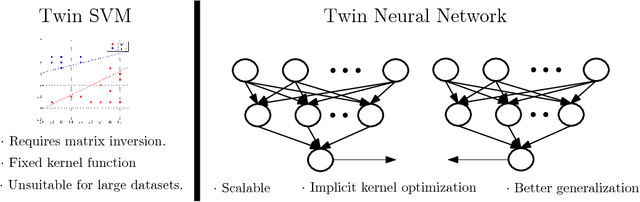
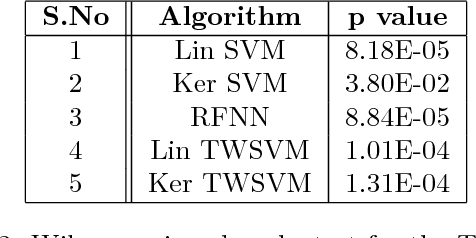
Twin Support Vector Machines (TWSVMs) have emerged an efficient alternative to Support Vector Machines (SVM) for learning from imbalanced datasets. The TWSVM learns two non-parallel classifying hyperplanes by solving a couple of smaller sized problems. However, it is unsuitable for large datasets, as it involves matrix operations. In this paper, we discuss a Twin Neural Network (Twin NN) architecture for learning from large unbalanced datasets. The Twin NN also learns an optimal feature map, allowing for better discrimination between classes. We also present an extension of this network architecture for multiclass datasets. Results presented in the paper demonstrate that the Twin NN generalizes well and scales well on large unbalanced datasets.